


European Powers Back US in Blaming Iran for Saudi Oil Attack, Urge Broader Talks

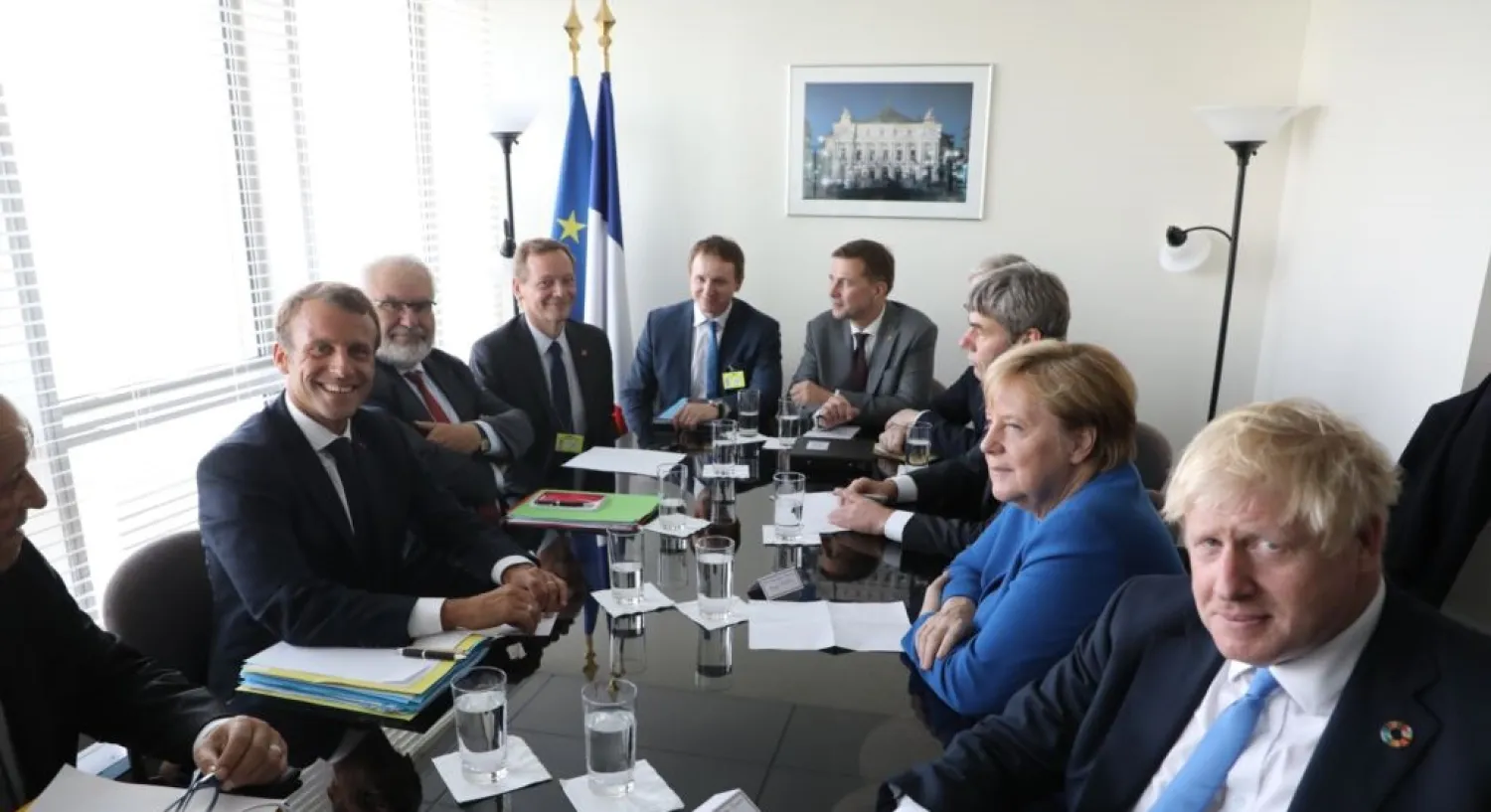
French President Emmanuel Macron (L) meets with German Chancellor Angela Merkel (2-R) and British PM Boris Johnson (R) at the UN headquarters on September 23, 2019. (AFP)
TT

European Powers Back US in Blaming Iran for Saudi Oil Attack, Urge Broader Talks

French President Emmanuel Macron (L) meets with German Chancellor Angela Merkel (2-R) and British PM Boris Johnson (R) at the UN headquarters on September 23, 2019. (AFP)

Britain, Germany and France backed the United States and blamed Iran on Monday for an attack on Saudi oil facilities, urging Tehran to agree to new talks with world powers on its nuclear and missile programs and regional security issues.

The Europeans issued a joint statement after British Prime Minister Boris Johnson, German Chancellor Angela Merkel and French President Emmanuel Macron met at the United Nations on the sidelines of the annual gathering of world leaders.

But Iran ruled out the possibility of negotiating a new deal with powers, Iranian Foreign Minister Mohammad Javad Zarif tweeted on Monday, saying European partners have failed to fulfill their commitments under a 2015 nuclear pact.

European leaders have struggled to defuse a brewing confrontation between Tehran and Washington since US President Donald Trump quit a deal last year that assures Iran access to world trade in return for curbs on its nuclear program.

The United States reimposed sanctions on Iran and sharply tightened them. Iran has responded by gradually breaching nuclear commitments made in the 2015 accord and has set an October deadline to further scale back its nuclear obligations unless the Europeans salvage the pact by shielding Tehran’s economy from US penalties.

“The time has come for Iran to accept negotiation on a long-term framework for its nuclear program as well as on issues related to regional security, including its missiles program and other means of delivery,” Britain, France and Germany said.

Tension rose on September 14 following an attack on Saudi Arabia’s oil facilities, which Riyadh and Washington have blamed on Iran. Tehran denies responsibility, and Yemen’s Iran-aligned Houthi militias has said it carried out the attack.

“It is clear to us that Iran bears responsibility for this attack. There is no other plausible explanation. We support ongoing investigations to establish further details,” Britain, France and Germany said.

US Secretary of State Mike Pompeo thanked the European nations for their statement blaming Iran, saying, “This will strengthen diplomacy and the cause of peace.”

Macron later met with Iranian President Hassan Rouhani.

The path to reduce tensions in the region has become smaller and the moment has come for Iran to help defuse the crisis, Macron told Rouhani on Monday, his office said in a statement.

The two leaders talked for more than 90 minutes. Neither took questions after their meeting.

“The president said that in the current situation, the path of de-escalation was narrow, but more necessary than ever, and that the time had come for Iran to take it,” Macron’s office said in the short statement, adding that it was urgent to start a discussion on a security agenda for the region.

Macron has led a European push over the summer to find a compromise between the United States and Iran and wants to use the UN meeting as an opportunity to revive diplomacy, though his efforts have stalled in recent weeks.

When asked about Macron’s attempt to mediate, US President Donald Trump said: “We don’t need a mediator. ... They (Iran) know who to call.”

The United States will intensify pressure on Iran, US Special Envoy for Iran Brian Hook said in New York on Monday.

The United States was seeking to address the issue through diplomacy and a multilateral effort, and there was a role for the United Nations Security Council to play, Hook said without elaborating.

In an interview with US network NBC on Monday, Johnson said Trump was “the one guy who can do a better deal. ... I hope there will be a Trump deal.”

Trump flirted with meeting Rouhani while both are in New York for the UN General Assembly, but the chances appear slim.

“We haven’t received any requests this time, yet, for a meeting and we have made it clear a request alone will not do the job,” Zarif told reporters in New York earlier on Monday. “A negotiation has to be for a reason, for an outcome, not just for a handshake.”

He said there are conditions for a meeting - Iran has demanded the United States lift sanctions - and then there could be a meeting between Iran, the United States, France, Britain, Germany, Russia and China - the original parties to the nuclear deal - but there would be no bilateral meeting.

Speaking after he arrived in New York on Monday, Rouhani said Iran’s message to the world “is peace, stability and also we want to tell the world that the situation in the Gulf is very sensitive,” the state news agency IRNA reported.

Trump has criticized the nuclear accord, negotiated under then-US President Barack Obama, for “sunset” clauses by which some of its provisions will expire as well as for its failure to address Iran’s missile program and regional activities.



Energy Secretary: US to Stop Iran's Nuclear Ambitions 'One Way or the Other'

US Secretary of Energy Chris Wright speaks during a press conference after a meeting with Venezuela's acting president Delcy Rodriguez at the Miraflores Presidential Palace in Caracas on February 11, 2026. (Photo by Juan BARRETO / AFP)
TT

Energy Secretary: US to Stop Iran's Nuclear Ambitions 'One Way or the Other'

US Secretary of Energy Chris Wright speaks during a press conference after a meeting with Venezuela's acting president Delcy Rodriguez at the Miraflores Presidential Palace in Caracas on February 11, 2026. (Photo by Juan BARRETO / AFP)

The United States will deter Iran from acquiring nuclear weapons "one way or the other", US Energy Secretary Chris Wright warned on Wednesday.

"They've been very clear about what they would do with nuclear weapons. It's entirely unacceptable," Wright told reporters in Paris on the sidelines of meetings of the International Energy Agency.

"So one way or the other, we are going to end, deter Iran's march towards a nuclear weapon," Wright said.

US and Iranian officials held talks in Geneva on Tuesday aimed at averting the possibility of US military intervention to curb Tehran's nuclear program.

Iran said following the talks that they had agreed on "guiding principles" for a deal to avoid conflict.

US Vice President JD Vance, however, said Tehran had not yet acknowledged all of Washington's red lines.


Iran, Russia to Conduct Joint Drills in the Sea of Oman 

This handout photo released by Iran's Revolutionary Guards Corps (IRGC)'s official website Sepanews on February 17, 2026, shows boats maneuvering around a tanker vessel during a military exercise by members of the IRGC and navy in the Strait of Hormuz. (Sepahnews / AFP)
TT

Iran, Russia to Conduct Joint Drills in the Sea of Oman 

This handout photo released by Iran's Revolutionary Guards Corps (IRGC)'s official website Sepanews on February 17, 2026, shows boats maneuvering around a tanker vessel during a military exercise by members of the IRGC and navy in the Strait of Hormuz. (Sepahnews / AFP)

Iran and Russia will conduct naval maneuvers in the Sea of Oman on Thursday, following the latest round of talks between Tehran and Washington in Geneva, Iranian media reported.

On Monday, the Revolutionary Guards, the ideological arm of Iran's military, also launched exercises in the strategic Strait of Hormuz, a challenge to US naval forces deployed in the region.

"The joint naval exercise of Iran and Russia will take place tomorrow (Thursday) in the Sea of Oman and in the northern Indian Ocean," the ISNA agency reported, citing drill spokesman, Rear Admiral Hassan Maghsoudloo.

"The aim is to strengthen maritime security and to deepen relations between the navies of the two countries," he said, without specifying the duration of the drill.

The war games come as Iran struck an upbeat tone following the second round of Oman-mediated negotiations in Geneva on Tuesday.

Previous talks between the two foes collapsed following the unprecedented Israeli strike on Iran in June 2025, which sparked a 12-day war that the United States briefly joined.

US President Donald Trump has deployed a significant naval force in the region, which he has described as an "armada."

Iranian officials have repeatedly threatened to block the Strait of Hormuz, particularly during periods of tension with the United States, but it has never been closed.

A key passageway for global shipments of oil and liquefied natural gas, the Strait of Hormuz has been the scene of several incidents in the past and has returned to the spotlight as pressure has ratcheted amid the US-Iran talks.

Iran announced on Tuesday that it would partially close it for a few hours for "security" reasons during its own drills in the strait.


First European Flight Lands in Venezuela Since Maduro’s Ouster 

A man holds up a Venezuelan flag while taking part in a march calling for amnesty for political prisoners and to mark Youth Day, in Caracas, Venezuela, February 12, 2026. (Reuters)
TT

First European Flight Lands in Venezuela Since Maduro’s Ouster 

A man holds up a Venezuelan flag while taking part in a march calling for amnesty for political prisoners and to mark Youth Day, in Caracas, Venezuela, February 12, 2026. (Reuters)

A plane from Spain's Air Europa landed in Venezuela Tuesday, according to a flight tracking monitor, the first European commercial flight to arrive in the country since the United States toppled president Nicolas Maduro.

A slew of international carriers stopped flying to Venezuela after the United States warned of possible military activity there in late November -- a prelude to its surprise attack on January 3.

The Boeing 787-9 Dreamliner landed at Simon Bolivar International Airport, which serves the Venezuelan capital Caracas, at 9:00 pm (0100 GMT).

Since US forces raided Venezuela and captured Maduro, US President Donald Trump has struck a cooperative relationship with interim president Delcy Rodriguez.

Late last month he called for flights to resume to the country.

Spanish airline Iberia is evaluating security guarantees before announcing a return, according to the Spanish press.

Portugal's TAP has said it will resume flights. Colombian airline Avianca and Panama's Copa have already restarted operations.

Hoping to prompt US flights, the Trump administration has lifted a 2019 ban on US airlines flying to the country.