


When Manchester United Had an Even Worse Start to the Season ... in 1989

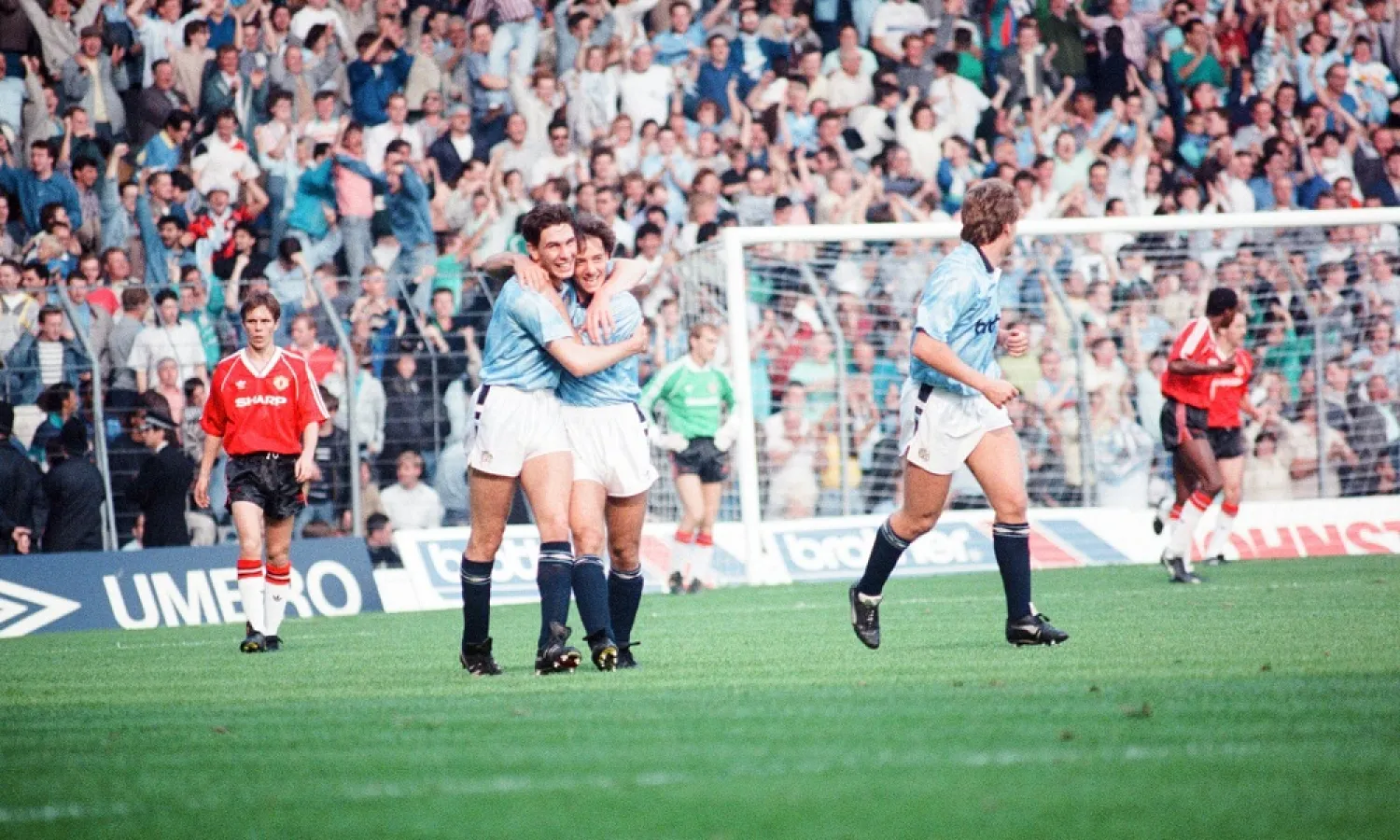
Manchester City players enjoy their 5-1 win over United. (Getty Images)
TT

When Manchester United Had an Even Worse Start to the Season ... in 1989

Manchester City players enjoy their 5-1 win over United. (Getty Images)

When Ole Gunnar Solskjær was appointed Manchester United manager, he wanted to emulate some of Alex Ferguson’s achievements in the job. But mirroring the start of the 1989-90 campaign was probably low down on his list. United’s disappointing 1-1 draw with Arsenal at Old Trafford last week left the club with just nine points from as many matches in the league this season, making this their worst start to a campaign for 30 years. They followed that up with a 0-1 loss to Newcastle on Sunday. The last time they began a season so badly – in 1989-90, when they only picked up seven points in their first nine games – Fergie time seemed to be running out.

Since joining the club from Aberdeen in November 1986, Alex Ferguson had done little to suggest that he would be the man to knock Liverpool off their perch. If anything, he needed to worry about losing his own position. He was backed heavily in the transfer market over the summer months in 1989, with Neil Webb, Mike Phelan, Gary Pallister, Paul Ince and Danny Wallace all joining the club, and the pressure was mounting.

The troubles ahead must have felt far away on the opening day of the season, when Arsenal visited Old Trafford on a gloriously sunny August afternoon. A crowd of 47,245 (their biggest of the season) watched a rampant United side thump the champions 4-1. With debutant Webb scoring a stunner, things appeared to be rosy.

Webb was not the only goalscorer who caused a stir at the Stretford End that day. Before the match, businessman Michael Knighton took to the pitch. The 37-year-old was seemingly on the brink of succeeding Martin Edwards as chairman and was keen to meet the fans. Donning a club tracksuit top and demonstrating some keepie-uppie skills, Knighton basked in the spotlight.

“We had heard about the takeover, but this chap came into the dressing room before the game, introduced himself as the new owner and then asked for a kit,” Webb later reflected. “We thought he just wanted to join in with the warm-up, but I couldn’t believe what I was seeing when he ran on to the pitch and whacked the ball into the net at the Stretford End. It was hilarious, really. Unbelievable.”

Alas, Knighton’s promises to complete a £20m takeover were as empty as the goal he scored before kick-off. Knighton’s plans turned to dust as the weeks progressed – just like United’s form. Results dipped quickly and the pressure on Ferguson grew. With United failing to win any of their next four matches, the manager was criticized in the press for allowing Paul McGrath and Norman Whiteside to leave the club and for replacing them with “expensive misfits”.

United were dominant in their second game of the campaign, away at Crystal Palace, but a last-minute equalizer from Ian Wright denied them three points. The real talk of the club being “in crisis” began after their 2-0 defeat at Derby. “After the sunny start it was back to the grey days,” wrote Clive White in the Times. Losing their next match, 2-0 at home to Norwich, did not help Ferguson’s case. With £2.3m signing Pallister giving away a penalty on his debut and influential skipper Robson limping out, the “woe upon woe for United” headline in the Times was spot on. When Webb ruptured his Achilles tendon while on international duty, Ferguson must have been bemoaning his luck.

The poor run of form continued with a 3-2 reverse at Everton, United’s third league defeat in a row. The result flattered Ferguson’a team. “United are as far as ever from breaking into the circle of power formed almost exclusively by Liverpool,” reflected James Lawton in the Express. Never mind Liverpool; Ferguson had one eye over his shoulder looking at Palace and Charlton. The gloom was lifted temporarily when Robson returned from injury and Mark Hughes scored a hat-trick in a 5-1 demolition of Millwall. Yet any talk of a revival was quickly extinguished a week later in the Manchester derby.

“Alex Ferguson knows what he has to do, he is the man in charge and there is no one working harder to put the situation right,” said Knighton before the trip to Maine Road. What happened on the pitch left many fans wondering about that statement.

Even though Steve Bruce and Robson were missing, United fans were still confident that they would get a result. City had just been promoted and had only won one of their first six games back in the top flight. They were even shorted on confidence than United, and were missing experienced midfielder Neil McNab and £1m signing Clive Allen. But on an unforgettable day for both sets of fans – whose fighting held the match up for eight minutes – United simply imploded.

Their defending was abysmal, with Pallister all at sea. The 5-1 hammering would enter City folklore and it looked increasingly likely that Ferguson would be on his way soon. “From boardroom to dressing room United are showing all the classic signs of a club cracking up,” wrote Harry Harris in the Mirror. After this humiliation it was reported that Ferguson had been given until Christmas to save his job. But, a few days after the derby debacle, he signed a new three-year contract that had originally been offered to him in May.

“It gives me more time to get on with the job,” said Ferguson, but time did not seem to be on his side. United were knocked out of the League Cup in October, their 3-0 defeat to Tottenham at Old Trafford ending one possible route to salvation. Although, in truth, their attention was now fixed on a relegation battle.

Ferguson refused to talk to the press after his side suffered another home defeat, losing 2-0 to Charlton in early November. The press rounded on the manager on his third anniversary at the club. The Express went with the headline “Fergie the Flop” and Colin Gibson was scathing in the Telegraph: “They [the supporters] are fed up with excuses and false dawns. Old Trafford needs success and it needs it quickly, otherwise the pressure Mr. Ferguson has experienced will grow much worse.”

The dissenting voices were growing louder and louder. And then came Crystal Palace at home on 9 December. The game will forever be remembered for the banner displayed by one disgruntled supporter – “Three years of excuses and it’s still crap. Ta ra Fergie” – yet he was not on the only angry fan at Old Trafford that day. Cries of “Fergie out” and “what a load of rubbish” filled the air. “The reaction of our fans after our home defeat by Crystal Palace was the worst I have experienced,” admitted Ferguson.

Edwards, still in charge after Knighton’s failed takeover, backed his man. But the bad results kept on coming. United went 11 league games without a victory – their worst run since the 1971-72 season – and the bookies slashed their odds of being relegated to 5/2.

“I know patience is a word football fans do not like to hear, but that is what United supporters need,” said Manchester City manager Howard Kendall, who had previously been linked to Ferguson’s job. “I am sure he will get it right given time,” added Kendall. How very true. Both Kendall and Ferguson benefited from patient chairman at the time. Whether Solskjær will be afforded the same luxury remains to be seen.

The Guardian Sport


Maresca Leaves Chelsea After Just 18 Months in Charge

Chelsea's Italian head coach Enzo Maresca reacts during the UEFA Champions League league phase day 6 football match between Atalanta Bergamo and Chelsea FC at Bergamo Stadium, in Bergamo on December 9, 2025. (AFP)
TT

Maresca Leaves Chelsea After Just 18 Months in Charge

Chelsea's Italian head coach Enzo Maresca reacts during the UEFA Champions League league phase day 6 football match between Atalanta Bergamo and Chelsea FC at Bergamo Stadium, in Bergamo on December 9, 2025. (AFP)

Enzo Maresca left his role as Chelsea head coach on Thursday after just 18 months in charge, the Premier League club announced.

The Italian's exit from Stamford Bridge comes with the club fifth in the Premier League table -- 15 points adrift of leaders Arsenal -- with one win in their last seven top-flight games.

"Chelsea Football Club and head coach Enzo Maresca have parted company," said a club statement.

Speculation about Maresca's position increased during Chelsea's poor run of recent results amid reports of a worsening relationship between the coach and the club's hierarchy.

"With key objectives still to play for across four competitions including qualification for Champions League football, Enzo and the club believe a change gives the team the best chance of getting the season back on track," Chelsea added.

Maresca did not attend the post-match press conference following a frantic 2-2 draw with Bournemouth on Tuesday, although his absence was attributed to illness.

The draw meant Chelsea had dropped 13 points at home from winning positions this season -- the bulk of the 15-point deficit between the Blues and Arsenal.

His decision to substitute Cole Palmer just after the hour mark during the Bournemouth game was booed by Chelsea fans.

Maresca has stood by comments made on December 13 after a league win at home to Everton when he said many people at Chelsea "didn't support me and the team".

He repeatedly refused to clarify the comments, although he insisted they were not an attack on the club's supporters.

The 45-year-old said the days leading up to the 2-0 victory over Everton were "the worst 48 hours" of his time at Chelsea.

Maresca's stock at Chelsea was high after the Blues beat Barcelona 3-0 in the Champions League in November.

- Man City talks -

But damaging defeats by Leeds, Atalanta and Villa increased the pressure on the Blues boss.

Maresca had also been linked as a potential successor to Manchester City boss Pep Guardiola should he end his decade-long stay at the Etihad Stadium at the end of the season.

It has been reported that Maresca twice informed Chelsea of talks with City, where he previously worked as one of Guardiola's assistants, as his contract required him to reveal negotiations with other clubs.

Chelsea sit 13th in the Champions League table and are likely to miss out on direct qualification for the last 16 via a top-eight finish.

But they have progressed to the semi-finals of the League Cup, where they will face Arsenal over two legs.

Maresca's contract had been due to run until the summer of 2029, with a club option of a further year.

Chelsea won the UEFA Conference League and the Club World Cup in 2025 and Maresca also led them back into the Champions League via a fourth-placed finish in the Premier League in his only full season in charge.

"Thank you for everything, mister, and to your staff. For the work and the trust from day one, and for the memories," Chelsea defender Marc Cucurella posted on social media alongside pictures of the Spain international with Maresca.

The Blues return to action on Sunday at Manchester City, the first of nine fixtures across four competitions during a congested January schedule.

Liam Rosenior, the head coach of French club Strasbourg, owned by Chelsea's parent company BlueCo -- a consortium headed up by US billionaire businessman Todd Boehly -- is a candidate to replace Maresca despite the 41-year-old's lack of Premier League experience.

Former Barcelona head coach Xavi, Crystal Palace manager Oliver Glasner, Fulham's Marco Silva and Bournemouth boss Andoni Iraola are other potential contenders for the job.


Hakimi, Salah and Osimhen Head Star-packed AFCON Last-16 Cast

Morocco's Achraf Hakimi gestures during the Africa Cup of Nations group A soccer match between Zambia and Morocco in Rabat, Morocco, Sunday, Dec. 28, 2025. (AP Photo/Themba Hadebe)
TT

Hakimi, Salah and Osimhen Head Star-packed AFCON Last-16 Cast

Morocco's Achraf Hakimi gestures during the Africa Cup of Nations group A soccer match between Zambia and Morocco in Rabat, Morocco, Sunday, Dec. 28, 2025. (AP Photo/Themba Hadebe)

A star-studded cast led by Achraf Hakimi, Mohamed Salah and Victor Osimhen switch to knockout fare from Saturday, when the Africa Cup of Nations resumes in Morocco.

Paris Saint-Germain defender Hakimi was crowned 2025 African player of the year in November. Liverpool attacker Salah and Galatasaray striker Osimhen were the runners-up.

After 36 matches spread across six groups, the 16 survivors from 24 hopefuls clash in eight second-round matches over four days.

Fit-again Hakimi is set to lead title favorites Morocco against Tanzania, Salah will captain Egypt against Benin and Osimhen-inspired Nigeria tackle Mozambique.

AFP Sport looks at the match-ups that will determine which nations advance to the quarter-finals, and move one step closer to a record $10 million (8.5 million euros) first prize.

Senegal v Sudan

Veteran Sadio Mane and Paris Saint-Germain 17-year-old Ibrahim Mbaye, in two appearances off the bench, have been among the stars as 2022 champions Senegal confirmed why they are among the favorites by winning Group D. Sudan, representing a country ravaged by civil war since 2023, reached the second round despite failing to score. Their only Group F win, against Equatorial Guinea, came via an own goal.

Mali v Tunisia

"If we carry on playing like this we will not go much further," warned Belgium-born Mali coach Tom Saintfiet after three Group A draws. Tunisia did well to hold Morocco, but were woeful against Nigeria until they trailed by three goals. The Carthage Eagles then scored twice and came close to equalizing.

Morocco v Tanzania

A mismatch on paper as Morocco, whose only previous title came 50 years ago, are 101 places above Tanzania in the world rankings. The east Africans ended a 45-year wait to get past the first round thanks to two draws. Morocco boast a potent strike force of Brahim Diaz from Real Madrid and Ayoub El Kaabi of Olympiacos. They have scored three goals each to share the Golden Boot lead with Algerian Riyad Mahrez.

South Africa v Cameroon

South Africa debuted in the AFCON 30 years ago by hammering Cameroon 3-0 in Johannesburg. It should be much closer when they meet a second time with only four places separating them in the world rankings. In pursuit of goals, South Africa will look to Oswin Appollis and Lyle Foster while 19-year-old Christian Kofane struck a stunning match-winner for Cameroon against Mozambique.

Egypt v Benin

Struggling to score for Liverpool this season, Salah has regained his appetite for goals in southern Morocco. He claimed match winners against Zimbabwe and South Africa to win Group B. Benin celebrated their first AFCON win 25 years after debuting by edging Botswana. The Cheetahs are a compact, spirited outfit led by veteran striker Steve Mounie, but lack punch up front.

Nigeria v Mozambique

Livewire Osimhen is a huge aerial threat and could have scored hat-tricks against Tanzania and Tunisia in Group C, but managed just one goal. Fellow former African player of the year Ademola Lookman has also impressed. Mozambique lost 3-0 in their previous AFCON meeting with the Super Eagles 16 years ago. It is likely to be tighter this time with striker Geny Catamo posing a threat for the Mambas (snakes).

Algeria v DR Congo

The clash of two former champions is potentially the match of the round. It is the only tie involving two European coaches -- Bosnian Vladimir Petkovic and Frenchman Sebastien Desabre. Algeria and Nigeria were the only teams to win all three group matches. Former Manchester City winger Mahrez has been an inspirational captain while scoring three times.

Ivory Coast v Burkina Faso

This is the only match featuring nations from the same region. Burkina Faso and defending champions Ivory Coast share a border in west Africa. Manchester United winger Amad Diallo was the only winner of two player-of-the-match awards in the group stage. The Ivorian now face impressive Burkinabe defenders Edmond Tapsoba and Issoufou Dayo.


After Waiting 36 Years, French Soccer Fans Finally Have a Capital City Derby again as PSG Faces PFC

Fireworks explode as Paris Saint-Germain's players parade on a bus on the Champs-Elysees avenue in Paris on June 1, 2025, a day after PSG won the 2025 UEFA Champions League final football match against Inter Milan in Munich. (AFP)
TT

After Waiting 36 Years, French Soccer Fans Finally Have a Capital City Derby again as PSG Faces PFC

Fireworks explode as Paris Saint-Germain's players parade on a bus on the Champs-Elysees avenue in Paris on June 1, 2025, a day after PSG won the 2025 UEFA Champions League final football match against Inter Milan in Munich. (AFP)

It's taken quite some time, but the first capital city derby in French men's league soccer since 1990 takes place on Sunday when Paris Saint-Germain hosts Paris FC.

A very local derby, too, with PSG's Parc des Princes stadium literally across the street from PFC's new home ground — 44 meters away according to the Paris City Hall website.

After winning promotion last season, Paris FC changed stadium and now plays at Stade Jean-Bouin, which traditionally held rugby matches.

Sunday's contest pits the defending French and European champion against a side struggling in the top tier. PFC has lost half its games, and was 14th in the 18-team league heading into this weekend's 17th round.

PFC's top scorer this season is skillful midfielder Ilan Kebbal with six goals, more than any PSG player. But he is away with Algeria at the Africa Cup of Nations.

PSG has coped with injuries to star forwards Ousmane Dembélé and Désiré Doué this season. That might have affected results because, for a change, PSG is not top but in second spot behind surprise leader Lens. Heading into Sunday's derby, PSG had already lost two league games, as many defeats as all last season.

While PSG has won a record 13 French league titles and 16 French Cups, PFC's trophy cabinet is bare. The PFC men's team has never won the league or even a cup.

Paris FC's takeover late last year by France's richest family, the Arnaults of luxury empire LVMH, promised to spice up Ligue 1.

Paris FC owner Antoine Arnault is the son of billionaire Bernard Arnault, and the family's cash input will prove crucial to the chances of PFC becoming a serious rival to PSG. Antoine used to be a PSG season-ticket holder and enjoys a cordial relationship with PSG president Nasser Al-Khelaïfi.

Before this season, PSG’s previous city rival was Matra Racing, which became Racing Paris 1 and beat PSG in the last men’s league derby in Paris in 1990. Antoine won't have to wait so long for another derby, because PSG is hosting PFC in the French Cup's last 32 on Jan. 12.

Fleeting rivalries, stadium shares

Parisian soccer history can be a bit confusing.

Paris FC men's team was created in 1969 and merged with Stade Saint-Germain to form Paris Saint-Germain, or PSG, in 1970.

The merger ended abruptly in 1972 with PSG losing its professional status and PFC staying in division 1, and playing at Parc des Princes. PSG kept the name and returned to play at the stadium in 1974 after winning promotion back to the top flight, coinciding with PFC's relegation.

Matra Racing was only briefly on the scene.

Matra spent a few seasons in the French top flight — sharing the Parc des Princes stadium — but the club faded after French media baron Jean-Luc Lagardère withdrew his backing in 1989. Matra was relegated the following year, when it was called Racing Paris 1, despite beating PSG in the derby.

Red Star's ambition

There may be more local derbies in the capital next season, with Red Star chasing promotion from Ligue 2.

Red Star is based in the northern suburbs of Paris and is second in Ligue 2. The team has long been respected for being close to its working-class fans in the Saint-Ouen-sur-Seine suburb.

Home games are played at the 5,600-capacity Stade Bauer, which has stands selling food right outside the entrance gates. Red Star’s down-to-earth image has remained the same for decades, with the club becoming increasingly trendy and attracting a new section of fans appreciating its old-school ways.

Plans are in place to increase capacity to 10,000 next year and the club says it hopes to have 80% of homegrown local players in the first team by 2030.

Founded in 1897, Red Star is among the oldest clubs in France. It has a famous founder in Jules Rimet, the longest-serving president in FIFA history (1921-54), and the World Cup trophy was named after him.

Red Star's period of success was after World War I, with the club winning four French Cups in the 1920s.
