


Lebanese Police Drag Protestors, Remove Roadblocks in Beirut

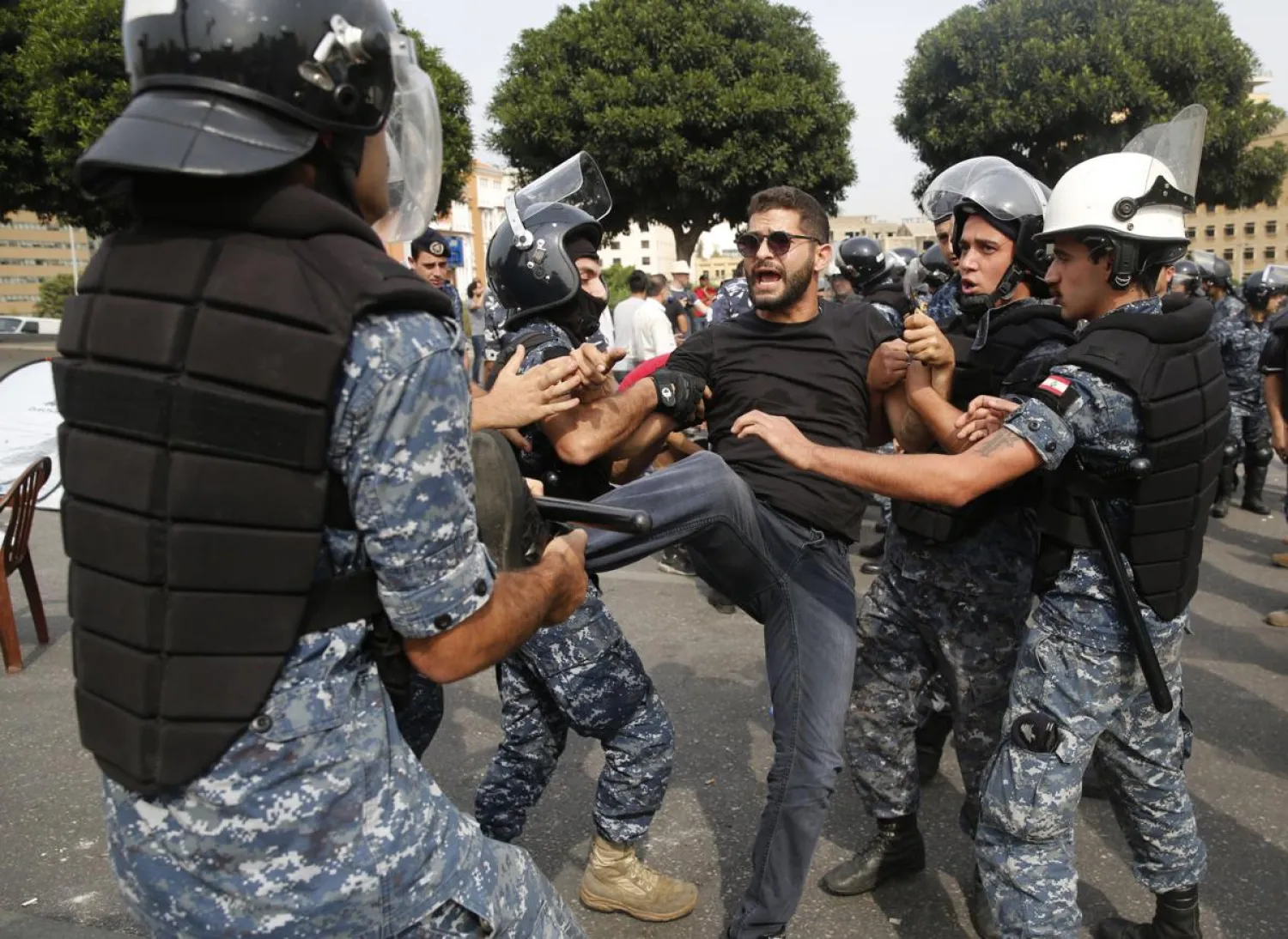
Police remove an anti-government protester blocking a main highway with his body in Beirut, Lebanon, Saturday, Oct. 26, 2019. The removal of the roadblocks on Saturday comes on the tenth day of protests in which protesters have called for civil disobedience until the government steps down. (AP Photo/Hussein Malla)
TT

Lebanese Police Drag Protestors, Remove Roadblocks in Beirut

Police remove an anti-government protester blocking a main highway with his body in Beirut, Lebanon, Saturday, Oct. 26, 2019. The removal of the roadblocks on Saturday comes on the tenth day of protests in which protesters have called for civil disobedience until the government steps down. (AP Photo/Hussein Malla)

Lebanese security forces pushed and dragged away protesters who refused to move from roadblocks in central Beirut on Saturday, to reopen roads closed during a campaign of civil disobedience.

The protesters had set up several roadblocks around Beirut and on major highways to enforce their calls for the government to step down amid nationwide protests, now in their tenth day.

When the riot police moved in to clear the roadblocks on the ring road that links eastern and western Beirut, many protesters sat or lay down on the asphalt in defiance.

Some protesters chanted: "The people want to bring down the regime."

"We are no bandits," cried one man. "We have rights and are asking for them."

Pushing and shoving, the security forces successfully opened the road and traffic flowed through. In another part of Lebanon, the army removed a roadblock without incident.

But on the coastal highway to the north, a large crowd of residents sat on the ground and others stood in one line, blocking the military's efforts to remove the roadblocks with a bulldozer. The military retreated.

The military warned that blocking roads was in violation of the law. The head of Lebanon's powerful militant Hezbollah group, Hassan Nasrallah, called on protesters to open the roads in a speech Friday.

The protests have paralyzed the country, which already faces a major economic crisis. Banks, universities and schools have been closed since last week.

But the unprecedented demonstrations have also brought together Lebanese from all sects and political affiliation, uniting them in a common demand that long-serving politicians, accused of corruption and mismanagement, step down.

Squares in Beirut and other cities have filled up in a spontaneous expression of anger at the country's political elite. A common chant, "All means all," has demanded all incumbent officials step down.

Nasrallah ordered his supporters to leave the protests on Friday after they clashed with anti-government protesters who criticized him. The Hezbollah leader tried to cast doubt on the spontaneity of the protests, saying that foreign powers and rivals are trying to exploit the rallies for political gains against his group.

Just before the security forces moved in on Saturday, two women and two men were manning the roadblock on the ring road. They said they have been at the roadblock for 10 days and have no plan to dismantle it but added that they would not fight the army. They let through an ambulance and a motorcycle.

"This is an uprising of a people who have been suffering for the last 30 years and can no longer tolerate their lies, theft and hypocrisy," said 29-year-old Rima, who was manning the roadblock, referring to the government. "We are protesting. We are not vandalizing or violent." Rima declined to give her last name, worried about her safety.

To the south, Lebanese soldiers removed chairs and tents set up in the middle of the intersection that links Beirut to the presidential palace, the mountain overlooking the city, the east and suburbs of Beirut.

The protesters did not resist but one broke into tears, telling the local LBC television station that he was disappointed the army had to force them to remove the roadblocks.

Amnesty International has said that blocking the roads was part of the protesters' efforts to make their voice heard, and called on authorities to protect the rallies against violence from political opponents.

The right of peaceful protesters to demonstrate on and block public roads has consistently been upheld by international human rights bodies which view urban spaces as a legitimate space for protest. The UN Special Rapporteur on Freedom of Peaceful Assembly and Association has stated that “the free flow of traffic should not automatically take precedence over freedom of peaceful assembly.”

Amnesty explained that restrictions can only be placed on the right to freedom of peaceful assembly where strictly necessary, proportionate and provided by law – such as clearing a access road to a hospital or removing an assembly which has caused substantial disruption for a significant period of time to accommodate a pressing social need.



Israel Military Says Soldier Killed in Gaza 

A drone view shows the destruction in a residential neighborhood, after the withdrawal of the Israeli forces from the area, amid a ceasefire between Israel and Hamas in Gaza, in Gaza City, October 21, 2025. (Reuters)
TT

Israel Military Says Soldier Killed in Gaza 

A drone view shows the destruction in a residential neighborhood, after the withdrawal of the Israeli forces from the area, amid a ceasefire between Israel and Hamas in Gaza, in Gaza City, October 21, 2025. (Reuters)

The Israeli military announced that one of its soldiers had been killed in combat in southern Gaza on Wednesday, but a security source said the death appeared to have been caused by "friendly fire".

"Staff Sergeant Ofri Yafe, aged 21, from HaYogev, a soldier in the Paratroopers Reconnaissance Unit, fell during combat in the southern Gaza Strip," the military said in a statement.

A security source, however, told AFP that the soldier appeared to have been "killed by friendly fire", without providing further details.

"The incident is still under investigation," the source added.

The death brings to five the number of Israeli soldiers killed in Gaza since a ceasefire took effect on October 10.


Syria: SDF’s Mazloum Abdi Says Implementation of Integration Deal May Take Time

People sit outdoors surrounded by nature, with the Tigris river flowing in the background, following a long atmospheric depression, near the Syrian-Turkish border in Derik, Syria, February 16, 2026 REUTERS/Orhan Qereman
TT

Syria: SDF’s Mazloum Abdi Says Implementation of Integration Deal May Take Time

People sit outdoors surrounded by nature, with the Tigris river flowing in the background, following a long atmospheric depression, near the Syrian-Turkish border in Derik, Syria, February 16, 2026 REUTERS/Orhan Qereman

Mazloum Abdi, commander of the Syrian Democratic Forces, said the process of merging the SDF with Syrian government forces “may take some time,” despite expressing confidence in the eventual success of the agreement.

His remarks came after earlier comments in which he acknowledged differences with Damascus over the concept of “decentralization.”

Speaking at a tribal conference in the northeastern city of Hasakah on Tuesday, Abdi said the issue of integration would not be resolved quickly, but stressed that the agreement remains on track.

He said the deal reached last month stipulates that three Syrian army brigades will be created out of the SDF.

Abdi added that all SDF military units have withdrawn to their barracks in an effort to preserve stability and continue implementing the announced integration agreement with the Syrian state.

He also emphasized the need for armed forces to withdraw from the vicinity of the city of Ayn al-Arab (Kobani), to be replaced by security forces tasked with maintaining order.


Israeli Far-Right Minister to Push for ‘Migration’ of West Bank, Gaza Palestinians 

A Palestinian man checks leather belts as people prepare for Ramadan, in the old city of Hebron in the Israeli-occupied West Bank, February 17,2026. (Reuters)
TT

Israeli Far-Right Minister to Push for ‘Migration’ of West Bank, Gaza Palestinians 

A Palestinian man checks leather belts as people prepare for Ramadan, in the old city of Hebron in the Israeli-occupied West Bank, February 17,2026. (Reuters)

Israel's far-right Finance Minister Bezalel Smotrich said he would pursue a policy of "encouraging the migration" of Palestinians from the occupied West Bank and Gaza Strip, Israeli media reported Wednesday.

"We will eliminate the idea of an Arab terror state," said Smotrich, speaking at an event organized by his Religious Zionism Party late on Tuesday.

"We will finally, formally, and in practical terms nullify the cursed Oslo Accords and embark on a path toward sovereignty, while encouraging emigration from both Gaza and Judea and Samaria.

"There is no other long-term solution," added Smotrich, who himself lives in a settlement in the West Bank.

Since last week, Israel has approved a series of measures backed by far-right ministers to tighten control over the West Bank, including in areas administered by the Palestinian Authority under the Oslo Accords, in place since the 1990s.

The measures include a process to register land in the West Bank as "state property" and facilitate direct purchases of land by Jewish Israelis.

The measures have triggered widespread international outrage.

On Tuesday, the UN missions of 85 countries condemned the measures, which critics say amount to de facto annexation of the Palestinian territory.

"We strongly condemn unilateral Israeli decisions and measures aimed at expanding Israel's unlawful presence in the West Bank," they said in a statement.

"Such decisions are contrary to Israel's obligations under international law and must be immediately reversed.

"We underline in this regard our strong opposition to any form of annexation."

UN Secretary-General Antonio Guterres on Monday called on Israel to reverse its land registration policy, calling it "destabilizing" and "unlawful".

The West Bank would form the largest part of any future Palestinian state. Many on Israel's religious right view it as Israeli land.

Israeli NGOs have also raised the alarm over a settlement plan signed by the government which they say would mark the first expansion of Jerusalem's borders into the occupied West Bank since 1967.

The planned development, announced by Israel's Ministry of Construction and Housing, is formally a westward expansion of the Geva Binyamin, or Adam, settlement situated northeast of Jerusalem in the West Bank.

The current Israeli government has fast-tracked settlement expansion, approving a record 52 settlements in 2025.

Excluding Israeli-annexed east Jerusalem, more than 500,000 Israelis live in West Bank settlements and outposts, which are illegal under international law.