

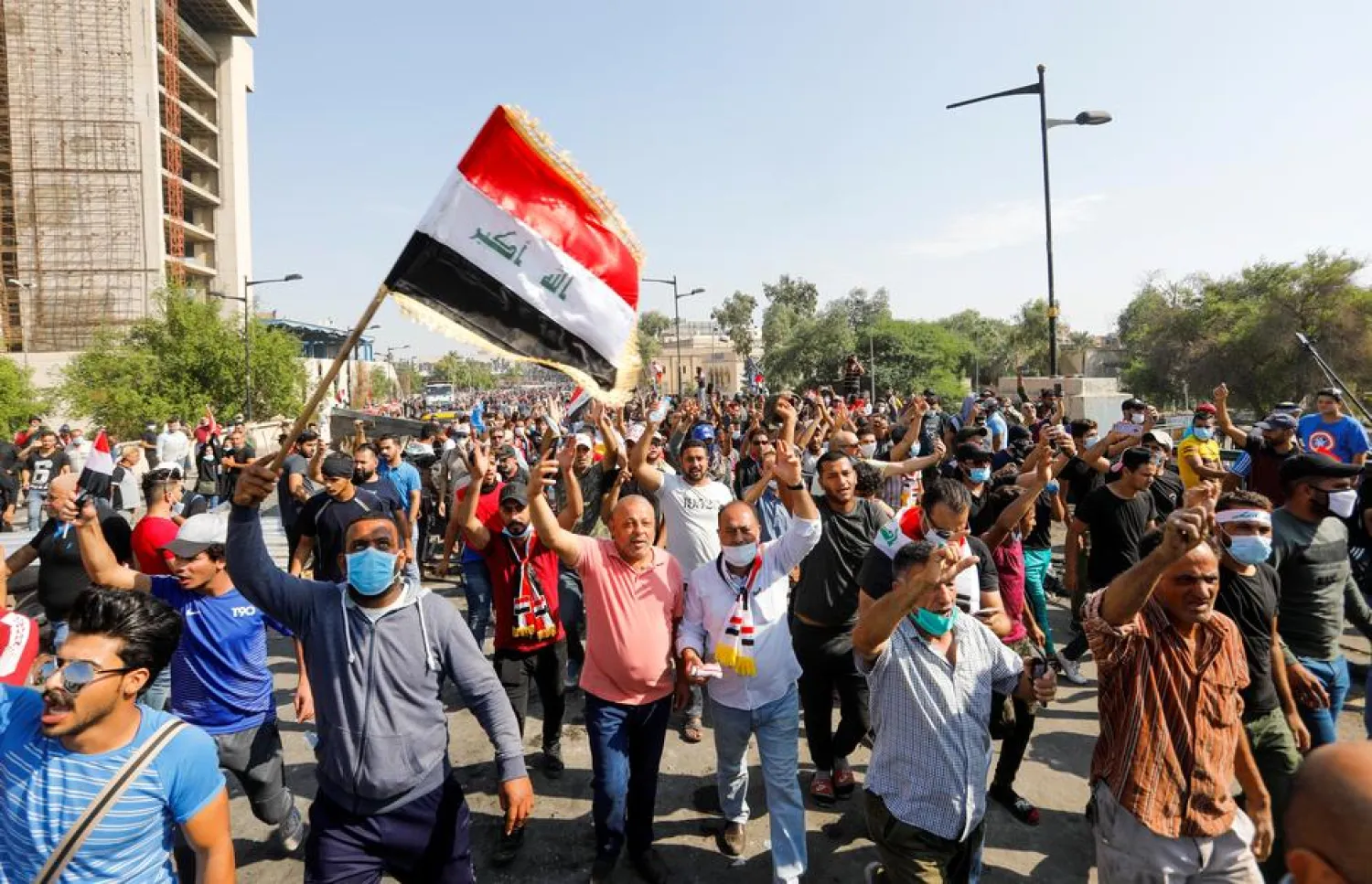

Dozens Killed in Anti-Government Protests in Iraq

Demonstrators are seen at Al Jumhuriya bridge during a protest over corruption, lack of jobs, and poor services, in Baghdad, Iraq October 26, 2019. REUTERS/Khalid al-Mousily
TT

Dozens Killed in Anti-Government Protests in Iraq

Demonstrators are seen at Al Jumhuriya bridge during a protest over corruption, lack of jobs, and poor services, in Baghdad, Iraq October 26, 2019. REUTERS/Khalid al-Mousily

Nearly 50 people have died in renewed anti-government protests across Iraq, officials said Saturday, with clashes breaking out as demonstrators turned their fury against government and paramilitary offices.

The death toll from protests this month has climbed to 205, including dozens who were killed as they torched government buildings or offices belonging to factions of the Popular Mobilization Forces (PMF) over the past two days.

The demonstrations first erupted on October 1, with protesters railing against government corruption and unemployment, while a second wave broke out late Thursday.

This latest round of demonstrations has been notably violent, with 48 people killed in as many hours.

Three protesters were killed in the capital Baghdad on Saturday, with medics and officials reporting trauma wounds sustained by tear gas canisters lobbed at demonstrators.

But the majority of victims have been in the Shiite-majority south, where protesters torched dozens of provincial government buildings, party offices and PMF centers.

On Saturday, three people were shot dead while setting fire to a local official's home, a police source told AFP.

The previous night, 12 protesters died in Diwaniyah while setting fire to the headquarters of the Badr organization.

Top PMF commanders have threatened "revenge" after their offices were attacked, and denounced those they said aimed at sowing "discord and chaos" in the country.

In a bid to contain the violence security forces have announced curfews across most of Iraq's southern provinces -- but brief protests nevertheless took place in Diwaniyah, Nasiriyah, Babylon and Najaf.

In the southern port city of Basra, protesters failed to come out in large numbers after security forces strictly enforced a curfew.

Fears of 'armed spoilers'

The PMF was founded in 2014 to fight the ISIS group but its factions have since been ordered to incorporate into the state security services.

"Public anger is directed at them in addition to governorate councils, for they were the obvious face of 'the regime'," wrote Harith Hasan, a senior fellow at the Carnegie Middle East Center, according to AFP.

But the attacks could also hint at political rivalries between the PMF and populist cleric Moqtada al-Sadr, who has thrown his weight behind the demonstrations.

"The Sadrists, especially in their traditional strongholds such as Missan, saw this an opportunity to act against competing militias," such as Asaib Ahl al-Haq, Badr, and Kataeb Hezbollah, Hasan said on Twitter.

The United Nations on Saturday said it was "tragic" to see renewed violence but also warned against "armed spoilers".

"Armed entities sabotaging the peaceful demonstrations, eroding the government's credibility and ability to act, cannot be tolerated," said the UN top official in Iraq, Jeanine Hennis-Plasschaert.

Protesters gathered in Baghdad's emblematic Tahrir (Liberation) Square on Saturday morning despite efforts by riot police to clear them with tear gas.

"It's enough -- theft, looting, gangs, mafias, deep state, whatever. Get out! Let us see a (functioning) state," said one protester, referring to perceived cronyism and corruption in the country.

"We don't want anything, just let us live," he added as puffs of smoke from tear gas rose behind him.

'It's enough!'

Oil-rich Iraq is OPEC's second-highest producer -- but one in five people live below the poverty line and youth unemployment sits at 25 percent, according to the World Bank.

About 60 percent of Iraq's 40-million-strong population is under the age of 25.

The staggering rates of joblessness and allegations of corruption sparked the widespread protests on October 1 and the government has struggled to quell public anger by proposing reforms.

Prime Minister Adel Abdul Mahdi has suggested a laundry list of measures, including hiring drives, increased pensions and a cabinet reshuffle.

New education and health ministers were approved by parliament in a session earlier this month, the only time it was able to meet since protests began.

But a scheduled meeting of parliament on Saturday to discuss the renewed protests failed to take due to a lack of quorum.

Protesters so far have seemed unimpressed by the government's efforts.

"They told young people: 'go home, we'll give you pensions and come up with a solution'. They tricked us," said one of the rare woman protesters on Saturday, her young son at her side.

They have even directed some of their anger at Sadr and country's top Shiite religious authority, Grand Ayatollah Ali al-Sistani, who is deeply revered among most Iraqis,

"Sadr, Sistani -- this is a shame," a protester in Tahrir said on Saturday.

"We were hit! It's enough," he said, waving a tear gas canister fired earlier by security forces.



Israel Military Says Soldier Killed in Gaza 

A drone view shows the destruction in a residential neighborhood, after the withdrawal of the Israeli forces from the area, amid a ceasefire between Israel and Hamas in Gaza, in Gaza City, October 21, 2025. (Reuters)
TT

Israel Military Says Soldier Killed in Gaza 

A drone view shows the destruction in a residential neighborhood, after the withdrawal of the Israeli forces from the area, amid a ceasefire between Israel and Hamas in Gaza, in Gaza City, October 21, 2025. (Reuters)

The Israeli military announced that one of its soldiers had been killed in combat in southern Gaza on Wednesday, but a security source said the death appeared to have been caused by "friendly fire".

"Staff Sergeant Ofri Yafe, aged 21, from HaYogev, a soldier in the Paratroopers Reconnaissance Unit, fell during combat in the southern Gaza Strip," the military said in a statement.

A security source, however, told AFP that the soldier appeared to have been "killed by friendly fire", without providing further details.

"The incident is still under investigation," the source added.

The death brings to five the number of Israeli soldiers killed in Gaza since a ceasefire took effect on October 10.


Syria: SDF’s Mazloum Abdi Says Implementation of Integration Deal May Take Time

People sit outdoors surrounded by nature, with the Tigris river flowing in the background, following a long atmospheric depression, near the Syrian-Turkish border in Derik, Syria, February 16, 2026 REUTERS/Orhan Qereman
TT

Syria: SDF’s Mazloum Abdi Says Implementation of Integration Deal May Take Time

People sit outdoors surrounded by nature, with the Tigris river flowing in the background, following a long atmospheric depression, near the Syrian-Turkish border in Derik, Syria, February 16, 2026 REUTERS/Orhan Qereman

Mazloum Abdi, commander of the Syrian Democratic Forces, said the process of merging the SDF with Syrian government forces “may take some time,” despite expressing confidence in the eventual success of the agreement.

His remarks came after earlier comments in which he acknowledged differences with Damascus over the concept of “decentralization.”

Speaking at a tribal conference in the northeastern city of Hasakah on Tuesday, Abdi said the issue of integration would not be resolved quickly, but stressed that the agreement remains on track.

He said the deal reached last month stipulates that three Syrian army brigades will be created out of the SDF.

Abdi added that all SDF military units have withdrawn to their barracks in an effort to preserve stability and continue implementing the announced integration agreement with the Syrian state.

He also emphasized the need for armed forces to withdraw from the vicinity of the city of Ayn al-Arab (Kobani), to be replaced by security forces tasked with maintaining order.


Israeli Far-Right Minister to Push for ‘Migration’ of West Bank, Gaza Palestinians 

A Palestinian man checks leather belts as people prepare for Ramadan, in the old city of Hebron in the Israeli-occupied West Bank, February 17,2026. (Reuters)
TT

Israeli Far-Right Minister to Push for ‘Migration’ of West Bank, Gaza Palestinians 

A Palestinian man checks leather belts as people prepare for Ramadan, in the old city of Hebron in the Israeli-occupied West Bank, February 17,2026. (Reuters)

Israel's far-right Finance Minister Bezalel Smotrich said he would pursue a policy of "encouraging the migration" of Palestinians from the occupied West Bank and Gaza Strip, Israeli media reported Wednesday.

"We will eliminate the idea of an Arab terror state," said Smotrich, speaking at an event organized by his Religious Zionism Party late on Tuesday.

"We will finally, formally, and in practical terms nullify the cursed Oslo Accords and embark on a path toward sovereignty, while encouraging emigration from both Gaza and Judea and Samaria.

"There is no other long-term solution," added Smotrich, who himself lives in a settlement in the West Bank.

Since last week, Israel has approved a series of measures backed by far-right ministers to tighten control over the West Bank, including in areas administered by the Palestinian Authority under the Oslo Accords, in place since the 1990s.

The measures include a process to register land in the West Bank as "state property" and facilitate direct purchases of land by Jewish Israelis.

The measures have triggered widespread international outrage.

On Tuesday, the UN missions of 85 countries condemned the measures, which critics say amount to de facto annexation of the Palestinian territory.

"We strongly condemn unilateral Israeli decisions and measures aimed at expanding Israel's unlawful presence in the West Bank," they said in a statement.

"Such decisions are contrary to Israel's obligations under international law and must be immediately reversed.

"We underline in this regard our strong opposition to any form of annexation."

UN Secretary-General Antonio Guterres on Monday called on Israel to reverse its land registration policy, calling it "destabilizing" and "unlawful".

The West Bank would form the largest part of any future Palestinian state. Many on Israel's religious right view it as Israeli land.

Israeli NGOs have also raised the alarm over a settlement plan signed by the government which they say would mark the first expansion of Jerusalem's borders into the occupied West Bank since 1967.

The planned development, announced by Israel's Ministry of Construction and Housing, is formally a westward expansion of the Geva Binyamin, or Adam, settlement situated northeast of Jerusalem in the West Bank.

The current Israeli government has fast-tracked settlement expansion, approving a record 52 settlements in 2025.

Excluding Israeli-annexed east Jerusalem, more than 500,000 Israelis live in West Bank settlements and outposts, which are illegal under international law.