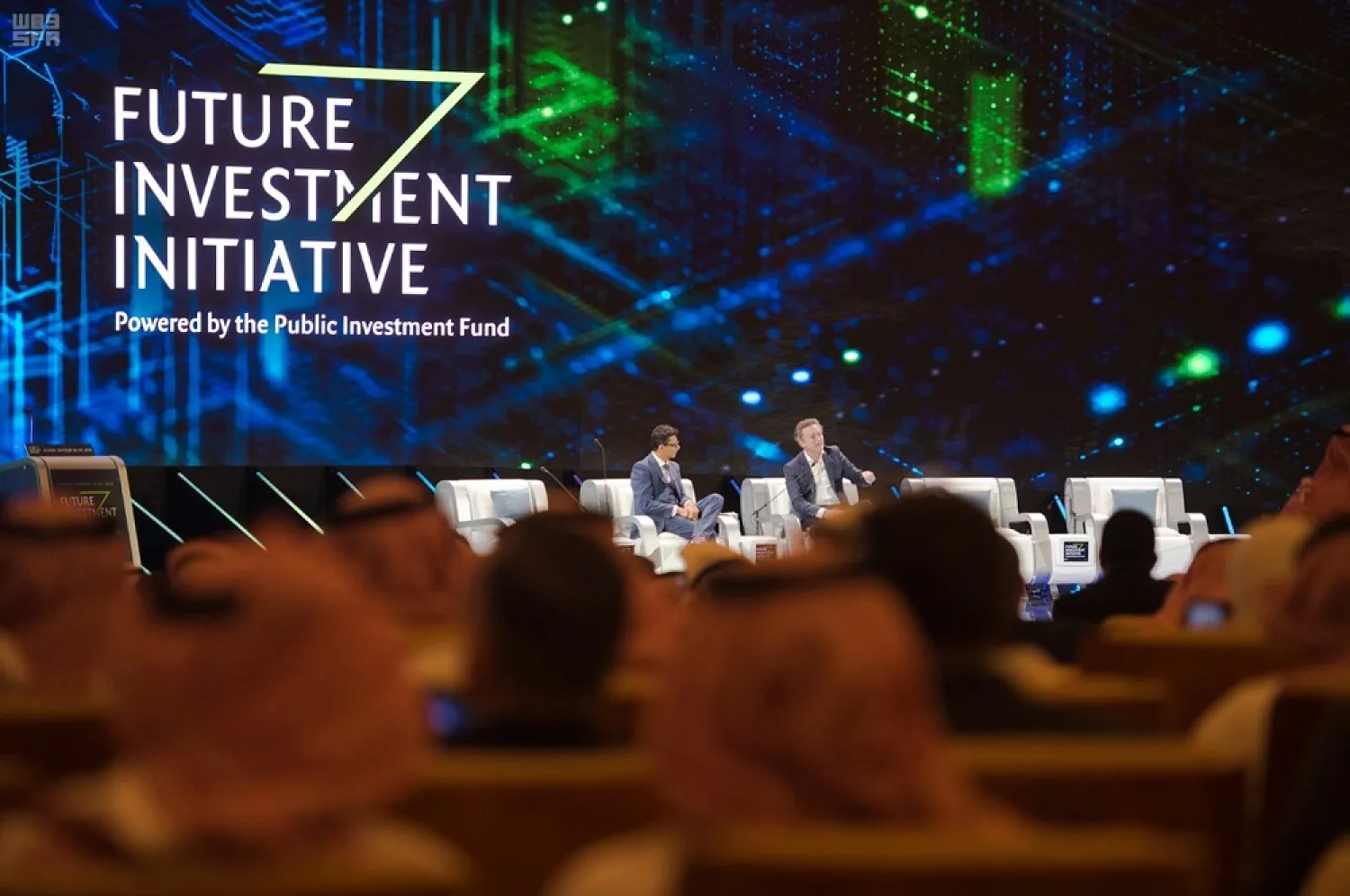
‘Davos in the Desert’ Tackles Int’l Economic Challenges, Future Aspirations

The Future Investment Initiative kicks off on Tuesday. (SPA)
TT

‘Davos in the Desert’ Tackles Int’l Economic Challenges, Future Aspirations

The Future Investment Initiative kicks off on Tuesday. (SPA)

The three-day Future Investment Initiative (FII), nicknamed "Davos in the desert", will kick off in Saudi Arabia on Tuesday, tackling strategic and vital questions about the regional and global economic and investment environment.

The event brings together global policymakers and tycoons from across the globe at 47 seminars and workshops and three summits. Dozens of global companies, including 25 American firms and investment banks, have confirmed their participation.

FII will seek to answer numerous questions, including how the current ambitious economy can shape the economy of the next decade.

Asharq Al-Awsat obtained a copy of the FII agenda. It addresses female economy and whether current developments will help further incorporate women in global economics. It will highlight Japan and China as examples.

Financial challenges will also be addressed, with attention directed at the situation in Europe. European governments will be asked how they are seeking to push innovation in the financial markets. On the international level, executives will tackle ways to meet the United States’ sustainable development goals.

FII will also shine the spotlight on the role India, Brazil and Africa can play in the global economy.

Energy files will take center stage at the event. Discussions will address new energy innovations.


Egyptian Central Bank Issues Regulations for Digital Financial Identity Services

The headquarters of the Central Bank of Egypt in downtown Cairo (Photography: Abdul Fattah Faraj)
TT

Egyptian Central Bank Issues Regulations for Digital Financial Identity Services

The headquarters of the Central Bank of Egypt in downtown Cairo (Photography: Abdul Fattah Faraj)

Egypt's central bank has approved regulations for a digital financial identity platform that will enable remote customer verification and identification, it said on Sunday, as it seeks to expand access to ⁠financial services.

According to Reuters, it said ⁠the move was part of efforts to support digital transformation, promote financial inclusion ⁠and modernize the banking sector's digital infrastructure.

Governor Hassan Abdalla said the platform will enable more citizens to open bank accounts and access banking products and services online without visiting branches.

The ⁠regulations set out a governance framework, defining the roles and responsibilities of relevant parties, along with technical, data protection, and cybersecurity requirements, the central bank said.


Sinopec's Half-year Profit Grew 19.3% on Year Despite Iran War

Oil storage tanks and facilities of a Sinopec plant in Shanghai, China, March 26, 2026. REUTERS/Go Nakamura
TT

Sinopec's Half-year Profit Grew 19.3% on Year Despite Iran War

Oil storage tanks and facilities of a Sinopec plant in Shanghai, China, March 26, 2026. REUTERS/Go Nakamura

China's Sinopec reported an unexpected 19.3% year-on-year increase in net profit for the first half of 2026, despite a litany of issues including the Middle East conflict and falling demand for fuel domestically, but said it had to write down its inventories by 16 billion yuan.

Net profit over the January-June period stood at 25.63 billion yuan ($3.81 billion) under Chinese accounting standards, versus the 21.48 billion yuan a year earlier, Sinopec said in a filing at the Shanghai stock exchange on Sunday.

In a separate filing, the company said it set aside provisions for asset impairment of 16 billion yuan as a result of the volatility in oil and fuel prices in the first six months of this year.

Sinopec, ⁠the world's biggest ⁠refiner, relies on the Middle East for half of its crude oil needs, making it vulnerable to the worst supply crisis in history as the Strait of Hormuz - through which it usually imports large quantities of oil - has remained largely closed since March.

It also processed 5.6% less crude oil between January and June versus the same year-ago period, at 113.31 million metric tons, or 4.57 million barrels per day (bpd), according to the filing.

The company said its refining margin was up 44.1% on ⁠the year in the first half of 2026 - up 139 yuan per metric ton to 453 yuan per metric ton - a surprising jump given domestic fuel price hikes lagged the surges in crude oil cost.

Its refining segment reported a 381.5% growth in operating profit by "broadening crude oil sourcing outside the Middle East, closely managing the timing of purchases in line with market conditions, and optimizing its product mix based on product profitability," the filing showed, according to Reuters.

China has drastically cut oil imports since the war began in March, freeing up barrels for others and keeping a lid on global prices. Sinopec's result is all the more surprising given how exposed it was to the Strait and the way in which Beijing has forced the refiner, and others like it, to ⁠absorb the oil price shock ⁠by limiting their ability to pass higher oil prices through to fuel consumers

Conflict in the Middle East caused "sharp volatility in international crude oil prices and a substantial increase in imported crude procurement costs", while the domestic refined product and chemicals markets remained weak, the management stated in the filing.

But the company said it "closely monitored changing conditions, dynamically adjusted production and operating arrangements, and effectively responded to unexpected shocks and challenges on multiple fronts."

The chemicals segment remained loss-making, recording an operating loss of over 200 million yuan, but losses narrowed sharply by around 4 billion yuan, it said.

Output of ethylene, a key building block for petrochemicals, sank 15.5% on the year to 6.4 million tons in the first half, as the company faced industry over-capacity and competition from the private sector.

Sinopec projects crude throughput for July–December at 113 million metric tons, roughly flat versus the amount processed in the first half.


ECB Chief Lagarde Reportedly 'Ready to Serve' WEF

President of European Central Bank Christine Lagarde addresses the media in Frankfurt, Germany, Thursday, July 23, 2026, after a meeting of the ECB's governing council. (AP Photo/Michael Probst)
TT

ECB Chief Lagarde Reportedly 'Ready to Serve' WEF

President of European Central Bank Christine Lagarde addresses the media in Frankfurt, Germany, Thursday, July 23, 2026, after a meeting of the ECB's governing council. (AP Photo/Michael Probst)

Christine Lagarde, chief of the European Central Bank, could take over the presidency of the World Economic Forum at some point in 2027, Swiss newspaper NZZ reported on Sunday.

At a board meeting near Geneva this week, Lagarde was reportedly described as a "putative candidate" to lead the organization behind the annual Davos gathering of political and business leaders.

According to sources cited by the newspaper, she also said she was "ready to serve.”

The WEF's board ⁠is currently co-chaired ⁠by Roche vice-chairman André Hoffmann and BlackRock CEO Larry Fink, who are navigating a leadership transition after founder Klaus Schwab stepped down last year.

At the board meeting, Singapore's President Tharman Shanmugaratnam said that the succession to Fink ⁠and Hoffmann should be resolved internally as suitable candidates were available, NZZ reported.

Lagarde, who has been a member of the WEF's board for several terms, thanked the members of the 28-strong body for their confidence in her, according to the paper's reporting.

The board did not determine exactly when Lagarde should take over the presidency, NZZ said, based on sources, adding that the ⁠only point ⁠of agreement was that Fink and Hoffmann should still chair the annual meeting in Davos in January 2027.

The WEF did not immediately reply to a Reuters request for comment.

Christine Lagarde said last year she was determined to complete her term at the ECB, following speculation she might leave early to take up a role leading the WEF.

Her eight-year presidential term at the ECB runs out at the end of October 2027.