

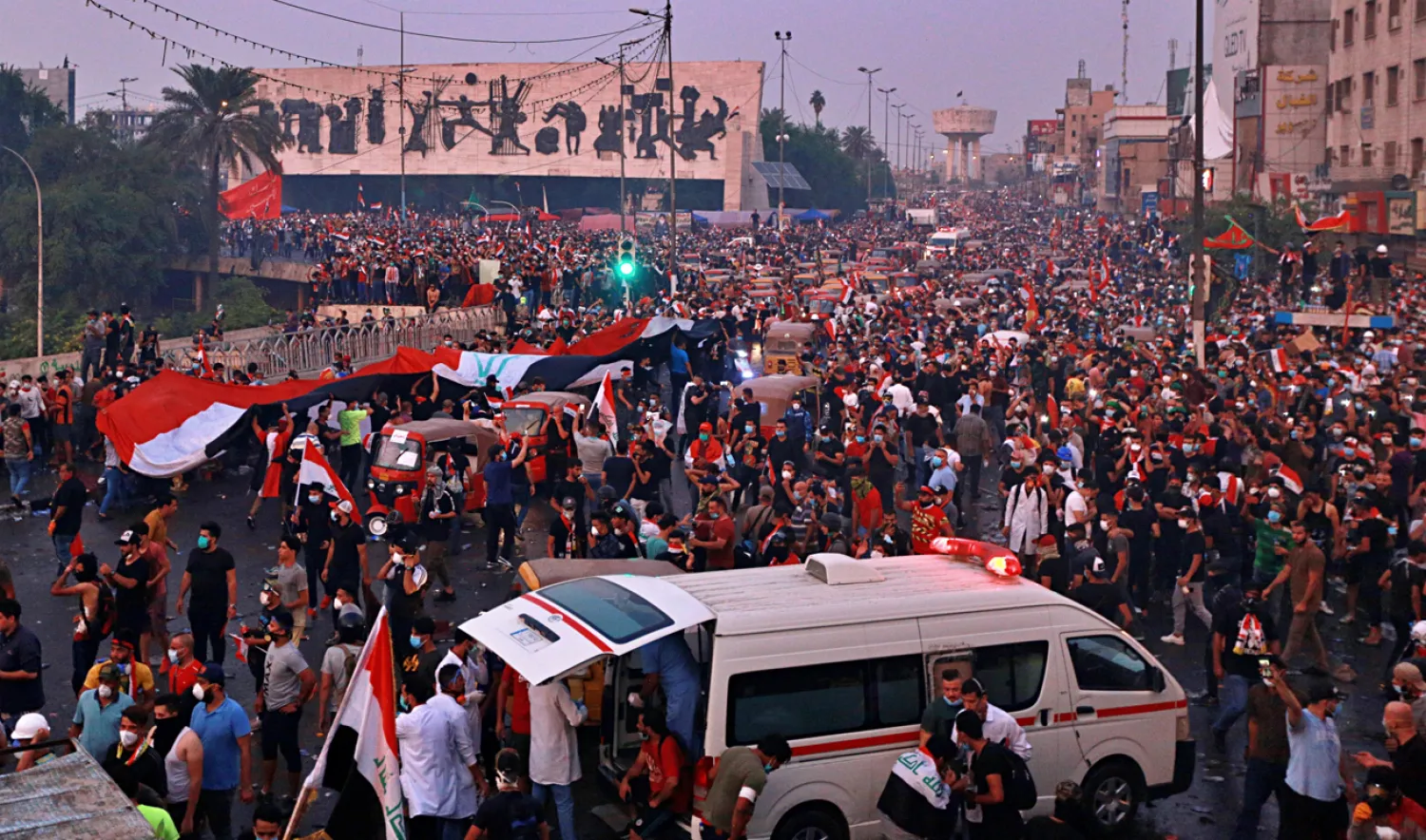

Iraqi Protesters Pack Baghdad Square, Anti-Government Movement Gains Momentum

Anti-government protesters gather in Tahrir Square during a demonstration in Baghdad, Iraq, Monday, Oct. 28, 2019. (AP)
TT

Iraqi Protesters Pack Baghdad Square, Anti-Government Movement Gains Momentum

Anti-government protesters gather in Tahrir Square during a demonstration in Baghdad, Iraq, Monday, Oct. 28, 2019. (AP)

Tens of thousands of Iraqis protested in Baghdad's central Tahrir Square on Tuesday for a fifth day, angered by reports of security forces killing demonstrators in the city of Karbala and the prime minister's refusal to call early elections.

It was the largest gathering in the capital since a second wave of demonstrations against Prime Minister Adel Abdul Mahdi's government and the ruling elite resumed on Friday. Populist cleric Moqtada al-Sadr, who helped install the premier, called for his removal.

Security forces stationed on the nearby Jumhuriya bridge, lobbed tear gas at protesters in Tahrir Square who tried to break through to the heavily fortified Green Zone, which houses government buildings and foreign missions.

"With life and blood we defend you Iraq," they chanted, according to Reuters.

The crowd consisted mostly of young men, many draped in Iraqi flags. Surrounding streets brimmed with cars, taxis, motorcycles and tuk-tuks as more people made their way in.

Earlier, trade unions announced that they would call strikes, following the lead of lawyers and teachers.

The latest protest in Baghdad took place after a night of violence in Karbala, where, according to medical and security sources, Iraqi security forces opened fire on protesters and killed at least 18 people.

At least 865 people were wounded, the sources said.

Karbala’s governor and police chief, Iraq's prime minister and the military all denied anyone was killed. But the security and medical sources said local authorities had been ordered to cover the deaths up.

The United Nations representative in Iraq condemned the violence and called for dialogue.

"The recent developments across many parts of Iraq, in particular in Karbala last night, are most alarming. Witness reports indicate that live fire was used against demonstrators, causing high numbers of casualties," the United Nations Assistance Mission for Iraq (UNAMI) said in a statement.

The death toll since the unrest started on October 1 is now at least 250 people.

"We want the government gone. Our demand is not for Abdul Mahdi to resign, if he resigns, it's not enough. Parliament must go, the parties must go," protester Salah al Suweidi said in Tahrir Square

"Yesterday we broke the curfew and stayed the night, we will do so again today, even if 10, 20, 100, 1,000 die. What happened in Karbala will not be ignored, the blood of our brothers in Karbala and other provinces will not be in vain."

In southern Iraq, protesters blocked the entrance to Umm Qasr commodities port near Basra, slowing operations by around 80 percent, port employees and local officials said.

Hardship and corruption

The protests, driven by discontent over economic hardship and corruption, have broken nearly two years of relative stability in Iraq.

An OPEC member, it has vast oil wealth, but many Iraqis live in poverty or have limited access to clean water, electricity, basic health care and education. Most of the protesters are young men who above all want jobs.

Many Iraqis criticize a political elite they say is subservient to one or another of Baghdad's two main allies, the United States and Iran. These powers use Iraq as a proxy to pursue their struggle for regional influence, without concern for the needs of ordinary people, they say.

Despite promising reforms and ordering a broad reshuffle of the cabinet, Abdul Mahdi has struggled to address the demonstrators' complaints.

Sadr, who backs parliament's largest bloc and helped bring Abdul Mahdi's coalition government to power, invited his main political rival Hadi al-Amiri on Tuesday to help him oust the premier.

Sadr had asked Abdul Mahdi to call an early election but the premier refused, saying on Tuesday it would be quicker if Sadr agreed with his rival on a replacement.

Parliament passed measures on Monday aimed at placating the protesters but many said this was too little too late. These included reduced salaries for officials, formation of a committee to draft constitutional amendments and the dissolution of all provincial and local councils outside the semi-autonomous Kurdistan Region.

The root cause of grievances is the sectarian power-sharing system of governance introduced in Iraq after 2003, analysts and activists say.

After Saddam Hussein was ousted, many opposition groups returning from exile divided state positions among themselves after dismantling the civil service under the banner of "de-Baathification", or getting rid of Saddam's people.

This was replaced by sprawling patronage networks among the political elites.

These elites exploited ethno-sectarian grievances. But Iraqis now are rejecting this system, even the Shiite majority who after 16 years of leading the government, still find themselves impoverished and undeserved.



Israel Military Says Soldier Killed in Gaza 

A drone view shows the destruction in a residential neighborhood, after the withdrawal of the Israeli forces from the area, amid a ceasefire between Israel and Hamas in Gaza, in Gaza City, October 21, 2025. (Reuters)
TT

Israel Military Says Soldier Killed in Gaza 

A drone view shows the destruction in a residential neighborhood, after the withdrawal of the Israeli forces from the area, amid a ceasefire between Israel and Hamas in Gaza, in Gaza City, October 21, 2025. (Reuters)

The Israeli military announced that one of its soldiers had been killed in combat in southern Gaza on Wednesday, but a security source said the death appeared to have been caused by "friendly fire".

"Staff Sergeant Ofri Yafe, aged 21, from HaYogev, a soldier in the Paratroopers Reconnaissance Unit, fell during combat in the southern Gaza Strip," the military said in a statement.

A security source, however, told AFP that the soldier appeared to have been "killed by friendly fire", without providing further details.

"The incident is still under investigation," the source added.

The death brings to five the number of Israeli soldiers killed in Gaza since a ceasefire took effect on October 10.


Syria: SDF’s Mazloum Abdi Says Implementation of Integration Deal May Take Time

People sit outdoors surrounded by nature, with the Tigris river flowing in the background, following a long atmospheric depression, near the Syrian-Turkish border in Derik, Syria, February 16, 2026 REUTERS/Orhan Qereman
TT

Syria: SDF’s Mazloum Abdi Says Implementation of Integration Deal May Take Time

People sit outdoors surrounded by nature, with the Tigris river flowing in the background, following a long atmospheric depression, near the Syrian-Turkish border in Derik, Syria, February 16, 2026 REUTERS/Orhan Qereman

Mazloum Abdi, commander of the Syrian Democratic Forces, said the process of merging the SDF with Syrian government forces “may take some time,” despite expressing confidence in the eventual success of the agreement.

His remarks came after earlier comments in which he acknowledged differences with Damascus over the concept of “decentralization.”

Speaking at a tribal conference in the northeastern city of Hasakah on Tuesday, Abdi said the issue of integration would not be resolved quickly, but stressed that the agreement remains on track.

He said the deal reached last month stipulates that three Syrian army brigades will be created out of the SDF.

Abdi added that all SDF military units have withdrawn to their barracks in an effort to preserve stability and continue implementing the announced integration agreement with the Syrian state.

He also emphasized the need for armed forces to withdraw from the vicinity of the city of Ayn al-Arab (Kobani), to be replaced by security forces tasked with maintaining order.


Israeli Far-Right Minister to Push for ‘Migration’ of West Bank, Gaza Palestinians 

A Palestinian man checks leather belts as people prepare for Ramadan, in the old city of Hebron in the Israeli-occupied West Bank, February 17,2026. (Reuters)
TT

Israeli Far-Right Minister to Push for ‘Migration’ of West Bank, Gaza Palestinians 

A Palestinian man checks leather belts as people prepare for Ramadan, in the old city of Hebron in the Israeli-occupied West Bank, February 17,2026. (Reuters)

Israel's far-right Finance Minister Bezalel Smotrich said he would pursue a policy of "encouraging the migration" of Palestinians from the occupied West Bank and Gaza Strip, Israeli media reported Wednesday.

"We will eliminate the idea of an Arab terror state," said Smotrich, speaking at an event organized by his Religious Zionism Party late on Tuesday.

"We will finally, formally, and in practical terms nullify the cursed Oslo Accords and embark on a path toward sovereignty, while encouraging emigration from both Gaza and Judea and Samaria.

"There is no other long-term solution," added Smotrich, who himself lives in a settlement in the West Bank.

Since last week, Israel has approved a series of measures backed by far-right ministers to tighten control over the West Bank, including in areas administered by the Palestinian Authority under the Oslo Accords, in place since the 1990s.

The measures include a process to register land in the West Bank as "state property" and facilitate direct purchases of land by Jewish Israelis.

The measures have triggered widespread international outrage.

On Tuesday, the UN missions of 85 countries condemned the measures, which critics say amount to de facto annexation of the Palestinian territory.

"We strongly condemn unilateral Israeli decisions and measures aimed at expanding Israel's unlawful presence in the West Bank," they said in a statement.

"Such decisions are contrary to Israel's obligations under international law and must be immediately reversed.

"We underline in this regard our strong opposition to any form of annexation."

UN Secretary-General Antonio Guterres on Monday called on Israel to reverse its land registration policy, calling it "destabilizing" and "unlawful".

The West Bank would form the largest part of any future Palestinian state. Many on Israel's religious right view it as Israeli land.

Israeli NGOs have also raised the alarm over a settlement plan signed by the government which they say would mark the first expansion of Jerusalem's borders into the occupied West Bank since 1967.

The planned development, announced by Israel's Ministry of Construction and Housing, is formally a westward expansion of the Geva Binyamin, or Adam, settlement situated northeast of Jerusalem in the West Bank.

The current Israeli government has fast-tracked settlement expansion, approving a record 52 settlements in 2025.

Excluding Israeli-annexed east Jerusalem, more than 500,000 Israelis live in West Bank settlements and outposts, which are illegal under international law.