


'It’s Surreal': Roberto Lopes's Road From Bank Job to International Footballer

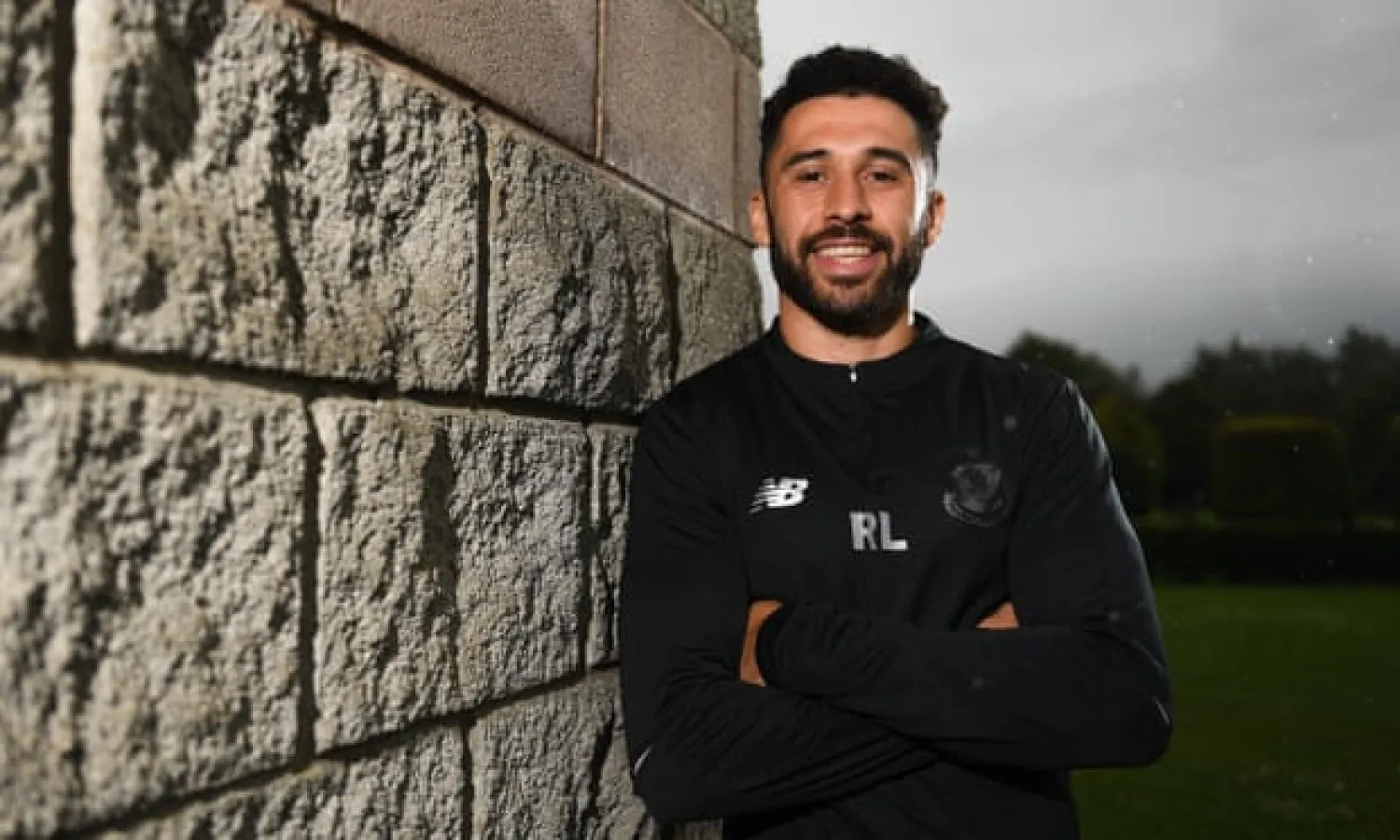
 Roberto Lopes plays for Shamrock Rovers in the FAI Cup final on Sunday and then for Cape Verde in an Africa Cup of Nations qualifier. Photograph: Eóin Noonan/Sportsfile via Getty Images
Roberto Lopes plays for Shamrock Rovers in the FAI Cup final on Sunday and then for Cape Verde in an Africa Cup of Nations qualifier. Photograph: Eóin Noonan/Sportsfile via Getty Images
TT

'It’s Surreal': Roberto Lopes's Road From Bank Job to International Footballer

 Roberto Lopes plays for Shamrock Rovers in the FAI Cup final on Sunday and then for Cape Verde in an Africa Cup of Nations qualifier. Photograph: Eóin Noonan/Sportsfile via Getty Images
Roberto Lopes plays for Shamrock Rovers in the FAI Cup final on Sunday and then for Cape Verde in an Africa Cup of Nations qualifier. Photograph: Eóin Noonan/Sportsfile via Getty Images

At the age of 24 Roberto “Pico” Lopes was a part-time centre-back with a steady day job in a bank in his native Dublin. He was freshly qualified as a mortgage adviser. A solid career was taking shape before him. He hated it.

Three years later he is a professional footballer who hopes to lift his first major trophy on Sunday before embarking this month on the Africa Cup of Nations qualification campaign with Cape Verde Islands, from where his father comes and for whom he made his debut in October. “It’s crazy, so surreal,” he says before explaining how excited he is about the new direction his career has taken and the cultural awakening it has inspired – and how close he came to missing out on all that because of an embarrassing social media mix-up and a twisted testicle. Those last two things, it should be made clear right now, were not related.

Where to start? How about with when Lopes was a teenager, because back then an international football career did not seem so improbable: he had, after all, played alongside John Egan, now of Sheffield United, in central defence for the Republic of Ireland Under-19s. Lopes was playing for Bohemians, a top-flight League of Ireland club without the resources to give players professional deals. Five years later Lopes was still playing for them while advancing in the bank.

Then Shamrock Rovers – Bohemians’ better-heeled arch-rivals – offered him a two-year deal to leave his boyhood club and his day job. It was a risk, as even Rovers could not offer the sort of money that would make quitting a secure job prudent. “I just thought: ‘Worry later about what happens next; at least I’ll be happy for a few years,’” says Lopes. “And then it took off. It’s been a dream.”

Mostly. There was a scare a few months later when he woke one morning with a pain in a testicle. He rolled over and hoped it would go away. It got worse. “I called the doctor and he told me come in. It took me 15 minutes to get there and by that time the pain had multiplied by 10. He said: ‘Yeah, you’ve twisted your testicle’ and started explaining the possibilities. I said: ‘Yeah, I don’t care, take them both off if you want, just make the pain stop!’ So he wrote me a reference for the hospital. I had to go straight there because apparently there’s a six- to eight-hour window in which your testicle can be saved. I had to drive to me ma’s to get her to take me to hospital. I was driving with my leg out the window at one stage just trying to get some pain relief.”

He made it to the hospital, was treated quickly and two weeks later, once the stitches had healed, he was back in action for Rovers.

Lopes has helped Rovers do well domestically and qualify for Europe every season. On Sunday they will contest the FAI Cup final against Dundalk. “But still, even at the start of this season I’d never have said I’d become an international footballer,” he says. That was despite the fact that Cape Verde’s manager, Rui Águas, had been in touch. Lopes had blanked him.

“I’ve been a member of LinkedIn since college and one day I was just doing up my profile and I remember connecting with Rui Águas after his name popped up. Then a while later I received a message from him. It was in Portuguese and I just thought it was spam so took no notice. That was in October 2018. Then in September of this year I got another message saying: Did you think about it?’ I was like: ‘Oh, what’s this?’ So I translated the [original] message. They were looking at players who might be interested in declaring.”

Lopes cannot help laughing as he continues the story. “I was straight back in there apologising with my tail between my legs saying: ‘Sorry, I don’t speak Portuguese but I’d love to be involved if it’s not too late.’ Lucky enough, he said: ‘That’s great, give me your mobile.”

And lo, Lopes made his international debut in a friendly against Togo in France last month, then played in a behind-closed doors match against Marseille. He feels he did well but does not know whether he will be included in the squad for this month’s qualifier in Cameroon. He has no doubt, though, that he has been enriched.

“Cape Verde has always been part of my identity but mainly because there are not many Roberto Lopeses floating around Crumlin so when people would hear your name they’d always ask: ‘Where are you from?’ and I’d explain that my da’s from Cape Verde and then have to explain where that is,” says Lopes, adding that he has met only one other Cape Verdean person in Ireland. “It’s only really now that I’m delving deeper into the culture and the heritage. It makes you proud. Even my girlfriend Leah, who’s a history teacher, has been looking into the history of the country. It’s really interesting. Being involved with the team just opened my mind and made me realise how much I didn’t know.”

The realisation started with his initiation, when he had to sing in front of the squad. “I was thinking I’d do something handy, maybe Drake, but they said: ‘No, no, it has to be a Creole song.’ So after lunch I went up to my room and on to Spotify and found a song called Dança Mami Creola. I went down and as soon as I sang the first line, everybody joined in. I probably got it wrong but everybody was so supportive that it turned out to be a bit of craic and a great way to help me settle in.

“It was such a positive environment. And it was really inspiring to be part of when you see how much playing for the country means to them, how dedicated they are to it even in a friendly with no fans.”

“And my dad, when I came back from the trip, he was just beaming,” says Lopes of his father, Carlos, who left his homeland at 16 and spent years travelling as a ship’s chef before opening a cafe in Belgium, going on a holiday to Ireland and, in the words of Roberto, “finding me ma!”

“There are more Cape Verdians living abroad than in the islands themselves,” says Lopes. “And they’re very active on social media. All the family across the world have been in touch to congratulate my dad; uncles were sharing posts from various Cape Verdian pages; and I’ve heard from cousins I never knew I had. It’s just a real buzz around the family. It makes you proud.

“And to think I nearly missed out on all that because I didn’t reply to a LinkedIn message. I reply to everyone now!

The Guardian sport


Over 75% of Fans Do Not Support VAR in Premier League, Says FSA Survey

Football - Premier League - Aston Villa v West Ham United - Villa Park, Birmingham, Britain - March 22, 2026 Referee Paul Tierney checks the VAR before overturning an Aston Villa penalty. (Action Images via Reuters)
TT

Over 75% of Fans Do Not Support VAR in Premier League, Says FSA Survey

Football - Premier League - Aston Villa v West Ham United - Villa Park, Birmingham, Britain - March 22, 2026 Referee Paul Tierney checks the VAR before overturning an Aston Villa penalty. (Action Images via Reuters)

More than ‌75% of Premier League fans do not support the continued use of Video Assistant Referees (VAR), a Football Supporters’ Association (FSA) survey showed.

The survey was conducted online between February 26 and March 23 and saw almost 8,000 fans of top-flight clubs participate, the FSA said.

The ‌results showed ‌that 75.7% did not ‌support ⁠the use of ⁠VAR in football, with 91.7% saying VAR had removed the spontaneous joy of goal celebrations.

“These findings back up the FSA’s previous survey in 2021, where fans ⁠expressed misgivings about the introduction ‌of VAR," ‌FSA’s Premier League network manager Thomas Concannon ‌said.

“We have shared the survey ‌results with the Premier League and PGMO (Professional Game Match Officials Limited), and look forward to discussing its findings ‌with them.”

Reuters has requested comment from the Premier League.

Premier League ⁠teams ⁠voted in favor of keeping VAR in June 2024 despite a considerable amount of criticism about the technology-aided officiating system.

"While VAR produces more accurate decision making, it was agreed that improvements should be made for the benefit of the game and supporters," the league said in a statement at the time.


King Kimi, Max Misery, Bearman Smash: Japan GP Talking Points

Red Bull Racing driver Max Verstappen of Netherlands in action during the Formula 1 Japanese Grand Prix at the Suzuka International Racing Course racetrack in Suzuka, Japan, 29 March 2026. (EPA)
TT

King Kimi, Max Misery, Bearman Smash: Japan GP Talking Points

Red Bull Racing driver Max Verstappen of Netherlands in action during the Formula 1 Japanese Grand Prix at the Suzuka International Racing Course racetrack in Suzuka, Japan, 29 March 2026. (EPA)

Kimi Antonelli won the Japanese Grand Prix from pole ahead of McLaren's Oscar Piastri as Max Verstappen endured another miserable outing in his Red Bull.

AFP Sport looks at three talking points from the third race weekend on the 2026 Formula One calendar:

- Mercedes protect teen hero -

Antonelli is in only his second season, but already Mercedes are playing down expectations of the 19-year-old -- now the youngest title race leader in Formula One history.

"We need to protect him now from people talking about world championships," said Mercedes team principal Toto Wolff after the race.

Antonelli admitted he had a stroke of fortune with a safety car that enabled him to dive in for fresh tires and emerge in the lead after his rivals had already pitted.

It was the second race in a row where a slow getaway saw him relegated from pole position and having to play catch-up.

"I had a terrible start. I need to check what happened. Then I was lucky with the safety car to be in the lead but then the pace was incredible," said Antonelli

"Luckily, I've got three weeks, so now I can practice some clutch drops just to get a better feel with it.

"It's been a weak point and I need to improve because you can easily win or lose races."

- Verstappen quit threat -

Red Bull's four-time world champion Verstappen openly questioned his future in Formula One after finishing eighth and lashing out again about the new cars and regulations.

"It's really anti-driving," he told the BBC.

"Then at one point, yeah, it's just not what I want to do."

Verstappen had won at Suzuka in each of the previous four years but was way off the pace and even waved goodbye to one car that overtook him, knowing that he did not have any capability to strike back.

The Dutchman said Formula One bosses "know what to do" to address his concerns and added: "You don't need to feel sorry for me, I'll be fine."

- Bearman sparks safety call -

Oliver Bearman escaped serious injury in a horror crash which prompted drivers to call for changes in the regulations.

The 20-year-old's Haas was closing rapidly at high speed on Franco Colapinto and smashed into the barriers after swerving to avoid the Argentine's Alpine.

Drivers and teams complained it had been an accident waiting to happen because of Formula One's new regulations that mean cars can be travelling at drastically different speeds on the track at the same time.

"These kind of closing speeds and these kind of accidents were always going to happen, and I'm not very happy with what we've had up until now," Grand Prix Drivers' Association chief Carlos Sainz told Sky Sports F1.

"Hopefully we come up with a better solution that doesn't create these massive closing speeds and a safer way of going racing," added the Williams driver.

Bearman said: "I think we've, as a group, warned the FIA what can happen, and this has been a really unfortunate result."


Premier League Fans Feel the Pinch from Ticket Price Hikes

Manchester United fans, many wearing black as a protest, display a banner in the crowd against seat prices and the current ownership of Manchester United ahead of the English Premier League football match between Manchester United and Arsenal at Old Trafford in Manchester, northwest England, on March 9, 2025. (AFP)
TT

Premier League Fans Feel the Pinch from Ticket Price Hikes

Manchester United fans, many wearing black as a protest, display a banner in the crowd against seat prices and the current ownership of Manchester United ahead of the English Premier League football match between Manchester United and Arsenal at Old Trafford in Manchester, northwest England, on March 9, 2025. (AFP)

The Premier League's global appeal is built on packed stadiums and electric atmospheres but as the arms race for talent intensifies, fans are feeling the pinch.

A recent UEFA report found English football's "Big Six" -- Arsenal, Chelsea, Liverpool, Manchester City, Manchester United and Tottenham -- earned nearly 20 percent more from selling tickets for home matches in the 2024/25 season than 12 months before.

Revenue from bumper broadcasting deals and commercial sponsorship still provides the vast majority of income for Premier League teams.

But as the growth in TV money has slowed, clubs have focused on increasing matchday revenue, with many investing in stadium renovations and expansions, promising improved facilities and better experiences.

Fans pay the price, particularly local supporters, as clubs target tourists from far and wide who are willing to pay a premium.

In wealthy west London, Fulham boast a rooftop pool and top-grade catering in the hospitality section, but season tickets are among the most expensive in the league, priced at up to £3,000 ($4,000).

"The Riverside stand is a great asset, glad it's at our football club, but it's expensive for your average match-going fan," Simon Duke of the Fulham Supporters' Trust told AFP.

"In having this fantastic asset, thank you owners, but can you please use that to keep football affordable in the other three sides of the ground?"

- Tourist market -

Liverpool sparked outrage last week by announcing that prices will rise in line with inflation for the next three seasons.

Fans group Spirit of Shankly said the club "choose to disregard those who make LFC what it is".

Major expansions of Anfield have increased capacity to 61,000, but there are just 34,000 season tickets available.

That allows the Premier League champions to sell nearly 50 percent of tickets on a match-by-match basis, often targeting day trippers willing to spend more on merchandise, food and drink.

"You look at the yield per fan, per match," said football finance expert Kieran Maguire.

"You're going to get more from a person that's coming for an experience as opposed to some grumpy old bloke who's been doing it for 50 years because the alternative is having to go to IKEA on a Saturday afternoon."

Hospitality packages can cost several thousand pounds per game, with the most expensive option for Manchester City's upcoming clash with Arsenal available for £5,500.

A report by campaign group Fair Game highlighted the long-term risk clubs are taking.

"Some clubs are looking at their stadium and seeing each seat as an individual opportunity to raise money," said CEO Niall Couper.

"If the club wants to be there for the long haul, and to be financially sustainable, then actually keeping ticket prices at an affordable level and allowing access to your local community is a safer way to go."

- 'National religion' -

Supporters, young and old, have also been squeezed by a loss of concessions.

Manchester United are increasing season ticket prices by five percent for the third consecutive year and halving a senior citizens' discount for some fans.

Supporters of United and Liverpool, England's two most successful clubs, joined forces to back the "Stop Exploiting Loyalty" campaign at a match at Anfield last year.

Despite the unrest, Premier League clubs boasted average attendances of just over 40,000 last season, with stadiums nearly 99 percent full.

However, cracks have appeared in recent months.

Tottenham, struggling at the bottom of the table, have failed to sell out their 63,000-capacity stadium on Champions League nights.

"Too many empty seats and too many supporters, particularly young supporters, priced out of attending. Thin the crowd and you thin the noise," the Tottenham Supporters' Trust said in a statement.

But the enduring popularity of football in England during a cost-of-living crisis is testament to its unique place in the national consciousness.

"When I'm making those budgetary decisions -- do we go on holiday this year? Are we going out for more meals? And am I going to renew my season ticket? Season tickets will take priority," said Maguire.
