


Fuel Shortage, Price Hikes Squeeze Protest-Hit Lebanon

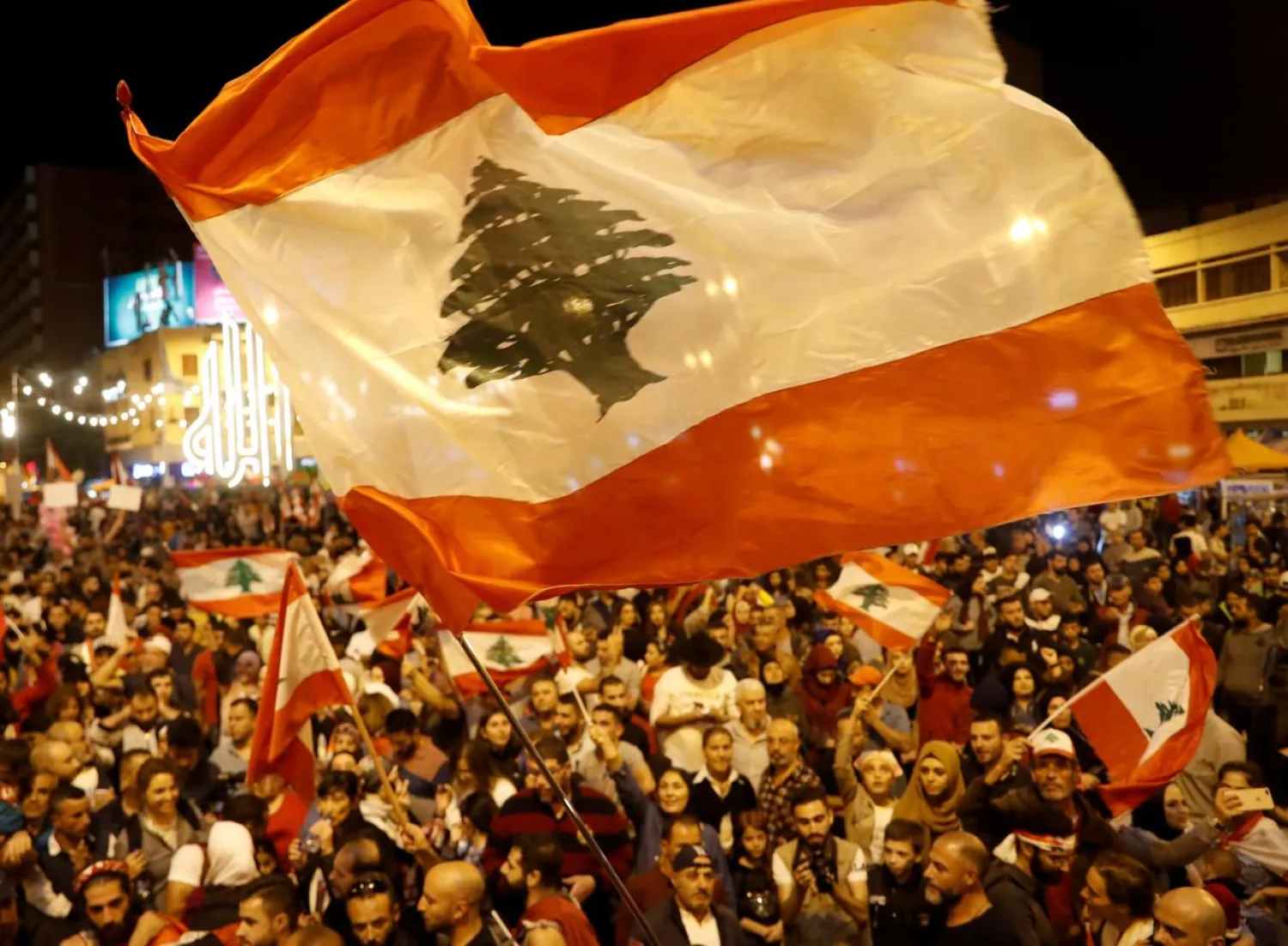
Demonstrators wave Lebanese flags during a protest in Tripoli, Lebanon, November 2, 2019. (Reuters)
TT

Fuel Shortage, Price Hikes Squeeze Protest-Hit Lebanon

Demonstrators wave Lebanese flags during a protest in Tripoli, Lebanon, November 2, 2019. (Reuters)

A rationing of dollars by banks in protest-hit Lebanon sparked growing alarm on Saturday as some petrol pumps ran dry and grocery stores introduced fresh price hikes.

For two decades, the Lebanese pound has been pegged to the greenback and both currencies used interchangeably in daily life.

But banks have gradually been reducing access to dollars since the end of the summer, following fears of a shortage in central bank reserves.

Access was limited further this week after banks reopened for the first time since an unprecedented popular uprising hit the country on October 17.

On Saturday, several petrol stations stopped services as reserves ran out because of a shortage of dollars needed to pay for imports, a syndicate head said.

"The petrol stations that opened today are the ones that still have reserves. They will close down as soon as supply runs out," said Sami Brax, the head of the Syndicate of Gas Station Owners.

He said if officials do not facilitate access to dollars by Tuesday, "we will be forced to stop imports and close down all petrol stations."

His warning came a day after hospitals threatened to stop receiving patients because of a lack of dollars to pay for medical imports.

Current medical stocks in the country "will not last more than a month", hospital syndicate head Suleiman Haroun said.

Price hikes

Lebanon has seen an unprecedented popular uprising against everything from power cuts and poor social security to state corruption.

The government yielded to popular pressure and stepped down last month, with the World Bank urging the quick formation of a new cabinet to prevent the economy from further deteriorating.

But the country seemed to plunge deeper into economic crisis after banks reopened this week and further limited dollar supply.

They halted all ATM withdrawals in dollars, introduced an additional charge on dollar withdrawals made at banks, and severely restricted conversions from Lebanese pounds.

This has forced many people to resort to the black market where they are charged higher exchange rates, in what amounts to the de-facto devaluation of the local currency.

The official exchange rate has remained fixed at 1,507 Lebanese pounds to the dollar, but the rate in the parallel market has surpassed 1,800.

According to Zouhair Berro, the head of the Lebanese Consumers Association, the dollar shortage is leading to price hikes, especially for meat, vegetables and dairy.

He said that suppliers are demanding payment in dollars.

Economist Naseeb Gharbeel said that banks are being put "under pressure" due to a large demand for dollars from Lebanese inside the country and abroad.

'Guarantee a future'

President Michel Aoun met central bank governor Riad Salameh and representatives from the Lebanese Association of Banks on Saturday to discuss the situation, according to the state-run National News Agency.

The meeting came as hundreds took part in student-led demonstrations across the country to pressure the government into meeting their demands.

The rallies have gained new momentum after pupils and university students boycotted lessons in recent days to spearhead the street movement.

“We want to guarantee a future for ourselves," said Mohammad, an 18-year-old high-school student.

"I shouldn't be forced to leave the country after I graduate to find a job," he said from a protest square in central Beirut.

"The current political class is not capable of providing this."

Even before protests erupted last month, growth in Lebanon had stalled following repeated political deadlocks in recent years, compounded by the war in Syria.

Public debt stood at more than $86 billion, over 150 percent of gross domestic product, according to the finance ministry.

Moody's ratings agency this week downgraded Lebanon's sovereign debt, saying the anti-government protests had hit investor confidence and threatened economic stability.

The World Bank had forecast a contraction of 0.2 percent before the turmoil, but has said that it now expects Lebanon's recession "to be even more significant".

Without quick steps to address the crisis, about half of Lebanon's population could fall into poverty and unemployment could "rise sharply", the lender said.
Israel Military Says Soldier Killed in Gaza 

A drone view shows the destruction in a residential neighborhood, after the withdrawal of the Israeli forces from the area, amid a ceasefire between Israel and Hamas in Gaza, in Gaza City, October 21, 2025. (Reuters)
TT

Israel Military Says Soldier Killed in Gaza 

A drone view shows the destruction in a residential neighborhood, after the withdrawal of the Israeli forces from the area, amid a ceasefire between Israel and Hamas in Gaza, in Gaza City, October 21, 2025. (Reuters)

The Israeli military announced that one of its soldiers had been killed in combat in southern Gaza on Wednesday, but a security source said the death appeared to have been caused by "friendly fire".

"Staff Sergeant Ofri Yafe, aged 21, from HaYogev, a soldier in the Paratroopers Reconnaissance Unit, fell during combat in the southern Gaza Strip," the military said in a statement.

A security source, however, told AFP that the soldier appeared to have been "killed by friendly fire", without providing further details.

"The incident is still under investigation," the source added.

The death brings to five the number of Israeli soldiers killed in Gaza since a ceasefire took effect on October 10.


Syria: SDF’s Mazloum Abdi Says Implementation of Integration Deal May Take Time

People sit outdoors surrounded by nature, with the Tigris river flowing in the background, following a long atmospheric depression, near the Syrian-Turkish border in Derik, Syria, February 16, 2026 REUTERS/Orhan Qereman
TT

Syria: SDF’s Mazloum Abdi Says Implementation of Integration Deal May Take Time

People sit outdoors surrounded by nature, with the Tigris river flowing in the background, following a long atmospheric depression, near the Syrian-Turkish border in Derik, Syria, February 16, 2026 REUTERS/Orhan Qereman

Mazloum Abdi, commander of the Syrian Democratic Forces, said the process of merging the SDF with Syrian government forces “may take some time,” despite expressing confidence in the eventual success of the agreement.

His remarks came after earlier comments in which he acknowledged differences with Damascus over the concept of “decentralization.”

Speaking at a tribal conference in the northeastern city of Hasakah on Tuesday, Abdi said the issue of integration would not be resolved quickly, but stressed that the agreement remains on track.

He said the deal reached last month stipulates that three Syrian army brigades will be created out of the SDF.

Abdi added that all SDF military units have withdrawn to their barracks in an effort to preserve stability and continue implementing the announced integration agreement with the Syrian state.

He also emphasized the need for armed forces to withdraw from the vicinity of the city of Ayn al-Arab (Kobani), to be replaced by security forces tasked with maintaining order.


Israeli Far-Right Minister to Push for ‘Migration’ of West Bank, Gaza Palestinians 

A Palestinian man checks leather belts as people prepare for Ramadan, in the old city of Hebron in the Israeli-occupied West Bank, February 17,2026. (Reuters)
TT

Israeli Far-Right Minister to Push for ‘Migration’ of West Bank, Gaza Palestinians 

A Palestinian man checks leather belts as people prepare for Ramadan, in the old city of Hebron in the Israeli-occupied West Bank, February 17,2026. (Reuters)

Israel's far-right Finance Minister Bezalel Smotrich said he would pursue a policy of "encouraging the migration" of Palestinians from the occupied West Bank and Gaza Strip, Israeli media reported Wednesday.

"We will eliminate the idea of an Arab terror state," said Smotrich, speaking at an event organized by his Religious Zionism Party late on Tuesday.

"We will finally, formally, and in practical terms nullify the cursed Oslo Accords and embark on a path toward sovereignty, while encouraging emigration from both Gaza and Judea and Samaria.

"There is no other long-term solution," added Smotrich, who himself lives in a settlement in the West Bank.

Since last week, Israel has approved a series of measures backed by far-right ministers to tighten control over the West Bank, including in areas administered by the Palestinian Authority under the Oslo Accords, in place since the 1990s.

The measures include a process to register land in the West Bank as "state property" and facilitate direct purchases of land by Jewish Israelis.

The measures have triggered widespread international outrage.

On Tuesday, the UN missions of 85 countries condemned the measures, which critics say amount to de facto annexation of the Palestinian territory.

"We strongly condemn unilateral Israeli decisions and measures aimed at expanding Israel's unlawful presence in the West Bank," they said in a statement.

"Such decisions are contrary to Israel's obligations under international law and must be immediately reversed.

"We underline in this regard our strong opposition to any form of annexation."

UN Secretary-General Antonio Guterres on Monday called on Israel to reverse its land registration policy, calling it "destabilizing" and "unlawful".

The West Bank would form the largest part of any future Palestinian state. Many on Israel's religious right view it as Israeli land.

Israeli NGOs have also raised the alarm over a settlement plan signed by the government which they say would mark the first expansion of Jerusalem's borders into the occupied West Bank since 1967.

The planned development, announced by Israel's Ministry of Construction and Housing, is formally a westward expansion of the Geva Binyamin, or Adam, settlement situated northeast of Jerusalem in the West Bank.

The current Israeli government has fast-tracked settlement expansion, approving a record 52 settlements in 2025.

Excluding Israeli-annexed east Jerusalem, more than 500,000 Israelis live in West Bank settlements and outposts, which are illegal under international law.
