


Balotelli Returned to Italy with Hope. It Has Been Crushed Again by Racism

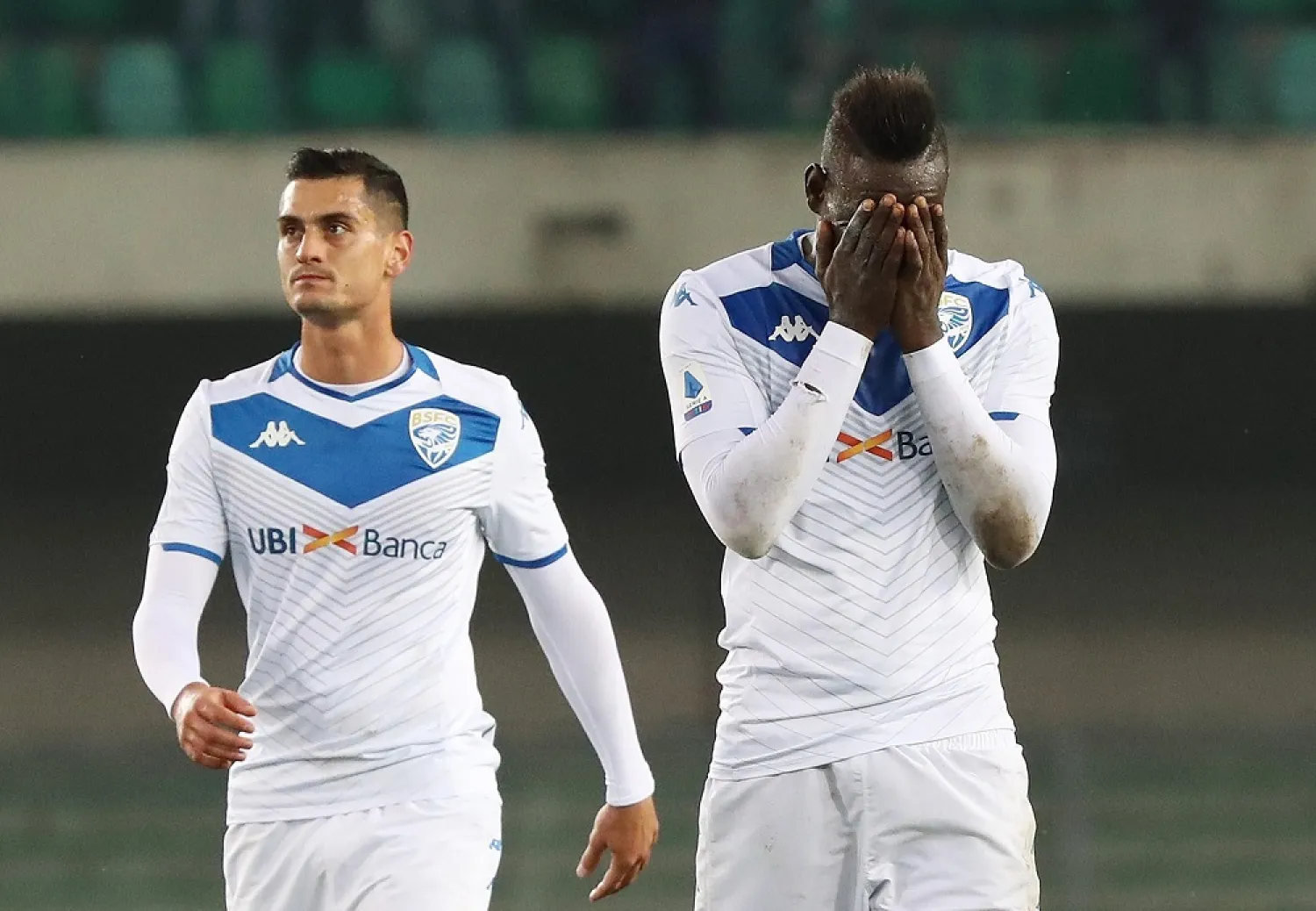
Brescia's Mario Balotelli, right, reacts at the end of the Italian Serie A match between Verona and Brescia at the Bentegodi stadium in Verona, Italy, Sunday, Nov. 3, 2019. (AP)
TT

Balotelli Returned to Italy with Hope. It Has Been Crushed Again by Racism

Brescia's Mario Balotelli, right, reacts at the end of the Italian Serie A match between Verona and Brescia at the Bentegodi stadium in Verona, Italy, Sunday, Nov. 3, 2019. (AP)

“You can’t delete racism. It’s like a cigarette. You can’t stop smoking if you don’t want to, and you can’t stop racism if people don’t want to.”

Six years have passed since Mario Balotelli spoke those words in an interview with Sports Illustrated. He was on top of the world, Italy’s No. 9 and fresh from a triumphant half-season at Milan. Signed from Manchester City during the January transfer window, he had scored 12 times in 13 games, carrying Milan to third place.

The magazine’s front cover depicted him walking on water. Yet even when so much seemed possible for the striker whose goals had obliterated Germany at Euro 2012, Balotelli acknowledged his powerlessness to stop football fans in his home country from abusing him for the color of his skin.

Returning to Italy this summer, after stints away at Liverpool, Nice and Marseille, he wondered if things had changed. “I hope with all my heart there won’t be any repeat of the things that happened when I was last here,” he said after signing for Brescia. “I hope Italy has taken some steps forward.”

He was destined to be disappointed. The Serie A season has witnessed several instances of players being racially abused, from Romelu Lukaku at Cagliari to Dalbert at Atalanta and Ronaldo Vieira during a home game for Sampdoria against Roma.

Balotelli was the target for monkey chants during Brescia’s game at Verona. In the 55th minute, he responded. Fighting to keep the ball in play down by the corner flag, Balotelli turned suddenly and lashed it up towards supporters.

Chaos ensued. The referee, Maurizio Mariani, booked Balotelli for unsportsmanlike behavior. Balotelli threatened to walk off. Players from both teams intervened, talking Balotelli down while also informing officials of the abuse he had received. Mariani waved off the yellow card and suspended the game, instructing the stadium announcer to warn fans it would be abandoned if the chants continued.

After a delay of almost five minutes, play resumed. Verona, already leading through a goal from Eddie Salcedo, extended their advantage through Matteo Pessina. Balotelli responded with a spectacular strike from the edge of the D, struck first time off his right instep into the top corner. It was not enough to rescue Brescia from a 2-1 defeat.

The situation only got worse after the final whistle, when the Verona manager, Ivan Juric, flatly denied any racist abuse had taken place. “I’m not afraid to say that nothing happened,” he said. “There was loud whistling and mockery but no racist chant. There was nothing. I am a Croatian and I hear ‘Gypsy piece of shit’ sometimes because unfortunately that is the tendency in Italy but today there was nothing.”

What possessed him to take such a hard line only he can know. In any case, he was wrong. Juric might not have heard the monkey chants but several of his players did and they were plainly audible on a fan-shot video that circulated on Sunday evening.

This has too often been the default mode for clubs whose fans stand accused of racist chanting: to mount an aggressive defense first – often calling into question the integrity of the victim – and ascertain the facts of what happened later. The Verona president, Maurizio Setti, supported his manager’s line, claiming his team’s supporters were simply “sarcastic, not racist”.

Verona will likely be punished. The independent observer sent to monitor this game heard the racist chants and included them in the official report – something that did not happen when Lukaku and Dalbert were verbally abused and which should allow the sporting justice greater scope for punishment.

Still, there are ambiguities that make the verdict hard to predict. According to La Gazzetta dello Sport, the observer only ascribed the monkey chants to a group of about 15 fans. Balotelli was booed and whistled by many more but we are into murky territory. What constitutes racist abuse rather than jeering of an opponent?

Regardless of the outcome, the discouraging thought is that once again nothing will change. This was a weekend when Roma’s game against Napoli was also suspended in response to territorial discrimination from Roma’s ultras. The initial warning from the stadium announcer was roundly ignored. Only the intervention of Edin Dzeko, encouraging fans to drown out the chants with cheers, seemed to get things back on track.

Balotelli’s assessment that you cannot force people not to be racist rings as true as ever. On the other hand, Italian football cannot absolve itself of responsibility. Clubs in other countries do a far more effective job of identifying individuals who engage in racist chanting and keeping them out of the stands.

This is a slow process and even with maximum commitment could not be achieved overnight. It is hard to see how it will ever happen at clubs whose first instinct is to accuse a victim of making it up.

The Guardian Sport


Shakhtar Boss Pays Ukrainian Racer $200,000 After Games Disqualification

Ukrainian President Volodymyr Zelenskiy holds helmet as he meets with a Ukrainian skeleton racer Vladyslav Heraskevych , who was disqualified from the Olympic skeleton competition over his "helmet of remembrance" depicting athletes killed since Russia's invasion and his father and coach, Mykhailo Heraskevych, amid Russia's attack on Ukraine, in Munich, Germany February 13, 2026. (Ukrainian Presidential Press Service/Handout via Reuters)
TT

Shakhtar Boss Pays Ukrainian Racer $200,000 After Games Disqualification

Ukrainian President Volodymyr Zelenskiy holds helmet as he meets with a Ukrainian skeleton racer Vladyslav Heraskevych , who was disqualified from the Olympic skeleton competition over his "helmet of remembrance" depicting athletes killed since Russia's invasion and his father and coach, Mykhailo Heraskevych, amid Russia's attack on Ukraine, in Munich, Germany February 13, 2026. (Ukrainian Presidential Press Service/Handout via Reuters)

The owner of ‌Ukrainian football club Shakhtar Donetsk has donated more than $200,000 to skeleton racer Vladyslav Heraskevych after the athlete was disqualified from the Milano Cortina Winter Games before competing over the use of a helmet depicting Ukrainian athletes killed in the war with Russia, the club said on Tuesday.

The 27-year-old Heraskevych was disqualified last week when the International Bobsleigh and Skeleton Federation jury ruled that imagery on the helmet — depicting athletes killed since Russia invaded Ukraine in 2022 — breached rules on athletes' expression at ‌the Games.

He ‌then lost an appeal at the Court ‌of ⁠Arbitration for Sport hours ⁠before the final two runs of his competition, having missed the first two runs due to his disqualification.

Heraskevych had been allowed to train with the helmet that displayed the faces of 24 dead Ukrainian athletes for several days in Cortina d'Ampezzo where the sliding center is, but the International Olympic Committee then ⁠warned him a day before his competition ‌started that he could not wear ‌it there.

“Vlad Heraskevych was denied the opportunity to compete for victory ‌at the Olympic Games, yet he returns to Ukraine a ‌true winner," Shakhtar President Rinat Akhmetov said in a club statement.

"The respect and pride he has earned among Ukrainians through his actions are the highest reward. At the same time, I want him to ‌have enough energy and resources to continue his sporting career, as well as to fight ⁠for truth, freedom ⁠and the remembrance of those who gave their lives for Ukraine," he said.

The amount is equal to the prize money Ukraine pays athletes who win a gold medal at the Games.

The case dominated headlines early on at the Olympics, with IOC President Kirsty Coventry meeting Heraskevych on Thursday morning at the sliding venue in a failed last-minute attempt to broker a compromise.

The IOC suggested he wear a black armband and display the helmet before and after the race, but said using it in competition breached rules on keeping politics off fields of play. Heraskevych also earned praise from Ukraine President Volodymyr Zelenskiy.


Speed Skating-Italy Clinch Shock Men’s Team Pursuit Gold, Canada Successfully Defend Women’s Title

 Team Italy with Davide Ghiotto, Andrea Giovannini, Michele Malfatti, celebrate winning the gold medal on the podium of the men's team pursuit speed skating race at the 2026 Winter Olympics, in Milan, Italy, Tuesday, Feb. 17, 2026. (AP)
Team Italy with Davide Ghiotto, Andrea Giovannini, Michele Malfatti, celebrate winning the gold medal on the podium of the men's team pursuit speed skating race at the 2026 Winter Olympics, in Milan, Italy, Tuesday, Feb. 17, 2026. (AP)
TT

Speed Skating-Italy Clinch Shock Men’s Team Pursuit Gold, Canada Successfully Defend Women’s Title

 Team Italy with Davide Ghiotto, Andrea Giovannini, Michele Malfatti, celebrate winning the gold medal on the podium of the men's team pursuit speed skating race at the 2026 Winter Olympics, in Milan, Italy, Tuesday, Feb. 17, 2026. (AP)
Team Italy with Davide Ghiotto, Andrea Giovannini, Michele Malfatti, celebrate winning the gold medal on the podium of the men's team pursuit speed skating race at the 2026 Winter Olympics, in Milan, Italy, Tuesday, Feb. 17, 2026. (AP)

An inspired Italy delighted the home crowd with a stunning victory in the Olympic men's team pursuit final as

Canada's Ivanie Blondin, Valerie Maltais and Isabelle Weidemann delivered another seamless performance to beat the Netherlands in the women's event and retain their title ‌on Tuesday.

Italy's ‌men upset the US who ‌arrived ⁠at the Games ⁠as world champions and gold medal favorites.

Spurred on by double Olympic champion Francesca Lollobrigida, the Italian team of Davide Ghiotto, Andrea Giovannini and Michele Malfatti electrified a frenzied arena as they stormed ⁠to a time of three ‌minutes 39.20 seconds - ‌a commanding 4.51 seconds clear of the ‌Americans with China taking bronze.

The roar inside ‌the venue as Italy powered home was thunderous as the crowd rose to their feet, cheering the host nation to one ‌of their most special golds of a highly successful Games.

Canada's women ⁠crossed ⁠the line 0.96 seconds ahead of the Netherlands, stopping the clock at two minutes 55.81 seconds, and

Japan rounded out the women's podium by beating the US in the Final B.

It was only Canada's third gold medal of the Games, following Mikael Kingsbury's win in men's dual moguls and Megan Oldham's victory in women's freeski big air.


Lindsey Vonn Back in US Following Crash in Olympic Downhill 

Milano Cortina 2026 Olympics - Alpine Skiing - Women's Downhill 3rd Official Training - Tofane Alpine Skiing Centre, Belluno, Italy - February 07, 2026. Lindsey Vonn of United States in action during training. (Reuters)
TT

Lindsey Vonn Back in US Following Crash in Olympic Downhill 

Milano Cortina 2026 Olympics - Alpine Skiing - Women's Downhill 3rd Official Training - Tofane Alpine Skiing Centre, Belluno, Italy - February 07, 2026. Lindsey Vonn of United States in action during training. (Reuters)

Lindsey Vonn is back home in the US following a week of treatment at a hospital in Italy after breaking her left leg in the Olympic downhill at the Milan Cortina Games.

“Haven’t stood on my feet in over a week... been in a hospital bed immobile since my race. And although I’m not yet able to stand, being back on home soil feels amazing,” Vonn posted on X with an American flag emoji. “Huge thank you to everyone in Italy for taking good care of me.”

The 41-year-old Vonn suffered a complex tibia fracture that has already been operated on multiple times following her Feb. 8 crash. She has said she'll need more surgery in the US.

Nine days before her fall in Cortina d'Ampezzo, Italy, Vonn ruptured the ACL in her left knee in another crash in Switzerland.

Even before then, all eyes had been on her as the feel-good story heading into the Olympics for her comeback after nearly six years of retirement.
