


Oil Prices Fluctuate, Impacted by Global Economy Slowdown

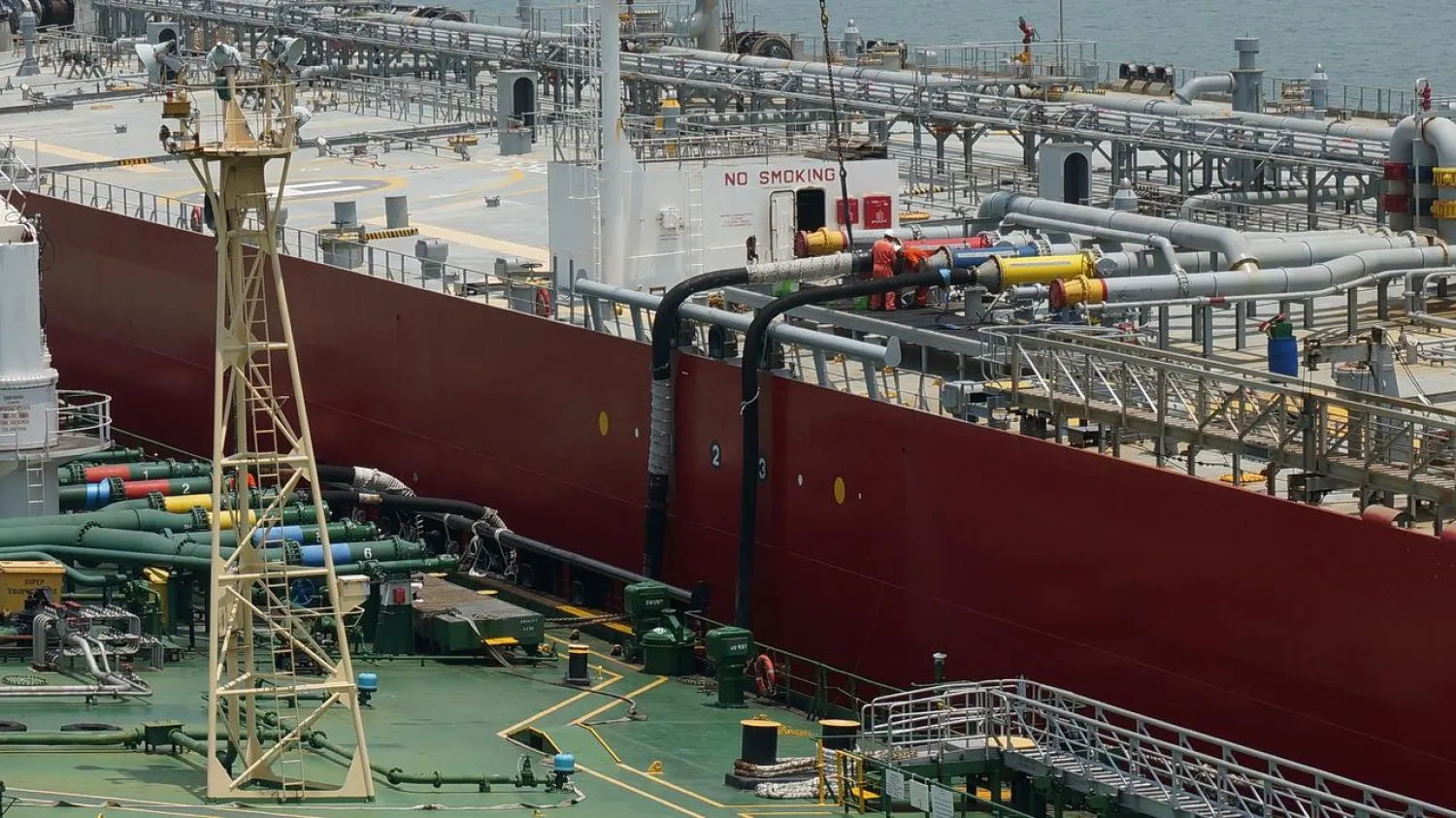
An oil tanker for blending to reproduce low-sulphur fuel oil with half-finished products of SK Trading International is seen during a marine blending at the sea off Singapore, September 20, 2018. (Reuters)
TT

Oil Prices Fluctuate, Impacted by Global Economy Slowdown

An oil tanker for blending to reproduce low-sulphur fuel oil with half-finished products of SK Trading International is seen during a marine blending at the sea off Singapore, September 20, 2018. (Reuters)

Oil prices returned to the normal with the end of the first week of November due to concerns over the growth of the global economy and the increase of oil supply. The last trading of Brent crude was at USD62.5 per barrel, which is a rise of 16.2 percent since the beginning of the year.

The trading relapsed from its highest score in four weeks on November 5, when it reached approximately USD63 per barrel.

The National Bank of Kuwait (NBK) issued a report revealing that the whole indicators rose for three days due to signs of progress in the US-Sino commercial ties. It is possible to reach a commercial agreement in credit to the positive number of US jobs and manufacturing data.

These reports also noted that it is unlikely for OPEC+ to push towards more output cut during the ministerial meeting scheduled in December. This followed OPEC forecasts that the demand for global oil would grow 1 million barrels per day in the mid-term. US shale oil would rise sharply by 40 percent by 2025.

Further, the International Monetary Fund (IMF) and the International Energy Agency (IEA) reduced their forecasts for the global economy growth and the global demand for oil in October.

The IMF cited rising trade barriers and increased geopolitical and trade uncertainty among the factors driving a “synchronized” global slowdown that left growth in 2019 at 3.0 percent - the slowest since the financial crisis more than ten years ago. Projected economic growth in 2020 was reduced by 0.2 percent points to 3.4 percent.

The IEA reduced its estimates for 2019 by 65,000 barrels a day to growth of 1m bpd in its monthly oil market report. For 2020 it fell by 110,000 bpd to 1.2m bpd.

“We expect growth in 2019 to be the weakest since 2016, following evidence of a slowdown in several major consumer regions and countries, including Europe, India, Japan, South Korea and the US,” the IEA said.

Non-OPEC supply growth, led by robust US shale growth, dominates the supply outlook, helping to offset the cutbacks in production that OPEC+ orchestrated this year.

US crude production reached a historic high of 12.6m bpd in October. The IEA sees US crude oil production alone increasing by 1.2m bpd in 2019 and 0.9m bpd in 2020, which accounts for at least 75 percent of the crude that OPEC+ removed from the market.



Four Saudi Companies Sign Agreements to Develop Syrian Oil and Gas Fields 

Saudi and Syrian officials are seen at Tuesday's signing ceremony. (SANA)
TT

Four Saudi Companies Sign Agreements to Develop Syrian Oil and Gas Fields 

Saudi and Syrian officials are seen at Tuesday's signing ceremony. (SANA)

Under the supervision and follow-up of the Saudi Ministry of Energy, four Saudi companies, TAQA, ADES Holding, Arabian Drilling, and the Arabian Geophysical and Surveying Company (ARGAS), signed on Tuesday agreements with the Syrian Petroleum Company covering services, technical support, and the development of oil and gas fields in Syria.

The agreements build on the ongoing cooperation between Saudi Arabia and Syria in the energy sector. They come within the framework of implementing the memoranda of understanding signed on August 28 and the subsequent technical workshops and field visits to gas fields and associated facilities, reported the Saudi Press Agency.

Tuesday’s deals include an agreement between ADES Holding and the Syrian Petroleum Company that sets out the basic principles for the development, operation, and production of gas fields. It defines the core terms that will form the basis of a final technical services contract to develop and operate gas fields and associated facilities within the designated contract area.

The agreement aims to increase production across five gas fields, Abu Rabah, Qamqam, North Al-Faydh, Al-Tiyas, and Zumlat al-Mahar, as well as any additional areas agreed upon at a later stage.

The second deal is a master service agreement between TAQA and the Syrian Petroleum Company to provide advanced, integrated solutions and services for the construction and maintenance of oil and gas fields and wells in Syria.

The agreement aims to boost operational efficiency and boost production using the latest technologies and state-of-the-art equipment.

Another master service agreement, between ARGAS and the Syrian Petroleum Company, will provide 2D and 3D seismic surveying and related technical services to support exploration and drilling activities.

It establishes a long-term cooperation framework designed to advance petroleum exploration and development in Syria’s energy sector, ensuring rapid response, operational flexibility, and the efficient initiation of technical projects.

The fourth agreement, between Arabian Drilling Company and the Syrian Petroleum Company, calls for the provision of drilling and workover services for oil and gas wells in Syria, including the leasing and operation of onshore drilling and workover rigs.

Arabian Drilling will supply the drilling and workover rigs, deliver workover operations and operational support, and provide workforce training and development.


Egypt’s Inflation Eases to 12.3% in November 

Boats sail on the Nile River in Cairo, Egypt, December 9, 2025. (Reuters)
TT

Egypt’s Inflation Eases to 12.3% in November 

Boats sail on the Nile River in Cairo, Egypt, December 9, 2025. (Reuters)

Egypt's annual urban consumer inflation slowed slightly to 12.3% in November after a month-on-month drop in food prices, statistics agency CAPMAS said on Wednesday, with inflation coming in lower than analyst expectations.

The median forecast in a poll of 14 analysts had been for inflation to climb to 13.1%. The urban consumer inflation rate in October was 12.5%.

Month-on-month, urban consumer prices rose by 0.3% in November, CAPMAS said. Food and beverage prices rose by an annual 0.7% but fell by a monthly 2.6%, it said.

The annual inflation rate has plunged from a record 38% in September 2023, helped by an $8 billion financial support package from the International Monetary Fund in March 2024.

Inflation has been in part fueled by an expanding money supply. M2 money supply grew by an annual 21.68% in October, central bank data showed.

The central bank's monetary policy committee left its overnight lending rate unchanged at its last meeting on November 20, but cut rates by 100 basis points in October and 200 points in August as inflation slowed.

The policy committee is next scheduled to review overnight interest rates at a meeting on December 25.


Egypt, Israel in Advanced Talks to Approve Israeli $35 Billion Gas Agreement

Israeli Energy Minister Eli Cohen and US Ambassador Mike Huckabee visiting the Leviathan platform in October. (Israeli Energy Ministry)
TT

Egypt, Israel in Advanced Talks to Approve Israeli $35 Billion Gas Agreement

Israeli Energy Minister Eli Cohen and US Ambassador Mike Huckabee visiting the Leviathan platform in October. (Israeli Energy Ministry)

Israel’s Ministry of Energy announced on Tuesday that negotiations over a natural gas supply agreement with Egypt have reached an “advanced stage,” though some issues remain unresolved.

Israel signed its largest-ever export deal in August to supply Egypt with up to $35 billion worth of natural gas from the Leviathan field.

After marathon discussions this week between the Leviathan partners and Israel’s Ministry of Energy and Infrastructure, a final agreement was reached that will allow the export of 130 BCM (billion cubic meters) to Egypt for $35 billion, the largest export agreement in the country's history.

Israel's Energy Minister Eli Cohen has said he was holding up approval for the gas deal to secure better commercial terms for the Israeli market, according to Reuters. On Tuesday, he confirmed that talks were still ongoing.

As part of the agreement, the Leviathan Partners, NewMed Energy, Chevron and Ratio Petroleum Energy, will commit to a guaranteed price for the domestic economy, to give priority to the Israeli economy, so that if there are any malfunctions in the Tanin, Karish or Tamar fields, it will transfer gas directly to the local economy.

One of the issues that senior Washington officials have been dealing with is ensuring that US energy major Chevron, which owns 39.66% of Leviathan, remains committed to the deal.

The partners are expected to make an investment decision to expand the Leviathan field infrastructure withing two weeks, once the Israeli government announces its final approval.