


In Iran: Talk About It but Don’t Mention Its Name

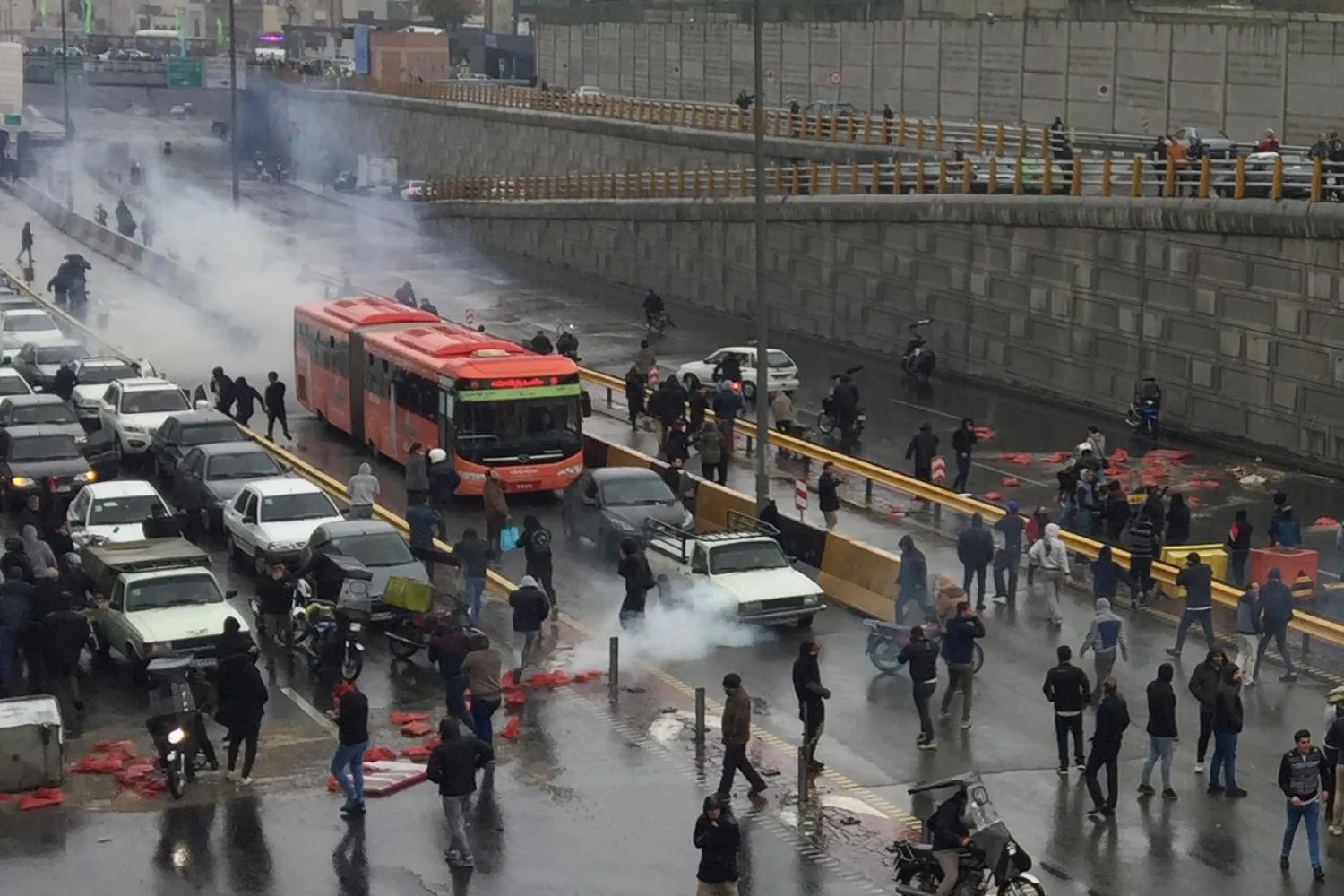
FILE PHOTO: People protest against increased gas price, on a highway in Tehran, Iran November 16, 2019. Nazanin Tabatabaee/WANA (West Asia News Agency) via REUTERS
TT

In Iran: Talk About It but Don’t Mention Its Name

FILE PHOTO: People protest against increased gas price, on a highway in Tehran, Iran November 16, 2019. Nazanin Tabatabaee/WANA (West Asia News Agency) via REUTERS

How would you get a book on censorship published in a country with one of the world’s toughest censorship systems?

This is the question that Shahrokh Tondro-Saleh and Goel Cohen faced as they took up the challenge of studying censorship in the Islamic Republic in Iran- a task as pleasant as walking on burning coal.

The first thing they did was to censor the very word “censorship” from the title and subtitle of their hook. As a result, we have a book with a title like this: “Phenomenology of …” And the subtitle like this: “Study of aspects of … in mass media.”

The “…..” in both cases replaces the unmentionable word “censorship” which the Tehran government claims does not exist in the Islamic Republic.

This is a slim book, in fact only 227 pages, but in this opinion at least, it is one of the best studies on the subject in recent years.

The book takes the form of an interview in which Tondro-Saleh, a researcher in media matters, questions Goel Cohen, a professor of mass media and a leading historian of the Iranian press.

To throw Khomeinist censors off the scent, they use yet another tactic. They devote some space to recalling censorship in Iran before the mullahs seized power, and in a number of other countries, notably the now-defunct Soviet Union. Without saying so in so many words, Professor Cohen shows that the censorship as practiced in the Islamic Republic today is far more pernicious than it was under the Shah or even in the USSR.

One key feature of the media in Iran today is the ambiguity surrounding its ownership. Under the Shah, the state-owned and controlled the “big media”, that is to say, radio and TV networks (with a few minor exceptions).

The printed press, however, was privately owned, and, thus, forced to keep an eye on readership providing its chief source of income. That created a tension between the newspapers that tried to stretch the rules as far as they could and the state that tried to enforce the rules as strictly as possible.

In the words of Abdul-Rahman Faramarzi, one of the founding fathers of the modern press in Iran, under the Shah, journalists faced two kinds of censorship: that of “ write this!” and that of “don’t write that!”.

A privately-owned press was better able to avoid the “write this!” censorship by dodging or doctoring state-produced texts imposed on them. When it came to the “don’t write that!’ type of censorship, too, a privately owned press could circumvent the ban in numerous ways depending on how many “ tricks of the trade” journalists could master.

Under the mullahs, however, the private part of the Iranian media has all but disappeared.

To be sure, some publications are supposedly owned by individuals and/or groups or individuals. For example, Eshaq Jahangiri, President Hassan Rouhani’s First Assistant, is billed as the owner of several newspapers and magazines. And, yet, a closer examination of the sources of capital for those publications quickly reveals a different picture with state-owned banks, companies linked to various ministries or the Islamic Revolutionary Guard Corps, providing the funds and exercising ultimate control.

That ambiguity in ownership has huge consequences. The media concerned are no longer essentially concerned about readership or audiences as sources of revenue. Their chief concern is to promote a political agenda in support of this or that faction in the context of the power struggle in Tehran. That, in turn, creates a new level of censorship, beyond the censorship imposed by the state as a whole, designed to protect the faction in question while harming its rivals.

Another big difference is the blurring, not to say almost total disappearance, of demarcation lines between journalism and politics. Under the Shah, some individuals did use journalism as a shortcut to apolitical career and many journalists remained on state payroll in fictitious official positions. Nevertheless, the main press corps were recognized as a distinct profession and thus more likely to defend its own patch against outside encroachment including through censorship.

Under the mullahs, however, journalism is often little more than a passage from one political career to another.

For example, someone like Saeed Hajjarian, a leading theoretician of the “reform seeking” faction has been a reporter, an interrogator of political prisoners, a security service analyst, a presidential adviser and a columnist for several dailies.

However, according to Professor Cohen, the biggest problem with censorship in Iran today is the unreliability of any rules imposed at any given time. “This puts the journalist in a state of uncertainty, akin to dying each day,” Cohen says. “He could never decide whether what he could write today would be admissible tomorrow as well.”

Periodical anti-media campaigns that lead to arrests, expulsions, enforced exile, and, in some cases, even assassinations, reinforce that feeling of uncertainty. In many instances, self-censorship becomes the norm as a defense mechanism against uncertainty.

Finally, according to Cohen, censorship in the Islamic Republic has the added feature of being exercised on behalf of both politics and religion.

“By definition, the Islamic Republic is an absolutist theological construct,” Cohen says. Thus, one could expect it to impose censorship with regard to material judged harmful to the doctrine, or at least the kerygma, of the Islamic faith. However, the problem is that the representation that the Islamic Republic makes of the faith it professes is in almost constant flux; what is regarded as licit could become illicit in a few hours and a man hailed as a model of piety today could be hanged as an infidel tomorrow.

In many cases, the regime’s political interests, real or imagined, often trump its religious concerns. However, how does the poor journalist know when and how the trumping as happened and what to do with it?

There is no doubt that Cohen and Tondro-Saleh are champions of press freedom, rejecting censorship as an attempt at limiting basic freedoms. Nevertheless, at times, their rather romantic view of journalism as a sacerdotal task rather than a profession leads them to censor what they regard as “yellow journalism” and “muckraking press”.

As examples, they cite a number of pre-Revolution Iranian papers such as “Shafaq Sorkh” (Red Dawn) and Mard-Emrooz” (Man of Today) that offered a banquet of violent sensationalism across the board. Cohen and Tondro-Saleh seem to think that such publications should not be allowed. One could disagree with them as banning a publication on any pretext could become a pretext for censorship and dictatorship.

In 1945, the Shah took “Mard Emrooz” to court for libel dished out in a series of violent articles against him and his family. The case did not come to judgment because the paper’s publisher and Editor-in-Chief Muhammad Massoud was assassinated by a Communist hitman. What is interesting, however, is that the suit brought by the Shah demanded an apology and not the imposition of a ban on the paper’s publication.

Among the many important points that Cohen makes in this seminal work is his clear-sighted observation that wherever and whenever anything called a special Press Law is legislated alarm bells for press freedom should be sounded. Thus, we may assume that the eminent professor isn’t all that happy about the situation in the Islamic Republic which has a Press Law, a Press Court, a Press Licensing System and, as shown by several incidents in the past four decades, a special unit to abduct or even assassinate journalists seen as troublemakers for the regime.


Greece’s Oldest Modern-Era Museum Reopens on the Acropolis After a Major Restoration

Visitors tour the Acropolis, with the old Acropolis Museum on the left and the Parthenon on the right, as Greece's Culture Ministry presents the museum's reopening following renovation and conversion to new uses, in Athens, Greece, Monday, Nov. 23, 2026. (AP)
TT

Greece’s Oldest Modern-Era Museum Reopens on the Acropolis After a Major Restoration

Visitors tour the Acropolis, with the old Acropolis Museum on the left and the Parthenon on the right, as Greece's Culture Ministry presents the museum's reopening following renovation and conversion to new uses, in Athens, Greece, Monday, Nov. 23, 2026. (AP)

A museum that has stood on the Acropolis since 1874, making it the oldest in modern Greece, reopened Monday after a high-tech makeover.

The squat stone building often goes unnoticed by visitors. It had been closed to the public since 2007, three years before the country was plunged into a massive financial crisis.

The seven-year restoration cost 6.2 million euros ($6.8 million), raised through public funds and private donations, Culture Minister Lina Mendoni said.

The site will host ancient artifacts never before exhibited, digital displays tracing the monuments’ 2,500-year history and a viewing gallery where Culture Ministry technicians will carry out restoration work on ancient objects.

The museum opened in 1874, making it the first museum purpose-built since modern Greece gained independence several decades earlier.

It closed in 2007, becoming an administrative building after cranes carefully lowered its renowned sculptures and other masterpieces to the new Acropolis Museum at the foot of the hill.

“For us, it was inconceivable, almost an affront, that this historic building, with its uniquely privileged location, should be converted into offices and storerooms,” Mendoni said.

“We therefore decided that the museum should reopen in accordance with its original purpose,” she said.

The Parthenon and other temples on the Acropolis remain Greece’s most visited ancient site, with more than 4.6 million admissions recorded last year.

Restoration work continues even during the peak summer months. The Parthenon recently shed its heavy scaffolding for the first time in years.

Prime Minister Kyriakos Mitsotakis attended Monday’s inauguration and described the reopening as another milestone for Greece’s cultural heritage.

He used the occasion to restate Greece’s long-running demand for the return of the Parthenon Sculptures held by the British Museum in London.

“The rightful home of these priceless masterpieces is here, beneath the Attic light and in direct proximity to the temple to which they belong,” he said, adding that Greece would not accept the return of the sculptures as a loan.

“No solution and no agreement can be based on the recognition of foreign ownership over our national treasures,” Mitsotakis said.

“I reaffirm my commitment that we will continue this effort with responsibility, seriousness and determination,” he added. “And in the end, we will succeed.”


Saudi Arabia's History, National Heritage Showcased at 'Bridge of Civilizations' Art Exhibition in Cairo

The exhibition features more than 60 visual artists from Saudi Arabia, Egypt, and Russia. (SPA)
TT

Saudi Arabia's History, National Heritage Showcased at 'Bridge of Civilizations' Art Exhibition in Cairo

The exhibition features more than 60 visual artists from Saudi Arabia, Egypt, and Russia. (SPA)

The "Bridge of Civilizations" art exhibition opened in Cairo, highlighting the power of art to foster closer ties between civilizations and peoples, reported the Saudi Press Agency on Monday.

The exhibition features more than 60 visual artists from Saudi Arabia, Egypt, and Russia, with prominent artists and art enthusiasts in attendance.

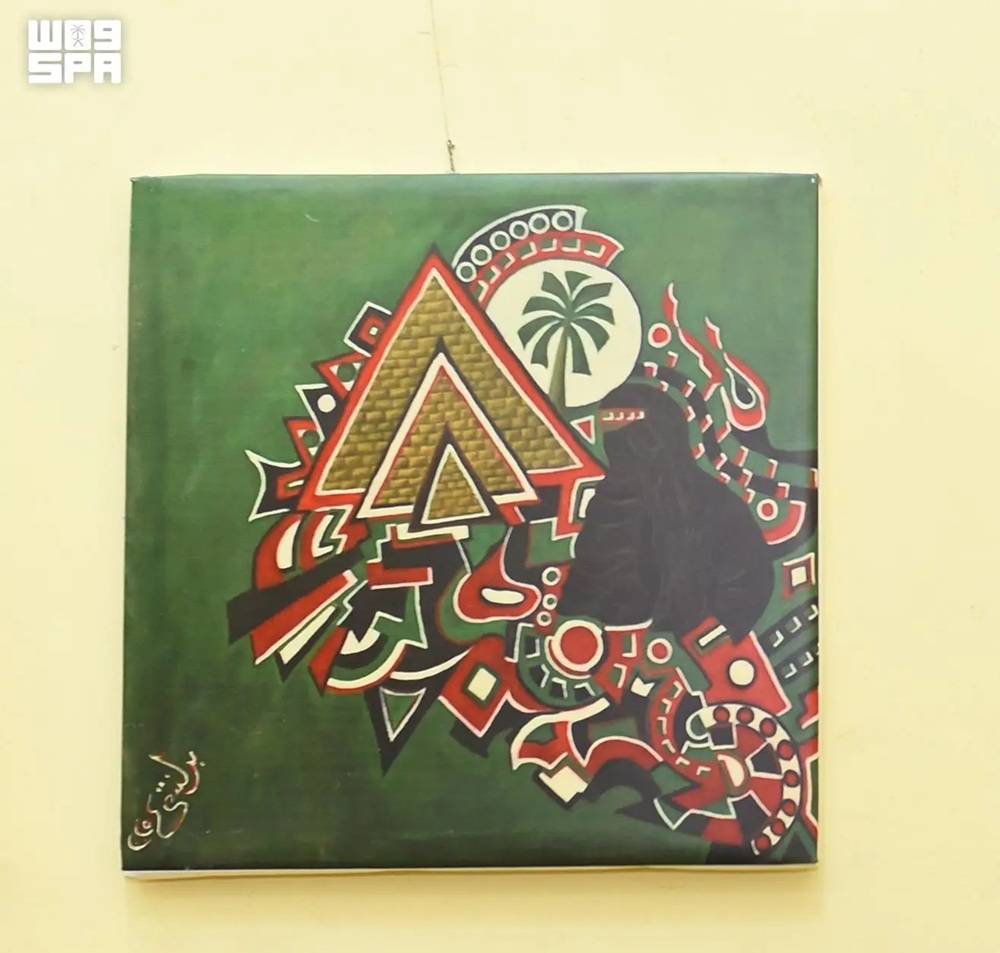
At the three-day exhibition, around 30 Saudi visual artists will present a diverse collection of works highlighting the Kingdom's history, national symbols, and heritage passed down through generations.

An artwork featured at the exhibition in Cairo. (SPA)

The Saudi artists' paintings document Islamic heritage, the Prophet Muhammad's biography, and historical sites associated with the Two Holy Mosques. They also highlight the Kingdom's development achievements, including the Haramain High Speed Railway, as well as its cultural and architectural heritage, such as Najdi Sadu weaving and Al-Masmak Palace.

Participating Saudi artists told SPA that they aim to introduce audiences to the Kingdom's history, identity, and heritage through contemporary artistic approaches while highlighting the development of visual arts in Saudi Arabia.


Red Sea Museum Showcases Jeddah's Black Coral Prayer-Bead Making Heritage

The gallery also features a wall displaying shells, molluscs and pieces of coral from the Red Sea - SPA
TT

Red Sea Museum Showcases Jeddah's Black Coral Prayer-Bead Making Heritage

The gallery also features a wall displaying shells, molluscs and pieces of coral from the Red Sea - SPA

The Red Sea Museum represents a valuable addition to Jeddah's cultural and tourism landscape, offering an educational experience that brings the history of the Red Sea to life and highlights Saudi Arabia’s rich civilization and cultural heritage associated with navigation, trade and Hajj.

As one of Saudi Arabia’s prominent cultural and educational destinations, the museum presents art exhibitions and cultural and educational programs that explore the history and civilization heritage of the Red Sea and document its connection with navigation, trade and human life through experiences that bring together visual arts, architecture, cinema and storytelling, SPA reported.

The Red Sea Museum showcases the craft of prayer-bead making. An identification label accompanying a set of prayer beads made from black coral on display at the museum bears the name of craftsman Ahmed Al-Halabi, who made the beads in Jeddah. The beads tell part of his family's history, as it is one of the oldest families known for this craft in the city.

The gallery also features a wall displaying shells, molluscs and pieces of coral from the Red Sea.

Visitors can observe coral in its natural form before seeing how the craftsman shaped black coral into beads, threaded them together to make a string of prayer beads, and designed them to pass smoothly between the fingers.
