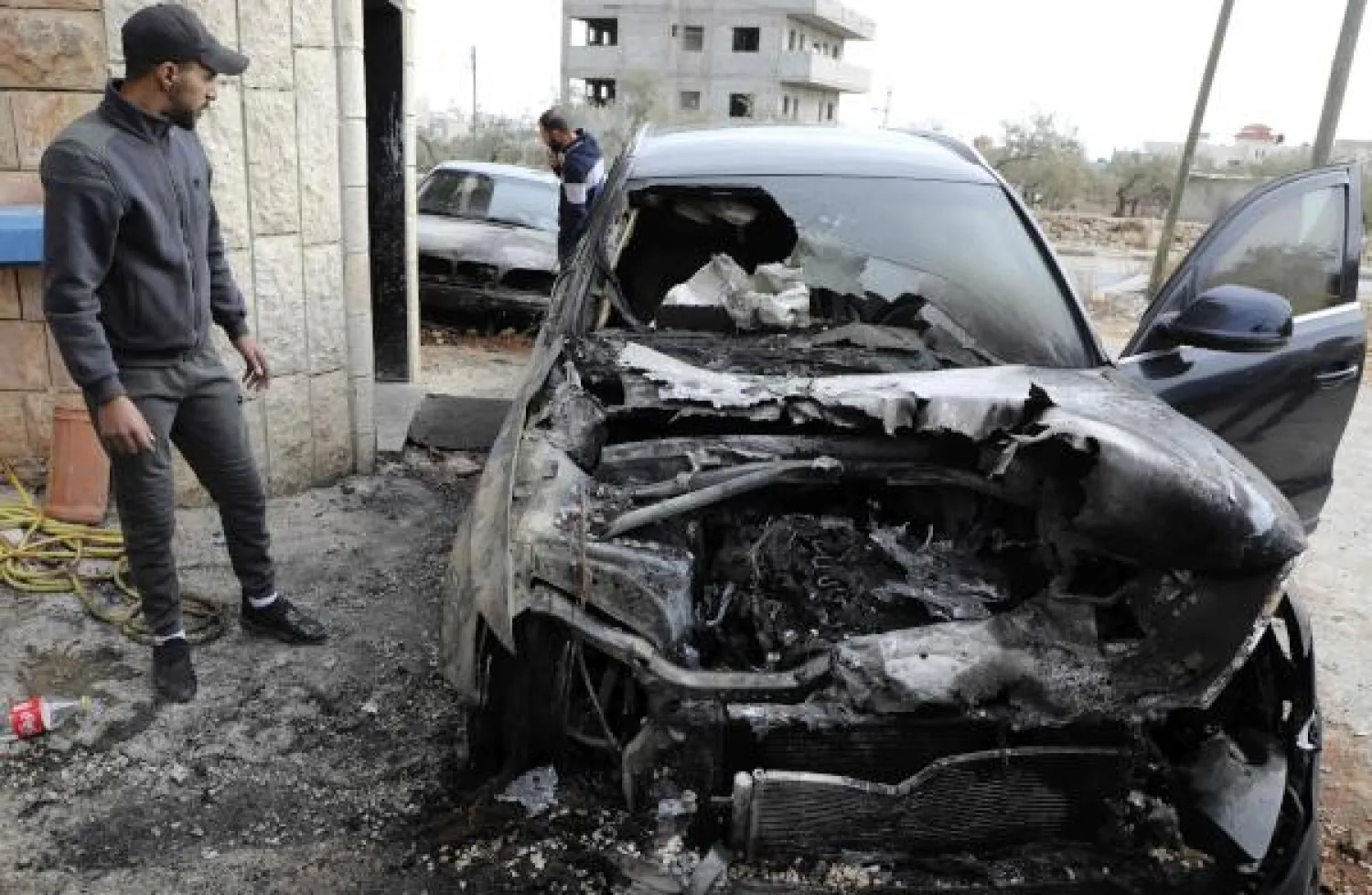
Palestinians: Israeli Settlers Burn Cars in West Bank

A Palestinian man checks burnt cars in the village of Majdal Bani Fadel, south of Nablus in the occupied West Bank, after Israeli settlers reportedly torched vehicles on November 22, 2019. (Photo by Jaafar ASHTIYEH / AFP)
TT

Palestinians: Israeli Settlers Burn Cars in West Bank

A Palestinian man checks burnt cars in the village of Majdal Bani Fadel, south of Nablus in the occupied West Bank, after Israeli settlers reportedly torched vehicles on November 22, 2019. (Photo by Jaafar ASHTIYEH / AFP)

Palestinian officials said Israeli settlers attacked five villages in the occupied West Bank overnight, torching vehicles and olive trees, and leaving graffiti on the walls of homes.

Ghassan Daghlas, a spokesman for the Nablus governorate, said the Jewish settlers set fire to five cars and spray-painted graffiti on more than 20 others.

Villagers circulated photos of the damage on social media, the Associated Press reported.

Israeli police said they are investigating the reports and that police and military units will visit the area.

Hundreds of thousands of Jewish settlers live in the West Bank, which Israel occupied in the 1967 Mideast War.

The Palestinians claim the West Bank as part of their future state.


HRW: Sudan's RSF Targeted Civilians with Disabilities in El-Fasher

RSF fighters in El Fasher, the capital of North Darfur (File photo – Telegram)
TT

HRW: Sudan's RSF Targeted Civilians with Disabilities in El-Fasher

RSF fighters in El Fasher, the capital of North Darfur (File photo – Telegram)

Sudanese Rapid Support Forces killed, abused and targeted people with disabilities during and after their takeover of El-Fasher, Human Rights Watch said Wednesday, calling it the first time it had documented abuse of "this type and scale".

The RSF, which have been fighting Sudan's regular army since April 2023, captured the military's last stronghold in western Darfur in October after an 18-month siege.

Reports later emerged of mass killings, abductions, rape and widespread looting, AFP reported.

Last week, the UN's independent fact-finding mission on Sudan said the assault on El-Fasher bore "the hallmarks of genocide".

"Human Rights Watch has documented abuses against people with disabilities in armed conflict around the world for over a decade," said Emina Cerimovic, the group's associate disability rights director.

"But this is the first time we have documented this type and scale of targeted abuse."

HRW interviewed 22 survivors and witnesses from El-Fasher and found that RSF fighters singled out civilians with disabilities as they tried to flee.

"The Rapid Support Forces treated people with disabilities as suspects, burdens or expendable," Cerimovic said.

She added that fighters accused amputees of being injured soldiers and "summarily executed them", while others were mocked as "insane" or "not being a complete person".

A 29-year-old nurse said fighters executed a young man with Down syndrome whose sister had carried him on her back.

"After killing her brother, they tied her hands, covered her face and took her away," said the nurse.

The nurse also described fighters ordering a woman carrying a blind teenage boy on her back to put him down.

"She said 'he cannot see'," the nurse said. "They immediately shot him in the head."

Another witness said he saw fighters kill "more than 10 people", most with physical disabilities.

Others were beaten, detained for ransom or stripped of essential devices such as wheelchairs and hearing aids, leaving many unable to escape, HRW said.

Conditions in displacement camps also remain dire, with "bathrooms and other facilities... inaccessible" to people with disabilities, witnesses told HRW.

On Tuesday, the UN Security Council sanctioned four RSF commanders over atrocities in El-Fasher.

The wider conflict has killed tens of thousands of people, displaced 11 million and triggered one of the world's worst humanitarian crises.



Hezbollah Official Says Will Not Intervene in Event of 'Limited' US Strikes on Iran

A bulldozer clears debris near heavily-damaged buildings in the village of Bednayel in Lebanon's eastern Bekaa Valley region on February 21, 2026, following Israeli strikes. (AFP)
TT

Hezbollah Official Says Will Not Intervene in Event of 'Limited' US Strikes on Iran

A bulldozer clears debris near heavily-damaged buildings in the village of Bednayel in Lebanon's eastern Bekaa Valley region on February 21, 2026, following Israeli strikes. (AFP)

A Hezbollah official said Wednesday that the Lebanese militant group would not intervene militarily in the event of "limited" US strikes on its backer Iran, but would consider any attack against supreme leader Ayatollah Ali Khamenei a "red line".

Lebanese authorities fear that Hezbollah would become involved if a potential US attack on Iran triggered a regional war, but the official told AFP on condition of anonymity: "In the event of limited US strikes on Iran, Hezbollah's position will be to not intervene militarily."


Syria Confirms Mass Escape of Militant Relatives from Al-Hol Camp

A general view of Al-Hol camp located in a desert region of Hasakeh province in Syria. Reuters file photo
TT

Syria Confirms Mass Escape of Militant Relatives from Al-Hol Camp

A general view of Al-Hol camp located in a desert region of Hasakeh province in Syria. Reuters file photo

Syria confirmed on Wednesday the mass escape of relatives of suspected ISIS group militants from the Al-Hol camp last month following the withdrawal of Kurdish forces who had overseen the facility.

"When our forces arrived, they found cases of collective escapes due to the camp having been opened up in a haphazard manner," interior ministry spokesman Noureddine al-Baba told a press conference, AFP reported

Al-Hol, the largest camp for relatives of suspected ISIS militants in northeastern Syria, had been under the control of the Kurdish-led Syrian Democratic Forces (SDF).

But last month, Syrian troops drove Kurdish forces from swathes of the north, sparking questions over the fate of the ISIS prisoners and their families.

Under pressure, the SDF withdrew from the camp on January 20, with Syrian security forces taking control a few hours later.

"The SDF withdrew suddenly, without coordination and without informing" the Syrian authorities or the international anti-militant coalition beforehand, al-Baba said.

There was a "chaotic situation" after the Kurdish forces pulled out, he added, and "more than 138 breaches" have been discovered in the camp's 17-kilometre (11-mile) perimeter wall that allowed mass escapes.

After the Kurdish forces withdrew, thousands of women and children fled the camp to parts unknown.

Al-Hol housed 23,500 people, mostly Syrian and Iraqis, the ministry spokesman said.

Around 6,500 foreigners of 44 different nationalities lived in a high-security section of the camp.

Last week, Syrian authorities moved the families still at Al-Hol to another site in the country's north.

Before the Kurdish forces withdrew, the United States military had transferred more than 5,700 detained ISIS suspects from Syrian prisons to Iraq.

The US had previously announced it would transfer around 7,000 detainees.

ISIS swept across Syria and Iraq in 2014, committing massacres and forcing women and girls into sexual slavery.

Backed by US-led forces, Iraq proclaimed the defeat of ISIS in the country in 2017, and the SDF ultimately beat back the group in Syria two years later.

The SDF went on to jail thousands of suspected militants and detain tens of thousands of their relatives in camps.