


US Official Denies Pompeo Discussed Jordan Valley Annexation with Israeli PM

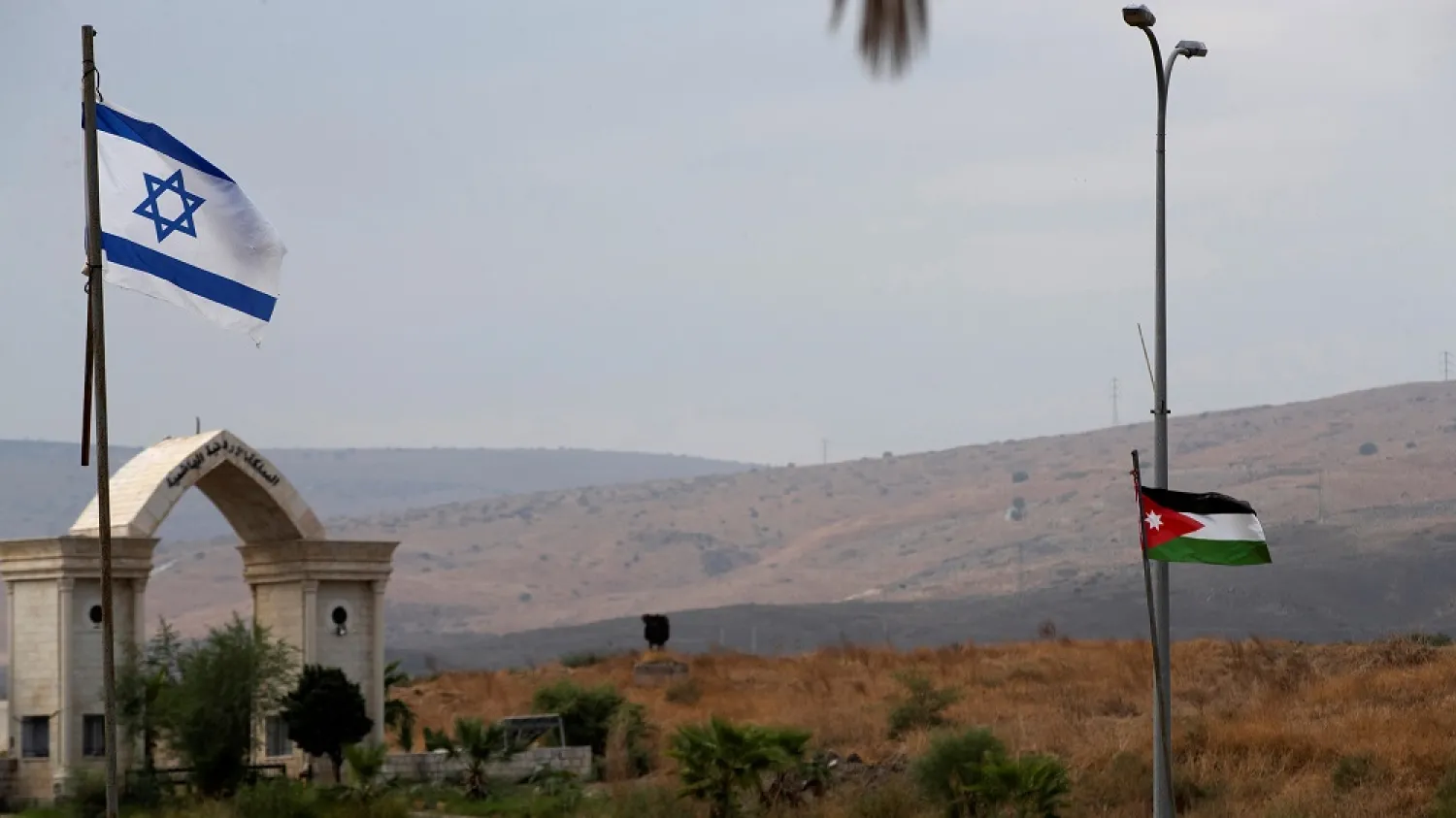
The national flags of Jordan and Israel are seen from the Israeli side of the border area between Israel and Jordan, Oct. 29, 2019. (Reuters)
TT

US Official Denies Pompeo Discussed Jordan Valley Annexation with Israeli PM

The national flags of Jordan and Israel are seen from the Israeli side of the border area between Israel and Jordan, Oct. 29, 2019. (Reuters)

The plan to annex Jordan Valley to Israel was not discussed between Israeli Prime Minister Benjamin Netanyahu and US Secretary of State Mike Pompeo during their meeting in Lisbon earlier this week, asserted the US State Department’s top Middle East official David Schenker.

He added that the US government position has long been that the ultimate disposition of territory is to be determined between the parties through negotiations.

Schenker's remarks contradict a statement made earlier by Netanyahu claiming he discussed the matter with Pompeo.

After meeting Pompeo on Thursday, Netanyahu said Israel had “the full right” to take this step, but stressed that such a move was impossible during a transitional period in which there is no Israeli government.

The PM described his meeting with Pompeo as “of great importance” to Israel's security, adding that he hopes they would move forward with plans for a joint defense treaty.

Prior to the meeting, he announced he would focus in his discussions on the Iranian issue, the formation of a defense alliance and a future US recognition of Israeli sovereignty over the Jordan Valley.

Netanyahu insists on annexing the Valley, claiming it is a border area and holds security significance for Israel.

During his negotiations with the Blue and White party to form a joint government, Netanyahu asked that he start the first period as prime minister in order to annex the Jordan Valley, but the negotiations failed.

Currently, there is no permanent government after the coalition voted on dissolving the Knesset and called for early elections following two electoral rounds that already failed to produce a cabinet.

The Jordan Valley and the northern Dead Sea span some 160,000 hectares, comprising almost 30 percent of the West Bank. In 2016, approximately 65,000 Palestinians and 11,000 settlers lived there.

Israel exploits almost all of the Jordan Valley and the northern Dead Sea for its own needs and bars Palestinians from entering or using about 85 percent of the area.

The Israeli Information Center for Human Rights in the Occupied Territories (B’Tselem) said that Palestinians are not allowed to use the land for housing, agricultural construction, public buildings, or infrastructure.

“The legal grounds cited for this sweeping ban vary. So much so that, in some cases, the same land has been given several different designations,” B’Tselem said in a report.

Almost 50 percent of the area is defined as “state land”, more than half of which was already designated as such under Jordanian rule, before Israel occupied the area in 1967.

In addition, about 46 percent of the area have been declared closed military zones, including the municipal jurisdictions of Israeli settlements and 11 firing zones.

The report also noted that some 20 percent of the area have been declared nature reserves and other areas have been allocated to settlements’ regional councils.

It explained that the ban on Palestinian construction and development in the Jordan Valley takes a particularly harsh toll on the roughly 10,000 residents of more than 50 Palestinian communities in Area C.

The authorities deny these communities any possibility whatsoever of lawful construction to meet the needs of their population, and refuse to connect them to water and power supplies.

In recent years, and especially since early 2013, the Israeli military has periodically ordered the temporary evacuation of the communities located in areas it declared firing zones, claiming the military needs to train in these particular areas.

Residents have been served military orders requiring them to vacate their homes for various periods of time, ranging from several hours to two whole days, warning that refusal to comply will result in forced removal, expropriation of their livestock, and retroactive fines covering the costs of the removal.

B’Tselem stated that Israel is trying to prevent any Palestinian development or presence in the region.



Egyptian-Turkish Military Talks Focus on Strengthening Partnership

The Commander of the Egyptian Air Force during his meeting with the Turkish Air Force chief in Cairo on Wednesday (Egyptian military spokesperson)
TT

Egyptian-Turkish Military Talks Focus on Strengthening Partnership

The Commander of the Egyptian Air Force during his meeting with the Turkish Air Force chief in Cairo on Wednesday (Egyptian military spokesperson)

Senior Egyptian and Turkish air force commanders met in Cairo on Wednesday for talks focused on strengthening military partnership and expanding bilateral cooperation, in the latest sign of warming defense ties between the two countries.

The meeting brought together the Commander of the Egyptian Air Force, Lt. Gen. Amr Saqr, and his Turkish counterpart, Gen. Ziya Cemal Kadioglu, to review a range of issues of mutual interest amid growing cooperation between the two air forces.

Egypt’s military spokesperson said the talks reflect the Armed Forces’ commitment to deepening military collaboration with friendly and partner nations.

Earlier this month, Egypt and Türkiye signed a military cooperation agreement during talks in Cairo between Egyptian President Abdel Fattah el-Sisi and his Turkish counterpart, President Recep Tayyip Erdogan.

Sisi highlighted similar viewpoints on regional and international issues, while Erdogan noted that enhanced cooperation and forthcoming joint steps would help support regional peace.

Cairo and Ankara also signed an agreement last August on the joint production of vertical take-off and landing (VTOL) drones. Production of unmanned ground vehicles has also begun under a partnership between the Turkish firm HAVELSAN and Egypt’s Kader Factory.

During the talks, Saqr underscored the importance of coordinating efforts to advance shared interests and expressed hope for closer ties that would benefit both air forces.

Kadioglu, for his part, stressed the depth of bilateral partnership and the strong foundations of cooperation between the two countries’ air forces.

According to the military spokesperson, Kadioglu also toured several Egyptian Air Force units to review the latest training and armament systems introduced in recent years.

Military cooperation between Egypt and Türkiye has gained momentum since 2023, following the restoration of full diplomatic relations and reciprocal presidential visits that reflected positively on the defense sector.

In September last year, the joint naval exercise “Sea of Friendship 2025” was held in Turkish territorial waters, aimed at enhancing joint capabilities and exchanging expertise against a range of threats.


UN Says Israeli Actions Raising 'Ethnic Cleansing' Fears in West Bank, Gaza

A member of the Salhab family weeps as he sits on the on the rubble of apartment building after it was demolished by Israeli bulldozers near the Israeli settlement of Hagai, south of the occupied West Bank city of Hebron, on February 18, 2026. (Photo by HAZEM BADER / AFP)
TT

UN Says Israeli Actions Raising 'Ethnic Cleansing' Fears in West Bank, Gaza

A member of the Salhab family weeps as he sits on the on the rubble of apartment building after it was demolished by Israeli bulldozers near the Israeli settlement of Hagai, south of the occupied West Bank city of Hebron, on February 18, 2026. (Photo by HAZEM BADER / AFP)

Israel's increased attacks and forcible transfers of Palestinians "raise concerns over ethnic cleansing" in the Gaza Strip and the West Bank, the United Nations said Thursday.

The UN human rights office said the cumulative impact of Israel's military conduct during the war in Gaza, plus its blockade of the territory, had inflicted living conditions "increasingly incompatible with Palestinians' continued existence as a group in Gaza".

"Intensified attacks, the methodical destruction of entire neighborhoods and the denial of humanitarian assistance appeared to aim at a permanent demographic shift in Gaza", the office said in a report.

"This, together with forcible transfers, which appear to aim at a permanent displacement, raise concerns over ethnic cleansing in Gaza and the West Bank."

The report looked at November 1, 2024 to October 31, 2025.

In the occupied West Bank and annexed East Jerusalem, the report said the "systematic use of unlawful force" by Israeli security forces, "widespread" arbitrary detention and the "extensive unlawful demolition" of Palestinian homes was being carried out to "systematically discriminate, oppress, control and dominate the Palestinian people".

"These violations were "altering the character, status and demographic composition of the occupied West Bank, raising serious concerns of ethnic cleansing", it said.

- 'Inhumane choice' -

In Gaza, the report condemned the continued killing and maiming of "unprecedented numbers of civilians", the spread of famine, and destruction of the "remaining civilian infrastructure".

During the 12 months covered in the report, at least 463 Palestinians, including 157 children, starved to death in Gaza, it said.

"Palestinians faced the inhumane choice of either starving to death or risking being killed while trying to get food," said the report.

"The situation of famine and malnutrition was the direct result of actions taken by the Israeli government," with the deaths and suffering from hunger "foreseeable and repeatedly foretold".

Across the reporting period, Hamas and other Palestinian armed groups continued to hold Israeli and foreign hostages seized on October 7, 2023 -- dead or alive -- as "bargaining tools".

The rights office said the hostages' treatment amounted to war crimes.

"Israeli forces, Hamas, and other Palestinian armed groups committed serious violations of international humanitarian law in Gaza, gross violations and abuses of international human rights law, and atrocity crimes," the report concluded.

- Impunity 'kills' -

Last week, UN rights chief Volker Turk warned that the world was witnessing "rapid steps to change permanently the demography of the occupied Palestinian territory".

On Tuesday, Israel's far-right Finance Minister Bezalel Smotrich vowed to encourage "emigration" from the Palestinian territories.

And on Wednesday, UN Under-Secretary-General Rosemary DiCarlo warned the Security Council that steps by Israel to tighten control of areas of the West Bank administered by the Palestinian Authority amount to "gradual de facto annexation".

Thursday's rights office report concluded that considered together, Israeli practices "indicated a concerted and accelerating effort to consolidate annexation of large parts of the Occupied Palestinian Territory and to deny Palestinians' right to self-determination".

The report said there was a pervasive climate of impunity for serious violations of international law by the Israeli authorities in the Palestinian territories.

"Impunity is not abstract -- it kills. Accountability is indispensable. It is the prerequisite for a just and durable peace in Palestine and Israel," Turk said in a statement.


UN Probe: RSF Actions in Sudan's el-Fasher Point to Genocide

Forces affiliated with the Rapid Support Forces in the city of el-Fasher, Darfur region (AFP)
TT

UN Probe: RSF Actions in Sudan's el-Fasher Point to Genocide

Forces affiliated with the Rapid Support Forces in the city of el-Fasher, Darfur region (AFP)

Mass killings of non-Arab communities when the Rapid Support Forces captured the Sudanese city of el-Fasher bears hallmarks that point to genocide, an independent UN probe said in a new report on Thursday.

At the end of October last year, the RSF took over the city - which had been the last remaining stronghold of the Sudanese Armed Forces (SAF) in the Darfur region in the west of the country - with thousands of people killed and raped during three days of horror, the UN Independent International Fact-Finding Mission for Sudan said.

It followed an 18-month siege where the RSF imposed conditions of life calculated to bring about the physical destruction of non-Arab communities, in particular the Zaghawa and the Fur, ‌the report stated.

The ‌UN mission said it found evidence that the RSF carried out a pattern ‌of ⁠coordinated and repeated ⁠targeting of individuals based on ethnicity, gender and perceived political affiliation, including mass killings, rape and torture, as well as inflicting conditions of life calculated to bring about the group’s physical destruction - core elements of the crime of genocide under international law.

The final draft of the report was shared with the Government of Sudan but no response was received, while the RSF did not respond to the UN mission's request to meet with its leadership, the report stated. The RSF and SAF did not immediately respond to requests from Reuters for comment.

In the past, the RSF has ⁠denied such abuses - saying the accounts have been manufactured by its enemies and ‌making counter-accusations against them.

"The scale, coordination, and public endorsement of the operation ‌by senior RSF leadership demonstrate that the crimes committed in and around el-Fasher were not random excesses of war" said Mohamad ‌Chande Othman, Chair of the Fact-Finding Mission on Sudan.

"They formed part of a planned and organized operation ‌that bears the defining characteristics of genocide," he added.

Before its takeover el-Fasher's population mainly consisted of the Zaghawa, a non-Arab community, while displacement camps around the area were comprised of the Fur community, as well as Berti, Masalit and Tama, the report said.

"Survivors describe explicit threats to 'clean' the city," the report stated. Alongside attacking displacement camps, communal kitchens and medical centers ‌with drones and heavy weapons, the RSF also carried out killings, looting, beatings and sexual violence in el-Fasher, the report stated.

The RSF's "exterminatory rhetoric" and other violations indicated ⁠its intent to destroy ⁠the Zaghawa and Fur communities in whole or in part, the report said.

"Witnesses heard the Rapid Support Forces saying, 'Is there anyone Zaghawa among you? If we find Zaghawa, we will kill them all'," the report said.

Survivors recounted point-blank executions of civilians, as well as bodies of men, women and children filling roads, the report stated.

Women and girls aged 7 to 70 years old from non-Arab communities, particularly the Zaghawa were raped and subject to other acts of sexual violence, including whipping and forced nudity, the report stated.

British Foreign Secretary Yvette Cooper said the international response to the report and the situation in Sudan had to be emphatic and urged for a ceasefire.

"The findings of this UN report are truly horrific - atrocities including systematic starvation, torture, killings, rape and deliberate ethnic targeting used on the most horrendous scale during the Rapid Support Forces siege of el-Fasher," she said in a statement.

The UN mission was mandated by members of the Human Rights Council, following backing from countries that included Britain, to urgently investigate violations and abuses under international law in and around el-Fasher.