


New Lebanese PM Begins Consultations to Form New Govt.

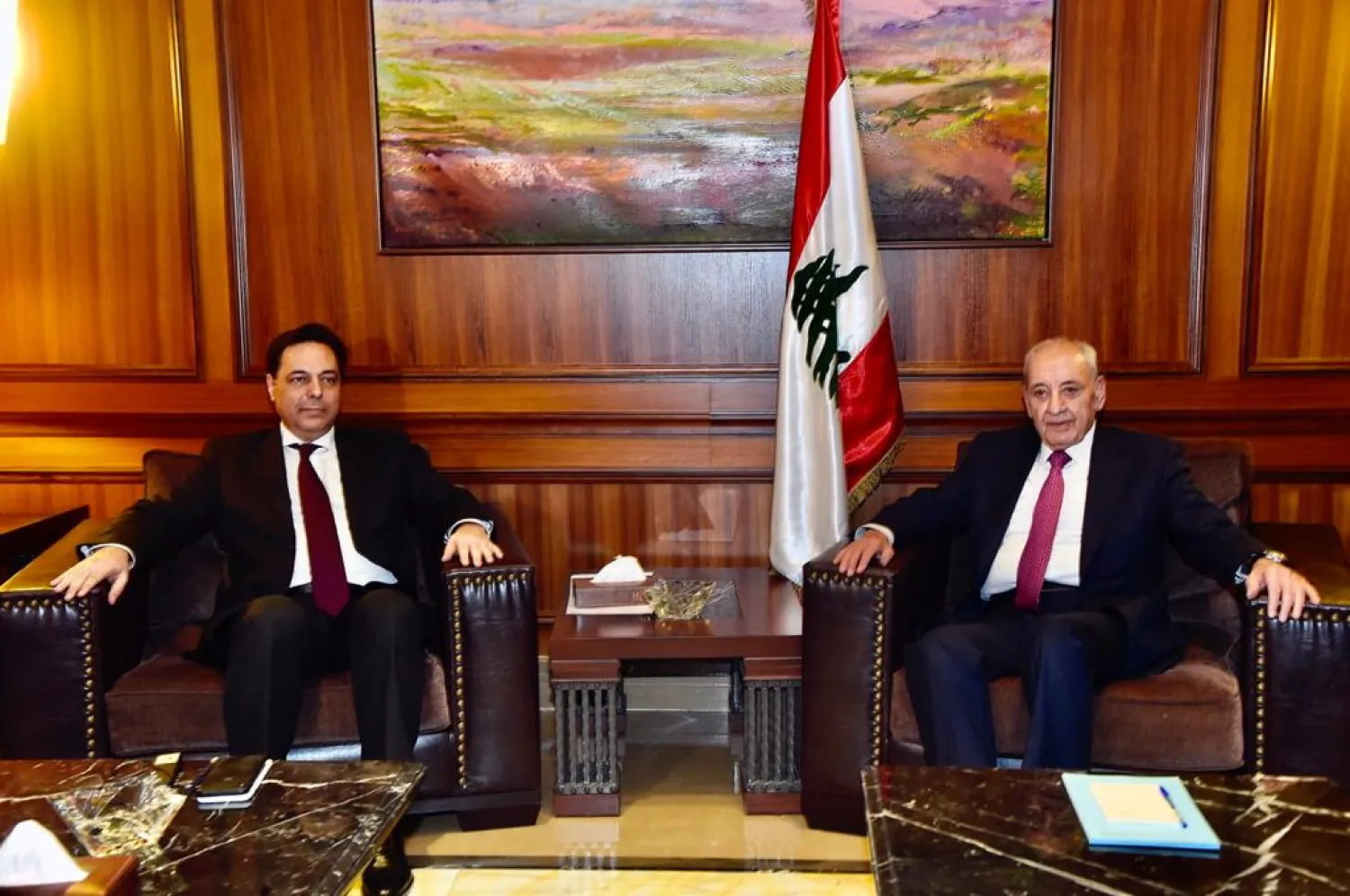
Lebanese PM-designate Hassan Diab (L) meets with parliament Speaker Nabih Berri. (Dalati & Nohra)
TT

New Lebanese PM Begins Consultations to Form New Govt.

Lebanese PM-designate Hassan Diab (L) meets with parliament Speaker Nabih Berri. (Dalati & Nohra)

Lebanon's new prime minister held consultations Saturday with parliamentary blocs in which they discussed the shape of the future government and said afterward that legislators all had one concern: To get the country out of its “strangling" economic crisis.

Hassan Diab, a university professor and former education minister, will have to steer Lebanon out of its worst economic and financial crisis in decades. He's also taking office against the backdrop of ongoing nationwide protests against the country's ruling elite.

“Lebanon is in the intensive care unit and needs efforts” by all sides, from political groups to protesters, Diab said.

Consultations began a day after scuffles broke out in Beirut and other areas between supporters of outgoing prime minister Saad Hariri and Lebanese troops and riot police. The ex-premier's supporters were protesting Diab's nomination. At least seven soldiers were injured.

Diab told reporters later that all members of parliament encouraged him to form a Cabinet “as soon as possible." Cabinets usually take months to form in Lebanon because of bargaining between rival groups.

Diab said he hopes to form a government of about 20 ministers made up of independents and technocrats within few weeks. “It's time to work and we ask God to make us successful.”

He added that the situation in Lebanon cannot stand any delays amid its worst economic and financial crisis since the end of the 1975-90 civil war.

Lebanese banks have imposed unprecedented capital controls in recent weeks. Thousands have lost their jobs and the economy is expected to contract in 2020.

Diab began his meetings Saturday at parliament with Speaker Nabih Berri, then held talks with former prime ministers, including caretaker premier Hariri. He later met with blocs at the legislature.

Hezbollah and its allies had previously insisted that a new government consist of politicians and experts but on Saturday, Diab said “all parties agree with me regarding a government made up of independents and experts, including Hezbollah.”

Legislator Paula Yacoubian, who backs the protest movement, said Diab told her “the government will be fully made up of independents and that he will step down if there is going to be members of the state's political parties.”

She added: “I heard very nice talk similar to what the people have been demanding.”

The protesters have been demanding a government that does not include members of political parties whom they blame for widespread corruption. Diab said he will meet with the protesters in the coming days without elaborating.

Earlier on Saturday, Hariri cautioned supporters after meeting Diab against violent protests, saying: "The army is ours and police forces are for all Lebanese.”

Shortly before sunset Saturday, scores of protesters including Hariri supporters, closed two major intersections in Beirut demanding that Diab step aside, saying he failed to win wide support from Sunni legislators. Saturday's protests were peaceful unlike those of the night before when stones and firecrackers were hurled at security forces.

The new prime minister won a majority of lawmakers' votes after receiving backing from Hezbollah and its allies, which have a majority of seats in parliament.

However, he lacks the support of major Sunni figures, including the largest Sunni party headed by Hariri. That's particularly problematic for Diab, who, as a Sunni, doesn't have the backing of his own community. And under Lebanon's sectarian power-sharing agreement, the prime minister must be Sunni.

The head of Hezbollah's 12-member bloc, Mohammad Raad, said the group wants a government that preserves what the Lebanese have achieved in “victories during the confrontation with the Israeli enemy and to maintain our national sovereignty, our maritime (oil and gas) wealth and land and to prevent the enemy from undermining its sovereignty and the national dignity.”

Samir al-Jisr of Hariri's Mustaqbal bloc said they will not take part in Diab's government.
Hezbollah ally, caretaker Foreign Minister Gebran Bassil, who heads the largest bloc in parliament, said the future government “is not Hezbollah's Cabinet but of all Lebanese and it is not against anyone.”

Michel Moawad, a harsh critic of the group, said Diab told him the new government will not be controlled by “Hezbollah and will not be confrontational.”

Hezbollah had backed Hariri for prime minister from the start, but the group differed with him over the shape of the new government.

Lebanon's sustained, leaderless protests erupted in mid-October, and forced Hariri's resignation within days. But politicians were later unable to agree on a new prime minister. The ongoing protests and paralysis have worsened the economic crisis.



EU Exploring Support for New Gaza Administration Committee, Document Says

Palestinians push a cart past the rubble of residential buildings destroyed during the two-year Israeli offensives, in Gaza City, February 17, 2026. REUTERS/Mahmoud Issa
TT

EU Exploring Support for New Gaza Administration Committee, Document Says

Palestinians push a cart past the rubble of residential buildings destroyed during the two-year Israeli offensives, in Gaza City, February 17, 2026. REUTERS/Mahmoud Issa

The European Union is exploring possible support for a new committee established to take over the civil administration of Gaza, according to a document produced by the bloc's diplomatic arm and seen by Reuters.

"The EU is engaging with the newly established transitional governance structures for Gaza," the European External Action Service wrote in a document circulated to member states on Tuesday.

"The EU is also exploring possible support to the National Committee for the Administration of Gaza," it added.

European foreign ministers will discuss the situation in Gaza during a meeting in Brussels on February 23.


Israel Military Says Soldier Killed in Gaza 

A drone view shows the destruction in a residential neighborhood, after the withdrawal of the Israeli forces from the area, amid a ceasefire between Israel and Hamas in Gaza, in Gaza City, October 21, 2025. (Reuters)
TT

Israel Military Says Soldier Killed in Gaza 

A drone view shows the destruction in a residential neighborhood, after the withdrawal of the Israeli forces from the area, amid a ceasefire between Israel and Hamas in Gaza, in Gaza City, October 21, 2025. (Reuters)

The Israeli military announced that one of its soldiers had been killed in combat in southern Gaza on Wednesday, but a security source said the death appeared to have been caused by "friendly fire".

"Staff Sergeant Ofri Yafe, aged 21, from HaYogev, a soldier in the Paratroopers Reconnaissance Unit, fell during combat in the southern Gaza Strip," the military said in a statement.

A security source, however, told AFP that the soldier appeared to have been "killed by friendly fire", without providing further details.

"The incident is still under investigation," the source added.

The death brings to five the number of Israeli soldiers killed in Gaza since a ceasefire took effect on October 10.


Syria: SDF’s Mazloum Abdi Says Implementation of Integration Deal May Take Time

People sit outdoors surrounded by nature, with the Tigris river flowing in the background, following a long atmospheric depression, near the Syrian-Turkish border in Derik, Syria, February 16, 2026 REUTERS/Orhan Qereman
TT

Syria: SDF’s Mazloum Abdi Says Implementation of Integration Deal May Take Time

People sit outdoors surrounded by nature, with the Tigris river flowing in the background, following a long atmospheric depression, near the Syrian-Turkish border in Derik, Syria, February 16, 2026 REUTERS/Orhan Qereman

Mazloum Abdi, commander of the Syrian Democratic Forces, said the process of merging the SDF with Syrian government forces “may take some time,” despite expressing confidence in the eventual success of the agreement.

His remarks came after earlier comments in which he acknowledged differences with Damascus over the concept of “decentralization.”

Speaking at a tribal conference in the northeastern city of Hasakah on Tuesday, Abdi said the issue of integration would not be resolved quickly, but stressed that the agreement remains on track.

He said the deal reached last month stipulates that three Syrian army brigades will be created out of the SDF.

Abdi added that all SDF military units have withdrawn to their barracks in an effort to preserve stability and continue implementing the announced integration agreement with the Syrian state.

He also emphasized the need for armed forces to withdraw from the vicinity of the city of Ayn al-Arab (Kobani), to be replaced by security forces tasked with maintaining order.