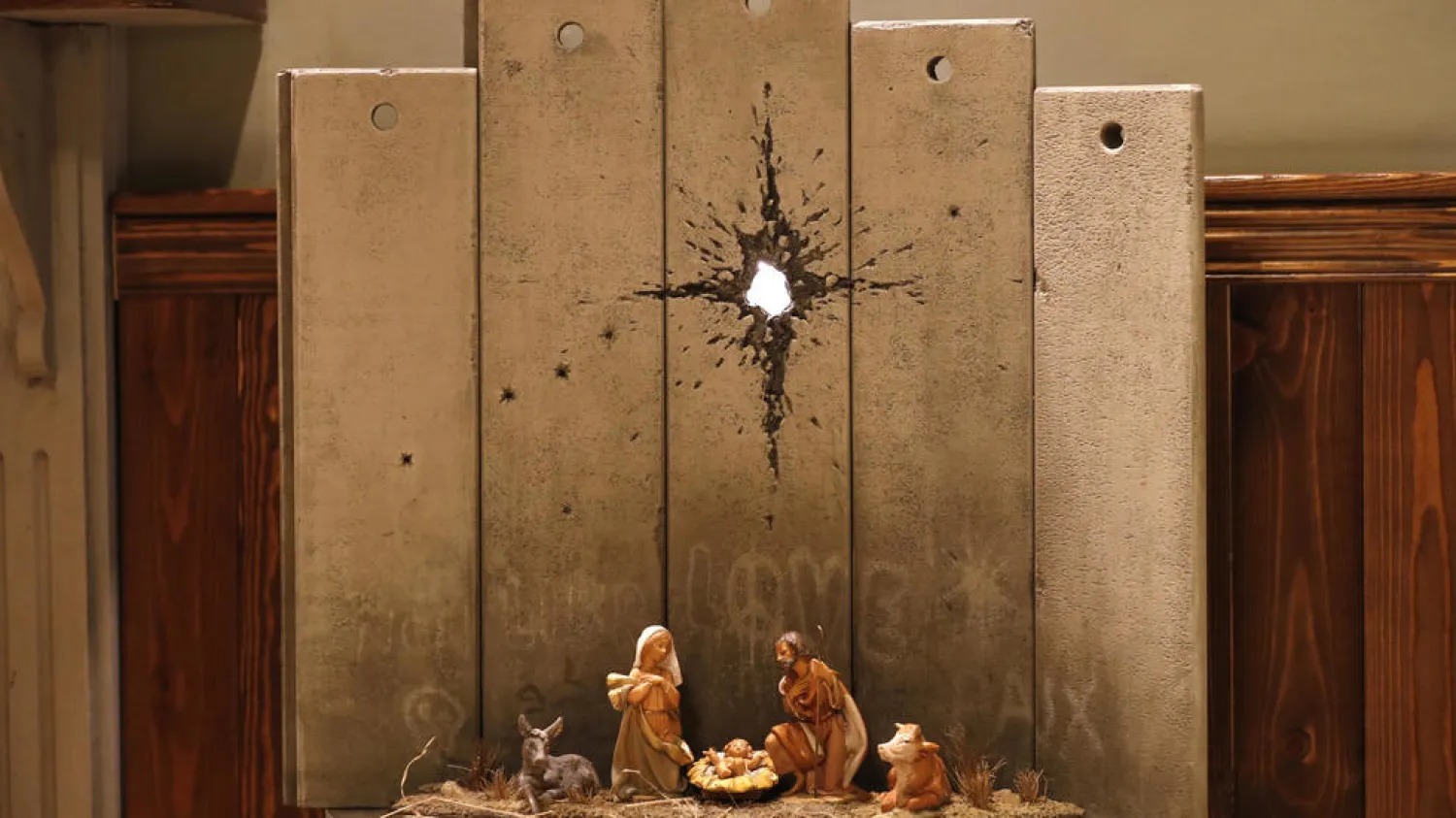
Mysterious Artist Banksy Unveils Dark Nativity in Bethlehem

Banksy unveils dark nativity in Bethlehem. (AFP)
TT

Mysterious Artist Banksy Unveils Dark Nativity in Bethlehem

Banksy unveils dark nativity in Bethlehem. (AFP)

A manger scene juxtaposed against concrete blocks seemingly pierced by a mortar shell: with Christmas looming, the latest Bethlehem offering by secretive artist Banksy appeared Saturday in the Israeli-occupied West Bank.

Dubbed the "Scar of Bethlehem", the baby Jesus, Mary and Joseph are backlit through damaged concrete, chiseled pockmarks exploding out from a gaping hole in four directions to approximate the Christmas Star.

The work is installed at Banksy's Walled-Off Hotel, where all rooms overlook a concrete section of the barrier built by Israel to cut off the occupied West Bank from Israeli territory.

"Love" and "peace" are respectively graffiti tagged in English and French on the artistic installation's concrete blocks, while three large wrapped presents are at the forefront of the scene.

"It is a nativity," the hotel's manager Wissam Salsaa told AFP after the piece was installed. "Banksy has his own contribution to Christmas."

"It is a great way to bring up the story of Bethlehem, the Christmas story, in a different way -- to make people think more" of how Palestinians live in Bethlehem.

Salsaa calls the Israeli wall a "scar" that should induce "shame in anyone who supported" its construction.

Israel began building the separation barrier -- in parts concrete, with other stretches consisting of fencing -- in 2002 during the Palestinian uprising, or intifada.

Built mostly inside the West Bank, Israel says it is necessary to prevent attacks, but Palestinians label it an apartheid wall, separating them from Jerusalem.

Regular Banksy haunt

The manger scene and hotel -- an establishment opened two years ago -- are far from Banksy's only West Bank imprint.

In 2007, he painted a number of artworks in Bethlehem, including a young girl frisking an Israeli soldier pinned up against a wall.

In 2005, he sprayed nine stenciled images at different locations along the eight-meter-high (27-foot) separation barrier.

They included a ladder on the wall, a little girl carried away by balloons and a window opening onto a peaceful mountain landscape.

Palestinian graffiti artists, too, have made the separation wall a place of political and artistic expression.

Like elsewhere in the world, Banksy's works in the occupied territory have become tourist attractions -- in part due to him often ghosting in to create his works in the dead of night.

The identity of the world's best known graffiti artist remains a mystery and he was not present during the revealing of his latest work.

"Banksy is trying to be a voice for those that cannot speak," Salsaa said.

He "is creating a new model of resistance through art."

Banksy rose to prominence after his subversive artworks started to appear in public spaces in the United Kingdom in the early 2000s, and he has long worked on themes of violence and conflict.


An Iconic Puzzle Comes Home as Production of the Rubik’s Cube Returns to Hungary

Hungarian architect and inventor Ernő Rubik attends the opening event of Rubik's Cube production line of the Jasz-Plasztik plastic processing company in Jaszbereny, Hungary, 10 November 2026. (EPA)
TT

An Iconic Puzzle Comes Home as Production of the Rubik’s Cube Returns to Hungary

Hungarian architect and inventor Ernő Rubik attends the opening event of Rubik's Cube production line of the Jasz-Plasztik plastic processing company in Jaszbereny, Hungary, 10 November 2026. (EPA)

More than half a century ago, a Hungarian architect, sculptor and professor invented what would become one of the world's most popular and beloved puzzles whose appeal has spanned generations: the colorful, mind-bending, six-sided Rubik's Cube.

Now, after selling more than half a billion units and becoming a worldwide cultural touchstone, production of the cube is returning to Hungary, where its inventor, Ernő Rubik, first conceived of the iconic object that bears his name.

Hungary “is the home of the cube. The cube was born here,” Rubik, 82, said on Tuesday at the opening of a new, fully automated Rubik's Cube production line in the Hungarian city of Jászberény.

The journey of the Rubik's Cube began in 1974, when Rubik was teaching design at the Academy of Applied Arts and Design in Budapest. Seeking to create a three-dimensional object that was “infinite,” he said, he completed a prototype — then made of wood — of a cube that could rotate on multiple axes and was made up of 27 blocks.

Recognizing its consumer value, Rubik soon began producing more of the puzzles. Beginning in 1977, an initial 5,000 units of what was then called the “Magic Cube” were sold at specialty shops in the Hungarian capital.

The invention — or what Rubik prefers to describe as a “discovery” — gained popularity, and after having difficulties procuring materials for the cubes in then-socialist Hungary, he realized: “We were not prepared for that size of production ... We can’t fulfill the needs of the market worldwide.”

The cube was licensed to a British and then a US toy company, and its production was moved abroad. By the early 1980s, its popularity had exploded in what Rubik called “the first big wave,” in which he said 200 million units were sold between 1980 and 1983.

While sales of the cube dipped after its initial success, it still attracts plenty of users eager to try their hand at solving the puzzle. Millions are sold every year.

At the new production line in Hungary, a series of robotic arms assembles the cubes and tests them for functionality and durability — a level of automation Rubik said was “very different” than in the early days when the cubes were assembled by hand.

The new line in Jászberény plans to produce 1 million cubes annually.

Steve Radewych, a senior vice president with Canadian toy company Spin Master, which owns the Rubik's Cube trademark, said at Tuesday's opening that the theme of the day was: “Back to its roots: The cube comes home.”

“Ernő, your discovery is more than a toy,” Radewych told Rubik. “It's a global social phenomenon.”

Radewych noted the “incredible staying power” of the Rubik's Cube, and the fact that the puzzle continues to hold the fascination of young people even today.

“The cube represents an intellectual journey, a symbol of intelligence, problem-solving and cognitive discipline,” he added, which “has brought joy — and frustration — to many generations.”

The cube has enjoyed another surge in popularity in recent years as global competitions have proliferated, measuring who can solve the puzzle the fastest.

The current record, set only last month in China by nine-year-old Xuanyi Geng, is 2.51 seconds, according to the World Cube Association, which organizes and certifies competitions across the world.

Rubik, who does not consider himself a speed competitor, said that for him, the cube represents a “transformable sculpture,” the place where art and engineering meet and users can manipulate and change the cube in nearly endless variations.

“If you are doing something, creating something, you have the chance to do something that is meaningful — that’s one part — and beautiful,” he said.


SpaceX Starship Test to Attempt First-Ever Spaceship ‘Catch'

SpaceX's mega rocket Starship is stacked and prepared for a test flight from Starbase, Texas, Thursday, Nov. 12, 2026. (AP)
TT

SpaceX Starship Test to Attempt First-Ever Spaceship ‘Catch'

SpaceX's mega rocket Starship is stacked and prepared for a test flight from Starbase, Texas, Thursday, Nov. 12, 2026. (AP)

Elon Musk's SpaceX was poised Friday to carry out its latest test of the world's biggest and most powerful rocket, the Starship, with plans for a groundbreaking "catch" of the spaceship following a day in orbit.

A successful capture of the Starship upper stage would mark a significant milestone in the space industry's decades-long pursuit of fully reusable spacecraft that can drastically reduce mission costs and make frequent travel possible.

"If successful, this will mark the first full recovery of an orbital launch system and a breakthrough moment in making Starship a reliable, rapidly reusable rocket," SpaceX said.

For the 15th Starship test flight Friday, SpaceX aims to recover both stages of the massive 124-meter (407-foot) launch vehicle.

The company has caught the booster, dubbed Super Heavy, on three previous occasions, with the first stage descending vertically back to the launch site shortly after blastoff and nestling into mechanical "chopstick" arms.

It will now attempt to do the same with the spaceship. Some versions of the vessel are designed to launch internet satellites and data centers into orbit, while others will be made to ferry people to the Moon and Mars.

A spacecraft that can be fully reused is the "Holy Grail" of the space industry, said Clayton Swope, an aerospace expert at the Center for Strategic and International Studies.

"No one's really been able to do that so far," he said. "People have been trying to do that since the (NASA) space shuttle. But the space shuttle ended up being kind of a compromise because a lot of the vehicle wasn't reusable."

Reusing the Starship spacecraft would require the vessel to withstand the extreme heat of reentering Earth's atmosphere and then return to service without extensive refurbishment.

- Refueling challenge -

Musk, the world's richest person, has already revolutionized the space sector with the partially reusable Falcon rockets, which are regularly employed to launch satellites and carry astronauts to the International Space Station.

The Starship project, however, has been plagued by years-long delays as SpaceX grapples with novel engineering challenges -- even as NASA is counting on the spaceship to serve as a lunar lander for its Artemis program.

Other technical challenges include transferring fuel to Starship in orbit -- a requirement for any journey to the Moon or Mars.

Following SpaceX's high-profile stock market debut in June, the company carried out the first orbital flight of Starship in September, though the mission was cut short due to an engine issue.

It is also investing heavily in additional launch sites for its mega-rocket in Louisiana and Florida.

- Complex capture -

Friday's launch is scheduled to take place at SpaceX's "Starbase" in southern Texas at 4:45 pm (2245 GMT).

Following liftoff and the mid-air separation of the two stages, SpaceX plans to bring Super Heavy back to Earth six and a half minutes later, catching it at the launch site on the Gulf of Mexico coastline.

The spaceship will continue to reach Earth's orbit, where it will deploy 26 satellites into Musk's Starlink satellite internet constellation that has become a major revenue stream for SpaceX.

It will then circle the planet 14 times, before returning 22 hours later and -- SpaceX hopes -- descending safely into the chopstick arms.

This capture attempt is more complex than that of the booster, as the spaceship will be descending much faster and from a much greater altitude.

SpaceX has said it would proceed with these maneuvers only if conditions are optimal, and in the past has made last-minute changes to test flights under Musk's "fail fast" strategy of learning through crashes, explosions and other mishaps.

As of late Thursday, the US Federal Aviation Administration had not yet given its final approval for the test flight.


Delhi Overtakes Lahore as World’s Most Polluted City as Air Quality Drops

Traffic moves on a smoggy morning as air pollution spikes in New Delhi, India, November 13, 2026. (Reuters)
TT

Delhi Overtakes Lahore as World’s Most Polluted City as Air Quality Drops

Traffic moves on a smoggy morning as air pollution spikes in New Delhi, India, November 13, 2026. (Reuters)

India's capital Delhi overtook Lahore in Pakistan to become the world's most polluted city on Friday, with air quality reaching hazardous levels and visibility dropping as smog blanketed the city of 20 million people.

Air quality index (AQI) in Delhi was "hazardous" at 334, making ‌it the ‌most polluted global major ‌city, ⁠according to Swiss group ⁠IQAir, which measures air quality levels based on the concentration of toxins.

An AQI reading up to 50 is considered good with little or no ⁠health risk.

India's official ‌Central Pollution ‌Control Board pegged the AQI higher at ‌403 and rated it "severe".

The ‌Swiss and Indian readings vary due to the different AQI scales and methodologies used to calculate and ‌classify air pollution levels.

Cars and motorcycles emerged from dense ⁠smog, ⁠which also appeared to obscure streetlights on the city's main roads, videos from news agency ANI showed.

Pollution is a seasonal problem in many parts of northern India and neighboring Pakistan, as the cold, heavy air of winter traps vehicle emissions, construction dust and smoke from agricultural burning.