


A Walk on the Frontier of Art, Where the Sky Is the Limit

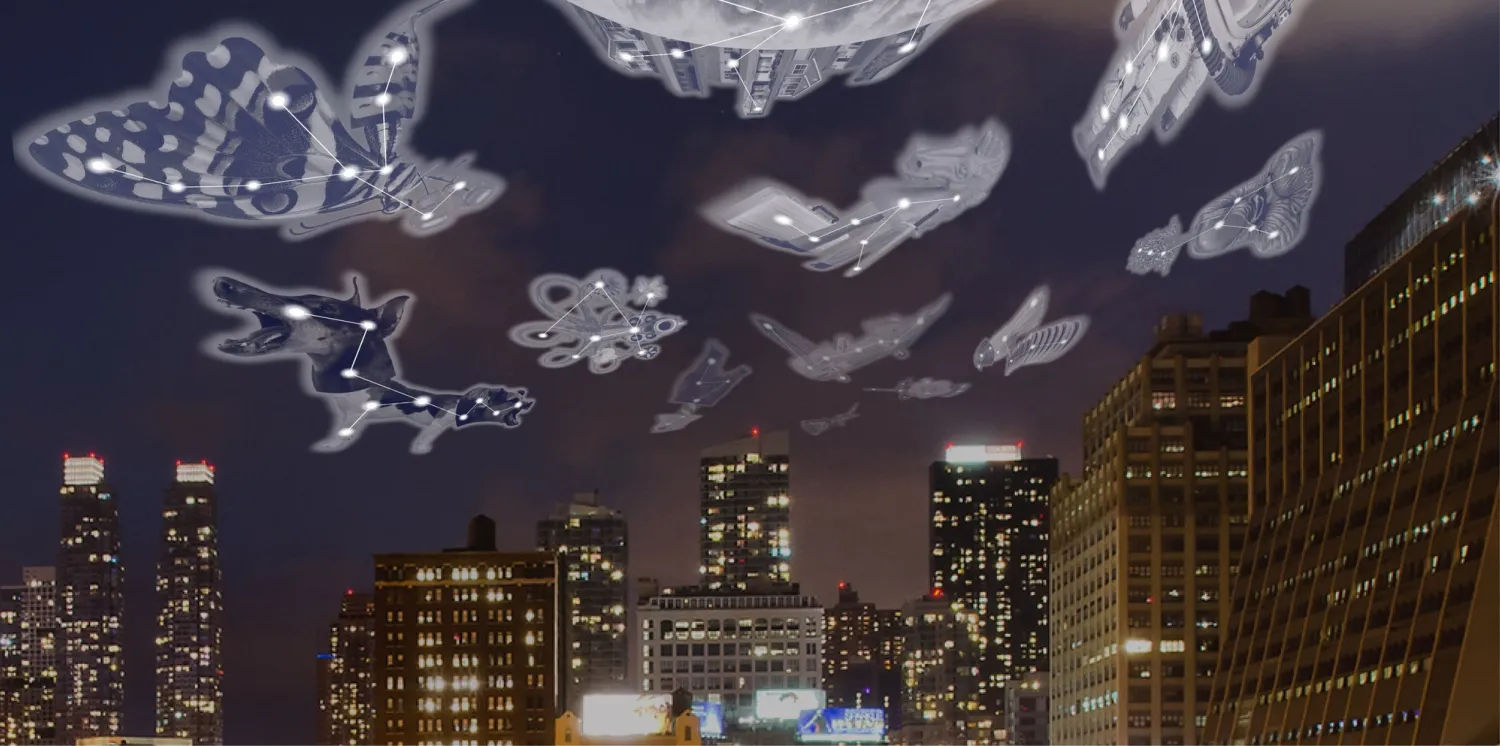
Richard Humann’s “Ascension” consists of 12 imaginary constellations suspended in the sky and is viewed through an iPad using the augmented reality platform Aery.Credit...Richard Humann
TT

A Walk on the Frontier of Art, Where the Sky Is the Limit

Richard Humann’s “Ascension” consists of 12 imaginary constellations suspended in the sky and is viewed through an iPad using the augmented reality platform Aery.Credit...Richard Humann

Augmented reality and virtual reality are opening doors to new experiences for artists and the public.

When walking on the High Line, it’s tough to look more lost than some of the tourists, but I did a pretty good job of it last month when I tripped on a curb while looking at art. (I caught myself before falling, but still.)

I was taking in an exhibition from Aery, a new augmented reality platform tailored to digital art exhibitions. Looking up to the heavens through an iPad, and not at my feet, I was using a loaner tablet to get an artwork by Richard Humann to magically appear.

But it worked: On the iPad, a constellation of a rose appeared, at an angle in the sky and topped by a crown, as Mr. Humann intended. A couple of out-of-towners who were watching me seemed mightily impressed when they looked over my shoulder at the screen.

The technologies known as augmented reality and virtual reality (AR and VR, for short) may seem futuristic, but they are being employed by artists more often.

For me — someone who looks at art for a living, but also avoids downloading new apps — experiencing three exhibitions of augmented reality art over a couple of weeks was a crossing of a threshold, one that more and more people will experience in the years ahead.

“It’s going to have a huge impact on the art world,” said Jay Van Buren, who, as chief executive and co-founder of the tech company Membit, helped create Aery, a joint venture between Membit and the real estate firm Related Companies. “Artists can do anything with it,” Mr. Van Buren said.

Membit’s technology is based on what it calls a Human Positioning System, its version of GPS. Essentially, the user adjusts the placement of the device based on a set of instructions. Aery is currently in beta mode, but is coming to Apple’s App Store soon for iPad and iPhone, and eventually will have an Android version.

As part of Aery’s inaugural exhibition, the artist Shuli Sade created a piece called “Wild, Heterotopias,” based on her photographs of the landscaping along the High Line. I viewed it in the High Line Nine Galleries: What appeared before me on the iPad, in an otherwise empty white gallery, were globes of spinning, floating greenery and flowers.

Ms. Sade, who is based in New York, has worked with augmented reality a few times during the past five years, building on her background in photography.

She likened the technology to a kiln or a paint brush: In the big picture, it is simply another way for an artist to create. “It’s a fabrication tool,” Ms. Sade said. “It’s a medium.”

“Whether it will develop further, I’m not sure,” she said. “But it’s a fun ride.”

In the same way that most sculptors do not cast a piece in bronze themselves — that work is done by experts at a foundry, to the artist’s specifications — Ms. Sade sent her photographs to Mr. Van Buren to be turned into augmented reality.

That is how it worked for [AR]T Walk, a joint venture from Apple and the New Museum in New York City. The experience is free in six cities — San Francisco, New York, London, Paris, Hong Kong and Tokyo — and is slightly customized in each. Seven artists contributed, including the poet-artist John Giorno, who died last month, and the Chicago-based Nick Cave.

Massimiliano Gioni, the New Museum’s artistic director who helped curate the artist contributions, said that when Apple approached the museum about collaborating on the project, the curators saw the same potential the company did.

“The benchmarks were previously more from the world of entertainment and gaming,” Mr. Gioni said of augmented reality and virtual reality. “And they wanted to go well beyond that.” (Mr. Van Buren said that whenever he was called upon to explain augmented reality, he mentioned Pokémon GO, the interactive game craze.)

I did [AR]T Walk on a glorious fall day in Central Park, starting at the Apple store on 59th Street and Fifth Avenue. I used one of its iPhones (you do not use your own) to experience the artworks, and to get each piece to appear, I pointed the phone at an object, usually a sign, part of process that the company calls “anchoring.”

The art is calibrated based on the position of you and the anchor, and when you have lined up the phone and the sign correctly you feel a slight vibration in the phone that the company calls “haptic feedback.”

Mr. Cave’s contribution, “Accumul-Istic Quest,” had his usual ebullience: At the beginning I was asked to pick one of several personality types, and on the screen I was suddenly being shadowed by a very bouncy, multicolored fright wig. He calls the different characters “istics.” (Mr. Cave also created an in-store augmented reality piece called “Amass,” which can be experienced in any Apple outlet around the world on your own iPhone.)

Normally the walk is a group affair of about 10 people, and every participant gets an istic. About five minutes into the walk, a large, friendly monster of sorts appears above the tree line — it has a head like a gramophone horn, a version of Mr. Cave’s “Soundsuits” characters, which he has been working with for years — and consumes everyone’s istics.

Though done with humor, Mr. Cave told me there was a larger theme at work.

“I wanted it to absorb and swallow everybody, becoming multicultural in the process,” he said.

The process of making the work involved many phone calls, with Mr. Cave sketching his ideas and making multiple trips to Apple headquarters in Silicon Valley. “We were practically in a relationship,” Mr. Cave joked.

For now, augmented reality seems to be getting more play among fine artists than virtual reality. As Mr. Van Buren put it, “AR loops you in more firmly to the place where you are, rather than taking you away into another world.”

But that could change. Bjarne Melgaard’s “My Trip” (2019) is a virtual reality work that can be experienced through Dec. 15 in Berlin at the Julia Stoschek Collection. It is a production of Acute Art, a virtual reality studio that collaborates with international artists.

Daniel Birnbaum, Acute Art’s director, said “My Trip” was a “trippy fantasy about darkness” that worked as an autobiography of the Norwegian artist.

To create the characters in the piece, Acute’s team scanned sculptures by Mr. Melgaard, and for some of the environments that people can experience in the piece, the artist provided developers with photographs of paintings.

“AR is easier, but it has limitations,” Mr. Birnbaum said. “You only see things on the phone. It can be a little gimmicky.”

But augmented reality’s ability to show two realities at once can be a powerful storytelling approach, as demonstrated by the New York-based artist Alan Michelson’s show “Wolf Nation,” at the Whitney Museum of American Art through Jan. 12.

Two of the four works in the show are made with augmented reality, and Mr. Michelson — a Mohawk member of Six Nations of the Grand River — collaborated on both with Steven Fragale, a painter who has become an augmented reality specialist, creating his own apps for his work.

One of the pieces, “Town Destroyer,” looks like a two-dimensional wall work depicting George Washington’s home at Mount Vernon. But when activated by the show’s augmented reality app on an iPhone, the bust of Washington in the center goes through a rapid transformation, overlaid with a series of colors, patterns and texts. “Town Destroyer” was the name given to Washington by the people of the Iroquois Confederacy, whose villages were burned and pillaged during the Revolutionary War.

To present an indigenous perspective on a familiar icon, “AR provided a solution — more than a solution, actually, a tool with all sorts of metaphorical aspects,” Mr. Michelson said.

Mr. Michelson said that the idea of multiple people holding up their phones to see his works at the same time also made him think of the technology’s “social possibilities.”

Although augmented reality and virtual reality explicitly take us out of the real world — our noses in another screen or two, and possibly tripping along the way — they also can be an invitation to interact with others about what they are seeing.

Mr. Gioni of the New Museum agreed. “The effects are in some ways just a pretext to come together,” he said. “This gets real only when you share it.”

The New York Times


Freezing Rain Paralyses Transport in Central Europe

Smoke from chimneys billows over snow-covered rooftops during sunrise as freezing temperatures have hit the country, in Prague, Czech Republic, January 11, 2026. (Reuters)
TT

Freezing Rain Paralyses Transport in Central Europe

Smoke from chimneys billows over snow-covered rooftops during sunrise as freezing temperatures have hit the country, in Prague, Czech Republic, January 11, 2026. (Reuters)

Freezing rain led to flights being suspended at Vienna airport on Tuesday, while neighboring Slovakia, Czech Republic and Hungary also experienced travel disruptions.

Snow and freezing temperatures buffeted Europe last week, with gale-force winds and storms claiming some 15 lives, causing travel mayhem, shutting schools, and cutting power to hundreds of thousands.

A thick layer of ice on the Vienna airport runways led to arriving flights being diverted to other airports, while all departing flights were put on hold early Tuesday.

Austria's state railway company OeBB also asked travelers to postpone non-urgent journeys, with numerous train connections facing interruptions and cancellations.

In neighboring Slovakia, the Bratislava airport was also closed early Tuesday due to bad weather.

Slovak police on Facebook urged people to avoid travel because of "extreme" ice and snow in the west of the country.

In the Czech Republic, ice was also hampering road and rail traffic.

Prague airport came to a virtual standstill, with firefighters having to de-ice the runways.

Around 50 people were treated for injuries because of the icy conditions, according to Prague's emergency services, cited by the CTK agency.

In Hungary, meteorological services also issued alerts for freezing rain and snowfall as severe winter conditions affect a large part of the country.

Trains and flights were experiencing delays, while authorities reported drift ice on the Danube and the Tisza rivers, where icebreakers have been put on alert.

Lake Balaton in the west of the country is currently frozen -- a relatively rare phenomenon seen about once every ten to fifteen years.

However, authorities warned that the ice is still too thin for skating, urging the public to be cautious.


AI Helps Fuel New Era of Medical Self-testing

Neurable research scientist Alicia Howell-Munson demonstrates the company's headset, which it says can detect early signs of Alzheimer's disease. Patrick T. Fallon / AFP
TT

AI Helps Fuel New Era of Medical Self-testing

Neurable research scientist Alicia Howell-Munson demonstrates the company's headset, which it says can detect early signs of Alzheimer's disease. Patrick T. Fallon / AFP

Beyond smart watches and rings, artificial intelligence is being used to make self-testing for major diseases more readily available -- from headsets that detect early signs of Alzheimer's to an iris-scanning app that helps spot cancer.

"The reason preventive medicine doesn't work right now is because you don't want to go to the doctor all the time to get things tested," says Ramses Alcaide, co-founder and CEO of startup Neurable.

"But what about if you knew when you needed to go to the doctor?"

Connected rings, bracelets and watches -- which were everywhere at last week's Consumer Electronics Show in Las Vegas -- can already monitor heart rate, blood pressure and glucose levels, with varying degrees of accuracy.

These gadgets are in high demand from consumers. A recent study published by OpenAI showed that more than 200 million internet users check ChatGPT every week for information on health topics.

On Wednesday, OpenAI even launched a chatbot that can draw on a user's medical records and other data collected by wearable devices, with their consent, to inform its responses.

Using electroencephalogram (EEG) technology, Neurable has developed a headset that records and deciphers brain activity.

The linked app compares data with the user's medical history to check for any deviation, a possible sign of a problem, said Alcaide.

"Apple Watch can pick up Parkinson's, but it can only pick it up once you have a tremor," Alcaide said. "Your brain has been fighting that Parkinson's for over 10 years."

With EEG technology, "you can pick these things up before you actually see physical symptoms of them. And this is just one example."

Detection before symptoms

Some people have reservations about the capabilities of such devices.

"I don't think that wearable EEG devices are reliable enough," said Anna Wexler, a University of Pennsylvania professor who studies consumer detection products, although she acknowledges that "AI has expanded the possibilities of these devices."

While Neurable's product cannot provide an actual diagnosis, it does offer a warning. It can also detect signs of depression and early development of Alzheimer's disease.

Neurable is working with the Ukrainian military to evaluate the mental health of soldiers on the front lines of the war with Russia, as well as former prisoners of war, in order to detect post-traumatic stress disorder (PTSD).

French startup NAOX meanwhile has developed EEG earbuds linked to a small box that can help patients with epilepsy.

Rather than detect seizures, which are "very rare," the device recognizes "spikes" -- quick, abnormal electrical shocks in the brain that are "much more difficult to see," said NAOX's chief of innovation Marc Vaillaud, a doctor by training.

NAOX's device -- which has been cleared by the US Food and Drug Administration -- is designed to be worn at night, to track several hours of data at a time.

The company is working with the Rothschild and Lariboisiere hospitals in Paris to try to better understand the links between these brain "spikes" and Alzheimer's disease, which have been raised in scientific papers.

Advances in AI and technology in general have paved the way for the miniaturization of cheaper detection devices -- a far cry from the heavy machinery once seen in medical offices and hospitals.

IriHealth is preparing to launch, for only about $50, a small smartphone extension that would scan a user's iris.

The gadget relies on iridology, a technique by which iris colors and markings are believed to reveal information about a person's health, but which is generally considered scientifically unreliable.

But the founders of IriHealth -- a spin-off of biometrics specialist IriTech -- are convinced that their device can be effective in detecting anomalies in the colon, and potentially the lungs or the liver.

Company spokesman Tommy Phan said IriHealth had found its device to be 81 percent accurate among patients who already have been diagnosed with colon cancer.


Hawaii's Kilauea Volcano Puts on Spectacular Lava Display

Kilauea has been regularly throwing out thousands of tonnes of molten rock and gases since it burst to life in December 2024. UNITED STATES GEOLOGICAL SURVEY/AFP
TT

Hawaii's Kilauea Volcano Puts on Spectacular Lava Display

Kilauea has been regularly throwing out thousands of tonnes of molten rock and gases since it burst to life in December 2024. UNITED STATES GEOLOGICAL SURVEY/AFP

Hawaii's Kilauea was spraying a spectacular fountain of lava on Monday, keeping up its reputation as one of the world's most active volcanoes.

For over a year now, Kilauea has been regularly throwing out thousands of tons of molten rock and gases since it burst to life in December 2024, reported AFP.

Volcanologists with the US Geological Survey said the incandescent lava was being hurled more than 1,500 feet (460 meters) into the air, with plumes of smoke and gases rising as high as 20,000 feet (six kilometers).

Eruptions such as this one tend to last around one day, the USGS said, but can still vent up to 100,000 tons of sulfur dioxide.

This gas reacts in the atmosphere to create a visible haze known as vog -- volcanic smog -- which can cause respiratory and other problems.

Tiny slivers of volcanic glass, known as "Pele's hair," are also being thrown into the air.

Named after Pele, the Hawaiian goddess of volcanoes, the strands can be very sharp and can cause irritation to the skin and eyes.

The eruption poses no immediate danger to any human settlement, with the caldera having been closed to the public for almost two decades.

Kilauea has been very active since 1983 and erupts relatively regularly.

It is one of six active volcanoes located in the Hawaiian Islands, which also include Mauna Loa, the largest volcano in the world.

Kilauea is much smaller than neighboring Mauna Loa, but it is far more active and regularly wows helicopter-riding tourists who come to see its red-hot shows.
