Jailed Fatah leader Marwan Barghouti attends a deliberation at Jerusalem Magistrate's court (file photo: Reuters)
Palestinian President Mahmoud Abbas along with several international and regional parties have increased efforts to release Fatah official Marwan Barghouti from an Israeli jail, an informed Palestinian source said.
But the source said there hasn’t been any breakthrough yet.
The source told Asharq Al-Awsat that Abbas is pressing to ensure his release, adding that Egypt is also exerting efforts.
Egypt believes his release could contribute to ending inter-Palestinian division, according to the source.
Fatah official Hatem Abdel Qader said Egypt strongly encourages the release of Barghouti and his inclusion in any future swap deal. He added that former Egyptian intelligence official Omar Suleiman made efforts to release the jailed Palestinian official in the previous deal.
Barghouti is a member of Fatah’s Central Committee and has been held in Israeli prisons since April 14, 2002 on charges of leading al-Aqsa Martyrs Brigades, Fatah’s military arm.
Israel has sentenced Barghouti to five years in prison in addition to another 40-year sentence.
During the movement’s seventh congress, Barghouti received the highest votes; 930 out of about 1,100 votes.
Several Fatah officials nominated Barghouti to become Abbas’ deputy even while in prison, but the Palestinian president appointed Mahmoud al-Aloul.
Many of his supporters were angered that Barghouti was not appointed because they believed that putting him in the post would increase pressure for his release.
Well-informed sources told Asharq Al-Awsat that Marwan's name was actually floated during discussions on choosing a vice-president in the Central Committee meetings, but the members strongly objected for several reasons, including the move being impractical because he is detained.
Abbas and Fatah officials recently met Fadwa Barghouti, Marwan’s wife. She is also a member of the Revolutionary Council of Fatah Movement and received the highest votes during the council’s elections.
A Fatah official told Asharq Al-Awsat the movement will remain united despite disagreements, adding that there might not be a named successor to Abbas, but there is no urgent need to resolve this issue.
He stated how the situation was far more complicated when choosing a successor to late President Yasser Arafat. However, Fatah later united and agreed on a candidate.
Iraq Fears Return of ‘Shadow Factions’ to Regional ‘Unity of Fronts’ Campaignhttps://english.aawsat.com/arab-world/5332467-iraq-fears-return-%E2%80%98shadow-factions%E2%80%99-regional-%E2%80%98unity-fronts%E2%80%99-campaign
Iraq Fears Return of ‘Shadow Factions’ to Regional ‘Unity of Fronts’ Campaign
Members of Harakat al-Nujaba movement attend a gathering in Baghdad on Oct. 8, 2023 (AFP)
Fears are mounting in Iraq that armed factions’ refusal to surrender their weapons may be an attempt to buy time ahead of a possible resumption of the war with Iran and the revival of the so-called “Axis of Resistance,” as Baghdad faces growing security and political pressure to prevent attacks on regional targets from Iraqi soil.
Political sources close to the Coordination Framework, an alliance of Iraq’s main Shiite political forces, said negotiations to bring all weapons under state control had made no tangible progress, with several factions yet to hand over the rockets and drones in their possession.
However, the sources told Asharq Al-Awsat that some alliance leaders considered it unlikely that the factions would attack countries in the region in support of Iran if the war resumed, given the potential repercussions for Prime Minister Ali al-Zaidi’s government, which could face mounting regional and international pressure.
Nujaba Reaffirms Refusal to Surrender Weapons
Those assessments have failed to ease fears that smaller armed groups could resume attacks that would be difficult to attribute directly to major factions, amid rising regional tensions and continuing divisions in Iraq over weapons outside state control.
Underscoring resistance to any change in the factions’ military status, Abdul Qadir al-Karbalai, military deputy of the Harakat al-Nujaba movement, said Wednesday that the group would not participate in the political process and that its position remained unchanged.
In a statement, al-Karbalai rejected the terms “placing weapons under state control,” “handing over weapons” and “disarmament” in reference to what the group calls resistance weapons.
His remarks pose an additional challenge to the government’s efforts to bring weapons under state control, with concerns extending beyond the political standoff between Baghdad and the factions to the possibility of renewed attacks on regional targets from Iraqi territory.
‘Shadow Factions’
Iraqi newspaper Al-Mada, citing informed sources, reported that the closure of the al-Sheeb border crossing with Iran in Maysan province was not solely related to the technical reasons cited by the government.
The move also came amid security fears of a return by so-called “shadow factions,” small groups of five to 10 members suspected of being used to carry out attacks that would be difficult to trace to those responsible.
Security agencies have stepped up surveillance of suspected attack sites over the past two weeks, the newspaper’s sources said, after attacks targeting Saudi Arabia reportedly shifted from areas in the Najaf desert in July to locations near the al-Sheeb crossing in September.
The developments suggest that armed groups may be changing tactics, avoiding heavily monitored sites and seeking new areas from which to operate.
The assessments and the identities of those behind the reported attacks could not be independently verified.
The Iraqi government has maintained that the crossing’s closure is temporary and intended to improve operational efficiency.
Government spokesman Haider al-Aboudi denied any political motive, describing the closure as “a purely administrative measure that requires no political interpretation.”
Meanwhile, Prime Ministerial adviser Abdul Amir Taiban accused the Iranian side of “serious violations” of Iraqi sovereignty, creating chaos along the shared border and deliberately undermining Iraq’s economy through the smuggling of counterfeit currency and drugs.
Mounting US Pressure
The closure comes as Washington steps up pressure on Baghdad over cross-border trade with Iran.
AFP quoted an Iraqi source Wednesday confirming the closure, while an Iranian official said border crossings with Iraq remained open to travelers, although truck traffic was experiencing delays.
Two political sources said Washington was pressing Baghdad to close additional crossings with Iran. One said the US Treasury Department had raised the issue with al-Zaidi during his visit to New York last month.
Security concerns also extend beyond Iraq’s land borders.
A security source in Basra province said Wednesday that a drone fell into the sea about 200 meters from an oil tanker identified as the Corden Eikel, after its crew alerted Iraqi naval forces to the presence of two drones.
One crashed into the water, while the other disappeared from sight, the source said.
Meanwhile, Baghdad is pursuing diplomatic contacts with regional countries in an effort to contain the escalation.
Iraq’s Foreign Ministry said Foreign Minister Fuad Hussein and his Emirati counterpart, Sheikh Abdullah bin Zayed Al Nahyan, discussed by phone ways to create conditions conducive to peaceful understandings that could ease regional tensions and strengthen security and stability.
Yemen’s Houthis Blow Up Roads, Loot Homes in Rural Taizhttps://english.aawsat.com/arab-world/5332460-yemen%E2%80%99s-houthis-blow-roads-loot-homes-rural-taiz
Yemen’s Houthis Blow Up Roads, Loot Homes in Rural Taiz
A cargo truck overturns on a road between Lahj and Taiz after the Houthis blocked the main route (X)
Houthi militias are tightening their grip on rural communities in southwestern Yemen, blowing up roads, erecting military barricades and digging trenches as abductions, home raids and attacks on drinking water sources disrupt daily life and raise fears of fresh displacement.
The crackdown is concentrated in the districts of Al-Shamayatayn and Al-Mawasit in Taiz province and neighboring Al-Maqatirah in Lahj, a vast, densely populated area of strategic importance.
The measures contrast sharply with the Houthis' efforts to restore normal life, win public acceptance of their rule and recruit supporters and fighters through various incentives.
The Yemeni army's Tur al-Baha military command said last Saturday that eight of its soldiers had been killed in Houthi shelling in Al-Maqatirah, without providing further details.
Local sources said Houthi fighters in Al-Shamayatayn had fired an artillery shell at soldiers gathered at a military facility.
Residents of Al-Maqatirah told Asharq Al-Awsat that Houthi gunmen had destroyed sections of roads connecting their villages to Al-Shamayatayn and the city of Al-Turbah.
Last Sunday, the Houthis blew up several culverts along the Hayjat al-Abd road, cutting off the main route linking Taiz to Lahj and Aden and forcing travelers and truck drivers onto the Al-Suha-Karbah road.
Five trucks carrying goods and essential supplies overturned on the alternative route on Tuesday, blocking traffic for hours and damaging large quantities of merchandise. The disruption came as areas under Houthi control faced severe food shortages.
The Yemeni government had improved the Al-Suha-Karbah road as an alternative to Hayjat al-Abd, which has repeatedly closed because of Houthi attacks and flooding. But its rugged terrain and narrow stretches make it unsuitable as a permanent replacement.
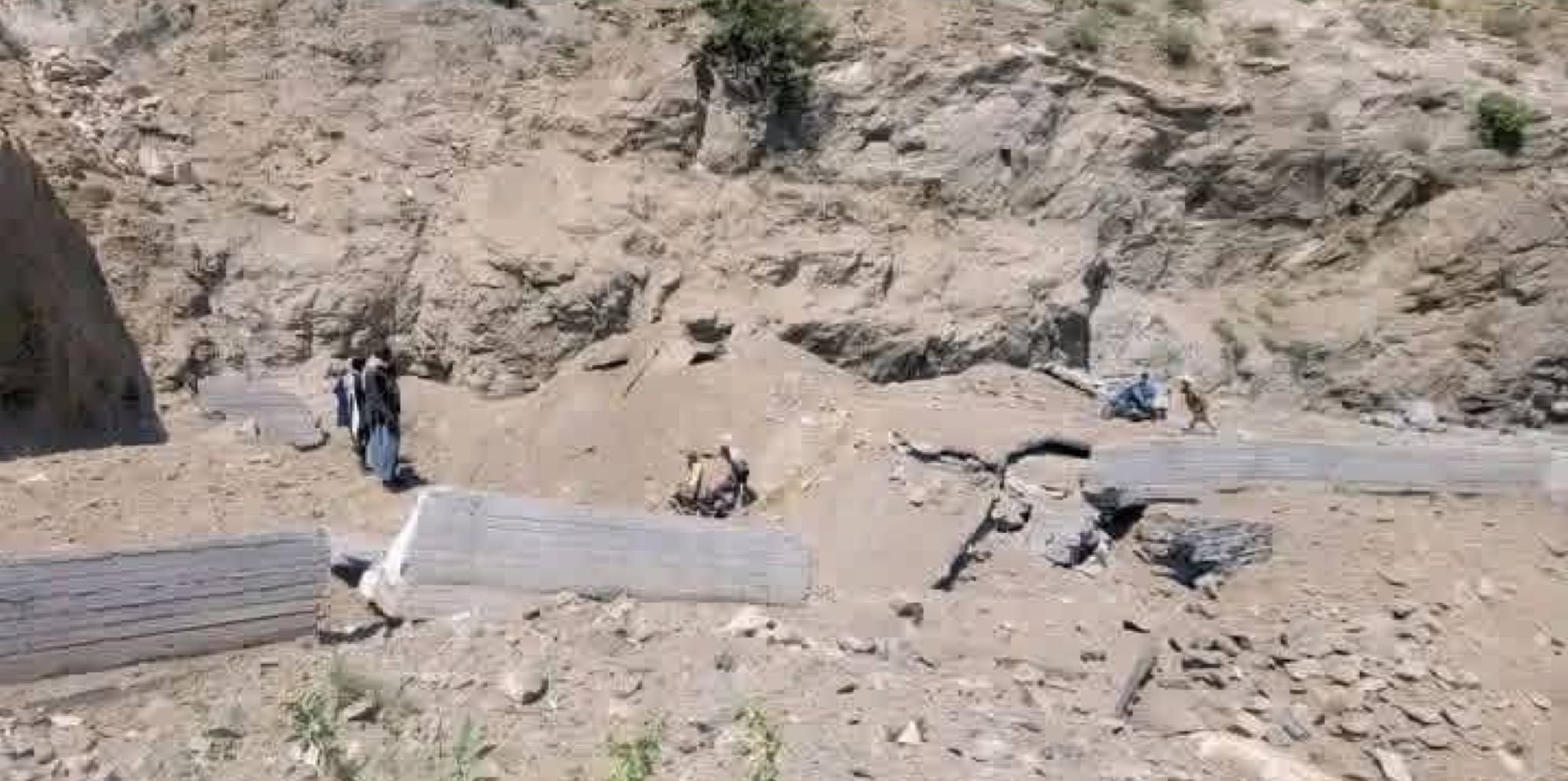
The Houthis resort to blowing up roads to impose collective punishment on the residents of Taiz and Lahj (X)
Villages cut off
The Houthis also blew up culverts along Naqil Musayr, a road connecting villages in western Al-Maqatirah to Al-Turbah, the administrative center of Al-Shamayatayn.
Residents must now walk to the city to shop and run errands. Vehicles can reach it only via the rugged Karbah road, a journey of at least three hours.
The group also blew up part of Naqil al-Khazrah, a stone stairway linking Al-Sharaf village and the Al-Jahili area in Al-Shamayatayn to villages in eastern Al-Maqatirah, forcing residents to take lengthy detours.
In Yemen, a naqil is a winding mountain route connecting higher elevations to foothills and valleys. Residents often build long stone stairways along these routes to make travel easier.
The blasts sent huge boulders crashing onto agricultural terraces, damaging farmland and nearby homes.
Residents of both districts told Asharq Al-Awsat that Houthi fighters had erected barricades and military outposts, dug trenches along roads connecting the districts and positioned weapons toward Al-Maqatirah.
The military buildup has left residents fearing they could be targeted on any pretext.
The Houthis have advanced only a few kilometers into Al-Maqatirah along the Hayjat al-Abd road, securing control of the route and blowing up its culverts. They also control the district's eastern areas.
Observers say the group appears satisfied, for now, with its hold over the high ground in Al-Shamayatayn overlooking Al-Maqatirah. Those positions put the district within range of Houthi fire and allow the group to monitor nearby military movements.
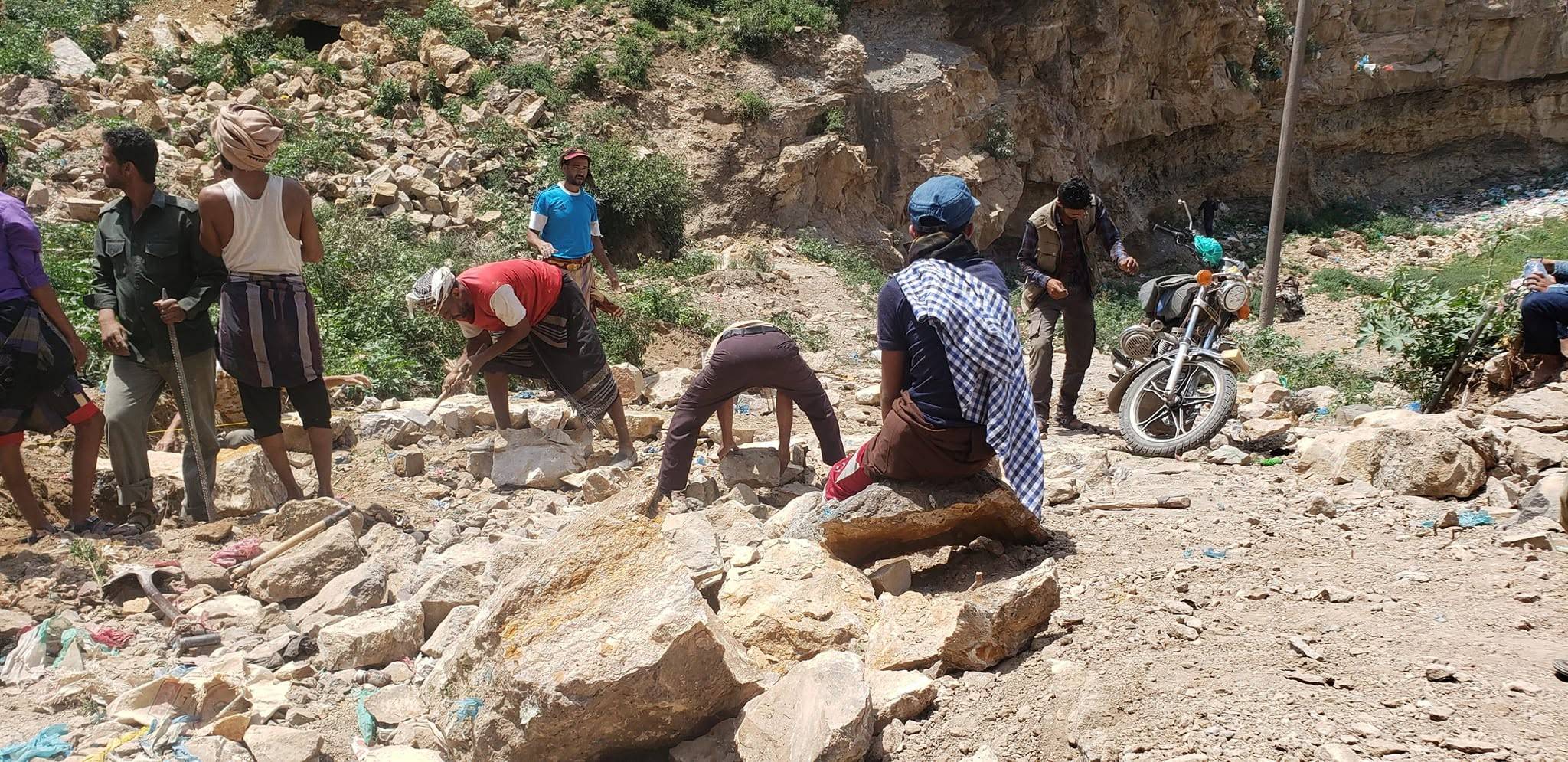
The Houthis blew up several rural roads after residents spent many years building them (Facebook)
Abductions and home raids
The Houthis abducted about 20 people in Qadas, in Al-Mawasit district, after a vehicle belonging to the group's so-called "Preaching Committee" caught fire.
The committee works to persuade residents to embrace the Houthis' ideology and sectarian views.
The group accused residents of Al-Mukayshah village of setting the vehicle ablaze and launched a manhunt, tightening security across the area.
Dozens of gunmen were deployed and new checkpoints set up, where passersby were forced to open their phones for inspection and explain why they were traveling.
In Al-Alqamah, west of Al-Shamayatayn, Houthi fighters also looted homes abandoned by residents who had fled fighting following the group's advance from Al-Wazi'iyah district.
Residents said the fighters broke down doors and entered the homes, claiming to be searching for weapons and accusing their owners of collaborating with the Yemeni army and the Saudi-led coalition supporting Yemen's internationally recognized government.
But the raids went beyond searches. Fighters seized household belongings and loaded them onto vehicles before taking them out of the area.
The escalating restrictions, raids and abductions have heightened fears across rural Taiz that hundreds more residents could be forced to flee their homes for Lahj and Aden.
Israeli Fire Kills Three People in Gazahttps://english.aawsat.com/arab-world/5332402-israeli-fire-kills-three-people-gaza
Palestinians gather around a burning a vehicle after it was hit by an Israeli strike, according to health officials, in Gaza City, October 22, 2026. REUTERS/Dawoud Abu Alkas
Palestinians gather around a burning a vehicle after it was hit by an Israeli strike, according to health officials, in Gaza City, October 22, 2026. REUTERS/Dawoud Abu Alkas
Israeli fire killed one person in a car in Gaza City and at least two others in other parts of the enclave on Thursday, health officials there said.
A crowd gathered around the burning wreckage in Gaza City's Tel Al-Hawa neighbourhood as orange-vested emergency workers sprayed it with water, photos from the scene showed, Reuters reported.
Another strike killed a Palestinian man on a bike in the southern city of Khan Younis, and gunfire killed a woman near the Jabalia refugee camp, in the north, the medics added.
The Israeli military said they had struck a Hamas militant in Khan Younis, without giving further details. The military added they were still checking reports of the strikes in Jabalia and Gaza City's Tel Al-Hawa suburb.
Israel, which says the Hamas militant group has been rearming and launching attacks in violation of a year-old ceasefire, has stepped up strikes on the group in recent weeks.
Hamas has denied trying to carry out attacks or rebuild its arsenal and accuses Israel of undermining the Gaza peace deal.
Last year's US-brokered ceasefire calls for eventual reconstruction of the territory. But little progress has been made as negotiators have failed to agree terms for Hamas to disarm and Israel to withdraw its troops.
Israeli airstrikes have continued. At least 1,500 Palestinians have been killed in Gaza since the ceasefire, according to the territory's health officials, while Israel says four soldiers have been killed.
Palestinian authorities say more than 74,000 people have been killed in Israel's assault on Gaza, launched after Hamas-led fighters killed about 1,200 people in southern Israel on October 7, 2023.
لم تشترك بعد
انشئ حساباً خاصاً بك لتحصل على أخبار مخصصة لك ولتتمتع بخاصية حفظ المقالات وتتلقى نشراتنا البريدية المتنوعة