


Arab League Says Trump Peace Plan Wastes Palestinian Rights as Europeans Review it

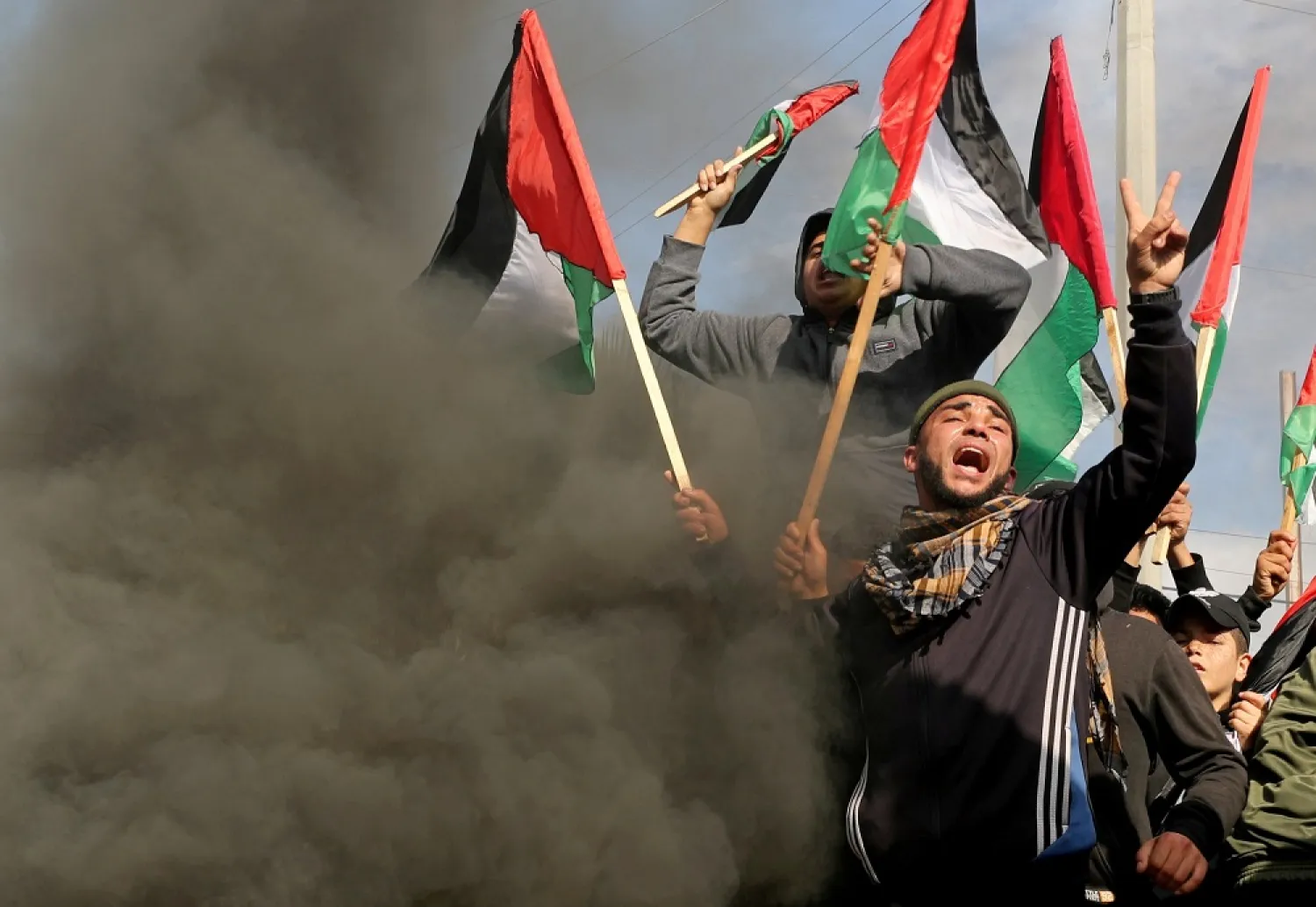
Palestinians protests against Trump's Middle East peace plan. (Reuters)
TT

Arab League Says Trump Peace Plan Wastes Palestinian Rights as Europeans Review it

Palestinians protests against Trump's Middle East peace plan. (Reuters)

Arab League Secretary General Ahmed Abul Gheit said on Wednesday that the first reading of US President Donald Trump's Middle East peace plan indicates a great waste of legitimate rights of Palestinians.

However, the Arab League is "studying the American vision carefully. We are open to any serious effort made to achieve peace," he said.

Kuwait "highly appreciates" US efforts to end the Arab-Israeli conflict, the foreign ministry said on Wednesday.

The statement, carried by the KUNA state news agency, reiterated Kuwait's commitment to an independent Palestinian state based on its borders before the Israeli occupation of the West Bank in 1967.

Bahrain supports all efforts towards achieving a just and comprehensive solution on the Palestinian issue, the foreign ministry said in a statement on Wednesday.

The ministry thanked the United States for its work on the plan and urged the Israeli and Palestinian sides to start direct negotiations under US sponsorship.

Europe

France said it welcomed Trump's latest efforts to strike a peace deal between Palestine and Israel, and added that Paris would have to study the proposals closely.

Trump on Tuesday proposed creating a Palestinian state as part of a Middle East peace plan, drawing Palestinian condemnation for imposing strict conditions and agreeing to let Israel maintain control of long-contested West Bank settlements.

"France welcomes President Trump's efforts and will study closely the peace program he has presented," said a statement from the French foreign ministry, which also reiterated France's desire for a two-state solution on Israel and Palestine.

Russia said it would study the plan and called on Palestinian and Israelis to negotiate directly to find a “mutually acceptable compromise.”

Deputy Foreign Minister Mikhail Bogdanov said: “We do not know if the American proposal is mutually acceptable or not. We must wait for the reaction of the parties.”

Israeli Prime Minister Benjamin Netanyahu is expected to visit Moscow on Wednesday to present the plan to Russian President Vladimir Putin.

EU foreign policy chief Josep Borrell said Trump's initiative “provides an occasion to re-launch the urgently needed efforts towards a negotiated and viable solution" to the conflict.

He said the EU would “study and assess the proposals put forward." He reiterated the bloc's commitment to a “negotiated and viable two-state solution that takes into account the legitimate aspirations of both the Palestinians and the Israelis, respecting all relevant UN resolutions and internationally agreed parameters.”

Germany, the EU's most powerful player, echoed Borrell's point by calling for a balanced approach.

"Only a negotiated two-state solution, acceptable to both sides, can lead to a lasting peace between Israelis and Palestinians," German Foreign Minister Heiko Maas said.

Britain, which is leaving the EU on Friday, gave the warmest reaction.

"This is clearly a serious proposal, reflecting extensive time and effort," British Foreign Secretary Dominic Raab said in a statement.

Earlier, Prime Minister Boris Johnson spoke to Trump to discuss the plans.

Downing Street said the proposal "could prove a positive step forwards".

UN Secretary-General Antonio Guterres said the United Nations supports two states living in peace and security within recognized borders, on the basis of the pre-1967 borders, according to his spokesman.

“The position of the United Nations on the two-state solution has been defined, throughout the years, by relevant Security Council and General Assembly resolutions by which the Secretariat is bound," the spokesman, Stephane Dujarric, said.

Disjointed Palestinian state

Trump’s plan presented a vision that matched Israeli Prime Minister Benjamin Netanyahu’s hard-line, nationalist views while falling far short of Palestinian ambitions.

The plan envisions a disjointed Palestinian state that turns over key parts of the West Bank to Israel. It sides with Israel on key contentious issues that have bedeviled past peace efforts, including borders and the status of Jerusalem and Jewish settlements, and attaches nearly impossible conditions for granting the Palestinians their hoped-for state.

Palestinian President Mahmoud Abbas dismissed the plan as “nonsense” and vowed to resist it. Netanyahu called it a “historic breakthrough” equal in significance to the country's declaration of independence in 1948.

The Palestinians seek all of the West Bank and east Jerusalem — areas captured by Israel in the 1967 Middle East war — for an independent state and the removal of many of the more than 700,000 Israeli settlers from these areas.

The only concession the plan appears to demand of Israel is a four-year freeze on the establishment of new Israeli settlements in certain areas of the West Bank.

Thousands of Palestinians protested in Gaza City ahead of the announcement.

The Palestinians cut off all contacts with the Trump administration after it recognized Jerusalem as the capital of Israel more than two years ago and moved the embassy there, saying it was no longer an honest broker in the peace process.

Late on Tuesday, Palestinian protesters clashed with Israeli forces on the outskirts of Ramallah, near the Jewish settlement of Beit El.



Israel Begins Demolishing 25 Residential Buildings in West Bank Camp

An Israeli army excavator demolishes buildings during a military operation in Nur Shams refugee camp, near the West Bank city of Tulkarem, 31 December 2025. (EPA)
TT

Israel Begins Demolishing 25 Residential Buildings in West Bank Camp

An Israeli army excavator demolishes buildings during a military operation in Nur Shams refugee camp, near the West Bank city of Tulkarem, 31 December 2025. (EPA)

Israeli bulldozers began demolishing 25 buildings housing Palestinians in a refugee camp on Wednesday, in what the military said was an effort to root out armed groups in northern areas of the occupied West Bank.

The buildings, home to some 100 families, are in the Nur Shams camp, a frequent site of clashes between Palestinian gunmen and Israeli forces.

Israeli military bulldozers and cranes tore through the structures early Wednesday, sending thick plumes of dust into the air, an AFP journalist reported. Many residents watched from a distance.

The military said the demolitions were part of an operation against gunmen.

"Following ongoing counterterrorism activity by Israeli security forces in the area of Nur Shams in northern Samaria, the commander of the Central Command, Major General Avi Bluth, ordered the demolition of several structures due to a clear and necessary operational need," the military told AFP in a statement.

"Areas in northern Samaria have become a significant center of terrorist activity, operating from within densely populated civilian areas."

Earlier this year, the military launched an operation it said was aimed at dismantling Palestinian armed groups from camps in northern West Bank -- including Nur Shams, Tulkarem and Jenin.

"Even a year after the beginning of military operations in the area, forces continue to locate ammunition, weapons, and explosive devices used by terrorist organizations, which endanger soldiers and impair operational freedom of action," the military said on Wednesday.

Earlier in December, AFP reported residents of the targeted buildings retrieving their belongings, with many saying they had nowhere to go.

The demolitions form part of a broader Israeli strategy aimed at easing access for military vehicles within the densely built refugee camps of the West Bank.

Israel has occupied the Palestinian territory since 1967.

Nur Shams, along with other refugee camps in the West Bank, was established after the creation of Israel in 1948, when hundreds of thousands of Palestinians were displaced from their homes in what is now Israel.

With time, the camps they established inside the West Bank became dense neighborhoods not under their adjacent cities' authority. Residents pass on their refugee status from one generation to the next.

Many residents believe Israel is seeking to destroy the idea of the camps themselves, turning them into regular neighborhoods of the cities they flank, in order to eliminate the refugee issue.


UN Makes First Visit to Sudan’s El-Fasher Since Its Fall, Finding Dire Conditions

Sudanese displaced from the Heglig area in western Sudan wait to receive humanitarian aid at the Abu al-Naga displacement Camp in the in Gedaref State, some 420km east of the capital Khartoum on December 30, 2025.(AFP)
TT

UN Makes First Visit to Sudan’s El-Fasher Since Its Fall, Finding Dire Conditions

Sudanese displaced from the Heglig area in western Sudan wait to receive humanitarian aid at the Abu al-Naga displacement Camp in the in Gedaref State, some 420km east of the capital Khartoum on December 30, 2025.(AFP)

A UN humanitarian team visited el-Fasher in Sudan’s Darfur region for the first time since a paramilitary force overran the city in October, carrying out a rampage that is believed to have killed hundreds of people and sent most of the population fleeing.

The hours-long visit gave the UN its first glimpse into the city, which remains under control of the Rapid Support Forces. The team found hundreds of people still living there, lacking adequate access to food, medical supplies and proper shelter, the UN said Wednesday.

“It was a tense mission because we’re going into what we don’t know ... into a massive crime scene,” Denise Brown, the UN humanitarian coordinator for Sudan, said of Friday’s visit.

For the past two months, el-Fasher has been nearly entirely cut off from the outside world, leaving aid groups unsure over how many people remained there and their situation. The death toll from the RSF takeover, which came after a more than a year-long siege, remains unknown.

Survivors among the more than 100,000 people who fled el-Fasher reported RSF fighters gunning down civilians in homes and in the streets, leaving the city littered with bodies. Satellite photos have since appeared to show RSF disposing of bodies in mass graves or by burning them.

Brown said “a lot of cleaning up" appeared to have taken place in the city over the past two months. The UN team visited the Saudi Hospital, where RSF fighters reportedly killed 460 patients and their companions during the takeover.

“The building is there, it’s clearly been cleaned up,” Brown said of the hospital. “But that doesn’t mean by any stretch of the imagination that this story has been wiped clean because the people who fled, fled with that story.”

El-Fasher lacks shelters and supplies

El-Fasher, the capital of North Darfur state, had been the last stronghold of the Sudanese military in the Darfur region until the RSF seized it. The RSF and the military have been at war since 2023 in a conflict that has seen multiple atrocities and pushed Sudan into one of the world’s worst humanitarian crises.

The UN team visiting el-Fasher focused on identifying safe routes for humanitarian workers and conducted only an initial assessment on the situation on the ground, with more teams expected to enter, Brown said.

“Villages around el-Fasher appeared to be completely abandoned. We still believe that people are being detained and that there are people who are injured who need to be medically evacuated,” said Brown, citing the initial U.N. findings.

The exact number of people still living in the city is hard to determine, but Brown said they’re in the hundreds and they lack supplies, social services, some medications, education and enough food.

They are living in deserted buildings and in shelters they erected using plastic sheets, blankets and other items grabbed from their destroyed homes. Those places lack visible toilets and access to clean drinking water.

The first charity kitchen to operate since the city’s fall opened Tuesday in a school-turned- shelter, according to the Nyala branch of the local aid initiative Emergency Response Rooms (ERR). The charity kitchen will be operated by ERR Nyala, serving daily meals, food baskets, and shelter supplies. More community kitchens are expected to open across 16 displacement centers, sheltering at least 100 people.

The UN team found a small open market operating while they were in the city, selling limited local produce such as tomatoes and onions. Other food items were either unavailable or expensive, with the price of one kilogram (2.2 pounds) of rice reaching as high as $100, Brown said.

‘Paralyzed’ health care system

Mohamed Elsheikh, spokesperson for the Sudan Doctors Network, told The Associated Press Wednesday that medical facilities and hospitals in el-Fasher are not operating in full capacity.

“El-Fasher has no sign of life, the healthcare system there is completely paralyzed. Hospitals barely have access to any medical aid or supplies,” he added.

Brown described the situation in el-Fasher as part of a “pattern of atrocities” in this war that is likely to continue in different areas.

The United States has accused the RSF of committing genocide in Darfur during the war, and rights groups said the paramilitaries committed war crimes during the siege and takeover of el-Fasher, as well as in the capture of other cities in Darfur. The military has also been accused of rights violations.


Israel to Ban 37 Aid Groups Operating in Gaza

Palestinians walk along streets past tent camps for displaced people in Gaza City, Wednesday, Dec. 31, 2025. (AP)
TT

Israel to Ban 37 Aid Groups Operating in Gaza

Palestinians walk along streets past tent camps for displaced people in Gaza City, Wednesday, Dec. 31, 2025. (AP)

Israel plans to ban 37 aid organizations from operating in Gaza from Thursday unless they hand over detailed information on their Palestinian staff, despite mounting criticism from the United Nations and the European Union. 

Several NGOs have told AFP the new rules will have a major impact on food and medical shipments to Gaza, and humanitarian groups warn there is already not enough aid to cover the devastated territory's needs. 

Israel's deadline for NGOs to provide the details expires at midnight on Wednesday. 

"They refuse to provide lists of their Palestinian employees because they know, just as we know, that some of them are involved in terrorism or linked to Hamas," spokesman for the Ministry of Diaspora Affairs and Combating Antisemitism, Gilad Zwick, told AFP, naming 37 NGOs that had so far failed to meet the new requirements. 

"I highly doubt that what they haven't done for 10 months, they will suddenly do in less than 12 hours," Zwick said. "We certainly won't accept any cooperation that is just for show, simply to get an extension." 

For its part, Hamas, the armed Palestinian group which still controls part of Gaza, branded the Israeli decision "criminal behavior" and urged the United Nations and broader international community to condemn it. 

Israel says the new regulation aims to prevent bodies it accuses of supporting terrorism from operating in the Palestinian territories. 

A fragile ceasefire has been in place in Gaza since October, following a deadly war waged by Israel in response to Hamas's unprecedented attack on Israeli territory on October 7, 2023. 

On Tuesday, Israel specified that "acts of de-legitimizing Israel" or denial of events surrounding Hamas's October 7 attack would be "grounds for license withdrawal". 

Israel has singled out international medical charity Doctors Without Borders (MSF), alleging that it had two employees who were members of Palestinian groups Islamic Jihad and Hamas. 

"We continue to seek reassurances and clarity over a concerning request to share a staff list, which may be in violation of Israel's obligations under international humanitarian law and of our humanitarian principles," MSF said, urging Israel to allow it to operate. 

"We will be exploring all possible avenues to alter the outcomes of this decision." 

Apart from MSF, some of the 37 NGOs to be hit with the ban are the Norwegian Refugee Council, World Vision International, CARE and Oxfam, according to the list given by Zwick. 

- 'Guarantee access' - 

On Wednesday, United Nations rights chief Volker Turk described Israel's decision as "outrageous", calling on states to urgently insist Israel shift course. 

"Such arbitrary suspensions make an already intolerable situation even worse for the people of Gaza," he said. 

The European Union warned that Israel's decision would block "life-saving" assistance from reaching Gazans. 

"The EU has been clear: the NGO registration law cannot be implemented in its current form," EU humanitarian chief Hadja Lahbib posted on X. 

UN Palestinian refugee agency chief Philippe Lazzarini said the move sets a "dangerous precedent". 

"Failing to push back against attempts to control the work of aid organizations will further undermine the basic humanitarian principles of neutrality, independence, impartiality and humanity underpinning aid work across the world," he said on X. 

UNRWA itself has faced the ire of Israeli authorities since last year, with Lazzarini declared persona non grata by Israel. 

Israel had accused UNRWA of providing cover for Hamas, claiming that some of the agency's employees took part in the October 7, 2023 attack. 

A series of investigations found some "neutrality-related issues" at UNRWA, the agency says, but insists Israel had not provided evidence for its headline allegation. 

On Tuesday, the foreign ministers of 10 countries, including France and the United Kingdom, had already urged Israel to "guarantee access" to aid in the Gaza Strip, where they said the humanitarian situation remains "catastrophic". 

In a territory with 2.2 million inhabitants, "1.3 million people still require urgent shelter support", the ministers of Britain, Canada, Denmark, Finland, France, Iceland, Japan, Norway, Sweden and Switzerland said. 

While a deal for a ceasefire that started on October 10 stipulated the entry of 600 trucks per day, only 100 to 300 are carrying humanitarian aid, aid groups say. 

COGAT, the Israeli defense ministry body responsible for Palestinian civilian affairs, said last week that on average 4,200 aid trucks enter Gaza weekly, which corresponds to around 600 daily. 

Israel's ambassador to Belgium and Luxembourg, Idit Rosenzweig-Abu, said that 104 aid organizations had filed for registration according to the new guidelines. 

Nine were rejected, while 37 did not complete the procedures, she said on X, insisting the registration process "intended to prevent the exploitation of aid by Hamas".