Trump Expands Travel Ban

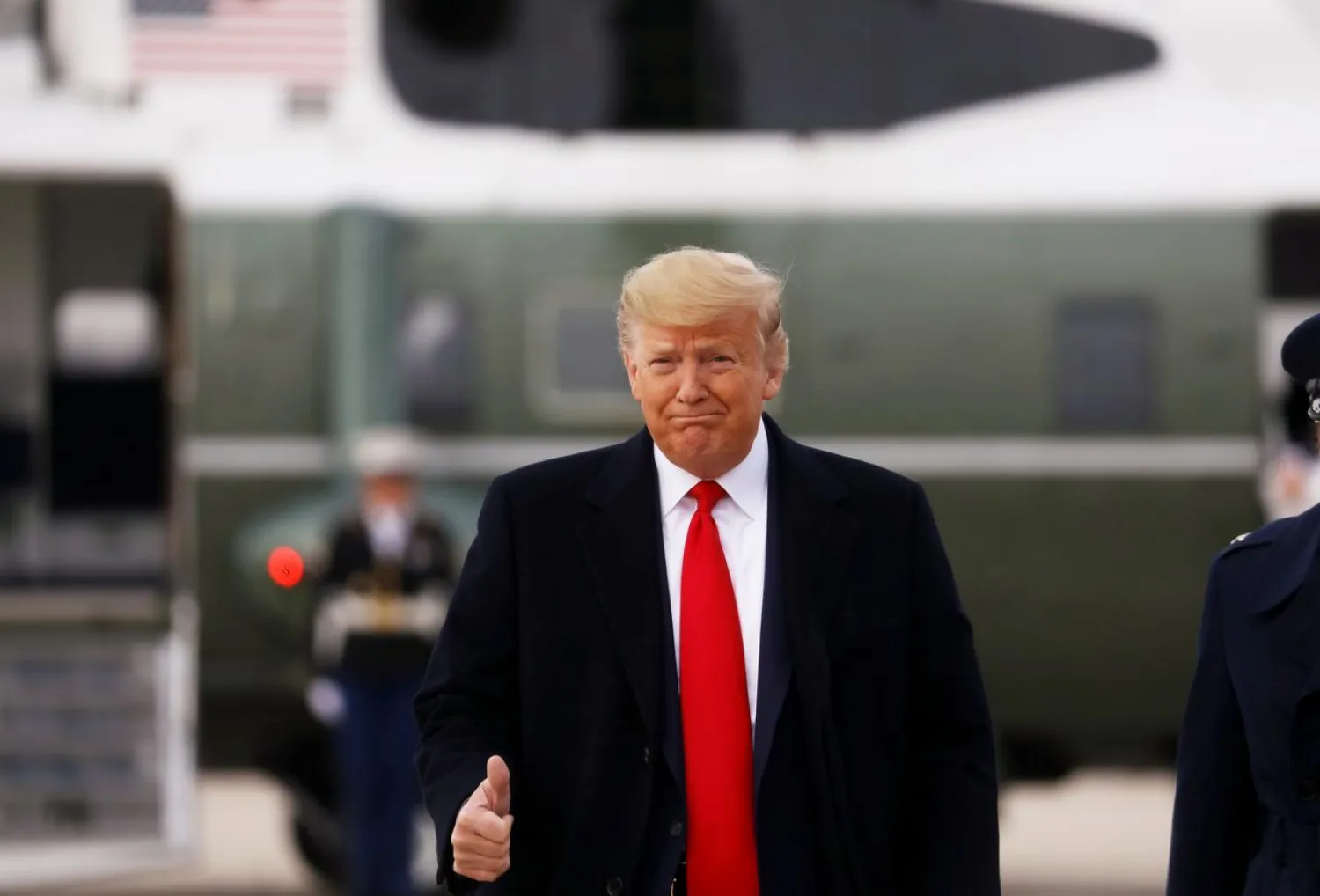
FILE PHOTO: US President Donald Trump gives a thumbs up as he boards Air Force One for travel to Florida at Joint Base Andrews, Maryland, US January 23, 2020. REUTERS/Leah Millis
TT

Trump Expands Travel Ban

FILE PHOTO: US President Donald Trump gives a thumbs up as he boards Air Force One for travel to Florida at Joint Base Andrews, Maryland, US January 23, 2020. REUTERS/Leah Millis

US President Donald Trump issued an expanded version of his travel ban on Friday that targets prospective immigrants from six countries, a move that could affect thousands of people and reignite debate on whether the policy is discriminatory.

Acting Homeland Security Secretary Chad Wolf said during a call with reporters that the six countries failed to meet US security and information-sharing standards, which necessitated the new restrictions.

The problems Wolf cited ranged from sub-par passport technology to a failure to sufficiently exchange information on terrorism suspects and criminals.

Belarus, which had been under consideration for inclusion, took steps to remedy deficiencies in recent months and will not face visa restrictions, Wolf said.

The United States will suspend the issuance of visas that can lead to permanent residency for nationals of Eritrea, Kyrgyzstan, Myanmar and Nigeria, a presidential proclamation said. Temporary visas for tourists, businesspeople, students and workers from those nations will not be affected, it said.

The US government also will stop issuing "diversity visas" to nationals of Sudan and Tanzania, the proclamation said. The visas, which Trump has criticized, are available by lottery for applicants from countries with low rates of immigration.

"These countries, for the most part, want to be helpful," Wolf said, "but for a variety of different reasons simply failed to meet those minimum requirements that we laid out."

The American Civil Liberties Union (ACLU) was quick to condemn the new restrictions, saying that the administration was simply "expanding" the ban's scope.

"President Trump is doubling down on his signature anti-Muslim policy -- and using the ban as a way to put even more of his prejudices into practice by excluding more communities of color," the ACLU said in a statement.


Iran Publishes Chart Showing It May Have Put Sea Mines in Strait of Hormuz as Shaky Ceasefire Holds

TOPSHOT - First responders stand amid rubble at the site of an Israeli airstrike in Beirut's Corniche al-Mazraa neighborhood on April 8, 2026.  (Photo by AFP)
TOPSHOT - First responders stand amid rubble at the site of an Israeli airstrike in Beirut's Corniche al-Mazraa neighborhood on April 8, 2026. (Photo by AFP)
TT

Iran Publishes Chart Showing It May Have Put Sea Mines in Strait of Hormuz as Shaky Ceasefire Holds

TOPSHOT - First responders stand amid rubble at the site of an Israeli airstrike in Beirut's Corniche al-Mazraa neighborhood on April 8, 2026.  (Photo by AFP)
TOPSHOT - First responders stand amid rubble at the site of an Israeli airstrike in Beirut's Corniche al-Mazraa neighborhood on April 8, 2026. (Photo by AFP)

Semiofficial news agencies in Iran published a chart Thursday suggesting the country’s paramilitary Revolutionary Guard put sea mines into the Strait of Hormuz during the war, in a message that may be intended to pressure the US as uncertainty hangs over a days-old two-week ceasefire and further negotiations are expected in Pakistan.

The shaky ceasefire has been largely holding between the US, Israel and Iran, although Tehran and Washington have offered vastly different explanations of the initial terms, The Associated Press said.

Israel insists the agreement does not apply to their war against Hezbollah militants in Lebanon and have escalated deadly strikes there, leading Iran to claim it is violating the deal. Meanwhile, Iran said it had won agreement that it would control the Strait of Hormuz, charge tolls and enrich uranium — while Trump said the deal called for the strait to be reopened and Iran to hand over its uranium stockpile.

The chart of the Strait of Hormuz was released by the ISNA news agency, as well as Tasnim, which is believed to be close to the Guard. They showed a large circle marked “danger zone” in Farsi over the Traffic Separation Scheme, which was the route ships take through the strait, the narrow mouth of the Arabian Gulf through which 20% of all oil and natural gas traded once passed.

The chart suggested ships travel further north through waters closer to Iran’s mainland near Larak Island, a route that some ships were observed taking during the war. It was dated from Feb. 28 until Thursday, April 9, and it was unclear if the Guard had cleared any mining on the route since then.

Oil rose again to above $97 a barrel and Asian stocks were trading lower Thursday on skepticism over the ceasefire. Brent crude, the international standard, was up 2.9% to $97.46 per barrel. It had fallen briefly to below $92 following the temporary ceasefire announcement. Benchmark US crude was 3.7% higher Thursday at $97.94 per barrel.

Ship-tracking data from Kpler showed only four vessels with their Automatic Identification System trackers on passed through the Strait of Hormuz on Wednesday, the first day of the ceasefire. However, that does not include so-called “dark fleet” vessels, which travel with their AIS trackers turned off. Many of those “dark fleet” ships carry sanctioned Iranian crude oil out to the open market.

Trump says US forces will remain in the area

US President Donald Trump posted a statement insisting that his surge of warships and troops will remain around Iran “until such time as the REAL AGREEMENT reached is fully complied with.”

Trump’s comments on his Truth Social platform appeared to be a way to pressure Iran.

“If for any reason it is not, which is highly unlikely, then the ‘Shootin’ Starts,’ bigger, and better, and stronger than anyone has ever seen before,” Trump wrote.

He also insisted Iran would not be able to build nuclear weapons and “the Strait of Hormuz WILL BE OPEN & SAFE.”

The US and Iran both claimed victory after reaching the ceasefire agreement, and world leaders expressed relief. But more drones and missiles hit Iran and Gulf Arab countries after the deal was announced.

Israel also intensified its attacks on the Hezbollah militant group in Lebanon on Wednesday, hitting commercial and residential areas in Beirut. At least 182 people were killed in the deadliest day of fighting there. First responders searched overnight for missing people still under the rubble after the deadly Israeli strikes.

A fragile ceasefire

The violence threatened to scuttle what US Vice President JD Vance called a “fragile” deal.

Iran's parliament speaker said Wednesday that planned talks were “unreasonable” because Washington had broken three of Tehran’s 10 conditions for an end to the fighting. In a social media post, Mohammad Bagher Qalibaf objected to Israeli attacks on Hezbollah, an alleged drone incursion into Iranian airspace after the ceasefire took effect and US refusal to accept any Iranian enrichment capabilities in a final agreement.

Iranian Foreign Minister Abbas Araghchi insisted that an end to the war in Lebanon was part of the ceasefire deal, but Israeli Prime Minister Benjamin Netanyahu and Trump said the truce did not cover Lebanon. When the deal was announced, the prime minister of Pakistan, which served as a mediator, said in a social media post that it applied to “everywhere including Lebanon and elsewhere.”

A New York-based think tank warned the ceasefire “hovers on the verge of collapse.”

The Soufan Center said Israel's strikes on Lebanon on Wednesday added to the risk the deal would fall apart.

“Even if Lebanon was formally outside the deal, the scale of Israel’s strikes was likely to be viewed as escalatory, nonetheless,” it wrote in an analysis published Thursday. “Israel’s strikes can be understood both as an effort to drive a wedge between Iran and its proxies and as a response to being allegedly sidelined in the original ceasefire discussions.”

Peace talks expected in Pakistan

The White House said that Vice President JD Vance would lead the US delegation to talks in Islamabad aimed at ending the war, which are set to start Saturday.

Iran’s negotiating team will arrive in Islamabad on Thursday night, the Iranian ambassador there said.

Reza Amiri Moghadam wrote on X that the “Iranian delegation arrives tonight in Islamabad for serious talks based on 10 points proposed by Iran,” without identifying who was on the Iranian team.

Those points include Iran enriching uranium, maintaining its control of the Strait of Hormuz and other issues that have been nonstarters in the past for Trump. The White House has repeatedly described the 10 points issued by Iran as false.

Moghadam wrote that the Iranians would come to Islamabad despite “skepticism of Iranian public opinion due to repeated ceasefire violations by Israeli regime to sabotage the diplomatic initiative,” likely referring to Israel’s strikes on Lebanon, which Israel and the US have said wasn’t included in the shaky ceasefire.



Iranian Delegation Due in Islamabad ahead of US Talks

Demonstrators flags of Iran and Lebanon during a protest against US military action in Iran near the White House in Washington, DC, on April 8, 2026. (Photo by Brendan SMIALOWSKI / AFP)
TT

Iranian Delegation Due in Islamabad ahead of US Talks

Demonstrators flags of Iran and Lebanon during a protest against US military action in Iran near the White House in Washington, DC, on April 8, 2026. (Photo by Brendan SMIALOWSKI / AFP)

An Iranian delegation is expected to arrive in Islamabad late Thursday ahead of Pakistan-brokered talks with the United States, Iran's envoy said.

Pakistan has been preparing for talks involving representatives from the US and Iran over the Mideast war, with the White House saying Vice President JD Vance would lead negotiations in Islamabad "this weekend".

Iran's ambassador to Pakistan, Reza Amiri Moghadam, said in a post on X that "despite skepticism due to repeated ceasefire violations by (the) Israeli regime" Pakistan's Prime Minister Shehbaz Sharif has welcomed an Iranian delegation for "serious talks".

"Iranian delegation arrives tonight in Islamabad for serious talks based on 10 points proposed by Iran," Moghadam added.

The development came as authorities in the Pakistani capital declared on Wednesday local holidays across Islamabad for the next couple of days, said AFP.

While no specific reason was provided, holidays or restrictions are often issued for security reasons ahead of high-profile diplomatic events in the region.

Offices providing essential services will remain open during this period, including police, hospitals and power and gas utilities.

"Essential services will remain operational," the deputy commissioner's office said in a statement posted on X on Wednesday, advising residents to "plan their activities accordingly".


Trump Says US-Iran Talks Will Be Behind Closed Doors

US President Donald Trump, flanked by Secretary of Defense Pete Hegseth, speaks during a press conference in the James S. Brady Press Briefing Room at the White House in Washington, DC, US, April 6, 2026. (Reuters)
TT

Trump Says US-Iran Talks Will Be Behind Closed Doors

US President Donald Trump, flanked by Secretary of Defense Pete Hegseth, speaks during a press conference in the James S. Brady Press Briefing Room at the White House in Washington, DC, US, April 6, 2026. (Reuters)

US President Donald Trump on Wednesday said talks on the Iran crisis would be held behind closed doors, and that "only one group of meaningful 'POINTS'" were acceptable to the United States, ‌but gave ‌no other details about ‌the ⁠negotiations.

"These are the ⁠POINTS that are the basis on which we agreed to a CEASEFIRE. It is something that is reasonable, and can easily be dispensed with," he ⁠said in a social ‌media post.

Trump ‌separately told ABC News in ‌an interview that he expects talks ‌to begin on Friday and to move very quickly.

Pakistan's Prime Minister Shehbaz Sharif earlier on Wednesday said ‌US and Iranian delegations would be arriving in Pakistan ⁠on ⁠Friday after the two nations accepted a two-week ceasefire.

Trump in his online post also threatened a federal probe into unnamed individuals he accused--without providing evidence--of circulating various correspondence that he said were not the basis for the ceasefire agreement.