


Muppets Help Conflict Kids in New Arabic 'Sesame Street'

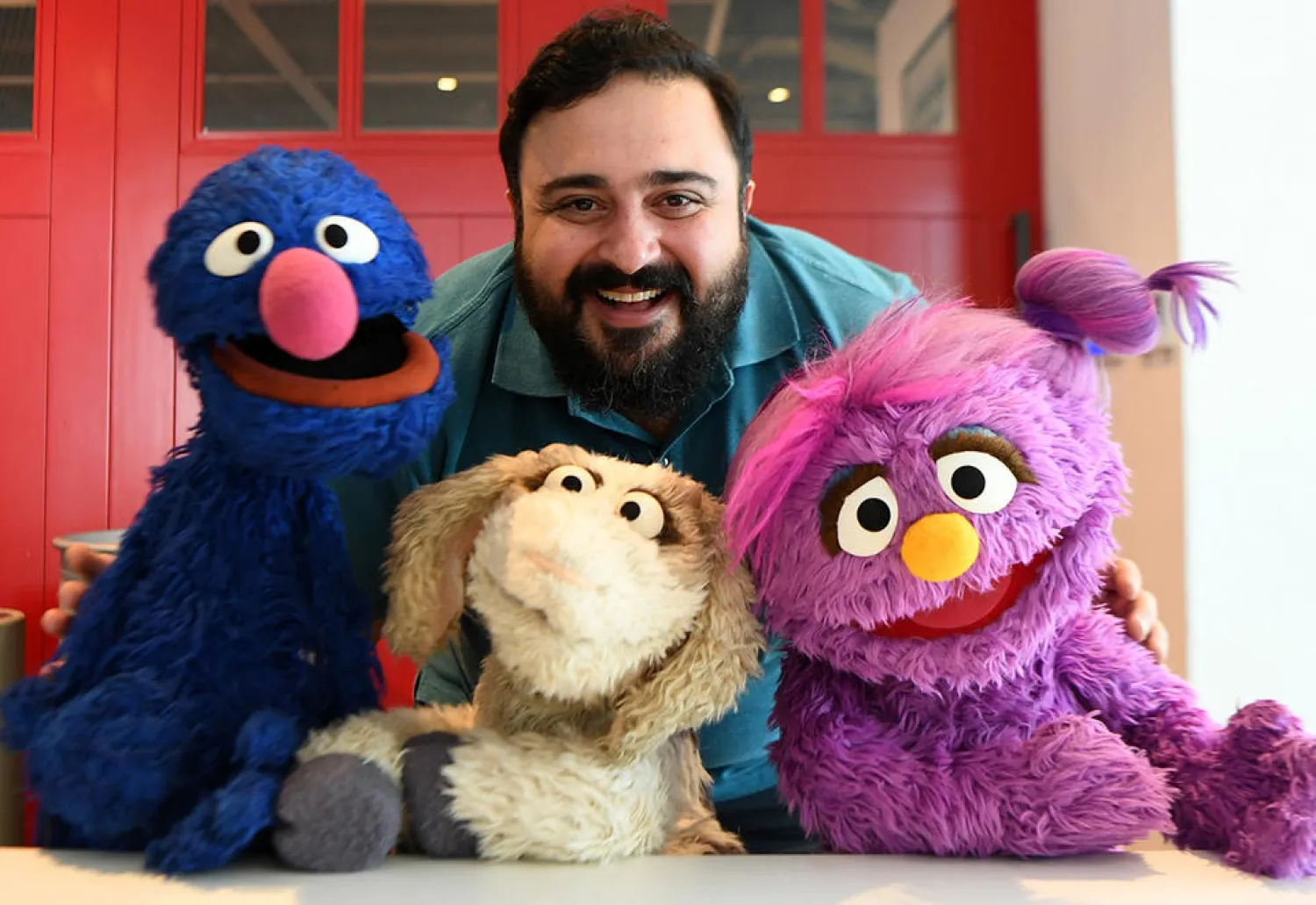
Hadi, the name of the character portrayed by Jordanian actor Rami Delshad, poses for a picture with Grover (L), Ma’zooza (C) and Basma from the Sesame Street series, in Dubai on January 28, 2020. (AFP)
TT

Muppets Help Conflict Kids in New Arabic 'Sesame Street'

Hadi, the name of the character portrayed by Jordanian actor Rami Delshad, poses for a picture with Grover (L), Ma’zooza (C) and Basma from the Sesame Street series, in Dubai on January 28, 2020. (AFP)

Aiming at helping children, especially young refugees, to cope with their emotions, the new Arabic version of "Sesame Street" has kicked off with new muppets joining old favorite ones.

Three new Arabic muppets have been added to the program: Jad, the yellow monster who arrived recently to the street after he left his old house, his friend Basma, the purple muppet, and the goat Ma'zooza. The new characters will join Cookie Monster (Kaa'ki), Grover (Gargur), Elmo and others in the new show in Arabic, called "Ahlan Simsim!" (Welcome Sesame).

Jad has recently arrived to the show to live new adventures with his new friends including Basma. The duration of each episode is 26 minutes, divided into two parts, one of which is a variety that hosts celebrities from the Arab world and children from all Arab nationalities.

"We always play and sing and try new things and have many adventures. We have a lot of friends in the neighborhood, but Jad is my best friend," purple muppet Basma told AFP on a publicity tour in Dubai.

According to a statement by the series' producers, the new version of Sesame Street comes as part of a wider humanitarian project implemented by "Sesame Workshop" and the International Rescue Committee (IRC) responsible for providing early education and care for children.

In its Western iterations, the long-running franchise addresses issues including family breakdown. The new Middle East version instead seeks to help children, especially young Syrian refugees, cope with emotions.

The new Sesame Street started airing on the Arab satellite channel MBC 3 from February 2, and on YouTube as well as many other channels.

The conflict in Syria has displaced over 5.1 million children, with 2.5 million of them now living in regional host countries including Lebanon, Turkey and Jordan.

"Jad and I are not that similar. He is an artist and a painter. I love to sing and dance and he likes things in order. He thinks and plans while I get bored," said Basma.

Sesame Street mainstay Grover, meanwhile, sets out to interview children from across the Arab world, tackling myriad issues including jealousy and how to care for loved ones. The blue character is one of the most loved muppets around the world because of its comic personality.

The makers of the series, which was produced in Jordan, said the episodes will take to the airwaves six days a week, and will focus on children's emotions and how to cope with them. The new show is the result of a two-year-long collaboration with numerous child development specialists.

Executive Producer Khaled Haddad said that the first season of Sesame Street will talk about emotions, noting that it will offer entertainment and education at the same time.

"Unfortunately, our children don't know what their emotion is, the child does not know he is terrified or angry or even jealous. Through our episodes we talk about these emotions and how to deal with them," he added.

In one episode, Basma and Jad learn from big brother figure Hadi how to handle fear. "You put your hand on your tummy then you take a breath through your nose, inhale and exhale. It calms you down," Basma said, demonstrating the technique.

Jad's character, who didn't join the trip to Dubai, is portrayed as new to the community. "But we don't label him as a refugee in the show. He is new to the neighborhood, meets all the kids and becomes friends with them. Our show speaks to all the children of the Arab world," Haddad stressed.

Since its US debut in 1969, Sesame Street was given different titles in more than 150 countries.

In the Arab world, the series was named "Iftah ya Simsim" (Open Sesame) and it enjoyed a great popularity. It was first produced and aired in the Gulf region from 1979 until 1990. Filming for a second season of the new series will begin in March.

"We hope children will become smarter, kinder and better at expressing their emotions after watching this show," Haddad said.




Saudi National Center for Wildlife, Soudah Development Company Release Birds of Prey

The release comes as part of reintroduction programs aimed at enhancing ecological balance and restoring biodiversity in one of the Kingdom’s most prominent mountainous environmental zones - SPA
TT

Saudi National Center for Wildlife, Soudah Development Company Release Birds of Prey

The release comes as part of reintroduction programs aimed at enhancing ecological balance and restoring biodiversity in one of the Kingdom’s most prominent mountainous environmental zones - SPA

Saudi Arabia's National Center for Wildlife (NCW), in cooperation with Soudah Development Company, has released a number of birds of prey in Al-Soudah Park, including three griffon vultures, a black kite, an Arabian scops owl, and an Eurasian sparrowhawk, after rehabilitating them at shelter centers.


The release comes as part of reintroduction programs aimed at enhancing ecological balance and restoring biodiversity in one of the Kingdom’s most prominent mountainous environmental zones, SPA reported.

This release followed the completion of rehabilitation and environmental acclimatization stages to ensure the birds’ readiness and ability to adapt to the nature of the area, contributing to the stability of local species and boosting their ecological roles within mountain ecosystems, particularly in regulating food chains and preserving the health of natural habitats.

The NCW noted that this step falls within its ongoing programs to breed and reintroduce threatened wildlife species, rehabilitate ecosystems, and enrich biodiversity across various regions of the Kingdom, in cooperation with national partners and in line with the objectives of the Saudi Green Initiative and the National Environment Strategy, which support the environmental development goals of the Saudi Vision 2030.

Specialized teams will continue to monitor the released birds and track their movements and ecological behavior using dedicated tools and technologies, supporting the evaluation of the program’s success and the improvement of its outcomes in the future in accordance with the best global environmental practices.


Ariane 6 Lifts Off with 2 European Navigation Satellites

The European Space Agency (ESA) Ariane 6 rocket carrying two Galileo satellites for the the EU's Global Navigation Satellite System (GNSS) launches at the Guiana Space Center in Kourou, on the French overseas department of Guiana, on December 17, 2025. (Photo by Ronan LIETAR / AFP)
TT

Ariane 6 Lifts Off with 2 European Navigation Satellites

The European Space Agency (ESA) Ariane 6 rocket carrying two Galileo satellites for the the EU's Global Navigation Satellite System (GNSS) launches at the Guiana Space Center in Kourou, on the French overseas department of Guiana, on December 17, 2025. (Photo by Ronan LIETAR / AFP)

A European Ariane 6 rocket blasted off from France's Kourou space base in French Guiana early Wednesday, carrying two Galileo global navigation satellites, according to an AFP correspondent.

Lift-off was at 2:01 am local time (0501 GMT) for the fourth commercial flight of the Ariane 6 launch system since the expendable rockets came into service last year.

The rocket was carrying two more satellites of the European Union's Galileo program, a global navigation satellite system that aims to make the bloc less dependent on the US's Global Positioning System (GPS).

The two satellites were set to be placed in orbit nearly four hours after lift-off.

They will bring to 34 the number of Galileo satellites in orbit and "will improve the robustness of the Galileo system by adding spares to the constellation to guarantee the system can provide 24/7 navigation to billions of users. The satellites will join the constellation in medium Earth orbit 23, 222 km (14,429 miles) above Earth’s surface," according to the European Space Agency (ESA) which oversees the program.

Previous Galileo satellites were primarily launched by Ariane 5 and Russian Soyuz rockets from Kourou.

After Russia's invasion of Ukraine, Europe halted space cooperation with Moscow.

Before the Ariane 6 rocket entered into service in July 2024, the EU contracted with Elon Musk's SpaceX to launch two Galileo satellites aboard Falcon 9 rockets in September 2024 from the Kennedy Space Center in Florida.


Delhi Restricts Vehicles, Office Attendance in Bid to Curb Pollution

Children ride a bicycle across a field on smoggy winter morning in New Delhi on December 17, 2025. (Photo by Arun SANKAR / AFP)
TT

Delhi Restricts Vehicles, Office Attendance in Bid to Curb Pollution

Children ride a bicycle across a field on smoggy winter morning in New Delhi on December 17, 2025. (Photo by Arun SANKAR / AFP)

Authorities in India's capital Delhi rolled out strict measures on Wednesday in an attempt to curb pollution, including a ban on vehicles not compliant with latest emission control norms and regulating attendance in private and government offices.

The air quality index (AQI) in the Delhi region, home to 30 million people, has been in the 'severe' category for the past few days, often crossing the 450-mark. In addition, shallow fog in parts of the city worsened visibility that impacted flights and trains.

This prompted the Commission for Air Quality Management to invoke stage four, the highest level, of the Graded Response Action Plan for Delhi and surrounding areas on Saturday.

The curbs ban the entry of older diesel trucks into the city, suspend construction, including on public projects, and impose hybrid schooling, Reuters reported.

Kapil Mishra, a minister in the local government, announced on Wednesday that all private and government offices in the city would operate with 50% attendance, with the remaining working from home.

Additionally, all registered construction workers, many of them earning daily wages, will be given compensation of 10,000 rupees ($110) because of the ban, Mishra said at a press conference in Delhi.

On Tuesday, the government enforced strict anti-pollution measures for vehicles in the city, banning vehicles that are not compliant with the latest emission control standards.

"Our government is committed to providing clean air in Delhi. We will take strict steps to ensure this in the coming days," Delhi's Environment Minister Manjinder Singh Sirsa said late on Tuesday.

Pollution is an annual winter problem in Delhi and its suburbs, when cold, dense air traps emissions from vehicles, construction sites and crop burning in neighboring states, pushing pollution levels to among the highest in the world and exposing residents to severe respiratory risks.

The area, home to 30 million people, gets covered in a thick layer of smog with AQI touching high 450-levels. Readings below 50 are considered good.