

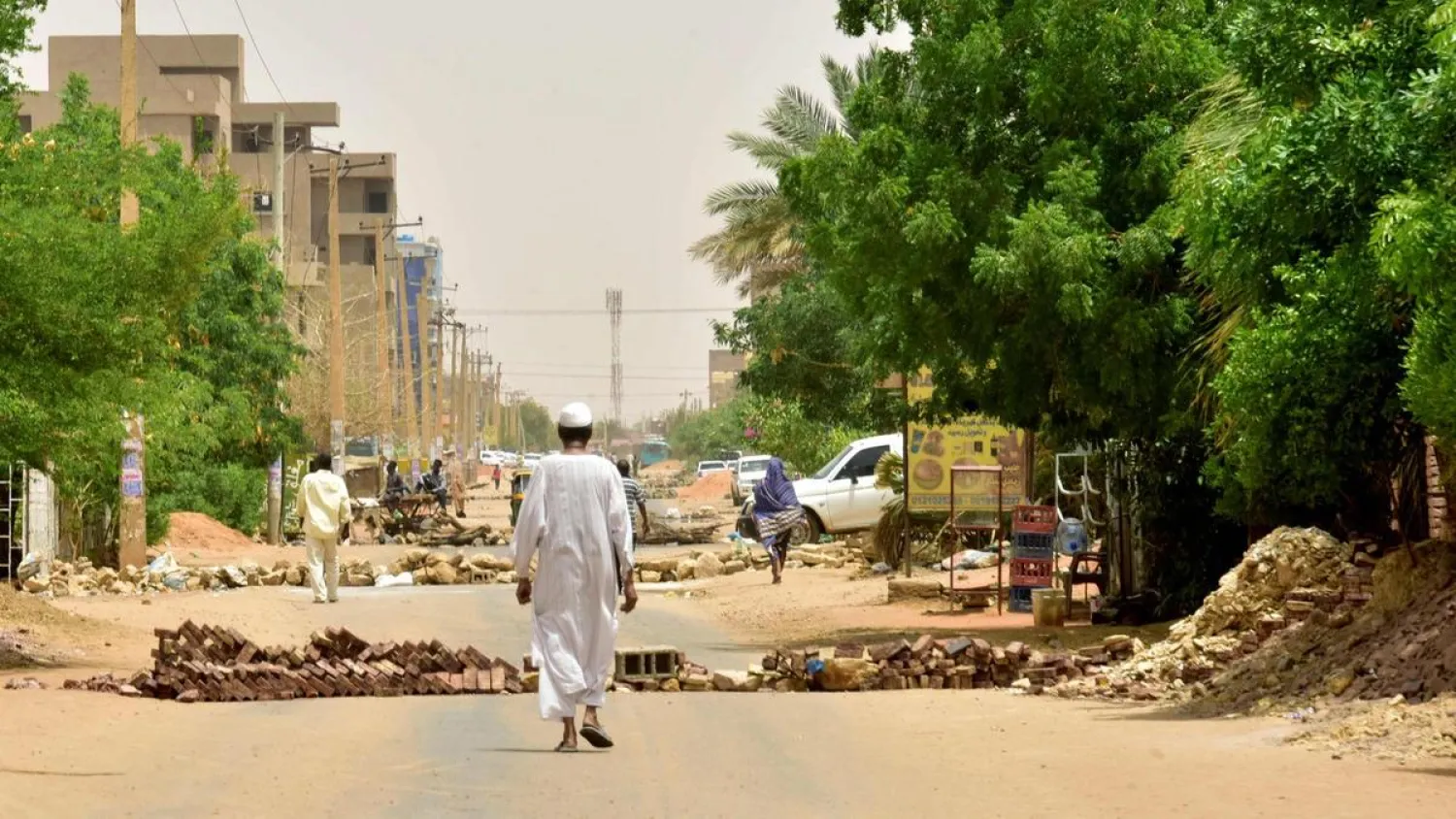

Muslim Brotherhood Cell Plotting Attacks Busted in Khartoum

Sudanese authorities revealed new details about the terrorist cell that was arrested for plotting bombings in Khartoum. (AFP)
TT

Muslim Brotherhood Cell Plotting Attacks Busted in Khartoum

Sudanese authorities revealed new details about the terrorist cell that was arrested for plotting bombings in Khartoum. (AFP)

Sudanese authorities revealed on Thursday new details about the terrorist cell that was arrested for plotting bombings in the capital, Khartoum.

The general prosecution said a suspected, who was detained on Tuesday, confessed to belonging to a terrorist network that is affiliated with the Muslim Brotherhood in Egypt.

He said the cell was sent to Sudan to carry out bombings in Khartoum. He had confessed to receiving training on bomb-making and to smuggling other members of the cell through forged Syrian passports.

The cell had arrived in Sudan six months ago.

Authorities have charged the detainee with terrorism and possessing weapons and ammunition and issued arrest warrants for the remaining members of the cell.

Authorities on Tuesday announced the busting of the cell, which is comprised of Sudanese and foreign members. They also confiscated bomb-making material in their possession.

Separately, the justice ministry said Thursday Sudan has agreed to compensate the families of sailors killed in an al-Qaeda attack on the USS Cole warship 20 years ago, as part of government efforts to remove the country from a list of state sponsors of terrorism.

The settlement had been signed on Feb. 7, reported Reuters. It did not mention the amount paid in compensation, but a source with knowledge of the deal, speaking on condition of anonymity, said that Sudan had agreed to settle the case for $30 million.

Seventeen sailors were killed and dozens of others injured in the attack on Oct. 12, 2000 when two men in a small boat detonated explosives alongside the Navy guided missile destroyer as it was refueling in the southern Yemeni port of Aden.

Khartoum agreed to settle “only for the purpose of fulfilling the condition set by the US administration to remove Sudan from its list of state sponsors of terrorism”, the SUNA news agency said, citing the justice ministry.

Being designated as a state sponsor of terrorism makes Sudan ineligible for desperately needed debt relief and financing from lenders such as the International Monetary Fund and World Bank.

Removal from the list potentially opens the door for foreign investment.

“The government of Sudan would like to point out that the settlement agreement explicitly affirmed that the government was not responsible for this incident or any terrorist act,” the justice ministry said in its statement, cited by SUNA.

The US sailors’ relatives had sued Sudan under the 1976 Foreign Sovereign Immunities Act, which generally bars suits against foreign countries except those designated by the United States as a sponsor of terrorism, as Sudan has been since 1993.

Sudan did not defend against the claims in court. In 2014, a trial judge found that Sudan’s aid to al-Qaeda “led to the murders” of the 17 Americans and awarded the families about $35 million, including $14 million in punitive damages.

Sudan then tried to void the judgment, arguing the lawsuit was not properly served on its foreign minister, violating notification requirements under US and international law.

The US Supreme Court turned down the bid by the families last year.


Lebanese Officials Slam Iran FM’s Remarks against Aoun, Back Negotiations

Iranian Foreign Minister Abbas Araghchi. (AP)
TT

Lebanese Officials Slam Iran FM’s Remarks against Aoun, Back Negotiations

Iranian Foreign Minister Abbas Araghchi. (AP)

Lebanese officials slammed on Saturday Iranian Foreign Minister Abbas Araghchi for criticizing President Joseph Aoun’s comments against Tehran and its meddling in his country.

Aoun, in an interview broadcast Friday by CNN, called on Iran to stop "interfering" in Lebanon's affairs following the collapse of a new truce announced by Washington between Israel and the Iran-backed Hezbollah movement.

"This is not your country. It is our country, our responsibility, and your role is not to interfere in our affairs," Aoun said. "It is our people who are being killed, and our homes that are being destroyed."

Araghchi on Saturday urged Aoun to save Lebanon from its "real foe," Israel.

"Based on Mr. Aoun's comments, one would think it's Iran that has occupied one-fifth of Lebanon, displaced one-quarter of its population and is bombing the country on a daily basis," Araghchi wrote on X.

"If Lebanon were a bargaining chip for Iran, we would have reached an agreement long ago. Save Lebanon from your real foe, Mr. President," he added.

Aoun has faced fierce opposition from Hezbollah since the launch of direct negotiations between Lebanon and Israel that are the first in decades between the countries that have no diplomatic ties.

Lebanese officials were quick to condemn Araghchi and throw their backing behind Aoun and the negotiations.

Lebanese Forces leader Samir Geagea said: "Aoun’s stances, which reject Iran’s continued use of Lebanon as a bargaining chip in its negotiations with the US so that it can remain an open arena for conflict, underscore the president’s clear will to end this flawed situation that has caused turmoil in Lebanon for decades."

In a statement, he added that Aoun’s stance reflects the position of the majority of the Lebanese people who want the establishment of a capable state.

"His stance is directed primarily at the two parties who are treating Lebanon as an open arena for their own agendas against the will of the Lebanese people: Iran and Hezbollah," he stressed.

"The Lebanese and Iranian people never had any problems between them, but the Iranian regime, since the revolution, has sought to use Lebanon as a card in its regional agenda. So, it armed a military proxy for it on Lebanese soil that operates outside the constitution, laws and national will."

"This has caused grave harm to Lebanon, its people, economy and stability and kept the country an open ground for conflicts and war," Geagea remarked.

On Hezbollah’s criticism against Aoun, he noted that the president’s statements again "highlight that the existence of weapons outside state control is a flagrant violation of the constitution and law."

"His latest stance is decisive in saying that this deadly situation in Lebanon can no longer continue," he said.

"Therefore, Iran must once and for all cease interfering in Lebanon’s affairs and respect its sovereignty and independent decision-making. Hezbollah must also immediately comply with the decision of the state and hand over its weapons, end its armed project and dismantle its military and security wings," he demanded.

"Should Iran refuse to comply, then the Lebanese government must execute its own orders, starting with physically removing the Iranian ambassador for Lebanon," who has continued to defy his expulsion order from months ago. This must culminate in the state imposing monopoly over arms, Geagea stressed.

Head of the Kataeb party MP Sami Gemayel slammed Iranian officials, demanding that they "take their hands off Lebanon. Lebanon is not an Iranian province."

"Our president does not ask for permission to defend our sovereignty," he added in a post on X.

"The period of hegemony is over. Our decisions are made in Beirut, not Tehran," he declared.


Drone Strike on Central Sudan Market Kills 11

FILE - This grab from video shows smoke rising over Khartoum, Sudan, Sept. 26, 2024, after Sudan's military started an operation to take areas of the capital from its rival, the paramilitary Rapid Support Forces. (AP Photo/Rashed Ahmed, File)
TT

Drone Strike on Central Sudan Market Kills 11

FILE - This grab from video shows smoke rising over Khartoum, Sudan, Sept. 26, 2024, after Sudan's military started an operation to take areas of the capital from its rival, the paramilitary Rapid Support Forces. (AP Photo/Rashed Ahmed, File)

A drone strike hit a market in central Sudan on Saturday, killing 11 civilians and wounding dozens more, a rights group said, as escalating aerial attacks deepen the toll of one of the world's worst humanitarian crises.

The attack targeted the main market in Abu Zaeima, a paramilitary-controlled town in North Kordofan state, according to the Emergency Lawyers, a rights group that has documented abuses since fighting erupted in April 2023 between the army and the paramilitary Rapid Support Forces (RSF).

The group said the casualty figures could rise but did not specify who carried out the attack. Neither side has commented.

Emergency Lawyers said similar drone attacks had struck nearby villages and civilian vehicles less than a day earlier.

Two witnesses told AFP that another drone hit a fuel station later on Saturday in El-Obeid, the capital of North Kordofan, which has been partially encircled by RSF forces for months.

A medical source at a hospital there said the facility received four wounded civilians.

The attacks followed a deadly week in the broader Kordofan region.

Nearly 70 people were killed in two separate drone strikes in West and North Kordofan states, according to Emergency Lawyers and a local leader.

Drone warfare has become an increasingly prominent feature of Sudan's conflict. The UN says that between January and April, at least 880 civilians were killed in drone strikes nationwide.

Fighting has intensified in Kordofan and Blue Nile state near the Ethiopian border since the RSF captured El-Fasher last October, the military's last major stronghold in western Darfur.

Since then, more than 300,000 people have fled frontline areas, including El-Fasher and parts of Kordofan and Blue Nile, according to the UN.

Kordofan, rich in oil and arable land, is strategically significant, linking RSF strongholds in the neighboring Darfur region to the country's army-controlled east. The region remains largely contested between the army and the RSF.

Having entered its fourth year, the war has killed tens of thousands of people and forced more than 11 million from their homes, creating what the UN describes as the world's largest displacement and hunger crises.


Facing Settler Violence, Palestinian Farmers Race to Harvest

Palestinians are rushing to gather in their crops against a backdrop of violence from Israeli settlers. Zain JAAFAR / AFP
TT

Facing Settler Violence, Palestinian Farmers Race to Harvest

Palestinians are rushing to gather in their crops against a backdrop of violence from Israeli settlers. Zain JAAFAR / AFP

With pitchforks and a makeshift combine the size of a golf cart, Hamad Jazi and his nephews race under the blazing sun to collect wheat from their West Bank field.

Israeli settlers have recently set fire to crops in the area, and Jazi fears his wheat could suffer a similar fate.

Their village of As-Sawiyah, in the center of the occupied West Bank, sits in a valley dominated by hills on top of which three settlements stand.

"The settlers have set fires twice already -- yesterday and the day before," Jazi told AFP.

"If you think back 10, 15 or 20 years ago, this season used to be a season of abundance. Today, you are racing against time just to harvest quickly and leave," he added.

Excluding east Jerusalem, more than 500,000 Israelis live in the occupied West Bank in settlements that are illegal under international law, among some three million Palestinians.

Israel has occupied the West Bank since 1967.

Shielded by what rights groups describe as impunity from the law, some settlers have harassed rural Palestinian communities, vandalizing property and crops, committing arson and sometimes killing.

By all metrics, 2026 has been one of the most violent years to date, with an average of six attacks per day, according to data from UN humanitarian agency OCHA.

The surge in violence goes hand in hand with the proliferation of settlements in the West Bank, which part of the Israeli political class is threatening to annex.

Settlers in rural areas vandalize property and start fires, at times sowing terror in villages, as shown in videos posted on social media, sometimes by the perpetrators themselves.

The attacks have sparked criticism inside Israel, where the opposition accuses Prime Minister Benjamin Netanyahu's government and his far-right allies of turning a blind eye to acts of settler violence.

According to Mahmud Fatafta of the Palestinian Authority's agriculture ministry, settlers killed or stole 8,000 goats or sheep in the West Bank in 2026.

According to his ministry's data, 41,000 olive trees, a crop as emblematic to Palestinians as it is ubiquitous in the West Bank's rocky hills, were damaged by settlers or Israel's military in 2026.

- 'Steal our own crops' -

"In the past, when we went out into the fields, the olive harvest was a celebration; the grain harvest was a celebration," Jazi, his face worn by the sun, told AFP.

Now, "we live those moments like thieves. We go and 'steal' our own olives or our own crops", he said, complaining that the Israeli military requires him to coordinate with it before entering his fields.

Hikmat Abu Ras, head of As-Sawiya's village council, told AFP that his and neighboring communities have faced near daily attacks from settlers since the start of the war in Gaza in October 2023.

"They constantly carry out these practices in order to drive us off our land and prevent us from entering it," he said.

Abu Ras lamented increasing movement restrictions that further isolate communities like his.

"Gates block the entrances to villages, camps, and cities. Movement is restricted. You race against time just to make sure the settler does not come and seize what is on your land."
