


Alisher Usmanov’s Remedy for Love? New Love. and a £6.8m Olympic Manifesto

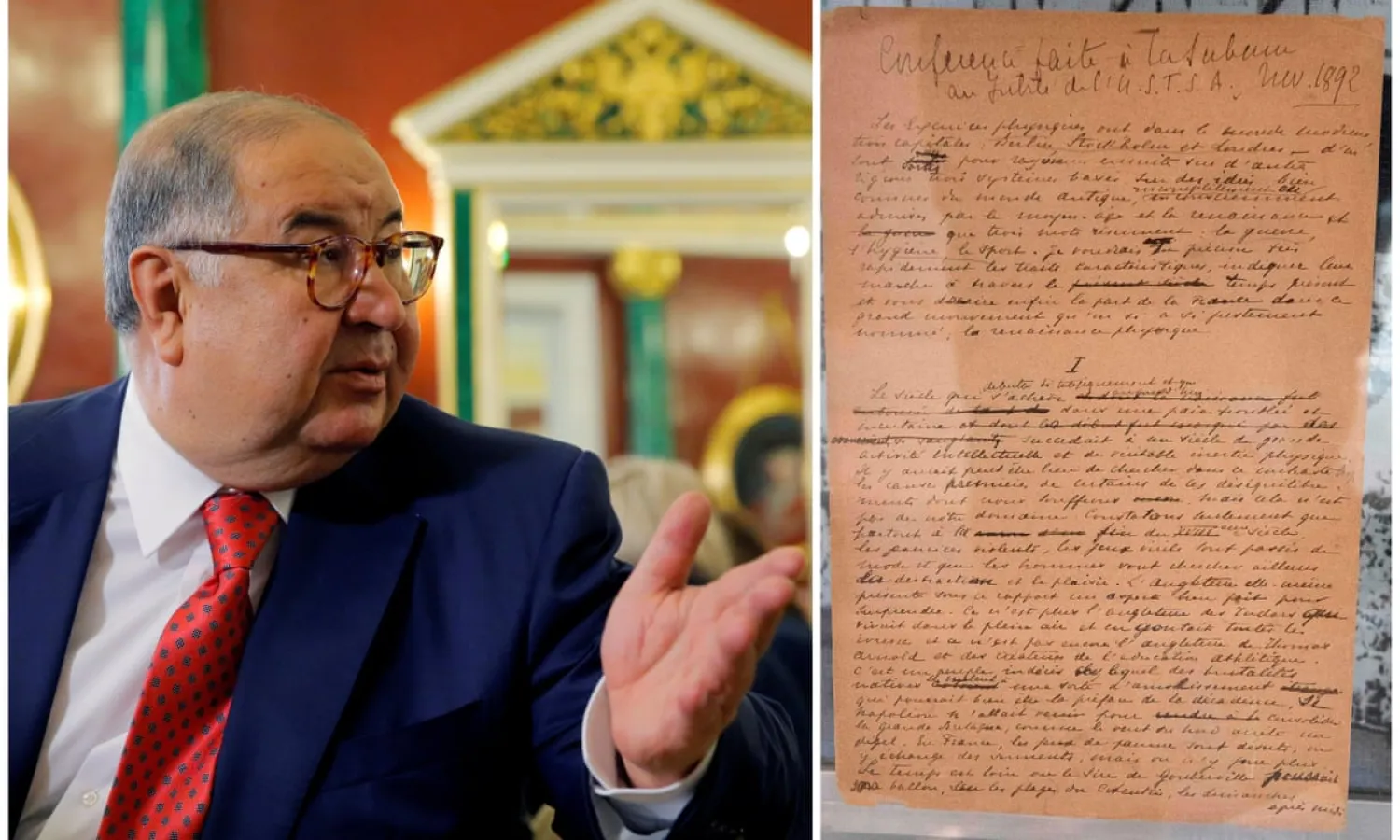
Alisher Usmanov bought the original Olympic manifesto a week after he had suggested Wada’s Russian doping ban was a ‘lynching’. Composite: AFP/Getty Images/Reuters
TT

Alisher Usmanov’s Remedy for Love? New Love. and a £6.8m Olympic Manifesto

Alisher Usmanov bought the original Olympic manifesto a week after he had suggested Wada’s Russian doping ban was a ‘lynching’. Composite: AFP/Getty Images/Reuters

At last, the mystery buyer of the world’s most expensive piece of sports memorabilia has been revealed as the Russian tycoon Alisher Usmanov. The cuddly oligarch purchased Pierre de Coubertin’s original 1892 Olympic manifesto for $8.8m (£6.8m) in December – a whole week after he had suggested Wada’s Russian doping ban was a “lynching”, and a whole two weeks after the IOC president, Thomas Bach, had awarded Usmanov the IOC Trophy of Olympic Values in his capacity as the deep-pocketed bankroller and president of the International Fencing Federation. As Bach advised delegates at the ceremony: “Be a part of the change you want to see.”

Despite being a man not universally hailed as a great listener, perhaps Usmanov took Bach’s friendly advice on board. He has now made known his identity as the buyer of the De Coubertin manifesto, which – in a sensational act of kindness – he has donated to the Olympic Museum. On Monday he posed for pictures with an emotional Bach and the document. “Pierre de Coubertin had a vision of a world united by athletic pursuits and not divided by confrontations and wars,” Usmanov declared. “I believe that the Olympic Museum is the most appropriate place to keep this priceless manuscript.”

Totally. For his part, Bach was lengthily effusive, offering several variations on: “Today we are witnessing history.” It wouldn’t be the first time he’d been grateful to Usmanov. At the same December ceremony that Usmanov was awarded the trophy of Olympic Values, the International Fencing Federation opted to present a gong to the person who has shown “the most chivalrous and unselfish attitude and spirit of sportsmanship and fair play”. And in an instance of synchronicity you’d struggle to describe as anything other than Jungian, that person turned out to be none other than Thomas Bach. I know! What are the chances?

Coincidentally, Bach is a former fencer, along with Usmanov, Pavel Kolobkov, who was until two weeks ago the Russian sports minister, and the Russian Olympic Committee chair, Stanislav Pozdnyakov. But please don’t think this is some kind of closed shop. For instance, in 2015, Bach presented the Olympic Order to the president of the Russian Rhythmic Gymnastic Federation, who – in unrelated news - is related to Usmanov by marriage. Specifically, she is his wife.

What else can be said about Usmanov? Formerly a significant investor in Facebook, he controls Russia’s second-biggest phone network, has a stake in its largest internet company and owns Metalloinvest, a hugely successful mining company which still sounds like someone named it in a hurry. “Just call it... Metall … o … invest. Metalloninvest. Shut up – it sounds fine – just file the paperwork and let’s start coining it.” Other than that, Alisher’s interweb presence has been carefully curated. When one PR firm overstepped the mark by editing unpleasantness out of his Wikipedia entry, they swiftly coughed to acting alone. So please don’t picture Usmanov’s image management as a sort of hole in the wall, through which tainted internet has been passed, while samples of clean internet have been passed the other way.

Whichever way you slice it, though, it’s been a busy couple of sport-related months for Usmanov. Aside from the lynching letter and the reciprocal awardfest with Bach, he also struck a £30m deal for naming rights to Everton’s new stadium. Everton’s majority shareholder is Usmanov’s business partner, Farhad Moshiri. Much of this football activity on Usmanov’s behalf is apparently to get over his love for Arsenal, after he sold his 30% stake in the club in 2018. “What is the remedy for love? New love,” he explained to the FT in a recent lunchtime interview, possibly as part of a PR blitz. This, he said, was why he was able to “move on” from Arsenal to Everton. “If you think like a Muslim, who can have four wives, or a harem.”

Well, put like that. Usmanov used the same interview to stress he wasn’t an oligarch. “But I would be indecent to say the state didn’t give me this opportunity. All the time, since I started doing big business, with big industrial assets, the power, the state, has been very co-operative and helpful and never refused us anything,” he says. Of Putin he acknowledged that the Russian president “is the number one leader in the world” but dismissed the idea he did him favors. “He doesn’t need anything.”

That feels vaguely debatable. In the area of, say, sport, Putin arguably really needs this whole Olympic ban to go away. By way of a recap, Wada recommended a blanket ban on all Russian athletes for the 2016 Rio Olympics after its massive, state-sponsored cheating program had been at least partially exposed, though this was helpfully fudged so that only some sports were prevented from competing. Alas, Russia was entirely banned from competing under its own flag at the 2018 Pyeongchang Winter Games. And given that misfortune comes in threes, it is perhaps no surprise the hapless nation has been banned from competing this year in Tokyo.

I guess the question for a country apparently unwilling to alter certain aspects of its competitive behavior is: are there any OTHER ways of being the change the IOC apparently wants to see?

Only time will show. Russia is appealing the latest Wada ban. In 2017 Usmanov claimed the ban on Russia “contradicts the principles of the Olympic movement”. Back then this plea was ignored – but perhaps he and Russia will have better luck this time. After all, who better to trust on the principles of the Olympic movement than the man who bought the original document of the principles of the Olympic movement?

(The Guardian)


Morocco's Igamane Suffers ACL Injury

Morocco's forward #07 Hamza Igamane reacts as he misses his penatly during the Africa Cup of Nations (CAN) semi-final football match between Nigeria and Morocco at the Prince Moulay Abdellah stadium in Rabat on January 14, 2026. (Photo by FRANCK FIFE / AFP)
TT

Morocco's Igamane Suffers ACL Injury

Morocco's forward #07 Hamza Igamane reacts as he misses his penatly during the Africa Cup of Nations (CAN) semi-final football match between Nigeria and Morocco at the Prince Moulay Abdellah stadium in Rabat on January 14, 2026. (Photo by FRANCK FIFE / AFP)

Lille striker Hamza Igamane suffered an anterior cruciate ligament injury in Morocco's Africa Cup of Nations final against Senegal, the Ligue 1 side announced on Monday, casting doubt over his participation in this year's World Cup.

The 23-year-old was on the bench ‌for the ‌final, which Senegal ‌won ⁠1-0, before ‌coming on in extra time as the sixth substitute. He lasted seven minutes before going off injured, leaving Walid Regragui's side to finish the match with ⁠10 men.

"Tests carried out on the ‌player have unfortunately confirmed ‍a serious ‍injury. Hamza Igamane has indeed ‍suffered a rupture of the anterior cruciate ligament in his right knee," Reuters quoted Lille as saying in a statement.

"Hamza will be unavailable for several months," it added, with ⁠the injury coming five months before the 2026 World Cup, where Morocco will face Brazil, Scotland and Haiti in Group C.

Igamane, who joined Lille from Rangers in the close season, has scored nine goals in 21 games for the French ‌side in all competitions.


Precision-Serving Former Finalist Rybakina Powers on in Melbourne

Kazakhstan's Elena Rybakina signs autographs after her victory against Slovenia's Kaja Juvan in their women's singles match on day three of the Australian Open tennis tournament in Melbourne on January 20, 2026. (AFP)
TT

Precision-Serving Former Finalist Rybakina Powers on in Melbourne

Kazakhstan's Elena Rybakina signs autographs after her victory against Slovenia's Kaja Juvan in their women's singles match on day three of the Australian Open tennis tournament in Melbourne on January 20, 2026. (AFP)

Former finalist Elena Rybakina warned Tuesday if her serve was firing she would be a threat at the Australian Open, after reinforcing her title credentials with a comfortable first-round victory.

The fifth seed, who lost the 2023 final in three tough sets to Aryna Sabalenka, sent Slovenia's Kaja Juvan packing 6-4, 6-3 with her serve proving a potent weapon.

Rybakina won 83 percent of her first-serve points to keep up her record of safely negotiating the first hurdle at every Grand Slam since the 2022 US Open.

"No matter who is on the other side, if the serve is going, then it's perfect," she said after routinely racing to 40-0 leads and holding to love three times.

"Of course, little things (to work on) on the serve. Maybe adjust, be better in the first few shots of the rally, then we will see how it's going to go.

"But I'm happy with the serve, it really worked today."

It was her second serve that truly separated her from Juvan, winning 10 of 18 points behind it and not facing a break point until the final game of the match.

Rybakina, who won Wimbledon in 2022, faces France's Varvara Gracheva next.


Tjen First Indonesian to Win at Australian Open in 28 Years

Indonesia's Janice Tjen prepares to serve Canada's Leylah Fernandez during their women's singles match on day three of the Australian Open tennis tournament in Melbourne on January 20, 2026. (AFP)
TT

Tjen First Indonesian to Win at Australian Open in 28 Years

Indonesia's Janice Tjen prepares to serve Canada's Leylah Fernandez during their women's singles match on day three of the Australian Open tennis tournament in Melbourne on January 20, 2026. (AFP)

Janice Tjen called it "special" after she pulled off an upset to become the first Indonesian to win a match at the Australian Open in 28 years on Tuesday.

Unseeded Tjen stunned Canadian 22nd seed Leylah Fernandez 6-2, 7-6 (7/1) to surge into the second round in Melbourne and add to her growing list of milestones.

Tjen, who this time last year was ranked 413 but is now the world number 59, is the first Indonesian to win a match at the major since Yayuk Basuki in 1998.

"I'm very happy to be a part of history and be able to get a win here for Indonesia," said the 23-year-old.

"It was special, especially being able to do it in front of my family here and there were a lot of Indonesians, and my close friends are also here."

Asked by AFP how her life had changed off court since a breakthrough 2025, she said: "I get recognized a little bit here and there and I think it's nice, it's a nice feeling to be recognized."

In front of the vocal Indonesia fans Tjen made a lightning start, sealing the first set in 36 minutes to leave her higher-ranked opponent from Canada reeling.

Tjen seized an early break in the second set to put 2021 US Open runner-up Fernandez immediately on the back foot.

The fourth game of the second set threatened to be pivotal, Tjen digging herself out of a hole on her own serve to hold and go 3-1 up.

The 23-year-old Fernandez fought back, reeling off three games in a row to turn the tide.
The battling duo headed into a tiebreak, where Tjen powered into a 3-0 lead and never looked back, letting out a mighty roar when victory was confirmed.

Tjen's career took off in 2025.

She pulled off another surprise in upsetting Russian 24th seed Veronika Kudermetova as a qualifier at the US Open.

In New York she was the first Indonesian to play in the main singles draw of a Grand Slam since 2004.

The Jakarta native lifted the title in Chennai last year -- the first Indonesian to win a WTA Tour singles crown since 2002.

Reflecting on the support in Melbourne of Indonesia fans waving their red and white flag and chanting, Tjen said: "It's something special and feels a little bit like home.

"Knowing that a lot of Indonesians came out to support me today means a lot."
