
Running Reaches Crossroads as Nike-Led Footwear Arms Race Infects Mainstream

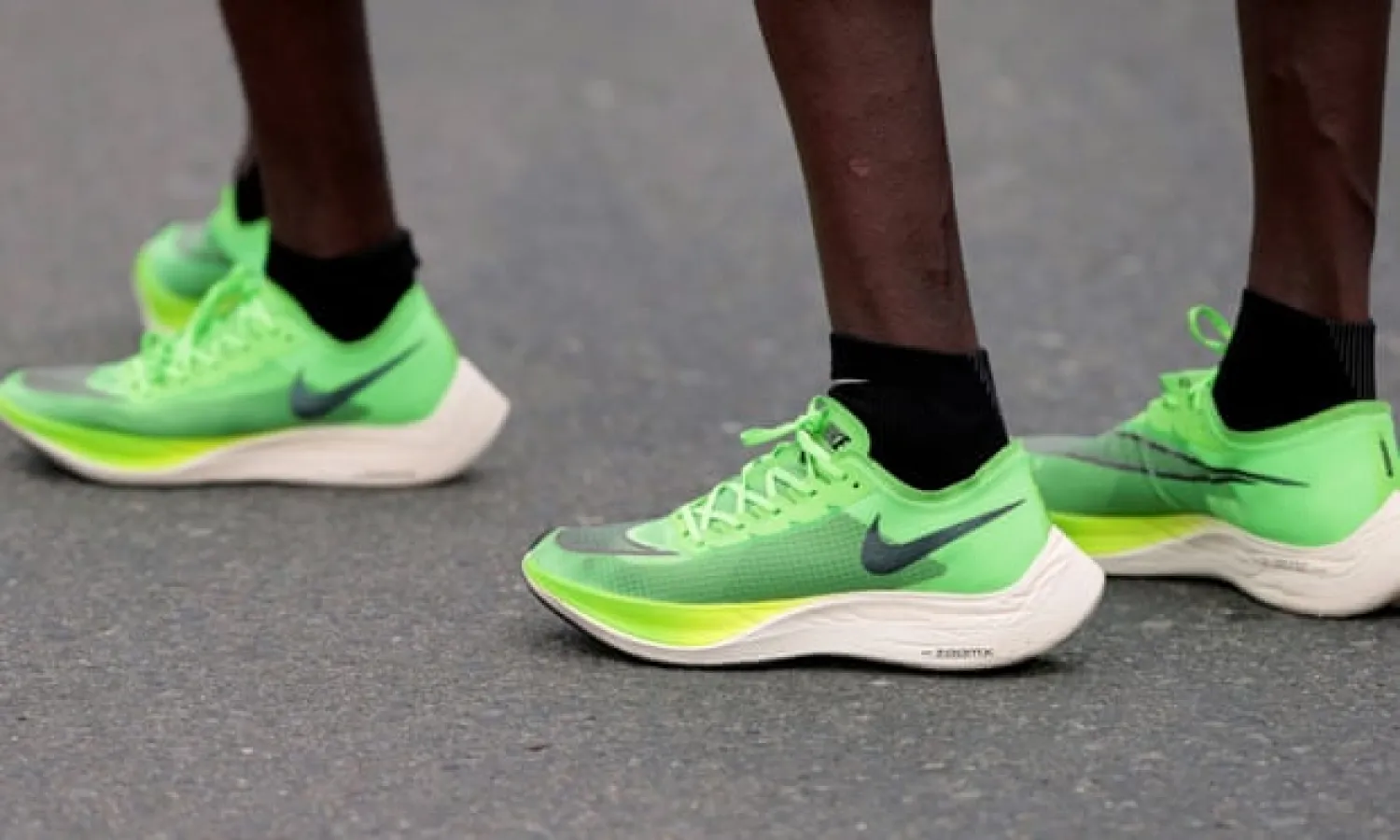
 Nike’s Vaporfly have been been dominant as eight of the top 12 men’s or women’s marathon times have been set in the last 18 months. Photograph: Christopher Pike/Reuters
Nike’s Vaporfly have been been dominant as eight of the top 12 men’s or women’s marathon times have been set in the last 18 months. Photograph: Christopher Pike/Reuters
TT

Running Reaches Crossroads as Nike-Led Footwear Arms Race Infects Mainstream

 Nike’s Vaporfly have been been dominant as eight of the top 12 men’s or women’s marathon times have been set in the last 18 months. Photograph: Christopher Pike/Reuters
Nike’s Vaporfly have been been dominant as eight of the top 12 men’s or women’s marathon times have been set in the last 18 months. Photograph: Christopher Pike/Reuters

There was a guy at parkrun the weekend before last wearing a pair of lime-green Vaporflys on the start line. At least he looked suitably sheepish about it – pointedly ignoring the sharp whispers, the discreet pointing, the gentle ribbing from his running club mates. With its clownish platform heels and lurid alien colour scheme, the Vaporfly is not a shoe for blending into the crowd. Even in a field of 600 anonymous runners the eye is always going to be drawn to the one wearing what looks like a mutant tropical fish on each foot. The race began and off he streaked: a blur of lime-green disappearing into the distance, leaving the rest of us, with our boring reasonably-priced shoes and sniggering moral judgments, in his dust.

Of course, it’s easy to scoff when the stakes are minuscule. Turning up for your local Saturday morning fun run in £250 space-age trainers: objectively very funny, and largely analogous to the guy who wears his Lionel Messi astro boots to Wednesday five-a-side (and leaves with several painful stud-shaped indentations in his ankle). What happens, though, when the stakes are far higher? When the prize is an Olympic gold medal, when the audience is global, when the margins are life-changing? Should it matter what shoes the competitors are wearing? And if not, why not?

These are some of the questions with which athletics has been grappling in recent months. In a way they go well beyond the optimum thickness of a nitrogen-infused midsole or whether two carbon plates should be allowed to overlap. No question of sporting ethics can be resolved purely through science and, by the same token, the terms of our emotional engagement are far too important to be dictated by administrators bearing formulae. The question of the Nike Vaporflys – and its successor models – is thus one that cuts to the very core of what sport is about, or should be.

By now readers will be aware of how Vaporfly-shod athletes have been laying waste to the record books, quietly and quickly changing the face of the sport. Eight of the 12 fastest men’s or women’s marathons in history have been run in the last 18 months. In October, in Vienna, Eliud Kipchoge became the first man to run the marathon distance in under two hours. The prototype Alphafly shoes he wore for that effort are banned but last month World Athletics retroactively declared the Vaporflys legal as well as the records set in them.

The first point to make here – although in the scale of things, not a terrifically helpful one – is that Nike have done nothing illegal or even that novel. Carbon plates date back to the early 2000s, with Paul Tergat breaking the marathon world record in a pair of Filas in 2003. Nor is there much new in the deployment of energy-efficient foam, which Adidas first pioneered almost a decade ago. Nike’s stroke of insight has been to synthesise largely existent technologies into a single devastating package, one that with the backing of World Athletics has in effect rewritten the terms of distance running. Either you join the arms race (if, that is, you can negotiate Nike’s imperial battalion of patent lawyers). Or you lose.

You don’t have to be a luddite or a nostalgic to wonder about where this vision of athletics might ultimately lead. For those at the vanguard of the revolution these are genuinely transformative times – a chance to rebrand athletics as a high-powered, jaw-dropping spectator entertainment. When Kipchoge states, with all the evangelical zeal of a tech bro in a headset giving a Ted talk, that “we must go with technology” and compares Nike’s trainer innovation with the role of tyre manufacturers in Formula One, he is articulating an entirely different sort of sport from the one we grew up with: one in which the turning wheel of technological progress is not merely an auxiliary sideshow but part of the spectacle itself.

The main gripe here is not driven by ideology or anti-progress. We are not talking about returning to cinder tracks and putting everyone in Dunlop Green Flash. Nor is it the increasingly corrosive influence of Nike on athletics, an entire sport now in effect in thrall to a single company; nor the inevitable human wastage of athletes physiologically unsuited to the new technology or sponsored by companies unable to replicate it or simply unable to afford it; nor even the colossal environmental dereliction of a shoe that has to be thrown away after 200 miles of use.

No, the real point is this: in the same way that nobody reads novels to marvel at the typeface, nobody watches athletics – in many ways the oldest and purest sport of all – to gawp at the trainers. Do you know how many butt-numbingly boring articles about shoe technology I had to read before I could start writing this column? Even its very existence feels like the triumph of the inane over the essential, a lame surrender to the Nike marketing octopus. (Woman in Nike’s PR department, reading Vaporfly’s press coverage: “Oh, no. Another article criticising our shoes for being too fast. How utterly terrible.”)

But then, if you’re a sport in 2020 and not somehow facilitating disposable parasite-consumerism, then do you even really exist? Perhaps once, long ago, before we were terminally jaded by doping scandals, we could still cling to the idea that athletics somehow represented the very best of us as a species; that its feats might inspire us, rather than simply inspire us to buy trainers; that this was genuinely a sport operating by the laws of the body, not the laws of the market. Or perhaps this too was always delusion: a lime-green speck on the horizon, gently receding ever further into the distance.

The Guardian Sport


IOC Boss Coventry Hails Milano Cortina Games a Success

 20 February 2026, Italy, Milan: President of the International Olympic Committee (IOC) Kirsty Coventry holds a press conference. (dpa)
20 February 2026, Italy, Milan: President of the International Olympic Committee (IOC) Kirsty Coventry holds a press conference. (dpa)
TT

IOC Boss Coventry Hails Milano Cortina Games a Success

 20 February 2026, Italy, Milan: President of the International Olympic Committee (IOC) Kirsty Coventry holds a press conference. (dpa)
20 February 2026, Italy, Milan: President of the International Olympic Committee (IOC) Kirsty Coventry holds a press conference. (dpa)

The Milano Cortina Olympics exceeded expectations despite a shaky build-up, IOC President Kirsty Coventry said on Friday, hailing the first spread-out Winter Games a success.

"These Games are truly ... successful in a new way of doing things, in a sustainable way of doing things, in a way that I think many people thought maybe we couldn't do, or couldn't be done well, and it's been done extremely well, and it's surpassed everyone's expectations," Coventry told a press conference.

It was the International Olympic Committee chief's clearest endorsement yet of a format that split events across several Alpine clusters rather than concentrating them in one host city.

Her assessment came after two weeks in which organizers sought to prove that a geographically dispersed Games could still deliver a consistent athlete experience.

The smooth delivery ‌comes after years ‌of logistical and political challenges, including construction delays at Milan’s Santagiulia Arena ‌and ⁠controversy over building ⁠a new sliding center in Cortina against IOC advice.

Organizers have also faced isolated disruptions during the Games, such as suspected sabotage on rail lines and protests in Milan over housing and environmental issues.

Transport concerns across the dispersed venues have been mitigated by limited cross-regional travel among spectators, though some competitors had to walk to the Cortina Curling Olympic Stadium in heavy snowfall that stopped traffic.

Central to the success of the Games, Coventry argued, was the effort to standardize conditions across multiple athlete villages despite the distances separating venues from Cortina d’Ampezzo to ⁠Livigno and Bormio.

Italian athletes’ performances also helped ticket sales, which amounted to ‌about 1.4 million.

"And the athletes are extremely happy. And they're happy ‌because the experiences that the MiCo (Milano Cortina) team and my team delivered to them have been the same," she ‌said.

Mixed relay silver medalist Tommaso Giacomel did, however, lament the fact there was no Olympic village near ‌the Antholz-Anterselva Biathlon Arena and that competitors were dotted around different hotels near the venue instead of in one place.

TWO OPENING CEREMONIES

Two opening ceremonies were held - the main one at Milan’s San Siro stadium and a more low-key parade on Cortina d’Ampezzo's Corso Italia, where athletes and spectators were within touching distance.

Feedback from competitors suggested the more intimate ‌settings had in some cases enhanced the Olympic atmosphere, Coventry said, taking the Cortina opening ceremony as an example.

The Zimbabwean, presiding over her first Games ⁠as IOC chief after elections in ⁠2025, framed Milano Cortina as proof of concept for future hosts grappling with rising costs and climate constraints, while acknowledging adjustments would follow.

"It allows us to really look at ourselves and look at the things that we have in place and how we're then going to make certain adjustments for the future," she said.

Beyond logistics, Coventry pointed to the broader impact of the Games, highlighting gender balance - with women making up 47% of competitors - and global engagement as marks of progress.

"But it's been an incredible experience and we're all very proud to have gender equity playing a big role in the delivery of the Games," she said, describing a "tremendous Games" in which athletes have "come together and shared in their passion".

With the closing ceremony in Verona approaching, Coventry said the focus would soon shift to a formal evaluation process, but insisted the headline conclusion was already clear.

"So we look forward to doing that and to learning from all the incredible experiences that I think all of the stakeholders have had across these Games, across these past two weeks," she said.


‘A Huge Mistake.’ Kompany Hits Out at Mourinho for Vinícius Júnior Comments

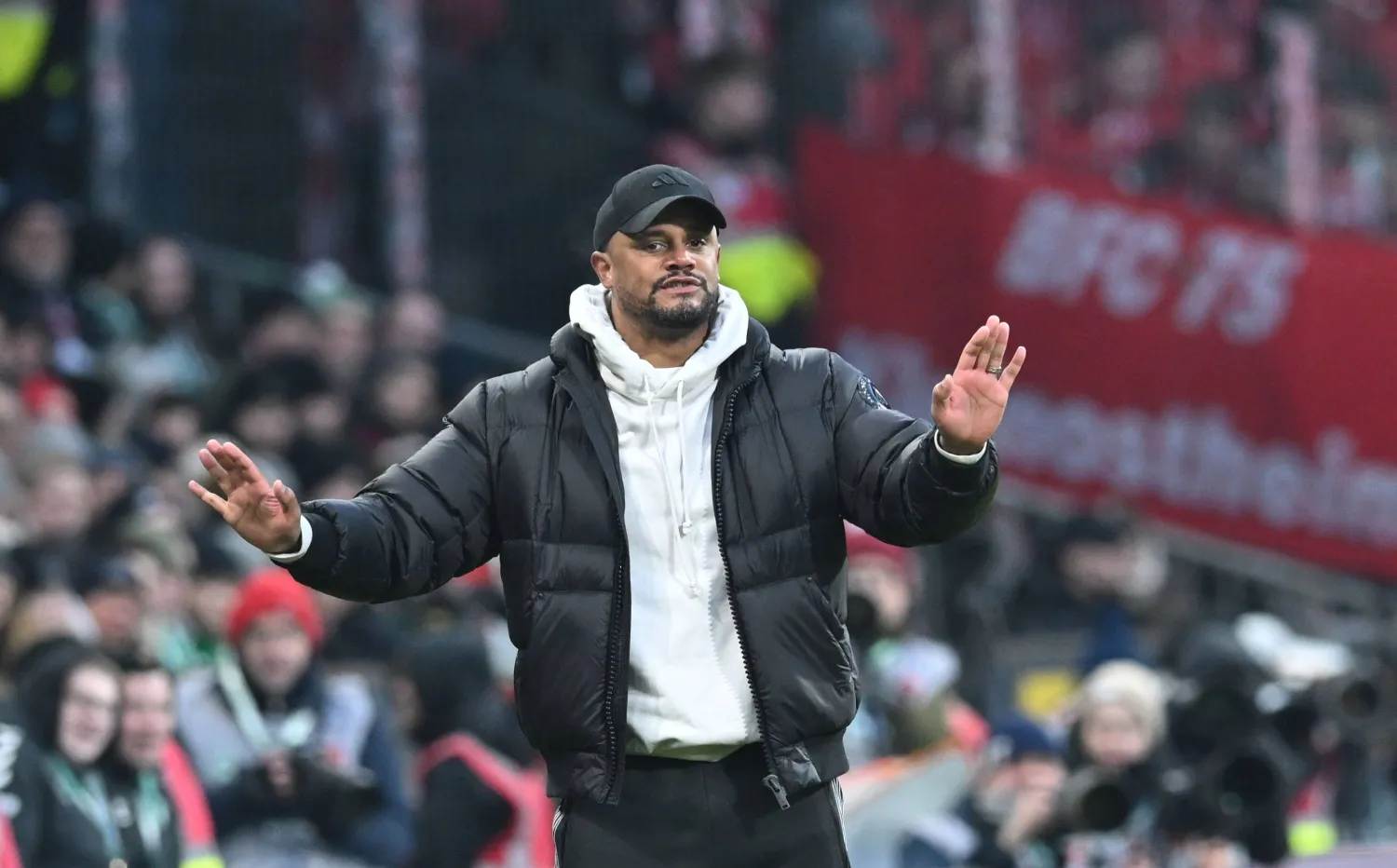
14 February 2026, Bremen: Bayern Munich coach Vincent Kompany gestures during the German Bundesliga soccer match between Werder Bremen and Bayern Munich at Weserstation. (dpa)
TT

‘A Huge Mistake.’ Kompany Hits Out at Mourinho for Vinícius Júnior Comments

14 February 2026, Bremen: Bayern Munich coach Vincent Kompany gestures during the German Bundesliga soccer match between Werder Bremen and Bayern Munich at Weserstation. (dpa)

Bayern Munich coach Vincent Kompany has criticized José Mourinho for attacking the character of Vinícius Júnior after the Real Madrid star accused an opponent of racially insulting him during a Champions League match.

Benfica coach Mourinho suggested that Brazil forward Vinícius had incited Benfica's players with his celebrations after scoring the only goal in Tuesday's playoff match.

Vinícius accused Benfica's Gianluca Prestianni of calling him "monkey" during a confrontation after his goal.

Mourinho also questioned why Vinícius, who is Black and has been subjected to repeated racist insults in Spain, was so frequently targeted.

"There is something wrong because it happens in every stadium," Mourinho said. "The stadium where Vinícius played something happened. Always."

Speaking on Friday, Kompany condemned Mourinho's comments.

"So after the game you have the leader of an organization, José Mourinho, who attacks the character of Vinícius Júnior by bringing in the type of celebration to discredit what Vinícius is doing in this moment," Kompany said. "And for me in terms of leadership, it’s a huge mistake and it’s something that we should not accept."

Mourinho’s celebrations

UEFA appointed a special investigator on Wednesday to gather evidence about what happened in Lisbon in Madrid’s 1-0 win in the first leg of the Champions League playoffs. Madrid said it had sent "all available evidence" of the alleged incident to European soccer's governing body.

Referring to Vinícius' celebrations after curling a shot into the top corner, Mourinho said he should "celebrate in a respectful way."

Kompany pointed out Mourinho's own history of exuberant celebrations — such as when he ran down the sideline to cheer when his Porto team beat Manchester United in the Champions League.

Kompany said Mourinho's former players "love him" and added "I know he’s a good person."

"I don’t need to judge him as a person, but I know what I’ve heard. I understand maybe what he’s done, but he’s made a mistake and it’s something that hopefully in the future won’t happen like this again," he said.

Prestianni denied racially insulting Vinícius. Benfica said the Argentine player was the victim of a "defamation campaign."

‘Right thing to do’

Kompany said Vinícius' reaction "cannot be faked."

"You can see it — his reaction is an emotional reaction. I don’t see any benefit for him to go to the referee and put all this misery on his shoulders," he said. "There is absolutely no reason for Vini Junior to go and do this.

"I think in his mind he’s doing it more because it’s the right thing to do in that moment."

Kompany added: "You have a player who’s complaining. You have a player who says he didn’t do it. And I think unless the player himself comes forward, it’s difficult. It’s a difficult case."


FIFA to Lead $75m Palestinian Soccer Rebuilding Fund

President of FIFA Gianni Infantino attended the inaugural meeting of US President Donald Trump's 'Board of Peace'. CHIP SOMODEVILLA / GETTY IMAGES NORTH AMERICA/AFP
TT

FIFA to Lead $75m Palestinian Soccer Rebuilding Fund

President of FIFA Gianni Infantino attended the inaugural meeting of US President Donald Trump's 'Board of Peace'. CHIP SOMODEVILLA / GETTY IMAGES NORTH AMERICA/AFP

FIFA will spearhead a $75 million fund to rebuild soccer facilities in Gaza that were destroyed by the war between Israel and Hamas, President Donald Trump and the sport's governing body said Thursday.

Trump made the announcement in Washington at the first meeting of his "Board of Peace," an amorphous institution that features two dozen of the US president's close allies and is initially focused on rebuilding the Gaza strip, said AFP.

"I'm also pleased to announce that FIFA will be helping to raise a total of $75 million for projects in Gaza," said Trump.

"And I think they're soccer related, where you're doing fields and you're getting the greatest stars in the world to go there -- people that are bigger stars than you and I, Gianni," he added, referring to FIFA president Gianni Infantino, who was present at the event.

"So it's really something. We'll soon be detailing the announcement, and if I can do I'll get over there with you," Trump said.

Later Thursday, FIFA issued a statement providing more details, including plans to construct a football academy, a new 20,000-seat national stadium and dozens of pitches.

The FIFA communique did not mention Trump's $75 million figure, and said funds would be raised "from international leaders and institutions."

Infantino has fostered close ties with Trump, awarding him an inaugural FIFA "Peace Prize" at the World Cup draw in December.

At Thursday's meeting, the FIFA president donned a red baseball cap emblazoned with "USA" and "45-47," the latter a reference to Trump's two terms in the White House.

In FIFA's statement, Infantino hailed "a landmark partnership agreement that will foster investment into football for the purpose of helping the recovery process in post conflict areas."

The "Board of Peace" came together after the Trump administration, teaming up with Qatar and Egypt, negotiated a ceasefire in October to halt two years of devastating war in Gaza.

The United States says it is now focused on disarming Hamas -- the Palestinian group whose unprecedented October 7, 2023, attack on Israel triggered the massive offensive.