


At Turkey's Frontier With Europe, Everyone Wants to Be Syrian

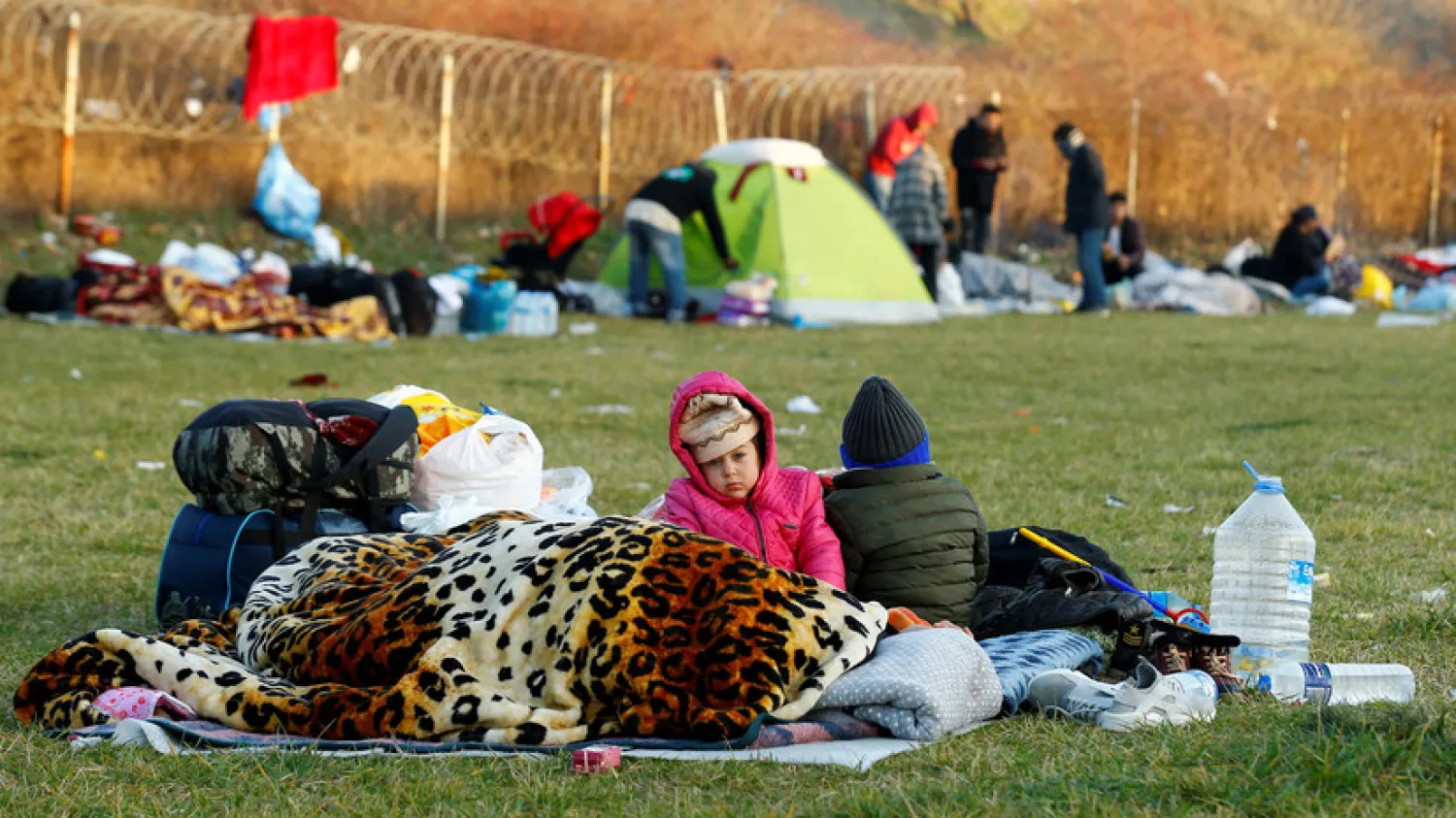
Migrant children are seen near Turkey's Pazarkule border crossing with Greece's Kastanies, near Edirne, Turkey, March 7, 2020. REUTERS/Huseyin Aldemir
TT

At Turkey's Frontier With Europe, Everyone Wants to Be Syrian

Migrant children are seen near Turkey's Pazarkule border crossing with Greece's Kastanies, near Edirne, Turkey, March 7, 2020. REUTERS/Huseyin Aldemir

Syrians camped on Turkey’s border with Greece believe their hopes of finding sanctuary in the European Union are being undermined by the thousands of other migrants at the frontier who have relatively safe homelands.

Vastly outnumbered by Afghans and Pakistanis at the border, Syrians who have fled their country’s protracted civil war say most of their fellow migrants are jumping on the bandwagon for economic reasons, and then pretending to be Syrian refugees.

“It makes me angry when I meet people from Morocco, Pakistan, and even Afghanistan,” said 20-year-old Yehya Rais from Aleppo, the scene of some of the heaviest fighting during the war.

“If only two to three thousand Syrians were here, maybe Greece would open the border. They know we are genuine refugees,” Rais said.

Thousands of migrants have been trying to get into Greece since Turkey said on Feb. 28 it would no longer try to keep them on its territory, as it had agreed to do with Brussels in 2016 in return for billions of euros in aid.

Turkey said it could no longer contain the hundreds of thousands of migrants it hosts, especially with the likelihood of more refugees fleeing intense fighting in northwestern Syria, but Greece is trying to keep the migrants out.

Rais’s animosity toward his fellow migrants is shared by his friend Labib Morghi.

“There is no war in Morocco, no war in Algeria and no war in Pakistan,” said 16-year-old Morghi. “Even in Afghanistan, the situation is better than in Syria. We had to leave because our government wants to either kill us or displace us.”

WE’LL BE SYRIAN

Rais and Morghi had left the border camp to charge their phones and breakfast at a shoddy cafe in the village of Karaagac, where old men were playing cards.

At a kiosk next door, North African migrants said they had come to the border without identification documents so they could claim to be Syrians and boost their chances of asylum - should they make it into the European Union.

“Our leaders are corrupt so we have no chance of a decent living,” said Moroccan Bader Abbasi. “If inshallah I make it to Europe I’ll say I’m from Syria otherwise they’ll send me back.”

His friends, sipping Turkish tea, nodded in approval.

Turkish interior minister Suleyman Soylu said on Wednesday that only 20%-25% of the 136,000 migrants who have made it to Europe since it stopped holding them back were Syrian.

Besides their desire for a better future, migrants such as Abbasi have another good reason to pretend to be Syrians.

In Germany, the favored destination in Europe among migrants along with Sweden, almost all Syrians are given some form of protection and are allowed to stay. But more than 20% of Afghan asylum seekers are rejected.

“Everyone here wants a better future,” said Morghi, who is from the northern Syrian city of Idlib.

“But people who have a country to go back to have a luxury we can only dream of. Syria is finished.”



Report: World Conflicts Hit Peak in 2025

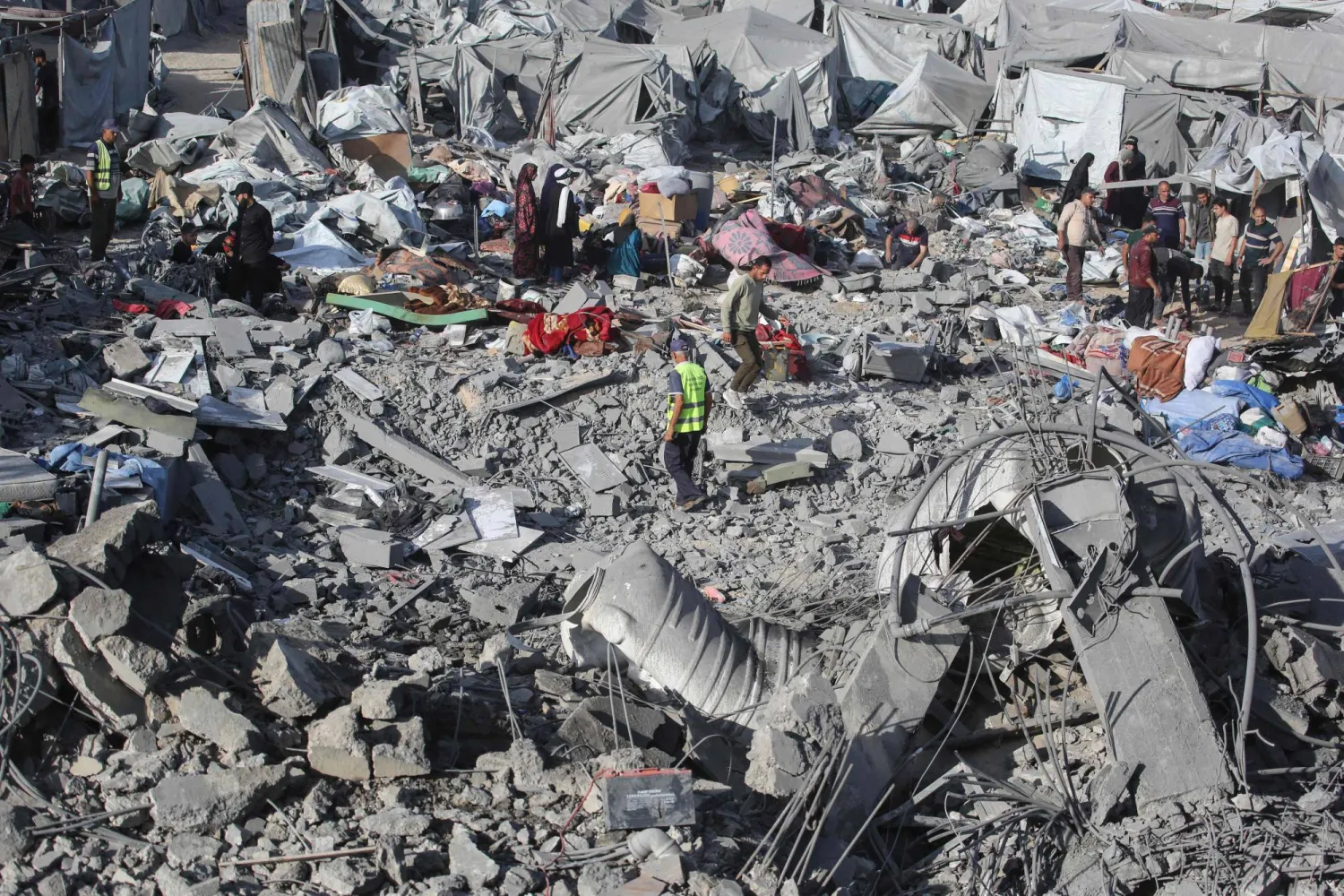
Palestinians assess damage at the site of an Israeli airstrike in Khan Younis, southern Gaza Strip, on June 7, 2026. (AFP)
TT

Report: World Conflicts Hit Peak in 2025

Palestinians assess damage at the site of an Israeli airstrike in Khan Younis, southern Gaza Strip, on June 7, 2026. (AFP)

The world saw the highest number of state conflicts since the Second World War in 2025, a Norwegian study said on Tuesday, warning of a surge in attacks targeting civilians.

The annual "Conflict Trends" report from the Peace Research Institute Oslo (PRIO) said 65 conflicts involving at least one state were recorded worldwide last year, a new high since 1946.

Conflicts between states also hit a new 80-year peak, doubling from the year before to eight -- including border clashes between India and Pakistan, Afghanistan and Pakistan, and Cambodia and Thailand, as well as Russia's invasion of Ukraine and Israeli military operations against Syria.

"Unfortunately, there are not a lot of positive things," researcher Siri Aas Rustad told a group of media outlets, including AFP.

"Usually, I'm able to sort of squeeze something positive out of it, but this year it's shocking, the numbers."

Last year was the third deadliest since the end of the Cold War, with around 245,000 deaths directly related to fighting or political violence -- nearly 76,500 of them attributed to attacks directly targeting civilians, compared with 14,200 in 2024.

The sharp increase in civilian deaths is due to the conflict between the army and paramilitaries in Sudan, where the siege and massacres carried out in El-Fasher city in the Darfur region are estimated to have left some 60,000 people dead.

Since the end of the Cold War, only 1994 and 2021 have seen more bloodshed, due to the Rwanda genocide and the war in Ethiopia's Tigray region respectively.

- Africa worst affected -

"What has happened in the past five or six years is that we have several big conflicts going on at the same time and they seem to take over from each other. The world doesn't get any break," Rustad said.

"And that's different from previously -- this continuous high intensity level of conflict globally."

The PRIO study is based on figures compiled by the Uppsala Conflict Data Program (UCDP), attached to Uppsala University.

It distinguishes between three main types of organized violence: conflicts involving at least one state, non-state conflicts, and one-sided violence against civilians.

Africa remained the region most affected by the first type of conflict with 29, followed by Asia, the Middle East, the Americas, and Europe.

Rustad said Israel was "clearly one of the most aggressive countries in the world at the moment", pointing to its involvement in different types of conflicts in Gaza, Syria, Lebanon, against Iran, and against Houthi militants.

She also pointed to the United States, saying President Donald Trump's return to power had brought "not just attacking and increasing violence, but also the trade barriers they're putting up."

"We are putting a lid on collaboration. The (UN) Security Council doesn't work at the moment. We get a much more polarized world," she said.


Defying Trump with Brief Iran Fight, Israel Seeks Sway over Peace Talks

 An Israeli security personnel inspects an impact site, after Iran launched missiles towards Israel, in an Israeli settlement in the Israeli-occupied West Bank, June 8, 2026. (Reuters)
An Israeli security personnel inspects an impact site, after Iran launched missiles towards Israel, in an Israeli settlement in the Israeli-occupied West Bank, June 8, 2026. (Reuters)
TT

Defying Trump with Brief Iran Fight, Israel Seeks Sway over Peace Talks

 An Israeli security personnel inspects an impact site, after Iran launched missiles towards Israel, in an Israeli settlement in the Israeli-occupied West Bank, June 8, 2026. (Reuters)
An Israeli security personnel inspects an impact site, after Iran launched missiles towards Israel, in an Israeli settlement in the Israeli-occupied West Bank, June 8, 2026. (Reuters)

In launching renewed strikes on Iran on Monday in apparent open defiance of Donald Trump, Israel has tried to make its case to have a say at the peace negotiating table, where it has so far been kept at arm's length by the US president.

Despite Trump publicly calling for Israel to hold fire, it struck targets in Iran for the first time since a ceasefire in April, after Iran fired missiles at Israel in what Tehran said was retaliation for Israeli strikes on Lebanon's capital.

Israel and Iran both called a halt to the exchange on Monday shortly after Trump told them to stop shooting, although they each left the door open to a possible resumption.

But in launching the strikes, Israel had sent a message to Washington that no final ‌agreement with Iran ‌can be reached if Israel's interests are ignored, said Danny Orbach, a military historian at ‌Israel's ⁠Hebrew University.

"Because if ⁠it tramples too heavily on Israeli interests, Israel can overturn the table."

TRUMP EXCLUDES ISRAEL FROM NEGOTIATIONS

Trump, who launched the war alongside Israel in February, has been trying to reach a negotiated settlement with Iran, while excluding Israel from those talks.

He has publicly prodded Israeli Prime Minister Benjamin Netanyahu to refrain from actions that could scupper the talks, including by holding fire in Lebanon, which Israel invaded in March in pursuit of the Iran-aligned Hezbollah movement.

Iran says it will not agree to any peace deal with Washington unless a ceasefire also holds in Lebanon.

Last week Netanyahu called off airstrikes on Beirut after a phone call with Trump. Trump later confirmed he ⁠had called the Israeli leader "[expletive] crazy" in the heated exchange, although he also said they ‌still get along well.

Netanyahu's domestic critics accused him of effectively surrendering sovereignty by ‌restricting Israeli military actions to sustain US negotiations, without a seat at the table.

ISRAEL SEEKS TO RETAIN ABILITY TO ATTACK IN LEBANON

After ‌Israel's strike on Lebanon on Sunday, and Iran's decision to fire at Israel in response, Trump made clear he believed ‌that should be the end of the matter.

"Each of them had their fun," he told the Axios website. "Israel had its strike and Iran had its strike. We don't need another one," Trump said.

But Israel concluded that only by striking Iran itself in response could it establish that Iran should not be granted future say over Israeli actions in Lebanon.

Israel could not accept a scenario in which Iranian ‌strikes on Israel were considered a justifiable "tit-for-tat response" to Israeli strikes on Lebanon, a senior Israeli defense official told Reuters.

Before deciding to strike Iran, Netanyahu convened a meeting of top security ⁠and defense officials to discuss ⁠goals of a potential short-term escalation, according to the senior defense official and two other Israeli officials familiar with the deliberations.

One goal was to establish that any future US-Iran deal would not remove Israel's right to attack Hezbollah in southern Lebanon and keep its troops deployed there, the senior defense official said.

Netanyahu had raised this consideration in weekend phone calls with Trump, the senior defense official said.

Netanyahu has not made any public comments or appearances since resuming attacks on Iran early on Monday. His office did not immediately respond to a request for comment.

ISRAEL CANNOT SUSTAIN LONG IRAN AIR CAMPAIGN ALONE, ANALYSTS SAY

The brief resumption of Israel-Iran fighting and Netanyahu's defiance of Trump's demands are the latest episode to lay bare the strains that have at times emerged between the two conservative leaders.

In private, Netanyahu has acknowledged difficulty influencing Trump's thinking on Iran, telling aides he has "no maneuver" to steer the president's decision-making.

But although Israel has the capability to strike Iran without US support, it would still need Washington's blessing and support to sustain such an air campaign for more than a few weeks, say military experts.

"There's no doubt that Israel (cannot) go alone in this war for a long, long time, because (the) ammunition is consumable," said Yehoshua Kalisky, a senior researcher at Israel's Institute for National Security Studies.


A Timeline of the Escalating Tensions Between Iran and Israel over Lebanon

Pro-government Iranian demonstrators wave flags of Iran and Lebanon's Hezbollah movement after Israeli strikes on Beirut's southern suburbs in Tehran on June 7, 2026. (AFP)
TT

A Timeline of the Escalating Tensions Between Iran and Israel over Lebanon

Pro-government Iranian demonstrators wave flags of Iran and Lebanon's Hezbollah movement after Israeli strikes on Beirut's southern suburbs in Tehran on June 7, 2026. (AFP)

The Middle East is suddenly bracing for war again. Iran fired missiles at Israel late Sunday in the first such bombardment in the two months since a ceasefire. Israel launched airstrikes early Monday targeting central and western Iran in response.

The truce in the Iran war that was reached in April has not spread to Lebanon, where Israel has been battling the Iranian-backed Hezbollah group. Israel says it is defending its northern communities that face Hezbollah drone and rocket fire.

Iran sees Israel’s ground invasion, with thousands of troops, and airstrikes in Lebanon as a ceasefire violation. It insists that any deal with the United States must end the fighting there. Israel disagrees.

Here’s a timeline of key events.

Feb. 28 The United States and Israel attack Iran. War begins.

March 2 Hezbollah enters the war by firing rockets at Israel. Israel retaliates.

April 7 A fragile ceasefire in the Iran war is announced, with talks to continue. Israel is not included in them.

April 8 Israel bombards Lebanon’s capital, Beirut, killing over 300 people in a 10-minute attack.

April 14 Lebanon and Israel hold their first direct diplomatic talks in decades in Washington.

April 17 A fragile ceasefire is announced between Israel and Lebanon, but Hezbollah plays no part. Fighting soon resumes from both sides.

May 31 Israel’s ground invasion of Lebanon makes its deepest incursion in over a quarter-century.

June 1 Israeli Prime Minister Benjamin Netanyahu threatens to strike Beirut if Hezbollah attacks don’t stop. US President Donald Trump says Israel and Hezbollah agree to calm the fighting.

June 2 Israeli drone strikes in Lebanon kill 11 people.

June 3 Israel and Lebanon say they agree to renew the fragile ceasefire and create security zones that exclude Hezbollah.

June 4 Hezbollah’s leader rejects the ceasefire agreement and demands that Israel withdraw from Lebanon.

June 5 Iran’s paramilitary Revolutionary Guard says “there will be no calm in the region ” if Israel doesn’t withdraw.

June 6 Israeli airstrikes on southern Lebanon kill three members of the Lebanese military.

June 7 Hezbollah again fires at Israel. Israel strikes Beirut’s southern suburbs. Iran fires at Israel.

June 8 Israel launches airstrikes in the early morning targeting central and western Iran in response to Iranian missile fire. Iranian state television reports the sound of explosions being heard in Isfahan, Tabriz and Tehran, without elaborating.