


Turkey Increases Military Observation Posts to 50 in Idlib

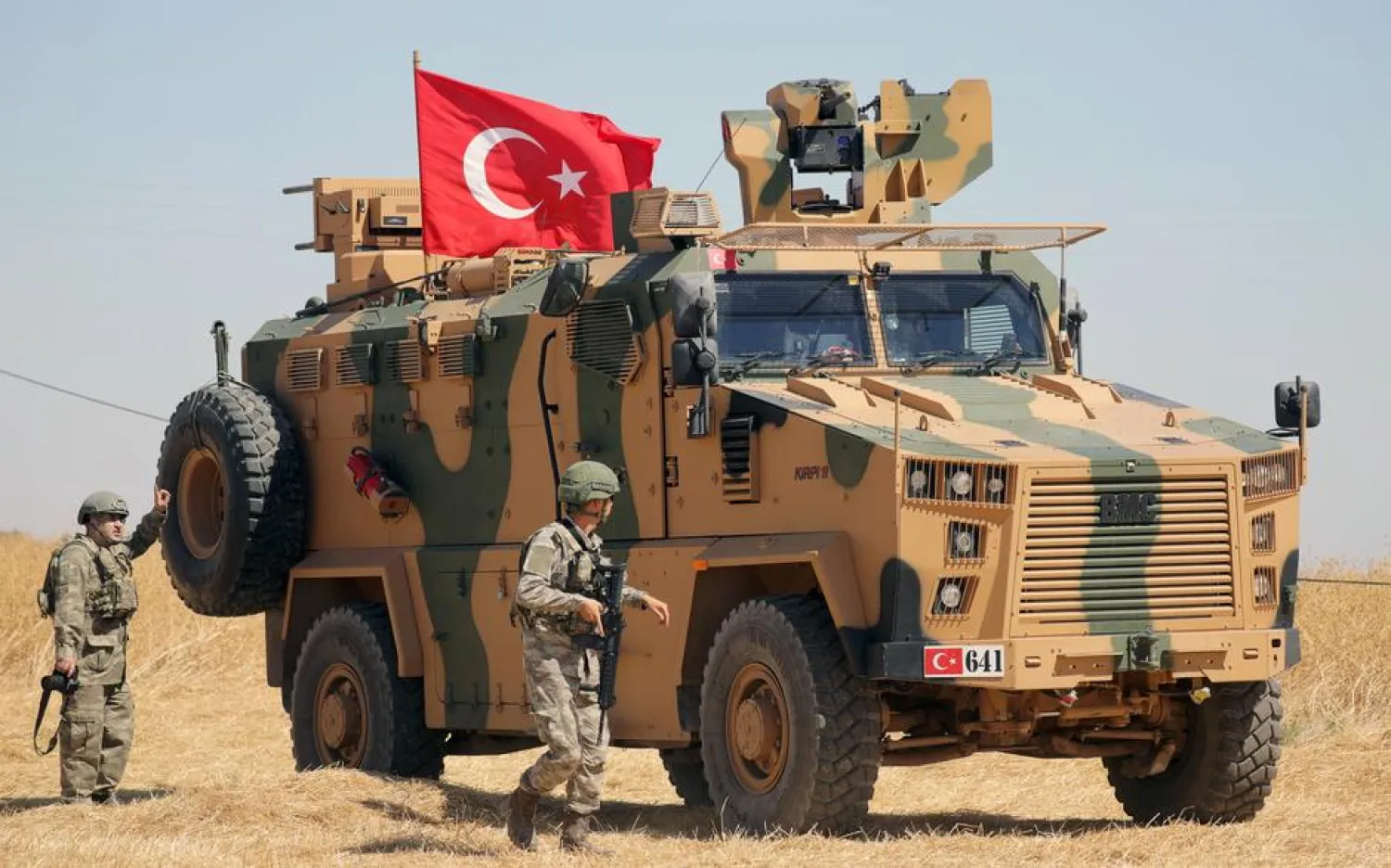
A Turkish soldier walks next to a Turkish military vehicle during a joint U.S.-Turkey patrol, near Tel Abyad, Syria (File Photo: Reuters)
TT

Turkey Increases Military Observation Posts to 50 in Idlib

A Turkish soldier walks next to a Turkish military vehicle during a joint U.S.-Turkey patrol, near Tel Abyad, Syria (File Photo: Reuters)

Turkey has increased its military observation points in Idlib to 50 by establishing a new one near Jisr al-Shughur city. Meanwhile, regime forces and armed opposition factions clashed on various axes in northwest Syria, despite the ceasefire announced on March 6.

Turkish forces established a new military post in al-Ghassaneyah town, west of Jisr al-Shughur in the western countryside of Idlib. Prior to that, the troops established three other military points in Bidama, al-Najiyeh, and al-Zainiya, and south of Aleppo-Lattakia road (M4).

Earlier, Turkish forces established two military points in al-Misherfah and Tel Khattab villages near the border with Hama Governorate, south of Jisr al-Shughur.

The Turkish forces want to expand their deployment area to the northern and western axes of Idlib in an attempt to prevent the advance of the regime forces and open a secure way towards M4 road.

Meanwhile, the Syrian Observatory for Human Rights (SOHR) reported that regime forces launched missiles towards al-Bara, Afes, and Kafar Aweed towns in southern Idlib.

The opposition then responded by targeting several posts of the regime in Saraqib and Kafr Nabl with several rocket-propelled grenades.

The Observatory said that the exchanged strikes happened while Russian reconnaissance aircraft were flying over the area of al-Zawiya mountain in the southern countryside of Idlib.

The factions launched rockets at a military bulldozer for the regime forces on the axis of Saraqib, east of Idlib, reported SOHR, adding that it was destroyed.

On Tuesday, the Turkish Ministry of Defense announced six members of the Kurdish People's Protection Units (YPG), the largest component of the Syrian Democratic Forces (SDF), were killed in eastern Euphrates.

The Ministry said they were trying to infiltrate into the so-called “Operation Peace Spring” zone controlled by the Turkish forces and factions loyal to it in northeastern Syria.

"Six PKK/YPG terrorists who were attempting to infiltrate the Operation Peace Spring zone were successfully neutralized in successful operations of our heroic command," said the ministry.

It added that the operations will continue uninterrupted in order to achieve peace and stability in the region.



Holdouts Flee Lebanon Border Village After Israeli Warning

An Israeli tank maneuvers in southern Lebanon near the border with Israel, Sunday, March 8, 2026. (AP Photo/Ariel Schalit)
TT

Holdouts Flee Lebanon Border Village After Israeli Warning

An Israeli tank maneuvers in southern Lebanon near the border with Israel, Sunday, March 8, 2026. (AP Photo/Ariel Schalit)

The last residents of a Christian village on Lebanon's border with Israel fled the area on Tuesday, a UN source and an AFP correspondent said, after locals had for days defied an Israeli order to leave.

Fighting flared last week between Israel and Lebanese militant group Hezbollah as part of a wider regional war, prompting the Israeli military to warn people across swathes of southern Lebanon to flee.

But some residents in Christian towns and villages refused to join a mass exodus, with dozens in the Alma al-Shaab area staying put despite the violence.

Fears spiked however after an Israeli strike at the weekend killed one resident.

On Tuesday, an AFP correspondent in the nearby Naqura area saw a convoy of vehicles transporting people who had left Alma al-Shaab, including women, children and the elderly. Their cars were packed with belongings, some strapped to the roofs.

Vehicles from Lebanon's United Nations peacekeeping force accompanied the convoy to a Lebanese army checkpoint further north, the correspondent said.

A source from the UN Interim Force in Lebanon (UNIFIL) told AFP that more than 80 people had left and the village was now empty, saying they had been transported to areas outside the force's operations.

UNIFIL had said on Monday that "at the request of the municipality" of Alma al-Shaab, it was "ready to facilitate the safe movement of civilians who wish to leave".

Last week, local mayor Shadi Sayah had told AFP that "it is our right to preserve and remain on our land".

"We are pacifists... a danger to no one," the mayor said.

The Israeli army announced last week its intention to establish a buffer zone in southern Lebanon, saying the goal was to protect residents of northern Israel from Iran-backed militant group Hezbollah.

The Lebanese army, which had maintained a post in Alma al-Shaab, withdrew last Tuesday as Israeli forces started incursions into the country.

Many towns and villages along Lebanon's border have been damaged or destroyed since October 2023, when hostilities erupted between Israel and Hezbollah over the Gaza war, but some predominantly Christian villages have gone relatively unscathed.

Farther east in the village of Qlayaa, a parish priest died on Monday of wounds sustained from Israeli tank fire, sparking anger and fear.

Qlayaa mayor Hanna Daher has urged Lebanese authorities to prevent any armed presence in or around the town, referring to Hezbollah.


Lives Being Upended on Massive Scale in Lebanon, Says UN Refugee Agency

A boy looks on while lying under a blanket alongside family belongings in a makeshift encampment along the waterfront in Beirut on March 10, 2026, as civilians who fled the city's southern suburbs due to Israeli bombardment remain displaced. (AFP)
TT

Lives Being Upended on Massive Scale in Lebanon, Says UN Refugee Agency

A boy looks on while lying under a blanket alongside family belongings in a makeshift encampment along the waterfront in Beirut on March 10, 2026, as civilians who fled the city's southern suburbs due to Israeli bombardment remain displaced. (AFP)

‌Lives have been upended on a massive scale in Lebanon amid a wider conflict in the Middle East, with more than 667,000 people now registered as displaced within the country - an increase of ‌100,000 in ‌just one day - the ‌UN ⁠refugee agency said ⁠on Tuesday.

Lebanon was dragged into the US-Israeli war on Iran this month when Iran-backed Hezbollah launched rockets ⁠and drones into Israel, which ‌has ‌responded with heavy bombardment across the ‌country.

Some 120,000 people are ‌staying in government designated shelters, while others are still looking for somewhere to stay, the ‌UNHCR said, citing government figures.

"Many others are ⁠staying ⁠with relatives or friends or still searching for accommodation, and we see cars lined along the street with people sleeping in them and also on the sidewalks," said Karolina Lindholm Billing, UNHCR representative in Lebanon.


Syrian Interior Ministry Airs Confessions of ‘Saraya al-Jawad’ Members

The February operation targeted hideouts in the villages of Beit Alouni and Basniya in Latakia province. (SANA)
TT

Syrian Interior Ministry Airs Confessions of ‘Saraya al-Jawad’ Members

The February operation targeted hideouts in the villages of Beit Alouni and Basniya in Latakia province. (SANA)

The Syrian Interior Ministry released a video showing confessions from members of the "Saraya al-Jawad" armed group, nearly two weeks after announcing a raid on one of its main strongholds in the countryside of Jableh in the Latakia province.

According to the ministry, the February 23 operation targeted hideouts in the villages of Beit Alouni and Basniya in Latakia province. The raid killed the group’s coastal leader Bashar Abdullah Abu Ruqayya and two other commanders, and led to the arrest of six members.

The video released Monday includes footage from the twin operation carried out by the Interior Ministry’s Internal Security Directorate.

Authorities said the raid followed several days of surveillance and resulted in the destruction of a weapons depot and explosives storage site belonging to the group.

One member of the Syrian special task forces was killed and another was lightly wounded during the operation.

In the recorded confessions, detainees said they took part in attacks along the Syrian coast in March 2025. One suspect admitted to ambushing a General Security patrol and killing one officer during a clash.

The confessions also described the establishment of an operations room in a residential house that doubled as an arms depot. According to the detainees, the group received financial support from businessmen Ayman Jaber and Mohammad Jaber, while supplies were smuggled in from Lebanon.

Mohammad Jaber, a businessman close to the former government of Bashar al-Assad and a commander in the Desert Hawks militia founded by his brother Ayman, previously appeared in a television interview acknowledging his role in organizing attacks by pro-regime remnants along the Syrian coast on March 6, 2025.

Documents and recordings obtained by Al Jazeera’s investigative program Al-Mutahari suggested that senior figures linked to the former government sought to form armed groups to carry out attacks on Syrian security forces and the army.

The Interior Ministry said it is pursuing members of those networks and attempting to curb their activities.

Saraya al-Jawad has been active in Syria’s coastal region — particularly in Latakia, Jableh and Tartus — since August 2025, when activists circulated a video showing a car bomb targeting a General Security vehicle in rural Jableh.

Earlier this month, security forces in Tartus also arrested three suspects — Ali Zuhair Idris, Ammar Madin Youssef and Mousa Mazhar Mia — accused of planning attacks targeting the province’s security and civilians.

Officials said intelligence showed the group had received explosives training abroad before infiltrating back into Syria.