


Houthis Allocate Donations to War, Ignoring Millions of Hungry Citizens

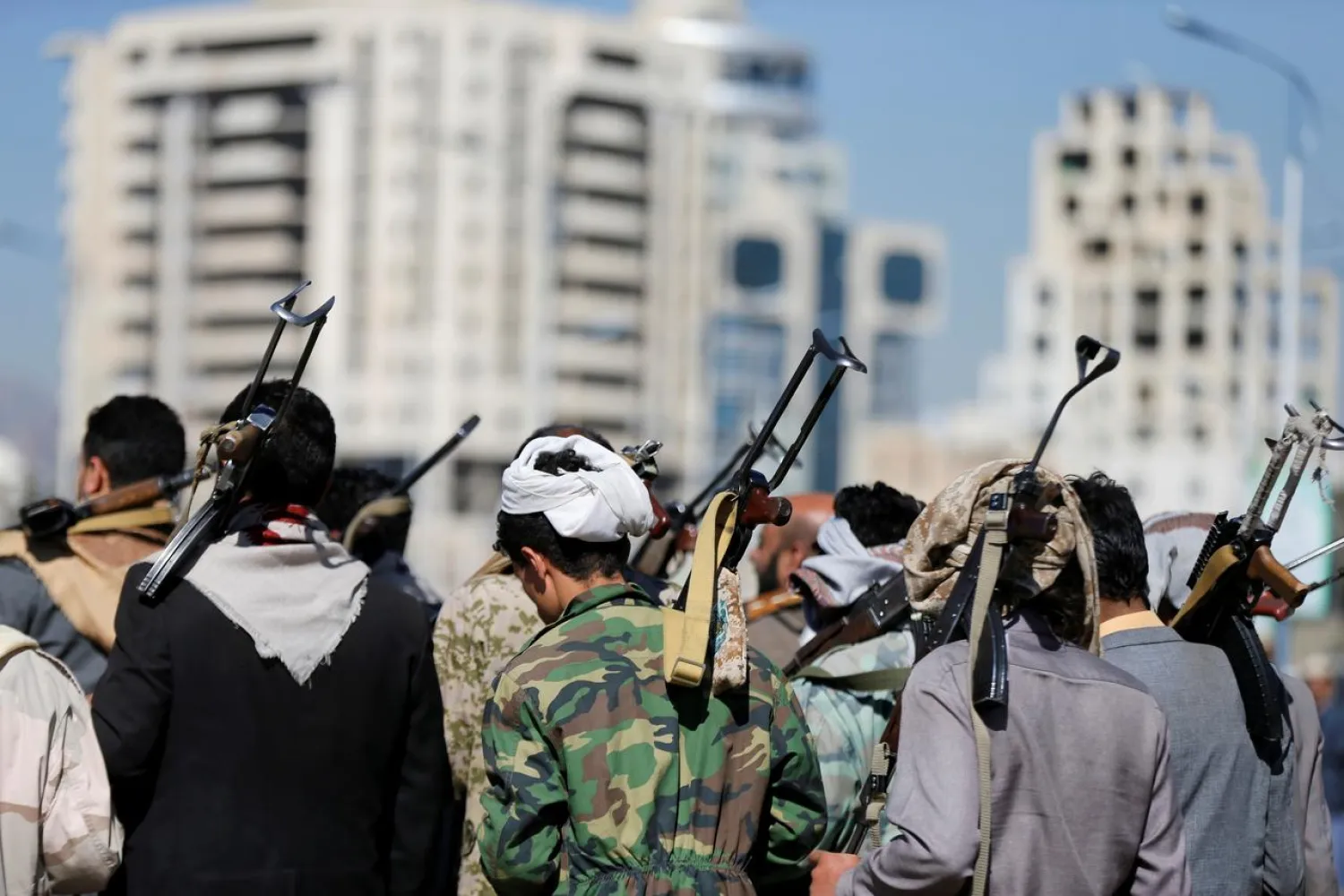
Armed Houthi followers carry their rifles as they attend a gathering to show support for the Houthi movement in Sanaa, Yemen (Reuters)
TT

Houthis Allocate Donations to War, Ignoring Millions of Hungry Citizens

Armed Houthi followers carry their rifles as they attend a gathering to show support for the Houthi movement in Sanaa, Yemen (Reuters)

Houthi leaders in Sanaa, al-Mahwit, Dhamar, and Amran governorates are forcing residents, including tribesmen, farmers, and merchants, to donate money and supplies to send them to the fronts and families of the group's militants.

Local and tribal sources in Sanaa and other regions told Asharq Al-Awsat that the group’s leaders and local officials held meetings with notables in villages and districts and forced them to collect donations for war, threatening to recruit the children of those who object.

A beekeeper from al-Mahwit, who asked to be referred to as Commander A., told Asharq al-Awsat that the group's supervisor in al-Khabt district forced him to donate 100 kilos of honey after he said he didn't have any cash to donate.

Asharq al-Awsat asked one of the local tribal elders in Saafan directorate about the reason why residents accept Houthi blackmail, he explained that many of them are small merchants or farmers and are forced to contribute in order to protect their children.

He indicated hundreds of poor families in the district are in need of help and support, but the insurgents do not care about their condition as much as they are concerned with collecting funds to defend the homeland as their leaders claim.

Houthis forced every village in Yarim and its environs, north of Ibb governorate, to equip 15 teenage students to join recruitment camps, or provide YR100,000 instead from each family.

Local sources told Asharq Al-Awsat that the group's regional administrators are now wealthy and own cars and homes from the money they claim they have been collecting for war.

Meanwhile, the official Houthi sources announced that the group managed to collect donations in Saada directorates and several directorates in Sanaa and in al-Mahwit, Hajjah, and Dhamar.

The group's media showed pictures of hundreds of millions of Yemeni riyals, along with other donations such as cows, sheep, honey, and clothing, claiming it would be distributed to the group's fighters on the frontlines.

Houthi militias insist on imposing a policy of levies and royalties, while they ignore thousands of hungry people in areas under their control.

Many Sanaa residents declared that despite their poverty and need, they did not receive any of the Zakat money.

The group's media reported that the militia leaders appointed at the Zakat Authority, distributed YR500 million about 10 days ago to the group's fighters and members in Naham district and the areas adjacent to the governorates of al-Jouf and Maarib.

A number of Sanaa residents informed Asharq Al-Awsat that the group's commanders give monthly salaries and food baskets to the group's followers and those who belong to their leader, al-Houthi.

Speaking to Asharq Al-Awsat, a merchant was confident that all of the Zakat, taxes, customs, and other fees collected by the insurgents end up with the commanders who pay some for war and militants’ salaries of YR30 thousand.

The merchant, who requested not to be named, cited the recent celebration of Prophet Mohammed where the Houthi Zakat Authority spent YR15 billion riyals on activities and war effort without donating any to the poor and those in need.

Over the past months, UN agencies and relief international organizations accused Houthis of corruption.

Last year, head of the United Nations food agency accused Yemen’s Houthi rebels of diverting food from the country’s hungriest people and threatened to suspend food aid.

UN agencies threatened to cut aid in the group's control areas, and the United States warned it would cease aid to Houthi-held regions starting late March and accused the Houthis of obstructing humanitarian operations in Yemen.

For its part, the Yemeni government estimates that 30 percent of humanitarian aid goes to fund the war effort of the Houthi militia, rather than allocating it to support the millions of starving Yemenis who lack health care and basic services in the areas controlled by the group.

The Houthi group has looted between December 23, 2018 and December 2019, about 440 food aid and medical supplies trucks in Hodeidah, Ibb, and Sanaa, according to governmental reports.

The government also accuses the group of taking medical aid for polio and swine flu in a number of governorates and selling them to private hospitals.

The group closed the offices of UN and international organizations in Dhale, Dhamar, Ibb, and Sanaa. They also raided storage units of relief aid and confiscated UN supplies in Rima, Dhamar, and Dhale.

In recent statements, the Yemeni Minister of Local Administration Abdul Raqib Fatah accused Houthi militias of looting approximately 900 relief convoys during the past year, which were on the way to relief citizens in different regions.



Israel Permits 10,000 West Bank Palestinians for Friday Prayers at Al Aqsa

Palestinians attend Friday prayers in a mosque following an attack that local Palestinians said was carried out by Israeli settlers, in the village of Deir Istiya near Salfit in the Israeli-occupied West Bank November 14, 2025. REUTERS/Sinan Abu Mayzer
TT

Israel Permits 10,000 West Bank Palestinians for Friday Prayers at Al Aqsa

Palestinians attend Friday prayers in a mosque following an attack that local Palestinians said was carried out by Israeli settlers, in the village of Deir Istiya near Salfit in the Israeli-occupied West Bank November 14, 2025. REUTERS/Sinan Abu Mayzer

Israel announced that it will cap the number of Palestinian worshippers from the occupied West Bank attending weekly Friday prayers at the Al-Aqsa Mosque in east Jerusalem at 10,000 during the holy month of Ramadan, which began Wednesday.

Israeli authorities also imposed age restrictions on West Bank Palestinians, permitting entry only to men aged 55 and older, women aged 50 and older, and children up to age 12.

"Ten thousand Palestinian worshippers will be permitted to enter the Temple Mount for Friday prayers throughout the month of Ramadan, subject to obtaining a dedicated daily permit in advance," COGAT, the Israeli defense ministry agency in charge of civilian matters in the Palestinian territories, said in a statement, AFP reported.

"Entry for men will be permitted from age 55, for women from age 50, and for children up to age 12 when accompanied by a first-degree relative."

COGAT told AFP that the restrictions apply only to Palestinians travelling from the West Bank, which Israel has occupied since the 1967 Arab-Israeli war.

"It is emphasised that all permits are conditional upon prior security approval by the relevant security authorities," COGAT said.

"In addition, residents travelling to prayers at the Temple Mount will be required to undergo digital documentation at the crossings upon their return to the areas of Judea and Samaria at the conclusion of the prayer day," it said, using the Biblical term for the West Bank.

During Ramadan, hundreds of thousands of Palestinians traditionally attend prayers at Al-Aqsa, Islam's third holiest site, located in east Jerusalem, which Israel captured in 1967 and later annexed in a move that is not internationally recognized.

Since the war in Gaza broke out in October 2023, the attendance of worshippers has declined due to security concerns and Israeli restrictions.

The Palestinian Jerusalem Governorate said this week that Israeli authorities had prevented the Islamic Waqf -- the Jordanian-run body that administers the site -- from carrying out routine preparations ahead of Ramadan, including installing shade structures and setting up temporary medical clinics.

A senior imam of the Al-Aqsa Mosque, Sheikh Muhammad al-Abbasi, told AFP that he, too, had been barred from entering the compound.

"I have been barred from the mosque for a week, and the order can be renewed," he said.

Abbasi said he was not informed of the reason for the ban, which came into effect on Monday.

Under longstanding arrangements, Jews may visit the Al-Aqsa compound -- which they revere as the site of the first and second Jewish temples -- but they are not permitted to pray there.

Israel says it is committed to upholding this status quo, though Palestinians fear it is being eroded.

In recent years, a growing number of Jewish ultranationalists have challenged the prayer ban, including far-right politician Itamar Ben Gvir, who prayed at the site while serving as national security minister in 2024 and 2025.


EU Exploring Support for New Gaza Administration Committee, Document Says

Palestinians push a cart past the rubble of residential buildings destroyed during the two-year Israeli offensives, in Gaza City, February 17, 2026. REUTERS/Mahmoud Issa
TT

EU Exploring Support for New Gaza Administration Committee, Document Says

Palestinians push a cart past the rubble of residential buildings destroyed during the two-year Israeli offensives, in Gaza City, February 17, 2026. REUTERS/Mahmoud Issa

The European Union is exploring possible support for a new committee established to take over the civil administration of Gaza, according to a document produced by the bloc's diplomatic arm and seen by Reuters.

"The EU is engaging with the newly established transitional governance structures for Gaza," the European External Action Service wrote in a document circulated to member states on Tuesday.

"The EU is also exploring possible support to the National Committee for the Administration of Gaza," it added.

European foreign ministers will discuss the situation in Gaza during a meeting in Brussels on February 23.


Israel Military Says Soldier Killed in Gaza 

A drone view shows the destruction in a residential neighborhood, after the withdrawal of the Israeli forces from the area, amid a ceasefire between Israel and Hamas in Gaza, in Gaza City, October 21, 2025. (Reuters)
TT

Israel Military Says Soldier Killed in Gaza 

A drone view shows the destruction in a residential neighborhood, after the withdrawal of the Israeli forces from the area, amid a ceasefire between Israel and Hamas in Gaza, in Gaza City, October 21, 2025. (Reuters)

The Israeli military announced that one of its soldiers had been killed in combat in southern Gaza on Wednesday, but a security source said the death appeared to have been caused by "friendly fire".

"Staff Sergeant Ofri Yafe, aged 21, from HaYogev, a soldier in the Paratroopers Reconnaissance Unit, fell during combat in the southern Gaza Strip," the military said in a statement.

A security source, however, told AFP that the soldier appeared to have been "killed by friendly fire", without providing further details.

"The incident is still under investigation," the source added.

The death brings to five the number of Israeli soldiers killed in Gaza since a ceasefire took effect on October 10.