

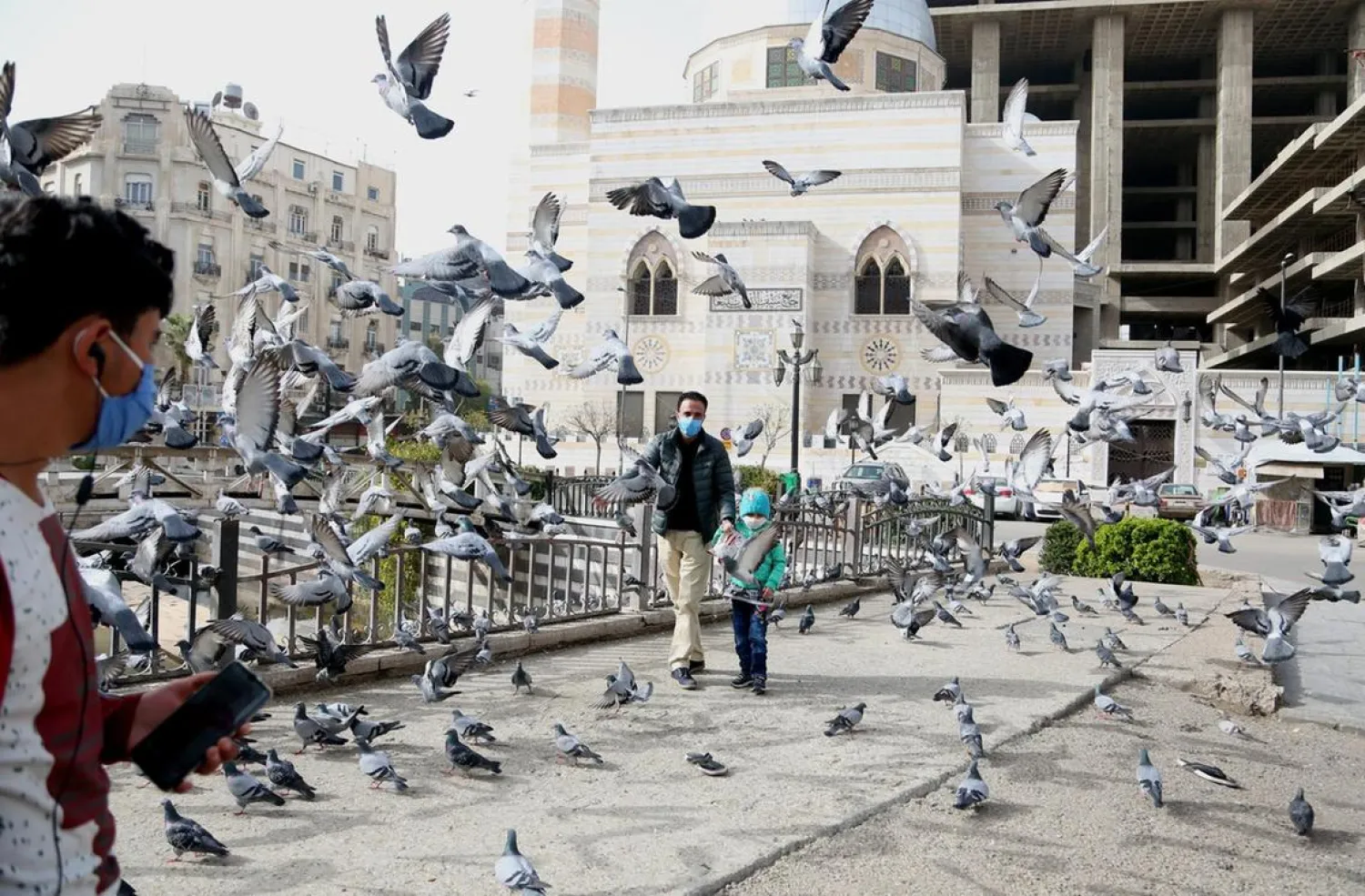

Social Distancing: Arab Countries Fight Coronavirus in Their Own Way

People wearing face masks walk in Damascus, Syria. (EPA)
TT

Social Distancing: Arab Countries Fight Coronavirus in Their Own Way

People wearing face masks walk in Damascus, Syria. (EPA)

Social distancing may be the most important weapon, and perhaps the only effective means to stop the spread of the coronavirus.

Policies of self-isolation, quarantine and curfews differed from one country to another. While countries such as Tunisia and Jordan implemented a total curfew, Egypt decided to impose it only at night. The UAE has resorted to the “national sterilization” initiative, and the Palestinian Authority has implemented the security zones plan.

Just as the policies differ from one country to another, the concerns of citizens are not the same. Poverty deprives some of Lebanon’s residents of the “luxury” of staying at home and in Syria, the quarantine is more frightening than COVID-19.

The UAE

The curfew in the UAE was called “national sterilization.” Launched on March 26, the program is implemented overnight, between 8 pm and 6 am, while most state and private institutions are implementing the teleworking policy.

Movement was restricted across the cities in the evening, while normal traffic was allowed during the day. Throughout the curfew period, many areas and facilities in the Emirates are sterilized in several stages.

Dr. Farida Al Hosani, the official spokeswoman for the health sector in the UAE, said that more than 70 percent of the citizens, residents and visitors have committed to the new policies.

Lebanon

Three weeks after the government in Lebanon declared general mobilization to reduce the outbreak of the coronavirus epidemic, life seemed to return to normal in a number of regions. In Beirut, Tripoli, Sidon and other cities, traffic is back to normal, at a time when citizens are supposed to be committed to the measures that protect them from a virus that does not distinguish between the elderly and the young, the poor and the rich.

But in Lebanon, where the poor do not have the “luxury” of staying home, many have no choice but to risk their own life and that of their beloved, to secure a livelihood, choosing between starving to death and contracting a virus.

Mayor of Tripoli, Riad Yamaq, summed up the situation to Asharq Al-Awsat: “When we ask people to stay in their homes, they reply: secure our income.”

Pending the implementation of the government plan, the Tripoli municipality is working to secure about 30,000 food rations out of 50,000, which the city’s families need, but which are only enough for 20 days, according to Yamaq.

Syria

Despite her high fever and acute cough, a Syrian woman in Jdeidet Artouz refused to see the doctor to check whether she was suffering from the new coronavirus or the seasonal flu, out of her fear of being forced into a quarantine.

A police patrol accompanied by a health team in her city, located in the western countryside of Damascus, took eight persons suspected of being infected with the virus to a quarantine area, after they were reported through clinics and health units.

“After we saw the way those people were taken, I fear for my family and the unknown that we may face in quarantine. I am almost sure that if I am not really infected, I will contract the virus there,” she told Asharq Al-Awsat.

So, the woman decided to keep silent about her illness and remain at home while following all the necessary health instructions.

A Syrian dissident residing in the Damascus countryside said security forces were treating people suspected of having the coronavirus as criminals.

“Moreover, lack of confidence in the health sector, which was destroyed during the war, reinforced the people’s fear of entering hospitals and being infected with the virus,” he underlined.

Jordan

The sleepless city, whose hustle and bustle could last until the early hours of the morning, appears void of life.

Reporters monitor this silence with their steady cameras, fixed in several points of Amman.

At 6 pm, sirens remind the population to stay home, with limited exceptions for doctors, journalists and some trucks providing basic services, such as food supplies and vegetables.

Jordanians spend their nights watching local news channels, which have devoted all their coverage to coronavirus cases.

Palestinian Territories

The Palestinian Authority has restricted the movement of people in order to ensure the implementation of social distancing. Strict instructions were issued, followed by the closure of cities, villages and camps, while allowing minor emergency cases through.

However, with the emergence of cases in other parts of Palestinian territories, the Authority locked down all cities and prohibited movement from one city to another before it launched a second phase that is isolating villages and rural areas from the main agglomerations.

The PA has also adopted the plan of “security zones”, which is based on isolating areas inside the cities, so that residents of these squares can obtain their needs, including vegetables, bread and medicine from inside the area itself.

Other measures include closing all borders and putting all people coming from abroad in a 14-day quarantine within specific centers across the different governorates.

In Israel, quarantine is imposed for a period of 14 days for every citizen coming from abroad, without exception, and for every resident or citizen showing any signs of infection.

Egypt

While Egyptians are separated by the curfew in the evening, they find themselves jammed in public transport in the morning, in search of their livelihood.

More than a week ago, Egyptian authorities imposed a temporary curfew from 7 pm to 6 am, and adopted a number of measures to ease crowding in government facilities, urging the private sector to adopt the same approach.

However, around 28.8 million Egyptians work in private institutions, which makes the need to avoid the crowds in public transportation almost impossible. Media outlets have launched “stay home” campaigns to raise awareness among the citizens.

Tunisia

Tunisia’s health and security authorities have registered many violations among citizens, who defied the general lockdown and the overnight curfew.

A number of Tunisians also violated the health ban by gathering in front of the post offices, in violation of social distancing, in order to obtain social assistance set by the government at around 200 Tunisian dinars (about 70 USD).

Algeria

A source from the Algerian Ministry of Health’s scientific committee, charged with following up the coronavirus epidemic, said that it submitted a report recommending the immediate implementation of a total lockdown in all regions of the country.

The partial isolation procedures in the capital and nine other states are not sufficient, according to the report, as hundreds of people still organize and visit popular markets.

Morocco

The health emergency in Morocco was approved on March 20. The government issued a special law to regulate it. The measures included social distancing and home confinement.

The law also stipulated the need to resort to government measures that would mitigate the social and economic impacts of quarantine, while maintaining the continuity of economic activity and providing the local market with the necessary products and materials.



Trump Heads into Davos Storm, with an Eye on Home

FILE - President Donald Trump is illuminated by a camera flash as he gestures while walking across the South Lawn of the White House, Nov. 2, 2025, in Washington, after returning from a trip to Florida. (AP Photo/Mark Schiefelbein, File)
TT

Trump Heads into Davos Storm, with an Eye on Home

FILE - President Donald Trump is illuminated by a camera flash as he gestures while walking across the South Lawn of the White House, Nov. 2, 2025, in Washington, after returning from a trip to Florida. (AP Photo/Mark Schiefelbein, File)

Donald Trump returns to the Davos ski resort next week after unleashing yet another avalanche on the global order. But for the US president, his main audience is back home.

Trump's first appearance in six years at the gathering of the world's political and global elite comes amid a spiraling crisis over his quest to acquire Greenland.

Fellow leaders at the mountain retreat will also be eager to talk about other shocks from his first year back in power, from tariffs to Venezuela, Ukraine, Gaza and Iran.

Yet for the Republican president, his keynote speech among the Swiss peaks will largely be aimed at the United States.

US voters are angered by the cost of living despite Trump's promises of a "golden age," and his party could be facing a kicking in crucial midterm elections in November.

That means Trump will spend at least part of his time in luxurious Davos talking about US housing.

A White House official told AFP that Trump would "unveil initiatives to drive down housing costs" and "tout his economic agenda that has propelled the United States to lead the world in economic growth."

The 79-year-old is expected to announce plans allowing prospective homebuyers to dip into their retirement accounts for down payments.

Billionaire Trump is keenly aware that affordability has become his Achilles' heel in his second term. A CNN poll last week found that 58 percent of Americans believe his first year back in the White House has been a failure, particularly on the economy.

Trump's supporters are also increasingly uneasy about the "America First" president's seemingly relentless focus on foreign policy since his return to the Oval Office.

But as he flies into the snowy retreat, Trump will find it impossible to avoid the global storm of events that he has stirred since January 20, 2025.

Trump will be alongside many of the leaders of the same European NATO allies that he has just threatened with tariffs if they don't back his extraordinary quest to take control of Greenland from Denmark.

Those threats have once again called into question the transatlantic alliance that has in many ways underpinned the western economic order celebrated at Davos.

- 'Economic stagnation' -

So have the broader tariffs Trump announced early in his second term, and he is set to add to the pressure on Europe in his speech.

Trump will "emphasize that the United States and Europe must leave behind economic stagnation and the policies that caused it," the White House official said.

The Ukraine war will also be on the cards.

Ukrainian President Volodymyr Zelensky is hoping for a meeting with Trump to sign new security guarantees for a hoped-for ceasefire deal with Russia, as are G7 leaders.

But while the largest-ever US Davos delegation includes Secretary of State Marco Rubio, special envoy Steve Witkoff and son-in-law Jared Kushner, who have all played key roles on Ukraine, no meeting is assured.

"No bilateral meetings have been scheduled for Davos at this time," the White House told AFP.

Trump is meanwhile reportedly considering a first meeting of the so-called "Board of Peace" for war-torn Gaza at Davos, after announcing its first members in recent days.

Questions are also swirling about the future of oil-rich Venezuela following the US military operation to topple its leader Nicolas Maduro, part of Trump's assertive new approach to his country's "backyard."

But Trump may also pause to enjoy his time in the scenic spot he called "beautiful Davos" in his video speech to the meeting a year ago.

The forum has always been an odd fit for the former New York property tycoon and reality TV star, whose brand of populism has long scorned globalist elites.

But at the same time, Trump relishes the company of the rich and successful.

His first Davos appearance in 2018 met occasional boos but he made a forceful return in 2020 when he dismissed the "prophets of doom" on climate and the economy.

A year later he was out of power. Now, Trump returns as a more powerful president than ever, at home and abroad.


Russia, China Unlikely to Back Iran Against US Military Threats

A man stands by the wreckage of a burnt bus bearing a banner (unseen) that reads "This was one of Tehran’s new buses that was paid for with the money of the people’s taxes,” in Tehran's Sadeghieh Square on January 15, 2026. (AFP)
TT

Russia, China Unlikely to Back Iran Against US Military Threats

A man stands by the wreckage of a burnt bus bearing a banner (unseen) that reads "This was one of Tehran’s new buses that was paid for with the money of the people’s taxes,” in Tehran's Sadeghieh Square on January 15, 2026. (AFP)

While Russia and China are ready to back protest-rocked Iran under threat by US President Donald Trump, that support would diminish in the face of US military action, experts told AFP.

Iran is a significant ally to the two nuclear powers, providing drones to Russia and oil to China. But analysts told AFP the two superpowers would only offer diplomatic and economic aid to Tehran, to avoid a showdown with Washington.

"China and Russia don't want to go head-to-head with the US over Iran," said Ellie Geranmayeh, a senior policy expert for the European Council on Foreign Relations think tank.

Tehran, despite its best efforts over decades, has failed to establish a formal alliance with Moscow and Beijing, she noted.

If the United States carried out strikes on Iran, "both the Chinese and the Russians will prioritize their bilateral relationship with Washington", Geranmayeh said.

China has to maintain a "delicate" rapprochement with the Trump administration, she argued, while Russia wants to keep the United States involved in talks on ending the war in Ukraine.

"They both have much higher priorities than Iran."

- Ukraine before Iran -

Despite their close ties, "Russia-Iranian treaties don't include military support" -- only political, diplomatic and economic aid, Russian analyst Sergei Markov told AFP.

Alexander Gabuev, director of Carnegie Russia Eurasia Center, said Moscow would do whatever it could "to keep the regime afloat".

But "Russia's options are very limited," he added.

Faced with its own economic crisis, "Russia cannot become a giant market for Iranian products" nor can it provide "a lavish loan", Gabuev said.

Nikita Smagin, a specialist in Russia-Iran relations, said that in the event of US strikes, Russia could do "almost nothing".

"They don't want to risk military confrontation with other great powers like the US -- but at the same time, they're ready to send weaponry to Iran," he said.

"Using Iran as a bargaining asset is a normal thing for Russia," Smagin said of the longer-term strategy, at a time when Moscow is also negotiating with Washington on Ukraine.

Markov agreed. "The Ukrainian crisis is much more important for Russia than the Iranian crisis," he argued.

- Chinese restraint -

China is also ready to help Tehran "economically, technologically, militarily and politically" as it confronts non-military US actions such as trade pressure and cyberattacks, Hua Po, a Beijing-based independent political observer, told AFP.

If the United States launched strikes, China "would strengthen its economic ties with Iran and help it militarize in order to contribute to bogging the United States down in a war in the Middle East," he added.

Until now, China has been cautious and expressed itself "with restraint", weighing the stakes of oil and regional stability, said Iran-China relations researcher Theo Nencini of Sciences Po Grenoble.

"China is benefiting from a weakened Iran, which allows it to secure low-cost oil... and to acquire a sizeable geopolitical partner," he said.

However, he added: "I find it hard to see them engaging in a showdown with the Americans over Iran."

Beijing would likely issue condemnations, but not retaliate, he said.

Hua said the Iran crisis was unlikely to have an impact on China-US relations overall.

"The Iranian question isn't at the heart of relations between the two countries," he argued.

"Neither will sever ties with the other over Iran."


Beirut’s Commodore Hotel, a Haven for Journalists During Lebanon’s Civil War, Shuts Down

People stand outside the closed Commodore hotel, in Beirut, Lebanon, Sunday, Jan. 11, 2026. (AP)
TT

Beirut’s Commodore Hotel, a Haven for Journalists During Lebanon’s Civil War, Shuts Down

People stand outside the closed Commodore hotel, in Beirut, Lebanon, Sunday, Jan. 11, 2026. (AP)

During Lebanon’s civil war, the Commodore Hotel in western Beirut's Hamra district became iconic among the foreign press corps.

For many, it served as an unofficial newsroom where they could file dispatches even when communications systems were down elsewhere. Armed guards at the door provided some sense of protection as sniper fights and shelling were turning the cosmopolitan city to rubble.

The hotel even had its own much-loved mascot: a cheeky parrot.

The Commodore endured for decades after the 15-year civil war ended in 1990 — until this week, when it closed for good.

The main gate of the nine-story hotel with more than 200 rooms was shuttered Monday. Officials at the Commodore refused to speak to the media about the decision to close.

Although the country’s economy is beginning to recover from a protracted financial crisis that began in 2019, tensions in the region and the aftermath of the Israel-Hezbollah war that was halted by a tenuous ceasefire in November 2024 are keeping many tourists away. Lengthy daily electricity cuts force businesses to rely on expensive private generators.

The Commodore is not the first of the crisis-battered country’s once-bustling hotels to shut down in recent years.

But for journalists who lived, worked and filed their dispatches there, its demise hits particularly hard.

“The Commodore was a hub of information — various guerrilla leaders, diplomats, spies and of course scores of journalists circled the cafes and lounges,” said Tim Llewellyn, a former BBC Middle East correspondent who covered the civil war. “On one occasion (late Palestinian leader) Yasser Arafat himself dropped in to sip coffee with” with the hotel manager's father, he recalled.

A line to the outside world

At the height of the civil war, when telecommunications were dysfunctional and much of Beirut was cut off from the outside world, it was at the Commodore where journalists found land lines and Telex machines that always worked to send reports to their media organizations around the globe.

Across the front office desk in the wide lobby of the Commodore, there were two teleprinters that carried reports of The Associated Press and Reuters news agencies.

“The Commodore had a certain seedy charm. The rooms were basic, the mattresses lumpy and the meal fare wasn’t spectacular,” said Robert H. Reid, the AP’s former Middle East regional editor, who was among the AP journalists who covered the war. The hotel was across the street from the international agency’s Middle East head office at the time.

“The friendly staff and the camaraderie among the journalist-guests made the Commodore seem more like a social club where you could unwind after a day in one of the world’s most dangerous cities,” Reid said.

Llewellyn remembers that the hotel manager at the time, Yusuf Nazzal, told him in the late 1970s “that it was I who had given him the idea” to open such a hotel in a war zone.

Llewellyn said that during a long chat with Nazzal on a near-empty Middle East Airlines Jumbo flight from London to Beirut in the fall of 1975, he told him that there should be a hotel that would make sure journalists had good communications, “a street-wise and well-connected staff running the desks, the phones, the teletypes.”

During Israel's 1982 invasion of Lebanon and a nearly three-month siege of West Beirut by Israeli troops, journalists used the roof of the hotel to film fighter jets striking the city.

The parrot

One of the best-known characters at the Commodore was Coco the parrot, who was always in a cage near the bar. Patrons were often startled by what they thought was the whiz of an incoming shell, only to discover that it was Coco who made the sound.

AP’s chief Middle East correspondent Terry Anderson was a regular at the hotel before he was kidnapped in Beirut in 1985 and held for seven years, becoming one of the longest-held American hostages in history.

Videos of Anderson released by his kidnappers later showed him wearing a white T-shirt with the words “Hotel Commodore Lebanon.”

With the kidnapping of Anderson and other Western journalists, many foreign media workers left the predominantly-Muslim western part of Beirut, and after that the hotel lost its status as a safe haven for foreign journalists.

Ahmad Shbaro, who worked at different departments of the hotel until 1988, said the main reason behind the Commodore’s success was the presence of armed guards that made journalists feel secure in the middle of Beirut’s chaos as well as functioning telecommunications.

He added that the hotel also offered financial facilities for journalists who ran out of money. They would borrow money from Nazzal and their companies could pay him back by depositing money in his bank account in London.

Shbaro remembers a terrifying day in the late 1970s when the area of the hotel was heavily shelled and two rooms at the Commodore were hit.

“The hotel was full and all of us, staffers and journalists, spent the night at Le Casbah,” a famous nightclub in the basement of the building, he said.

In quieter times, journalists used to spend the night partying by the pool.

“It was a lifeline for the international media in West Beirut, where journalists filed, ate, slept, and hid from air raids, shelling, and other violence,” said former AP correspondent Scheherezade Faramarzi.

“It gained both fame and notoriety,” she said, speaking from the Mediterranean island of Cyprus.

The hotel was built in 1943 and kept functioning until 1987 when it was heavily damaged in fighting between Shiite and Druze militiamen at the time. The old Commodore building was later demolished and a new structure was build with an annex and officially opened again for the public in 1996.

But Coco the parrot was no longer at the bar. The bird went missing during the 1987 fighting. Shbaro said it is believed he was taken by one of the gunmen who stormed the hotel.