Everything Exists in a Vacuum in the Month of Sport That Never Was

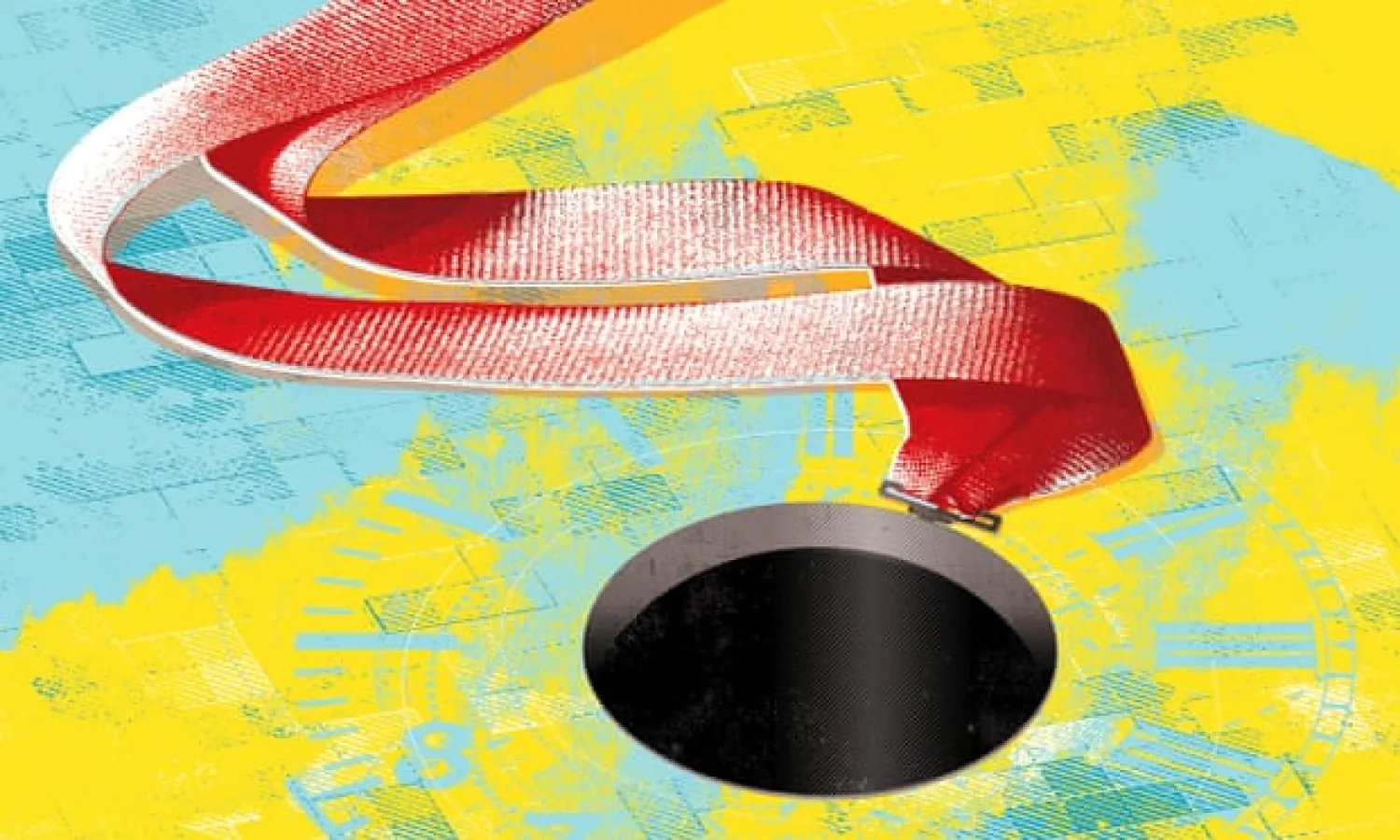
 ‘The best way to understand what happened in sport between March and April 2020, is to understand what didn’t happen.’ Illustration: Gary Neill
‘The best way to understand what happened in sport between March and April 2020, is to understand what didn’t happen.’ Illustration: Gary Neill
TT

Everything Exists in a Vacuum in the Month of Sport That Never Was

 ‘The best way to understand what happened in sport between March and April 2020, is to understand what didn’t happen.’ Illustration: Gary Neill
‘The best way to understand what happened in sport between March and April 2020, is to understand what didn’t happen.’ Illustration: Gary Neill

The best way to annoy a group of scholarly historians, if you ever have an urgent need to annoy scholarly historians – perhaps in some kind of emergency situation – is to propose a counterfctual analysis of events.

You know the kind of thing. What if Winston Churchill had died of a heart attack in 1941? What if skiffle, rather than the music of the Beatles, had seized the imagination of the world in 1963?

This is an inflammatory line of reasoning, interesting to readers of alarming pulp novels about the Third Reich taking over the world, but likely to cause an outbreak of pipe-chewing, tweed-flapping rage within the common rooms of Big History. It is also an interesting dynamic when applied to sports writing and sports analysis. Most of it would collapse if the counterfactual analysis were outlawed.

What is Expected Goals, or the Expected Points Table, or a counterintuitive stats-based gallery of the leading creative left-backs in Europe (No 5 will surprise you!) if not the type of “unhistorical shit” that so enraged the 20th-century historian EP Thompson? What is a revisionist colour sidebar take on the managerial achievements of José Mourinho, but the kind of counterfactual “parlour game” EH Carr, chronicler of the early Soviet Union, would have raged against?

And yet right now counter-facts are all sport has. In the Guardian’s pages this week you will have seen detailed analysis of a significant staging point: 100 days since coronavirus took hold and changed the world. This has mainly been a business of hard facts, sifted out from an overload of actual real-world news.

But not in sport. It is a month now since the first cancelled Premier League Saturday, a month since sport basically stopped. And this is the one significant event sport has to offer, its own cancellation. The story didn’t happen. That’s the story. It feels like counterfactual history in action. The best way to understand what happened in sport between March and April 2020, is to understand what didn’t happen.

At which point wind chimes tinkle, the screen starts to dissolve, and we’re back in the undoctored timeline, the one where sport still exists, where the talk of an illness in China remained talk of an illness in China, and where the wheels of Big Sport have continued to grind on.

In counterfactual April 2020 more than 300 unplayed professional men’s and women’s football fixtures have been played in the last four weeks. Close to £1bn in revenue has still been raked in.

In the Premier League Liverpool stuttered a little, then romped across the line, clinching the title with victory at Manchester City on 5 April, a moment that confirmed once again in its sheer operatic sweep that Premier League football is, and always will be, the most important thing currently happening to human civilisation.

Pep Guardiola declared himself “so very, very happy”, albeit in a murderous, glassy-eyed sarcastic whisper. The Liverpool board announced that the title win was “vindication for a community club where finances take second place to our football family – and let’s face it nothing’s ever likely to test this idea so there you go.”

Elsewhere news of Cristiano Ronaldo’s agreement to sign for Manchester United on a world record weekly wage led to questions in parliament over footballers’ salaries. “We have always backed the right of the market to decide how much individuals earn, this is all good for Britain,” Matt Hancock, MP for West Suffolk, announced, to cheers from the benches.

England’s cricketers continued to rebuild the Test team along strict attritional lines, battling out all 10 days of the two-match series in Sri Lanka to seal a triumphant 0-0 series draw. At home the ECB continued to plan for the Hundred, the nonexistent tournament involving nonexistent teams played out in front of nonexistent fans, which actually doesn’t sound such a weird idea these days.

Meanwhile, in the one really astonishing turn of the non-Covid timeline, Formula One announced that it would cease to function with immediate effect, having re-evaluated its place in human society, renounced its role as a carbon-fed playground for the mega-rich, and apologised in particular for the last decade of watching the best car win in dubiously-framed locations around the world. So congratulations, there, Formula One.

Away from all this the real business of sport didn’t un continue. It was announced that a combined one million miles would not go un-run in the postponed London Marathon, and £50m of charity donations not be deferred in the process. Around the country 350,000 amateur cricketers would not miss their final winter nets, and continue to look forward to another endless summer.

The FA would not cancel completely the seasons of at least 100 leagues in men’s and women’s non-league football. Similarly the results of the entire sub-pyramid of the amateur game – hundreds of leagues, thousands of clubs – were not declared null and void and scrubbed from the record.

In the wider world hundreds of thousands of coaches, teachers and volunteers did not stop working away at grassroots sport and the shared health of the nation. A combined two million people from the age of four upwards didn’t fail to participate in cancelled parkruns. And beyond this an unquantifiable mass did not fail to take their first step into sport or to come back to some kind of a more active life.

This, then, is the counterfactual history of sport March-April 2020, a month of urgent unhappenings and eventful nonevents. There will be quite a bit more of this to come from here. The important part, when it all starts up again, will be to remember which of those absences seemed to matter the most.

The Guardian Sport


‘Not Competitive’ Brazil Can Improve, Insists Ancelotti

Brazil's head coach Carlo Ancelotti looks on before the Mizuho Blue Challenge – The Kallang Football Series international friendly match between Japan and Brazil at the National Stadium in Singapore, 14 November 2026. (EPA)
TT

‘Not Competitive’ Brazil Can Improve, Insists Ancelotti

Brazil's head coach Carlo Ancelotti looks on before the Mizuho Blue Challenge – The Kallang Football Series international friendly match between Japan and Brazil at the National Stadium in Singapore, 14 November 2026. (EPA)

Brazil coach Carlo Ancelotti on Monday promised an improved performance in the year-ending clash against Singapore, admitting that his squad was "currently not competitive."

The Selecao lost 3-2 against Japan in a friendly in Singapore on Saturday, where Ancelotti and skipper Raphinha were red-carded after Japan scored the dramatic clincher in stoppage time.

"Given that the team is currently not competitive, I want to do more," Ancelotti told reporters in Singapore, where Brazil play on Tuesday.

The Italian, Brazil's first-ever permanent foreign coach, said: "I want to do more because I enjoy being here, so that the team can become more competitive on the global stage.

"The priority is to play well first (tomorrow) and to do well."

Ancelotti, 67, is coming under increasing pressure, following a string of underwhelming performances including two defeats, two wins and a draw in Brazil's last five international outings.

Japan avenged a 2-1 defeat by Brazil in their previous meeting at this year's World Cup, when the South Americans beat them in a round-of-32 clash.

After Saturday's loss, Ancelotti faced a barrage of criticism, including from former Brazilian national team star Romario.

Ancelotti brushed off Romario's remarks, saying "like anyone he has the right to express an opinion."

But the former Real Madrid coach, who reacted with fury after Brazil appealed for a foul in the build-up to Japan's winning goal on Saturday -- which was upheld by VAR -- said that his team "didn't deserve to lose" against Japan.

Japan face Paraguay on Tuesday in the second match of the double-header at Singapore's National Stadium.


Vinicius Says Less Training and Transfer Distractions May Explain Dip in Form

 Brazil's Vinicius Junior celebrates after goal during a friendly soccer match between Japan and Brazil in Singapore, Saturday, Nov. 14, 2026. (AP)
Brazil's Vinicius Junior celebrates after goal during a friendly soccer match between Japan and Brazil in Singapore, Saturday, Nov. 14, 2026. (AP)
TT

Vinicius Says Less Training and Transfer Distractions May Explain Dip in Form

 Brazil's Vinicius Junior celebrates after goal during a friendly soccer match between Japan and Brazil in Singapore, Saturday, Nov. 14, 2026. (AP)
Brazil's Vinicius Junior celebrates after goal during a friendly soccer match between Japan and Brazil in Singapore, Saturday, Nov. 14, 2026. (AP)

Real Madrid winger Vinicius Junior says ‌his reduced training schedule, and transfer interest, may have affected his performances in an underwhelming start to his Real Madrid season.

The Brazilian signed a new contract until 2032 in August, but so far his output on the pitch has fallen short of his own previous standards. Press scrutiny in Spain has been intensified by the impressive start of Ivorian signing Yan Diomande, who has eclipsed Vinicius in his preferred left-sided role.

“I don’t think I prepared as well as I could have after the World Cup, because ‌the impact of ‌that tournament is so significant for all ‌Brazilians," ⁠he told a ⁠press conference in Singapore on Monday.

"Being knocked out so early was something we hadn’t expected. So, I took advantage of my holidays to enjoy myself, rest, relax, and spend more time with my family. I ended up training less than in previous years," he said.

“That may have affected my start to the season."

Vinicius' future ⁠at Real Madrid was a talking point in ‌Spain for months as he entered ‌the final year of his contract before re-signing in August. Premier ‌League champions Arsenal were said to be interested at the ‌time.

"On top of that, regarding my contract renewal, with so many clubs showing interest last summer, I felt truly overwhelmed, as with the situation at Real Madrid. But it’s a very long season.”

The 26-year-old said he ‌had a track record of hitting top form in the decisive moments of the season, ⁠and that he ⁠was on a positive trajectory.

“Maintaining such a high level for so long is always very difficult," said Vinicius.

"I think only Cristiano Ronaldo and (Lionel) Messi have managed to do this for so many years, reaching the same kinds of numbers."

"I am human, I often make mistakes, but I always try to improve.”

This season Vinicius has scored one goal and given three assists in his 12 Real Madrid appearances. Coach Jose Mourinho has only used him for a full 90 minutes on three occasions.

Nevertheless, he did score twice on Saturday in Brazil's 3-2 loss to Japan, and is likely to feature in another friendly against Singapore on Tuesday.


Belgium’s Lukaku Retires from International Football

Belgium's forward #09 Romelu Lukaku celebrates after scoring his team third goal during the UEFA Nations League, League A - Group 1, football match between Belgium and Turkey at the Maurice Dufrasne stadium, in Liege, eastern Belgium on October 2, 2026. (AFP)
TT

Belgium’s Lukaku Retires from International Football

Belgium's forward #09 Romelu Lukaku celebrates after scoring his team third goal during the UEFA Nations League, League A - Group 1, football match between Belgium and Turkey at the Maurice Dufrasne stadium, in Liege, eastern Belgium on October 2, 2026. (AFP)

Belgium forward Romelu Lukaku on Monday retired from international football after scoring 94 goals in 135 games for his country, saying he was "at peace" with his decision.

Lukaku featured in four World Cups for the Red Devils and helped them reach the quarter-finals of this year's tournament before losing to eventual winners Spain.

The 33-year-old, who now plays for Turkish club Fenerbahce, made his debut in 2010 as a teenager and was an unused substitute in Sunday's 4-1 Nations League win over Italy.

"These 16 years I gave all I had for the national team. It was a nice ride and I enjoyed every single moment," Belgium's record goal scorer said on Instagram.

"To the Belgium fans, thank you for the support you gave our team. I am proud to have represented my country in 4 World Cups and 3 European Championships.

"I will never forget those moments. I'm at peace with my decision to stop here," Lukaku said.

The former Chelsea, Manchester United and Inter Milan forward was part of Belgium's so-called "golden generation".

Lukaku, alongside Kevin De Bruyne, Thibaut Courtois and Eden Hazard, finished third at the 2018 World Cup, a best-ever finish for Belgium in the tournament but they failed to lift a trophy during the period.

"I played with amazing teammates that I will always be grateful for," Lukaku said.

"I want to thank them all. I want to thank all the coaches as well for pushing and trusting me to help the team," he added.

- 'Legend, my brother' -

A host of fellow Belgian players paid tribute to Lukaku.

"Legend, my brother," midfielder Axel Witsel said on Instagram.

"Thank you for everything my bro," Courtois said.

"So many amazing memories," the Real Madrid goalkeeper added.

Lukaku's last appearance for his country came in October's 4-1 loss to France.

"Beyond his exceptional performances on the pitch, he has been a true leader, with a strong personality and an essential role in the dressing room," Lukaku's former team-mate and now Belgium's technical director Simon Mignolet said in a statement from the Belgian football association.

"We respect his decision and are deeply grateful to him for everything he has brought to our national team," the former Liverpool goalkeeper added.

Belgium's first game without Lukaku will be a Nations League last-eight fixture in March.

"We must now turn our attention to the future and prepare for the Nations League quarter-finals," Mignolet said.

"With the ambition of continuing to make progress as a team," he added.