


Israel Reaches Govt. Coalition Deal, Keeps Netanyahu in Power

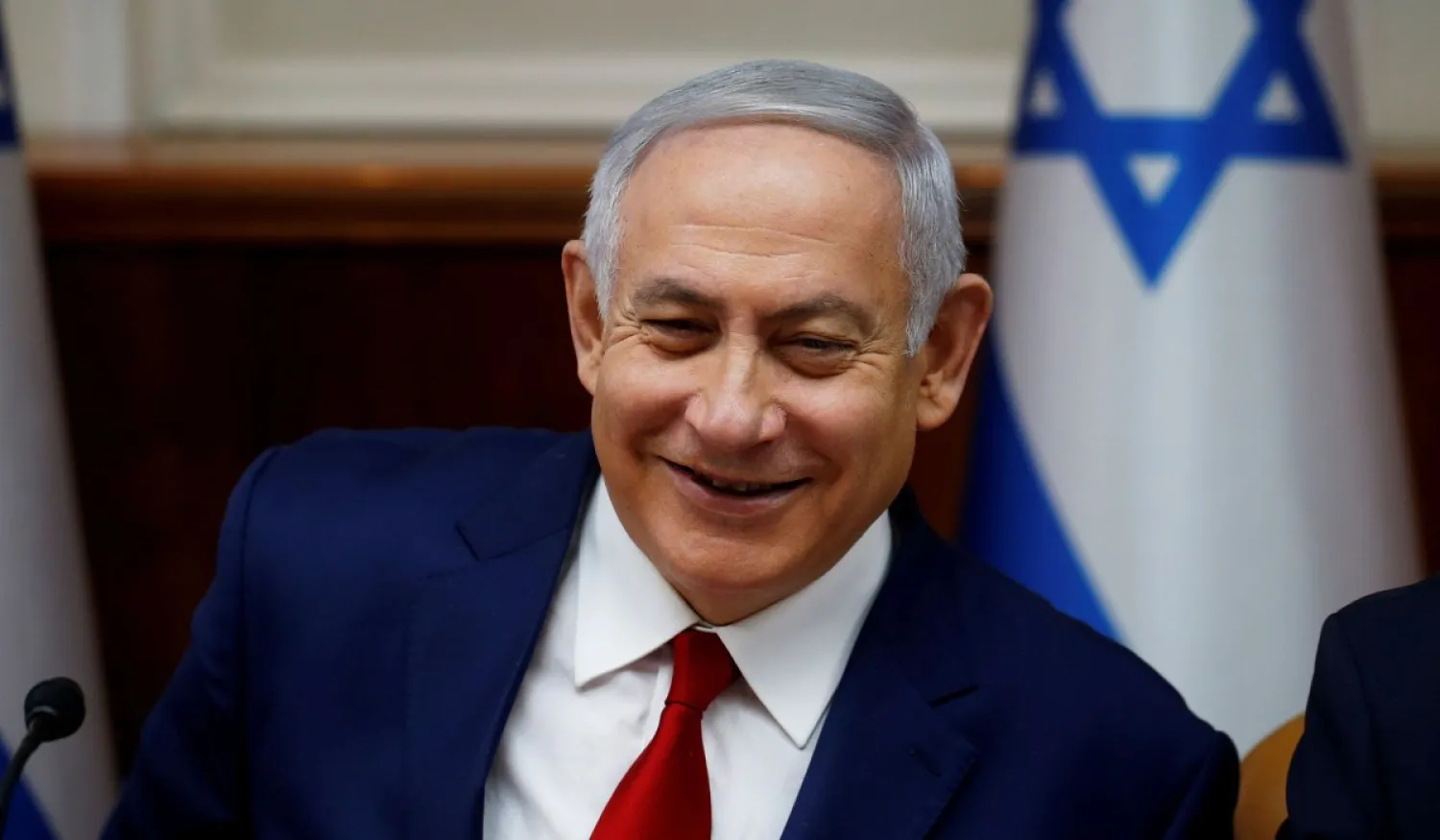
Israeli Prime Minister Benjamin Netanyahu. (Reuters)
TT

Israel Reaches Govt. Coalition Deal, Keeps Netanyahu in Power

Israeli Prime Minister Benjamin Netanyahu. (Reuters)

Israeli Prime Minister Benjamin Netanyahu and his chief rival announced Monday that they have forged a deal to form an “emergency” government, ending months of political paralysis.

The deal averts what would have been a fourth consecutive election in just over a year as the country fights its coronavirus outbreak.

Terms of the agreement weren’t immediately announced. But Israeli media said it called for a three-year period with Netanyahu serving as prime minister for the first half, and former military chief Benny Gantz taking the job for the second half.

After the last vote on March 2 ended in a stalemate, Netanyahu and Gantz agreed late last month to try to form a unity government because of the burgeoning coronavirus crisis. The talks have dragged on and stalled several times since, reportedly over Netanyahu’s personal legal problems, sparking concern that the collapse of a deal would force the country into new elections.

Although Netanyahu repeatedly came up short in the last elections, the coalition agreement returns the long-serving leader to the premiership, defying critics who predicted his downfall and restoring his reputation as a political wizard.

The deal likely required major compromise by both men. During three bitter campaigns over the past year, Gantz and his Blue and White party vowed never to serve in a government under Netanyahu so long as he faces a slew of corruption charges. Netanyahu, meanwhile, would likely be forced to step aside and allow Gantz to serve as prime minister for part of the time, if the coalition manages to survive long enough.

Negotiations between the two leaders largely revolved around Netanyahu's corruption trial set to start next month. Main sticking points included a demand by the prime minister to have more say on judicial appointments, which could play a role if his case eventually reaches the Supreme Court.

Last month’s election, just like the campaigns last September and April, ended with no clear winner. But with a slight majority of lawmakers endorsing him, Gantz was given the first shot at building a coalition government.

The glue holding together Gantz's different backers was their shared animosity toward Netanyahu. The opposition leader had begun to move forward with legislation that would have disqualified the indicted Netanyahu from serving as prime minister in the future.

But with the virus crisis worsening, and his own shaky alliance fraying, Gantz made an about-face late last month and accepted an offer from Netanyahu to pursue a joint government to deal with the pandemic. The move drew heavy criticism from Gantz’s supporters and tore apart his Blue and White alliance, leaving him with a faction roughly half its original size.

Negotiations have continued even after Gantz’ allotted time to build a coalition ended last week, with the president now giving the Knesset until May 7 to select a candidate for prime minister. If a majority of legislators fails to choose a candidate, the Knesset would automatically be dissolved, triggering new elections.

On Sunday night, several thousand demonstrators, including Gantz’s former political partner Yair Lapid, gathered in Tel Aviv to protest the expected government deal. Protesters accused Netanyahu of using the coronavirus crisis to shield himself from prosecution and accused Gantz of abandoning his central campaign promises.

“You don’t fight corruption from within. If you’re inside, you’re part of it,” Lapid said.

Netanyahu is awaiting trial on charges of accepting bribes, breach of trust and fraud. He has denied any wrongdoing and portrays himself as a victim of a media and judicial witch hunt. Citing the coronavirus crisis, Netanyahu’s hand-picked justice minister has already delayed the trial by two months by shuttering most of the court system.

Israel has identified more than 13,000 cases of the coronavirus, with 172 deaths. While this week the country began relaxing some of its health restrictions, hundreds of thousands are out of work and the economy has come to a standstill.

There has also been growing criticism over Netanyahu’s approach to beating back the virus, with accusations that he has sidelined democratic norms in the name of fighting the virus. The government has also come under criticism for moving too slowly in compensating workers and businesses hit by the crisis.



First Flight of Deported Venezuelan Migrants Arrives in Caracas after Maduro's Capture

A migrant participating in the government's program Great Mission Return to the Homeland, waves upon arrival at Maiquetia International Airport, in Venezuela 16 January 2026. EPA
TT

First Flight of Deported Venezuelan Migrants Arrives in Caracas after Maduro's Capture

A migrant participating in the government's program Great Mission Return to the Homeland, waves upon arrival at Maiquetia International Airport, in Venezuela 16 January 2026. EPA

A flight with 231 Venezuelan migrants deported from the US city of Phoenix arrived Friday to their home country, nearly two weeks after the United States captured former President Nicolás Maduro and took him to New York to face drug trafficking charges.

The Eastern Airlines plane arrived at an airport outside the capital, Caracas, marking the resumption of flights after Washington — according to Venezuelan officials — unilaterally suspended direct deportation air transfers in mid-December, The Associated Press reported.

The previous direct flight from the US was on Dec. 10.

Return flights for deported migrants had been regularized since late March as part of the transfers agreed upon by both governments.

The transfers were successively affected amid heightened tensions since US military forces began to execute a series of deadly attacks against boats suspected of smuggling drugs in international waters of the Caribbean and Pacific Ocean, including several vessels that they claim departed from Venezuela.

Maduro maintained at all times that US President Donald Trump could order military action to try to overthrow him.

The flight’s arrival comes 13 days after Maduro was captured along with his wife, Cilia Flores, during a military intervention in Caracas. Subsequently, he was transferred to US territory, where both appeared on Jan. 5 before a New York court to face narcoterrorism charges. Both have pleaded not-guilty.


Putin in Contact with Israel, Iran Leaders to Help 'De-escalate', Says Kremlin

Russian President Vladimir Putin takes part in a ceremony to receive letters of credence from newly appointed foreign ambassadors at the Grand Kremlin Palace in Moscow on January 15, 2026. (Photo by Ramil Sitdikov / POOL / AFP)
TT

Putin in Contact with Israel, Iran Leaders to Help 'De-escalate', Says Kremlin

Russian President Vladimir Putin takes part in a ceremony to receive letters of credence from newly appointed foreign ambassadors at the Grand Kremlin Palace in Moscow on January 15, 2026. (Photo by Ramil Sitdikov / POOL / AFP)

Russian President Vladimir Putin on Friday held phone calls with the leaders of Israel and Iran, the Kremlin said, offering mediation amid large-scale protests in Iran that have raised fears of a military confrontation in the region. 

Independent monitors say Iranian security forces have killed thousands in a forceful response to nationwide anti-government protests -- a crackdown that prompted threats of military action by the United States, Israel's key ally. 

Iran and Israel fought a brief war in June that saw unprecedented Israeli attacks on Iranian military and nuclear facilities. The United States had briefly joined those strikes, hitting three major Iranian nuclear sites. 

On Friday, Russia announced Putin was in contact with both Israeli Prime Minister Benjamin Netanyahu and Iranian President Masoud Pezeshkian in a bid to cool tensions between the two rivals. 

"The situation in the region is highly tense, and the president continues his efforts to facilitate de-escalation," Kremlin spokesman Dmitry Peskov said. 

Moscow is a close ally of Iran. It has also strived for good relations with Israel, though those ties became strained amid Russian criticsm of Israel's actions in Gaza since October 7, 2023. 

In a call with Israel's Netanyahu on Friday, the Kremlin said Russia had expressed its "readiness to continue its mediation efforts." 

It did not clarify what current efforts were being undertaken or comment on the protests in Iran. 

Moscow had previously offered mediation during the June war. 

Peskov said that Moscow would announce "the results of our telephone conversation with the Iranian President very soon." 

Netanyahu said Sunday that he hoped Iran would soon be freed from what he described as the "yoke of tyranny", amid the protests. 

However, the rallies appear to have diminished over the last few days in the face of repression and a week-long internet blackout. 

Iran has repeatedly accused the United States and Israel of inciting the unrest and trying to undermine the Islamic republic's national unity. 


Trump Accepts Nobel Medal from Venezuelan Opposition Leader Machado

(COMBO) This combination of pictures created on January 14, 2026 shows US President Donald Trump at the White House in Washington, DC, on March 26, 2025 and Nobel peace laureate Maria Corina Machado in Oslo, Norway, on December 11, 2025. On January 15 US President Donald Trump is scheduled to meet with Venezuelan opposition leader Maria Corina Machado, whose pro-democracy movement he has sidelined since toppling her country's leader, and whose Nobel Peace Prize he openly envies.
TT

Trump Accepts Nobel Medal from Venezuelan Opposition Leader Machado

(COMBO) This combination of pictures created on January 14, 2026 shows US President Donald Trump at the White House in Washington, DC, on March 26, 2025 and Nobel peace laureate Maria Corina Machado in Oslo, Norway, on December 11, 2025. On January 15 US President Donald Trump is scheduled to meet with Venezuelan opposition leader Maria Corina Machado, whose pro-democracy movement he has sidelined since toppling her country's leader, and whose Nobel Peace Prize he openly envies.

Venezuelan opposition leader Maria Corina Machado gave her Nobel Peace Prize medal to US President Donald Trump on Thursday during a White House meeting, in a bid to influence his efforts to shape her country's political future.

A White House official confirmed that Trump intends to keep the medal, Reuters reported.

In a social media post on Thursday evening, Trump wrote: "Maria presented me with her Nobel Peace Prize for the work I have done. Such a wonderful gesture of mutual respect. Thank you Maria!"

Machado, who described the meeting as "excellent," said the gift was in recognition of what she called his commitment to the freedom of the Venezuelan people.

The White House later posted a photo of Trump and Machado with the president holding up a large, gold-colored frame displaying the medal. Accompanying text read, "To President Donald J. Trump In Gratitude for Your Extraordinary Leadership in Promoting Peace through Strength," and labeled ‌the gesture as a "Personal ‌Symbol of Gratitude on behalf of the Venezuelan People."

Machado's attempt to sway Trump ‌came ⁠after he dismissed ‌the idea of installing her as Venezuela's leader to replace the deposed Nicolas Maduro.

Trump openly campaigned for the prize before Machado was awarded it last month and complained bitterly when he was snubbed.

Though Machado gave Trump the gold medal that honorees receive with the prize, the honor remains hers; the Norwegian Nobel Institute has said the prize cannot be transferred, shared or revoked.

Asked on Wednesday if he wanted Machado to give him the prize, Trump told Reuters: "No, I didn't say that. She won the Nobel Peace Prize."

The Republican president has long expressed interest in winning the prize and has at times linked it to diplomatic achievements.

The lunch meeting, which appeared to last slightly over ⁠an hour, marked the first time the two have met in person.

Machado then met with more than a dozen senators, both Republican and Democratic, on Capitol Hill, ‌where she has generally found more enthusiastic allies.

During the visit, White House press ‍secretary Karoline Leavitt said Trump had looked forward to meeting ‍Machado, but stood by his "realistic" assessment that she did not currently have the support needed to lead the country in the ‍short term.

Machado, who fled the South American nation in a daring seaborne escape in December, is competing for Trump's ear with members of Venezuela's government and seeking to ensure she has a role in governing the nation going forward. After the United States captured Maduro in a snatch-and-grab operation this month, opposition figures, members of Venezuela's diaspora and politicians throughout the US and Latin America expressed hope for Venezuela to begin a process of democratization.

HOPES OF A MOVE TO DEMOCRACY

Democratic Senator Chris Murphy, one of the senators who met with Machado, said the opposition leader had told senators that repression in Venezuela was no different now ⁠than under Maduro.

Venezuela's interim President Delcy Rodriguez is a "smooth operator" who was growing more entrenched by the day thanks to Trump's support, he said.

"I hope elections happen, but I'm skeptical," said Murphy, of Connecticut.

Trump has said he is focused on securing US access to the country's oil and economically rebuilding Venezuela. Trump has on several occasions praised Rodriguez, Maduro's second-in-command, who became Venezuela's leader upon his capture. In an interview with Reuters on Wednesday, Trump said, "She's been very good to deal with."

Machado was banned from running in Venezuela's 2024 presidential election by a top court stacked with Maduro allies.

Outside observers widely believe Edmundo Gonzalez, an opposition figure backed by Machado, won by a substantial margin, but Maduro claimed victory and retained power. While the current government has freed dozens of political prisoners in recent days, outside groups and advocates have said the scale of the releases has been exaggerated by Caracas.

In an annual address to lawmakers, Rodriguez called for diplomacy with the United States and said should she need to travel to Washington, she would do so "walking on ‌her feet, not dragged there."

She also said she would propose reforms to her country's oil industry aimed at increasing access for foreign investors.