The Inventive Chef Who Kept His 700 Paintings Hidden

Ficre Ghebreyesus had no art gallery representation during his lifetime. Now his widow is working with Galerie Lelong in New York to show the work that summed up his search for identity.

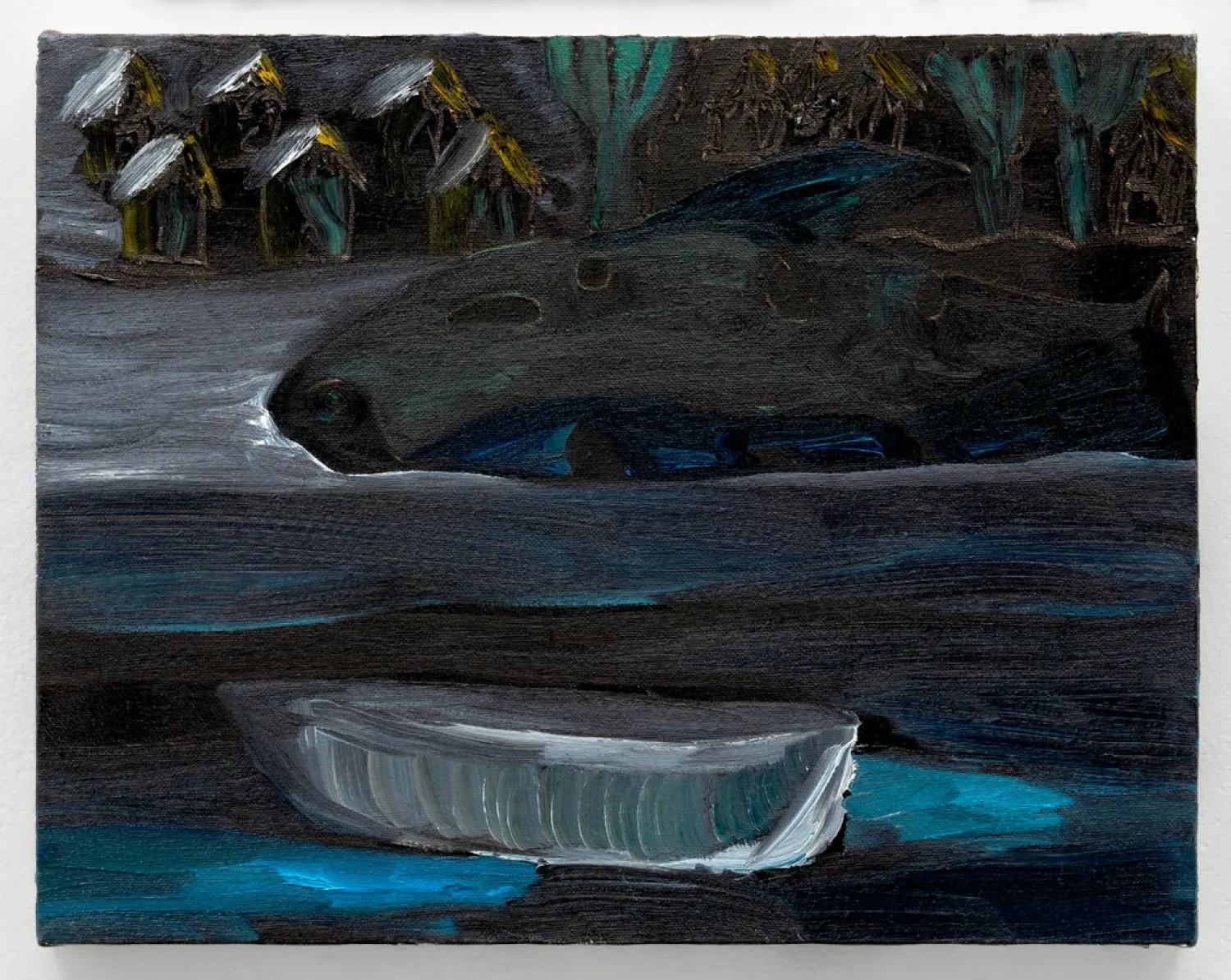
“Boat at Night,” circa 2002-07, oil on canvas. His early paintings are often thickly painted nighttime scenes with a single source of illumination. Credit...The Estate of Ficre Ghebreyesus; via Galerie Lelong & Co., New York
TT

The Inventive Chef Who Kept His 700 Paintings Hidden

“Boat at Night,” circa 2002-07, oil on canvas. His early paintings are often thickly painted nighttime scenes with a single source of illumination. Credit...The Estate of Ficre Ghebreyesus; via Galerie Lelong & Co., New York

Mixing memories of his East African childhood with his day-to-day life as a husband and father in New Haven, Conn., Ficre Ghebreyesus conjured up an imaginary space of his own. He created this multilayered world in his studio, where, after his sudden death at 50 in 2012, he left behind more than 700 paintings and several hundred works on paper. And he performed a similar magic in the popular Caffe Adulis, where he earned his living by cooking hybrid recipes that drew on the culinary heritage of his native Eritrea and neighboring Ethiopia.

If, by some chance, a habitué of the Caffe Adulis ventured to Asmara, the capital of Eritrea, and sought a beloved dish on a local restaurant menu, disappointment usually ensued. “People would ask for shrimp barka in Eritrea, and it doesn’t exist,” said Mr. Ghebreyesus’s widow, the distinguished poet Elizabeth Alexander, who is the president of the Andrew W. Mellon Foundation. “The thing that was cool about Ficre as a chef is that to him it was making art. It’s like the dreaminess of the paintings. There’s something remembered and something invented.”

Mr. Ghebreyesus very rarely exhibited his paintings publicly. “We disagreed about that,” Ms. Alexander said. “I now see that he just wanted to work. He thought that self-advocacy was inappropriate.” But she thinks he would be very pleased that Galerie Lelong in Chelsea is now representing him. “Gate to the Blue,” his first New York exhibition, was scheduled to open there in late April. Although the actual opening has been postponed until Sept. 10, the gallery has posted the images of the paintings in the show online.

One reason Mr. Ghebreyesus chose not to spend time promoting his painting was that he had lost a great deal of time already. “He went through so much with his upheaval,” Ms. Alexander said.

Born into a prominent Coptic Christian family in Asmara and educated in Catholic schools, he grew up in a strife-torn country at the beginning of Eritrea’s 30-year war of independence from Ethiopia. When he met Ms. Alexander in New Haven in 1996, they communicated their shared reverence for “The Diary of Anne Frank.” “We understood it in different ways,” she recalled. “He had soldiers breaking into his house.”

Mr. Ghebreyesus left Eritrea at 16 on a three-year odyssey, traveling to Sudan, Italy, and Germany, before finding refuge in the United States. He settled in New Haven, where he and his two brothers opened Caffe Adulis in 1992. In 2000, he was admitted to the Yale School of Art. “He was certainly distinctive for how dedicated he was to painting,” said Pamela Franks, an art historian who knew him at Yale and is now director of the Williams College Museum of Art. “He was painting all the time.”

Like other refugees, he carried with him his loss, including the separation from his family and the pain of knowing the suffering in his homeland. His early paintings are often thickly painted nighttime scenes with a single source of illumination, such as truck headlights or a campfire.

“What I found in all Eritrean art is there is an element of darkness in it,” said Kassahun Checole, the publisher of Africa World Press and Red Sea Press, based in New Jersey. A native Eritrean, Mr. Checole met Mr. Ghebreyesus in New York, and they worked together politically for Eritrean war relief. “The depression that settles in all of us from our situation as exiles is expressed in the art,” Mr. Checole continued. “With Ficre, that was transformed when he met Elizabeth, moved to Connecticut, and his children were born. His art becomes more bright and hopeful.”

Indeed, Mr. Ghebreyesus’s distinctive talent as a colorist blossomed with his marriage to Ms. Alexander in 1997 and the birth of their two sons: Solomon, 22, and Simon, 20, who are both undergraduate students at Yale. As with his cooking, his sources as a painter were eclectic. The checkerboard motifs that he incorporated into many pictures bear a resemblance to the basketry and embroidery that he saw in his youth. The pinks and peachy oranges may derive from the colors of painted stucco houses in Asmara, a city that was occupied by the Italians in the 1920s and became a landmark of colonial modernism — like Mr. Ghebreyesus, a hybrid.

The saturated reds and blues of his paintings, however, seem indebted to the Western artists he loved, particularly Matisse. From Giotto’s Scrovegni Chapel, which he saw in Padua, Italy, to the modernist paintings and African sculptures that he studied during his frequent visits to the Yale University Art Gallery, Mr. Ghebreyesus absorbed everything he was exposed to. He was also passionate about music, with eclectic taste. “He would put together a playlist that would include music we knew and didn’t know — Nina Simone and then this incredible Ethiopian jazz mixed in,” said the musician Jason Moran, a friend.

Reticence confined Mr. Ghebreyesus’s reputation to his circle of devoted friends until his unexpected death. Complaining of feeling unwell a couple of days after his 50th birthday party, he continued working and exercising. No one recognized the seriousness of his ailment until it was too late. His younger son found him fallen off his treadmill, lying dead on the floor, of massive heart failure.

Three years later, after coping with the shocking grief and moving her family to New York, Ms. Alexander wrote a New Yorker article that was expanded in 2016 into a best-selling memoir, “The Light of the World,” making Mr. Ghebreyesus’s name more widely known. His art, though, awaited its audience.

A posthumous exhibition at a gallery in New Haven was followed by one at the Museum of the African Diaspora in San Francisco in 2018. After showcasing him at its booth at the Art Dealers Association of America fair last month, Galerie Lelong is presenting a selection of works that focus on Mr. Ghebreyesus’s unsettled traveling between worlds.

The most directly autobiographical painting, “Mangia Libro,” normally hangs in the Mellon Foundation headquarters. In it, Mr. Ghebreyesus depicts himself as a child, reading a book as he walks, with a dusky rose building behind him and water teeming with fish and seaweed in front. As often in Mr. Ghebreyesus’s paintings, there are abstract sections of checks and stripes, and enigmatic details.

Allusions to Eritrean culture abound in such paintings as “Angel and Musician,” which evokes the depiction of angels in Coptic Christian churches and the stringed lyre-like krar played by traditional musicians. One of the delights of this beautiful exhibition is the evident joy that Mr. Ghebreyesus took in the deft application of paint. The watery reflections of the banded vessel in “Solitary Boat in Red and Blue” create a shimmery, ghostly presence in the foreground, and the sea shifts without clear demarcation into a crepuscular streaky green sky. The interior of the vessel (similar in its hollow form to the used coconut shells that Mr. Ghebreyesus brought by the box from the restaurant to the studio) is an opalescent blending of thinly applied acrylic paint that divides into four softly distinct sections. The picture represents a boat in the ocean; but just as much, it is a bravura demonstration of paint handling.

The centerpiece of the exhibition is a huge painting, 16 feet by 8 feet on unstretched canvas, “The Sardine Fisherman’s Funeral.” A frieze of angel faces at the top, looking down on a scrum of human activity, plays against the focus of the painting: a gigantic fish propped up against a deep blue backdrop. And what are those two umbrellas doing here? Maybe their beautiful shapes are reason enough for their presence.

“I don’t look at them as biographical,” the Ethiopian-born American artist Julie Mehretu said of Mr. Ghebreyesus’s works. “They’re experiential paintings. They are explorations in paint. ”

Especially in these later paintings, he created an autonomous universe through the flattened picture planes, in which figures, fish, trees and geometric patterns jostle against one another in freewheeling abandon.

“With a lot of artists from the continent, the work is read as a history of the past and the time, and I don’t experience his painting that way,” Ms. Mehretu said. “It’s not tethered to who he was. There was a possibility that he imagined. And that is super interesting to me — that he untethered himself.”

(The New York Times)


An Iconic Puzzle Comes Home as Production of the Rubik’s Cube Returns to Hungary

Hungarian architect and inventor Ernő Rubik attends the opening event of Rubik's Cube production line of the Jasz-Plasztik plastic processing company in Jaszbereny, Hungary, 10 November 2026. (EPA)
TT

An Iconic Puzzle Comes Home as Production of the Rubik’s Cube Returns to Hungary

Hungarian architect and inventor Ernő Rubik attends the opening event of Rubik's Cube production line of the Jasz-Plasztik plastic processing company in Jaszbereny, Hungary, 10 November 2026. (EPA)

More than half a century ago, a Hungarian architect, sculptor and professor invented what would become one of the world's most popular and beloved puzzles whose appeal has spanned generations: the colorful, mind-bending, six-sided Rubik's Cube.

Now, after selling more than half a billion units and becoming a worldwide cultural touchstone, production of the cube is returning to Hungary, where its inventor, Ernő Rubik, first conceived of the iconic object that bears his name.

Hungary “is the home of the cube. The cube was born here,” Rubik, 82, said on Tuesday at the opening of a new, fully automated Rubik's Cube production line in the Hungarian city of Jászberény.

The journey of the Rubik's Cube began in 1974, when Rubik was teaching design at the Academy of Applied Arts and Design in Budapest. Seeking to create a three-dimensional object that was “infinite,” he said, he completed a prototype — then made of wood — of a cube that could rotate on multiple axes and was made up of 27 blocks.

Recognizing its consumer value, Rubik soon began producing more of the puzzles. Beginning in 1977, an initial 5,000 units of what was then called the “Magic Cube” were sold at specialty shops in the Hungarian capital.

The invention — or what Rubik prefers to describe as a “discovery” — gained popularity, and after having difficulties procuring materials for the cubes in then-socialist Hungary, he realized: “We were not prepared for that size of production ... We can’t fulfill the needs of the market worldwide.”

The cube was licensed to a British and then a US toy company, and its production was moved abroad. By the early 1980s, its popularity had exploded in what Rubik called “the first big wave,” in which he said 200 million units were sold between 1980 and 1983.

While sales of the cube dipped after its initial success, it still attracts plenty of users eager to try their hand at solving the puzzle. Millions are sold every year.

At the new production line in Hungary, a series of robotic arms assembles the cubes and tests them for functionality and durability — a level of automation Rubik said was “very different” than in the early days when the cubes were assembled by hand.

The new line in Jászberény plans to produce 1 million cubes annually.

Steve Radewych, a senior vice president with Canadian toy company Spin Master, which owns the Rubik's Cube trademark, said at Tuesday's opening that the theme of the day was: “Back to its roots: The cube comes home.”

“Ernő, your discovery is more than a toy,” Radewych told Rubik. “It's a global social phenomenon.”

Radewych noted the “incredible staying power” of the Rubik's Cube, and the fact that the puzzle continues to hold the fascination of young people even today.

“The cube represents an intellectual journey, a symbol of intelligence, problem-solving and cognitive discipline,” he added, which “has brought joy — and frustration — to many generations.”

The cube has enjoyed another surge in popularity in recent years as global competitions have proliferated, measuring who can solve the puzzle the fastest.

The current record, set only last month in China by nine-year-old Xuanyi Geng, is 2.51 seconds, according to the World Cube Association, which organizes and certifies competitions across the world.

Rubik, who does not consider himself a speed competitor, said that for him, the cube represents a “transformable sculpture,” the place where art and engineering meet and users can manipulate and change the cube in nearly endless variations.

“If you are doing something, creating something, you have the chance to do something that is meaningful — that’s one part — and beautiful,” he said.


SpaceX Starship Test to Attempt First-Ever Spaceship ‘Catch'

SpaceX's mega rocket Starship is stacked and prepared for a test flight from Starbase, Texas, Thursday, Nov. 12, 2026. (AP)
TT

SpaceX Starship Test to Attempt First-Ever Spaceship ‘Catch'

SpaceX's mega rocket Starship is stacked and prepared for a test flight from Starbase, Texas, Thursday, Nov. 12, 2026. (AP)

Elon Musk's SpaceX was poised Friday to carry out its latest test of the world's biggest and most powerful rocket, the Starship, with plans for a groundbreaking "catch" of the spaceship following a day in orbit.

A successful capture of the Starship upper stage would mark a significant milestone in the space industry's decades-long pursuit of fully reusable spacecraft that can drastically reduce mission costs and make frequent travel possible.

"If successful, this will mark the first full recovery of an orbital launch system and a breakthrough moment in making Starship a reliable, rapidly reusable rocket," SpaceX said.

For the 15th Starship test flight Friday, SpaceX aims to recover both stages of the massive 124-meter (407-foot) launch vehicle.

The company has caught the booster, dubbed Super Heavy, on three previous occasions, with the first stage descending vertically back to the launch site shortly after blastoff and nestling into mechanical "chopstick" arms.

It will now attempt to do the same with the spaceship. Some versions of the vessel are designed to launch internet satellites and data centers into orbit, while others will be made to ferry people to the Moon and Mars.

A spacecraft that can be fully reused is the "Holy Grail" of the space industry, said Clayton Swope, an aerospace expert at the Center for Strategic and International Studies.

"No one's really been able to do that so far," he said. "People have been trying to do that since the (NASA) space shuttle. But the space shuttle ended up being kind of a compromise because a lot of the vehicle wasn't reusable."

Reusing the Starship spacecraft would require the vessel to withstand the extreme heat of reentering Earth's atmosphere and then return to service without extensive refurbishment.

- Refueling challenge -

Musk, the world's richest person, has already revolutionized the space sector with the partially reusable Falcon rockets, which are regularly employed to launch satellites and carry astronauts to the International Space Station.

The Starship project, however, has been plagued by years-long delays as SpaceX grapples with novel engineering challenges -- even as NASA is counting on the spaceship to serve as a lunar lander for its Artemis program.

Other technical challenges include transferring fuel to Starship in orbit -- a requirement for any journey to the Moon or Mars.

Following SpaceX's high-profile stock market debut in June, the company carried out the first orbital flight of Starship in September, though the mission was cut short due to an engine issue.

It is also investing heavily in additional launch sites for its mega-rocket in Louisiana and Florida.

- Complex capture -

Friday's launch is scheduled to take place at SpaceX's "Starbase" in southern Texas at 4:45 pm (2245 GMT).

Following liftoff and the mid-air separation of the two stages, SpaceX plans to bring Super Heavy back to Earth six and a half minutes later, catching it at the launch site on the Gulf of Mexico coastline.

The spaceship will continue to reach Earth's orbit, where it will deploy 26 satellites into Musk's Starlink satellite internet constellation that has become a major revenue stream for SpaceX.

It will then circle the planet 14 times, before returning 22 hours later and -- SpaceX hopes -- descending safely into the chopstick arms.

This capture attempt is more complex than that of the booster, as the spaceship will be descending much faster and from a much greater altitude.

SpaceX has said it would proceed with these maneuvers only if conditions are optimal, and in the past has made last-minute changes to test flights under Musk's "fail fast" strategy of learning through crashes, explosions and other mishaps.

As of late Thursday, the US Federal Aviation Administration had not yet given its final approval for the test flight.


Delhi Overtakes Lahore as World’s Most Polluted City as Air Quality Drops

Traffic moves on a smoggy morning as air pollution spikes in New Delhi, India, November 13, 2026. (Reuters)
TT

Delhi Overtakes Lahore as World’s Most Polluted City as Air Quality Drops

Traffic moves on a smoggy morning as air pollution spikes in New Delhi, India, November 13, 2026. (Reuters)

India's capital Delhi overtook Lahore in Pakistan to become the world's most polluted city on Friday, with air quality reaching hazardous levels and visibility dropping as smog blanketed the city of 20 million people.

Air quality index (AQI) in Delhi was "hazardous" at 334, making ‌it the ‌most polluted global major ‌city, ⁠according to Swiss group ⁠IQAir, which measures air quality levels based on the concentration of toxins.

An AQI reading up to 50 is considered good with little or no ⁠health risk.

India's official ‌Central Pollution ‌Control Board pegged the AQI higher at ‌403 and rated it "severe".

The ‌Swiss and Indian readings vary due to the different AQI scales and methodologies used to calculate and ‌classify air pollution levels.

Cars and motorcycles emerged from dense ⁠smog, ⁠which also appeared to obscure streetlights on the city's main roads, videos from news agency ANI showed.

Pollution is a seasonal problem in many parts of northern India and neighboring Pakistan, as the cold, heavy air of winter traps vehicle emissions, construction dust and smoke from agricultural burning.