


Premier League Must Exercise Caution in Return Fraught With Lethal Hazards

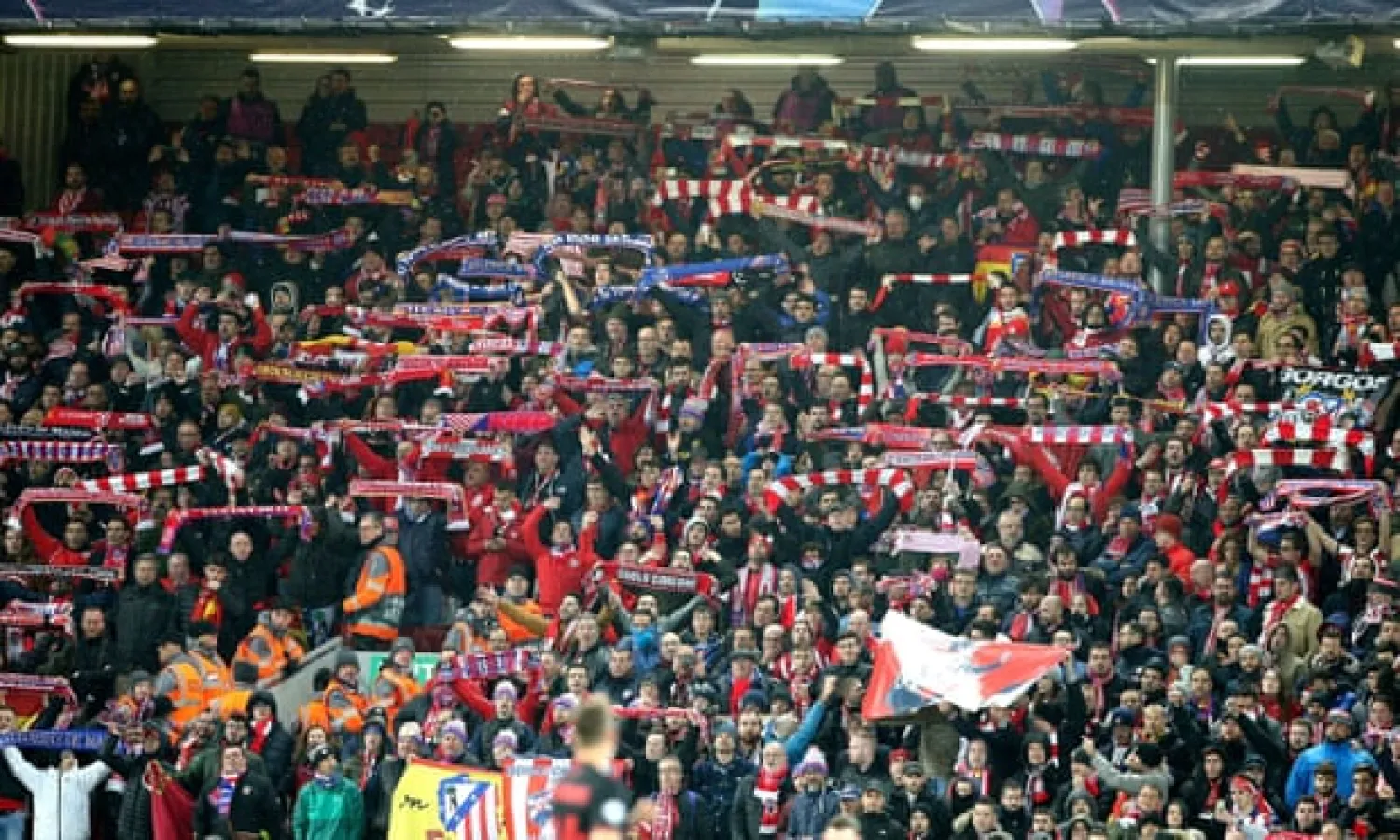
 Atlético Madrid fans at Anfield for the Champions League game against Liverpool on 11 March. Photograph: Craig Galloway/ProSports/Rex/Shutterstock
Atlético Madrid fans at Anfield for the Champions League game against Liverpool on 11 March. Photograph: Craig Galloway/ProSports/Rex/Shutterstock
TT

Premier League Must Exercise Caution in Return Fraught With Lethal Hazards

 Atlético Madrid fans at Anfield for the Champions League game against Liverpool on 11 March. Photograph: Craig Galloway/ProSports/Rex/Shutterstock
Atlético Madrid fans at Anfield for the Champions League game against Liverpool on 11 March. Photograph: Craig Galloway/ProSports/Rex/Shutterstock

Fair play to the Premier League, EFL and everybody trying to plot a cautious way back to normal life, but amid their expert advice‑taking and scenario‑modelling it feels increasingly that they should also be stress-testing the alternative – calling the season off.

The more savvy professionals involved are exercising caution about the government’s position, after another oddly judged intervention this week by Oliver Dowden, the culture secretary, who said that – health guidance permitting – he wanted to “get football up and running – as soon as possible”.

Bill Shankly’s classic quip about the importance of football when manager of the club who could still be crowned 2020 champions whatever happens, was cast in terribly serious perspective after the horrors of Heysel and Hillsborough in the 1980s. Now, considering whether to play professional football in the middle of a pandemic is literally a matter of life and death.

One of football’s perennial failings is to inflate its obsession into a bubble in which the great game’s dramas, outcomes, personalities and controversies seal it off into an alternative world which can feel somehow as significant as everything else. Hearing Boris Johnson mention “our current success” in dealing with coronavirus, the health secretary, Matt Hancock, deny that allowing the virus to run through the population and achieve “herd immunity” was ever “part of their plan” and the refusal by the government to admit to a single failure, they often appear to be creating a bubble of their own.

For people not in the front line of the NHS or caring professions, and not stricken personally by the virus, lockdown can make the horror of this situation feel unreal. But 27,000 people in the UK have died, each one a tragedy and grievous blow to a family.

Into the second week in March, Dowden and his government were still encouraging people to go to matches and the Cheltenham Festival, based on scientists’ advice that “mass gatherings” pose a low risk of virus transmission. Prof Neil Ferguson of Imperial College explained that with reference to the Liverpool v Atlético Madrid match played on 11 March. “Some people will have got infected,” he said of the transmission potential of mass gatherings, “and if it hadn’t happened they wouldn’t have been.” But he went on to explain that “at a population level, stopping them has a marginal impact”.

But in normal circumstances we do not think of a risk to some lives as “marginal” because they are not many as a proportion of the whole population; normally everything is aimed at saving and preserving life. Most of the talk in football now is about how players and staff could be tested, somehow housed in a sterile environment, how they might ingeniously be tiptoed into empty stadiums while the rest of the population are still largely housebound.

The mayor of Liverpool, Joe Anderson, was criticized by the club itself for raising public health concerns about games restarting, but however in-depth the planning may be to avoid people massing outside the stadium or gathering instinctively to celebrate, he was sounding a genuine alarm about risks.

To be balanced against those lethal hazards are the benefits of trying so hard to stage matches again. As seven weeks have gone by since football suspended itself on 13 March, against the advice of Dowden and his government that it was fine to carry on into that weekend, the significance of promotion, relegation and Champions League qualification has been put into perspective by the pandemic’s elemental threat. Now the urge to play is articulated more as a grim job of having to get the season done to avoid difficult conversations with broadcasters, and be able to keep their money.

After Dowden spoke up in parliament, more than one senior football executive told the Guardian this week they felt uneasy, as if the government needs some good news, some entertainment for the masses, and that lies behind their desire to get the Premier League playing “as soon as possible”.

Dowden said in parliament that this would “help release resources through the rest of the system”, but the EFL is understood to be baffled by that, as no more money will go down the football pyramid now if the Premier League starts playing again.

In France, where the number of people killed by Covid-19 is lower than in Britain, the government has banned team sports until September and, however much the odd club such as Lyon may grumble, Ligue 1 is cancelled, and the summer is cleared of yet another complication, to try to address the virus. If that were to happen here, however much football people are missing the game and would love current realities to be different, many people could usefully calm down.

The financial situation, of course difficult, will probably be just about manageable. If that did happen, the Premier League could concentrate on being true to the principle it has stressed throughout and did again on Friday: “The thoughts of all are with those directly affected by the Covid-19 pandemic,” and: “The Premier League’s priority is the health and safety of players, coaches, managers, club staff, supporters and the wider community.”

The Guardian Sport


Lindsey Vonn Back in US Following Crash in Olympic Downhill 

Milano Cortina 2026 Olympics - Alpine Skiing - Women's Downhill 3rd Official Training - Tofane Alpine Skiing Centre, Belluno, Italy - February 07, 2026. Lindsey Vonn of United States in action during training. (Reuters)
TT

Lindsey Vonn Back in US Following Crash in Olympic Downhill 

Milano Cortina 2026 Olympics - Alpine Skiing - Women's Downhill 3rd Official Training - Tofane Alpine Skiing Centre, Belluno, Italy - February 07, 2026. Lindsey Vonn of United States in action during training. (Reuters)

Lindsey Vonn is back home in the US following a week of treatment at a hospital in Italy after breaking her left leg in the Olympic downhill at the Milan Cortina Games.

“Haven’t stood on my feet in over a week... been in a hospital bed immobile since my race. And although I’m not yet able to stand, being back on home soil feels amazing,” Vonn posted on X with an American flag emoji. “Huge thank you to everyone in Italy for taking good care of me.”

The 41-year-old Vonn suffered a complex tibia fracture that has already been operated on multiple times following her Feb. 8 crash. She has said she'll need more surgery in the US.

Nine days before her fall in Cortina d'Ampezzo, Italy, Vonn ruptured the ACL in her left knee in another crash in Switzerland.

Even before then, all eyes had been on her as the feel-good story heading into the Olympics for her comeback after nearly six years of retirement.


Japan Hails ‘New Chapter’ with First Olympic Pairs Skating Gold 

Gold medalists Japan's Riku Miura and Japan's Ryuichi Kihara pose after the figure skating pair skating free skating final during the Milano Cortina 2026 Winter Olympic Games at Milano Ice Skating Arena in Milan on February 16, 2026. (AFP)
TT

Japan Hails ‘New Chapter’ with First Olympic Pairs Skating Gold 

Gold medalists Japan's Riku Miura and Japan's Ryuichi Kihara pose after the figure skating pair skating free skating final during the Milano Cortina 2026 Winter Olympic Games at Milano Ice Skating Arena in Milan on February 16, 2026. (AFP)

Japan hailed a "new chapter" in the country's figure skating on Tuesday after Riku Miura and Ryuichi Kihara pulled off a stunning comeback to claim pairs gold at the Milan-Cortina Olympics.

Miura and Kihara won Japan's first Olympic pairs gold with the performance of their careers, coming from fifth overnight to land the title with personal best scores.

It was the first time Japan had won an Olympic figure skating pairs medal of any color.

The country's government spokesman Minoru Kihara said their achievement had "moved so many people".

"This triumph is a result of the completeness of their performance, their high technical skill, the expressive power born from their harmony, and above all the bond of trust between the two," the spokesman said.

"I feel it is a remarkable feat that opens a new chapter in the history of Japanese figure skating."

Newspapers rushed to print special editions commemorating the pair's achievement.

Miura and Kihara, popularly known collectively in Japan as "Rikuryu", went into the free skate trailing after errors in their short program.

Kihara said that he had been "feeling really down" and blamed himself for the slip-up, conceding: "We did not think we would win."

Instead, they spectacularly turned things around and topped the podium ahead of Georgia's Anastasiia Metelkina and Luka Berulava, who took silver ahead of overnight leaders Minerva Fabienne Hase and Nikita Volodin of Germany.

American gymnastics legend Simone Biles was in the arena in Milan to watch the action.

"I'm pretty sure that was perfection," Biles said, according to the official Games website.


Mourinho Says It Won’t Take ‘Miracle’ to Take Down ‘Wounded King’ Real Madrid in Champions League

Benfica's coach Jose Mourinho reacts during a press conference on the eve of their UEFA Champions League knockout round play-off first leg football match against Real Madrid at Benfica Campus in Seixal, outskirts of Lisbon, on February 16, 2026. (AFP)
TT

Mourinho Says It Won’t Take ‘Miracle’ to Take Down ‘Wounded King’ Real Madrid in Champions League

Benfica's coach Jose Mourinho reacts during a press conference on the eve of their UEFA Champions League knockout round play-off first leg football match against Real Madrid at Benfica Campus in Seixal, outskirts of Lisbon, on February 16, 2026. (AFP)

José Mourinho believes Real Madrid is "wounded" after the shock loss to Benfica and doesn't think it will take a miracle to stun the Spanish giant again in the Champions League.

Benfica defeated Madrid 4-2 in the final round of the league phase to grab the last spot in the playoffs, and in the process dropped the 15-time champion out of the eight automatic qualification places for the round of 16.

Coach Mourinho's Benfica and his former team meet again in Lisbon on Tuesday in the first leg of the knockout stage.

"They are wounded," Mourinho said Monday. "And a wounded king is dangerous. We will play the first leg with our heads, with ambition and confidence. We know what we did to the kings of the Champions League."

Mourinho acknowledged that Madrid remained heavily favored and it would take a near-perfect show for Benfica to advance.

"I don’t think it takes a miracle for Benfica to eliminate Real Madrid. I think we need to be at our highest level. I don’t even say high, I mean maximum, almost bordering on perfection, which does not exist. But not a miracle," he said.

"Real Madrid is Real Madrid, with history, knowledge, ambition. The only comparable thing is that we are two giants. Beyond that, there is nothing else. But football has this power and we can win."

Benfica's dramatic win in Lisbon three weeks ago came thanks to a last-minute header by goalkeeper Anatoliy Trubin, allowing the team to grab the 24th and final spot for the knockout stage on goal difference.

"Trubin won’t be in the attack this time," Mourinho joked.

"I’m very used to these kinds of ties, I’ve been doing it all my life," he said. "People often think you need a certain result in the first leg for this or that reason. I say there is no definitive result."
