


Amnesty Calls for UN Probe Into Iran Protest Killings

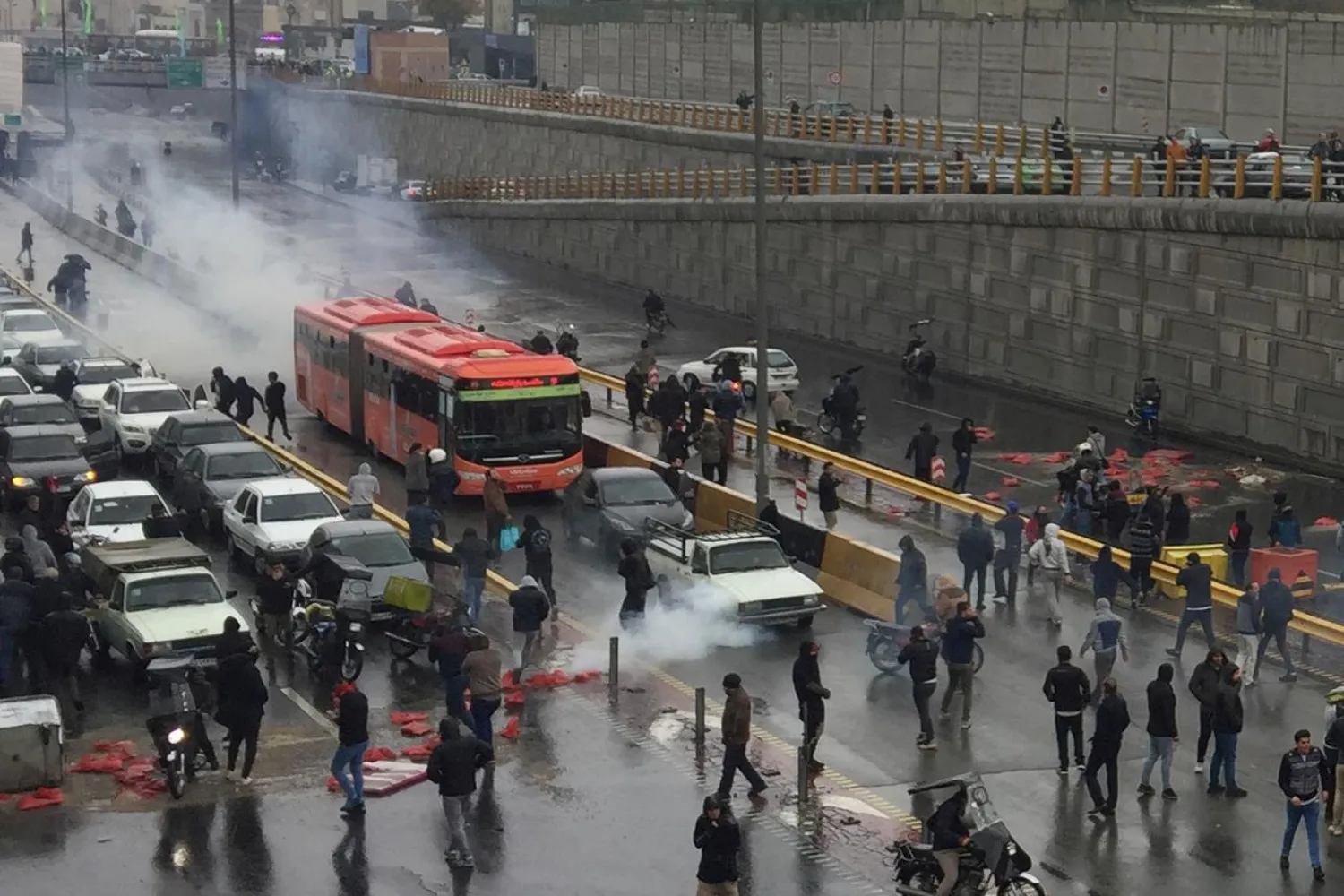
People protest against increased gas price, on a highway in Tehran, Iran November 16, 2019. Nazanin Tabatabaee/WANA (West Asia News Agency) via REUTERS
TT

Amnesty Calls for UN Probe Into Iran Protest Killings

People protest against increased gas price, on a highway in Tehran, Iran November 16, 2019. Nazanin Tabatabaee/WANA (West Asia News Agency) via REUTERS

Amnesty International urged the United Nations on Wednesday to launch an inquiry into the killing of protesters by Iranian security forces, six months after they erupted over petrol prices.

The demonstrations broke out across Iran on November 15 after the announcement of a shock decision to hike the price of petrol by up to 200 percent.

They turned violent before being put down by security forces amid a near-total internet blackout.

Iran has yet to issue an official death toll but has repeatedly dismissed what it has said are exaggerated tolls from hostile Western sources.

In a statement, Amnesty said it had evidence that 304 men, women and children were killed by Iran's security forces during the "ruthless" crackdown.

The London-based human rights group said 220 of them died within two days, based on its research, including analysis of videos and photographs.

It said the "vast majority" were killed by the security forces whose use of force was "unlawful" as there was "no evidence that people were in possession of firearms or that they posed an imminent threat to life".

Amnesty did note an exception, however, when protesters and security forces exchanged fire in one city.

It called on the United Nations Human Rights Council to mandate an inquiry into the November crackdown.

"Six months later, the devastated families of victims continue their struggle for truth and justice while facing intense harassment and intimidation from the authorities," AFP quoted Amnesty's Philip Luther as saying.

"The prevailing impunity afforded to the security forces allows the recurrence of lethal force to crush dissent," he said.

"In the absence of any meaningful prospect for accountability at the national level, we reiterate our call to members of the UN Human Rights Council to mandate an inquiry into the killings, and identify pathways for truth, justice and reparations."

Amnesty said that based on its analysis, security forces killed people in 37 cities across eight provinces.

It said this reflected the "widespread nature of the crackdown".

The poverty-stricken suburbs around Tehran were hardest hit, with 163 killings, followed by the minority-populated provinces of Khuzestan and Kermanshah with 57 and 30, respectively, it said.

Amnesty said it had credible information confirming the deaths of 304 people, including 10 women and 23 children.

But it stressed the real death toll was likely to have been higher.

"In all but four cases, the victims were shot dead by Iranian security forces -- including members of the Revolutionary Guards, paramilitary Basij forces and the police -- firing live ammunition, often at the head or torso, indicating that they were shooting to kill," Amnesty said.

"The organization is aware of scores of additional cases reported by activists, but assessed that it does not yet have sufficient reliable details."



OpenAI Disrupts 2 Influence Operations Linked to Russia and Iran

A keyboard is placed in front of a displayed OpenAI logo in this illustration taken February 21, 2023. REUTERS/Dado Ruvic/Illustration//File Photo
TT

OpenAI Disrupts 2 Influence Operations Linked to Russia and Iran

A keyboard is placed in front of a displayed OpenAI logo in this illustration taken February 21, 2023. REUTERS/Dado Ruvic/Illustration//File Photo

OpenAI on Thursday said it shut down two influence operations -- from Russia and Iran -- that used ChatGPT to push fake journalist personas and run a “think-tank” to covertly peddle anti-Ukraine propaganda.

The American AI giant said it banned a cluster of ChatGPT accounts that originated in Russia and Iran and were used to support “false front” entities for geopolitical and conflict-related messaging, according to AFP.

The Iranian operation involved seven “journalist” profiles, each purporting to be from Western countries including the United States, that were used to plant long-form articles in media outlets around the world.

“We identified almost 100 articles published or syndicated under the operation's bylines across roughly a dozen online outlets around the world,” OpenAI said.

“These were small to medium outlets, generally focused on international affairs, geopolitics, and events in the Middle East.”

The earliest article identified by OpenAI was published in July 2025, and the latest in October 2026, with the frequency of reports increasing after the US-Iran war broke out earlier this year.
The operation also generated social media comments on topics related to the US-Iran war, it added.

One of the personas named Ervin B Hoskins, whose bio claimed to be “an American freelance writer,” had social media accounts across tech platforms including Elon Musk's X and Meta-owned Instagram.

X's transparency information showed the account was connected via a “West Asia android app” and Instagram's transparency information showed the account was based in Iran, according to screenshots provided by OpenAI.

Both accounts appeared to be suspended.

The Russian operation co-opted “unwitting people” in Latin America to run a “think-tank” -- called the Social Research Center (SRC) -- used for covert activities aimed at undermining Ukraine's reputation in the region and to influence local politics, the company said.

“The available evidence indicates that the SRC's employees in Latin America were not aware that they were working for a Russian group,” OpenAI said.

The SRC appears to have produced a majority of original content via its co-opted staff. “This stands out as the most complex attempt to run a front identity that we've disrupted over the past two and a half years,” it added.


Iran Guards Say Struck Tanker Transiting Strait of Hormuz

An aerial view shows ships anchored off the coast of Khasab in Oman's Musandam Governorate, near the Strait of Hormuz, on October 2, 2026. (Photo by AFP)
TT

Iran Guards Say Struck Tanker Transiting Strait of Hormuz

An aerial view shows ships anchored off the coast of Khasab in Oman's Musandam Governorate, near the Strait of Hormuz, on October 2, 2026. (Photo by AFP)

Iran's Revolutionary Guards said that they had struck a tanker attempting to take an “illegal route” through the Strait of Hormuz, which Tehran has sought to blockade since the outset of the Middle East war.

Maritime trackers also reported on Friday that an unknown projectile sparked a fire aboard a ship off the UAE coast, but named a different vessel.

In a statement carried by official media, the Guards said its naval forces were acting in accordance with “the orders of the commander-in-chief of the armed forces and the Iranian people’s desire to exercise sovereignty over the Strait of Hormuz.”

“In carrying out this mission, a few hours ago, a giant LPG carrier named NV Sunshine, owned by NatWit, which was attempting to transit via the illegal route south of the Strait of Hormuz, was struck,” they added, according to AFP.

Iran has attempted to impose its control over the Hormuz over the course of the war, insisting that vessels seek its permission to cross via its preferred routes.

However, ships have increasingly been willing to risk transiting via an alternative route hugging the strait's southern coast.

Britain's UKMTO maritime agency said on Friday that a ship 13 nautical miles (24 kilometers) off the UAE's Al Jazeera Al Hamra, southwest of the strait, was struck by a projectile, which caused a fire on board.

“Status of the crew, damage assessment and environmental impact are unknown at present. Authorities are investigating,” UKMTO said in a statement.

British security firm Vanguard also reported the incident, and identified the vessel as the Panama-flagged crude tanker GEM NO2.

The incident comes days after a tanker was hit off Qatar, around 500 kilometers west of the vital strait.

Ships in the Gulf and those attempting to transit the strait -- the only maritime route in or out of the oil-rich region -- have come under repeated attack since the US and Israel sparked the Middle East war on February 28.

Iran has blockaded the strait ever since, though some vessels do manage to cross, and US media has reported on American military efforts to protect ships on the southern route.

The United States has set up its own counter-blockade of Iranian ports and occasionally fires on vessels linked to Tehran.

Hormuz is vital to the world economy, with around a fifth of the planet's oil and liquefied natural gas passing through the strait before the war began.


Police Official Killed in Roadside Bombing in Southeast Iran

Iranian people in a park, with Milad Tower in the background, in Tehran, Iran, October 6, 2026. Majid Asgaripour/WANA (West Asia News Agency) via REUTERS
TT

Police Official Killed in Roadside Bombing in Southeast Iran

Iranian people in a park, with Milad Tower in the background, in Tehran, Iran, October 6, 2026. Majid Asgaripour/WANA (West Asia News Agency) via REUTERS

A provincial police official was killed in a roadside bombing on Friday in southeastern Iran, the semi-official Fars ⁠news agency reported.

The ⁠police official had been travelling near ⁠Zahedan, capital of the impoverished Sistan-Baluchistan province, which borders Pakistan and Afghanistan and is a drug trafficking route.

The incident follows ⁠clashes ⁠between security forces and armed groups including militants and separatists.

Gunmen attacked a vehicle carrying Iranian army personnel in Sistan-Baluchistan, killing one person and injuring three others on Thursday, state media reported.

"A minibus transporting personnel from a division stationed along the Makran coast... came under armed attack this morning," the official IRNA news agency said.

The agency gave the dead man's name, but did not specify whether he was army personnel.

In a separate incident in the same province, "a police patrol while carrying out its mission... came under a terrorist attack by armed outlaws," provincial police said in a statement on Thursday carried by IRNA.

"Several terrorists were wounded and fled the scene... while a police officer was martyred," it added.

Last week, Iran's Revolutionary Guards killed six members of a "terrorist" group in Zahedan, IRNA reported.

The IRNA report ⁠said security forces had discovered and confiscated explosive packages. It did not identify the six people killed and gave no further information on the incident.