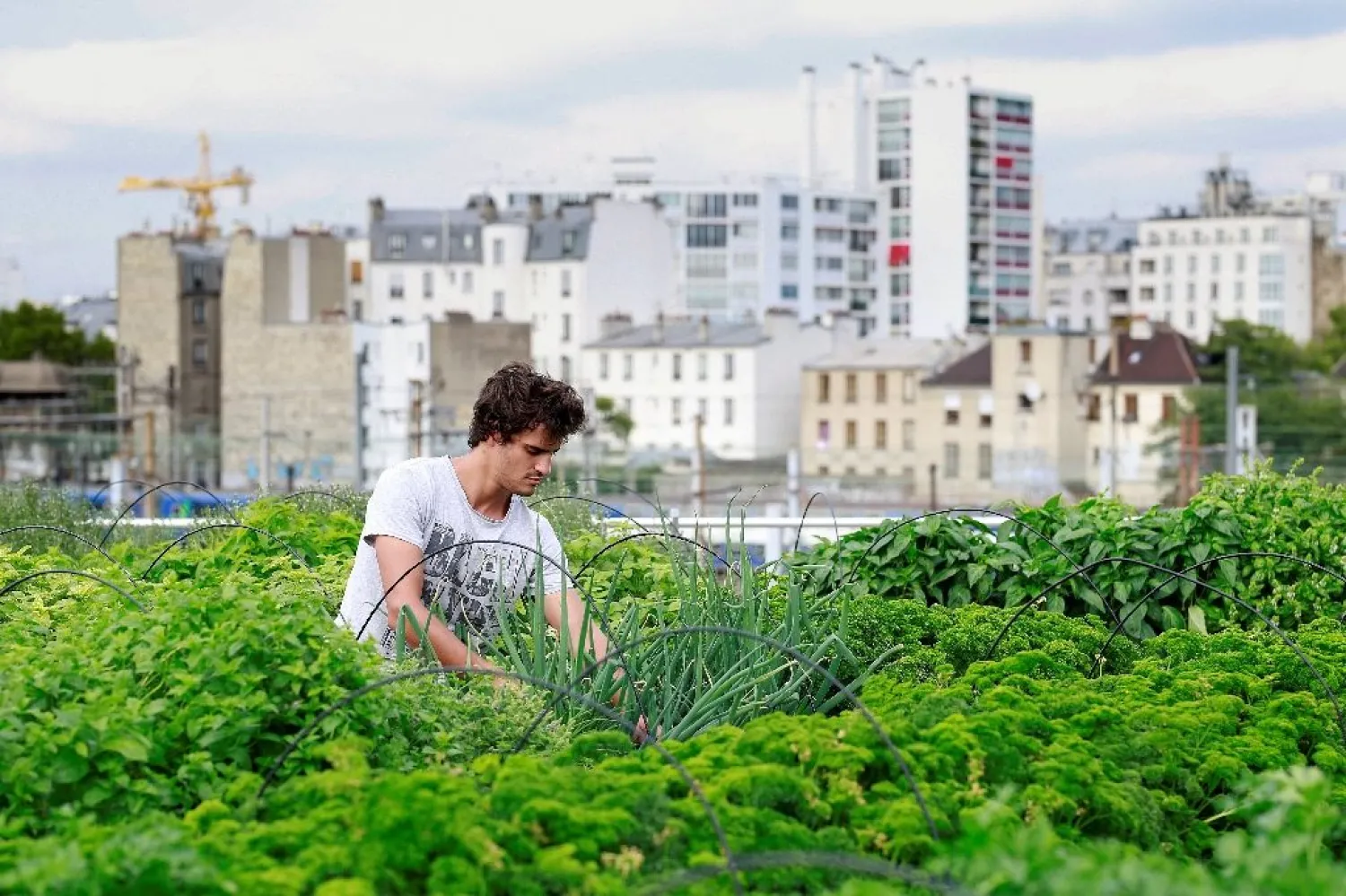

Growing Crops the Indoor Way

(AFP Photo/Benjamin Cremel)
TT

Growing Crops the Indoor Way

(AFP Photo/Benjamin Cremel)

Farming is moving indoors to help bring fresh food to urban environments and, ultimately, to feed the world efficiently, sustainably and cleanly. To feed a rapidly growing population, costly farming practices need to change. Industrial agriculture is responsible for over 70% of the global water supply, hundreds of millions of pounds of pesticides in the U.S. alone, the loss of arable farmland, and a high carbon footprint. Indoor agriculture is successfully tackling many of those challenges. It may not be a cure-all for all that's broken in modern agriculture, but it's certainly a leap into the future of farming and food production.

What is indoor farming?

Indoor farming is growing plants or crops entirely indoors. Often seen on a small scale, like a home greenhouse or basement, it usually refers to large scale commercial farming, popular in large cities where plots of land are not easily available or ideal for growing crops. Urban locations are being used to bring fresh, local produce to communities where it's not always accessible. Many utilize vertical farms (multi-level, green walls), which maximize the plants grown in a small area, producing far more than traditional outdoor, soil-based farms.

There are many variations of indoor growing methods, but hydroponics, aeroponics and artificial lights are commonly used to provide plants with nutrients and light needed for them to grow. Some indoor farms, like greenhouses, utilize a combination of natural and simulated resources, such as natural sunlight and liquid nutrient fertilizers. Others are completely controlled by the farmer. In controlled environment agriculture (CEA), farmers determine precise amounts of light exposure each crop receives, the nutrient levels provided, moisture levels and temperature. Not all crops are grown indoors, but lettuces, herbs, tomatoes and fruits are popular.

Eco-friendly?

Variety Menu
By Variety Menu
SUBSCRIBE
Email Address
Your email is safe with us. Privacy Policy
or

Environmental Nutrition: Growing crops the indoor way
By Lori Zanteson on Mar 23, 2020
undefined

Environmental Nutrition

Farming is moving indoors to help bring fresh food to urban environments and, ultimately, to feed the world efficiently, sustainably and cleanly. To feed a rapidly growing population, costly farming practices need to change. Industrial agriculture is responsible for over 70% of the global water supply, hundreds of millions of pounds of pesticides in the U.S. alone, the loss of arable farmland, and a high carbon footprint. Indoor agriculture is successfully tackling many of those challenges. It may not be a cure-all for all that's broken in modern agriculture, but it's certainly a leap into the future of farming and food production.

What is indoor farming?

Indoor farming is growing plants or crops entirely indoors. Often seen on a small scale, like a home greenhouse or basement, it usually refers to large scale commercial farming, popular in large cities where plots of land are not easily available or ideal for growing crops. Urban locations are being used to bring fresh, local produce to communities where it's not always accessible. Many utilize vertical farms (multi-level, green walls), which maximize the plants grown in a small area, producing far more than traditional outdoor, soil-based farms.

There are many variations of indoor growing methods, but hydroponics, aeroponics and artificial lights are commonly used to provide plants with nutrients and light needed for them to grow. Some indoor farms, like greenhouses, utilize a combination of natural and simulated resources, such as natural sunlight and liquid nutrient fertilizers. Others are completely controlled by the farmer. In controlled environment agriculture (CEA), farmers determine precise amounts of light exposure each crop receives, the nutrient levels provided, moisture levels and temperature. Not all crops are grown indoors, but lettuces, herbs, tomatoes and fruits are popular.

Eco-friendly?

Indoor farming is more efficient and uses fewer resources than traditional farming methods. A fraction of indoor farm space has the same crop yield as a much larger outdoor space. In fact, it's 100 times as productive as traditional agriculture. Indoor crops need less water (85% to 95% less), no pesticides, and grow twice as quickly because the climate, weather and seasons are controlled. They are also located in large cities, and are closer to consumers, so they don't travel long distances to market.

Fewer food miles

Reducing food miles, the distance food travels to consumers, helps indoor farms keep a low carbon footprint. "When greenhouses or other indoor agriculture systems can be put in place near consumers, the fuel and other energy involved in transporting and storing the foods can be reduced. This can be a very positive thing, especially when considering issues such as food access barriers or large urban population centers," says Robin Currey, PhD., Director of Sustainable Food Systems at Prescott College, Arizona. Traditionally grown produce is generally grown in a large, central area and then shipped to cold storage, then transported across the country before it's finally delivered to markets. Indoor agriculture all but eliminates the polluting emissions of food distribution.

High energy

Reliance upon high-tech indoor systems that include lighting, heating, cooling, hydroponics and more takes a lot of energy. Depending on climate, that can mean a significant environmental cost. A study published in a 2015 issue of the Journal of Cleaner Production found that heating greenhouses in France used so much energy that the tomatoes grown in them had a higher carbon footprint than imported tomatoes grown in unheated greenhouses in Morocco. Although Currey agrees the energy use is significant, she says "But with growth projections of upwards of 14 percent per annum in the controlled environment agriculture sector and energy accounting for upwards of 30 percent of operating costs, we can be assured that companies will be looking for energy and thus cost efficiencies."

Health impact

Indoor farmers claim that control over environmental conditions, including sunlight, fertilizer nutrients, and no pesticides, improves crops in terms of health, nutrition, quality, and flavor. In addition, the closed growing environment helps minimize risk of contamination from foodborne illness from factors like animal waste or tainted groundwater that can affect traditionally grown crops.

How nutrition compares

"The nutrient content of any plant is dependent on two global factors: genetics and environmental conditions," says Currey. Vitamin A content of one variety of pepper, she explains, can vary from another variety by a factor of nearly 20,000. Plants also get their nutrients from the soil, or in the case of indoor farming, from the soilless medium in which they are grown. "Unsustainable agriculture can and does deplete the soil, leaving little for plants to uptake," says Currey. "Sustainable agriculture in healthy soils results in healthy plants that can have higher micronutrient contents than a similar variety grown in a depleted soil." So, depending on the nutrient concentration, plants getting nutrients from hydroponic fertilizers can be as nutritious, or even more so than those grown in nutrient-rich soil.

Indoor farming's movement toward smaller footprint agriculture using technology to produce healthy food in a sustainable way that can make local produce accessible to more people can potentially change the way we feed the world. While there are several factors to consider between sustainably-grown outdoor crops and indoor-grown crops, the goal is the same--to make fresh, nutritious food accessible to all.

Environmental Nutrition
via Tribune Media


Saturn's Moon Titan May Not Have a Buried Ocean as Long Suspected, New Study Suggests

This image made by the Cassini spacecraft and provided by NASA on March 12, 2006, shows two of Saturn's moons, the small Epimetheus and smog-enshrouded Titan, with Saturn's A and F rings stretching across the frame. (NASA via AP)
TT

Saturn's Moon Titan May Not Have a Buried Ocean as Long Suspected, New Study Suggests

This image made by the Cassini spacecraft and provided by NASA on March 12, 2006, shows two of Saturn's moons, the small Epimetheus and smog-enshrouded Titan, with Saturn's A and F rings stretching across the frame. (NASA via AP)

Saturn's giant moon Titan may not have a vast underground ocean after all.

Titan instead may hold deep layers of ice and slush more akin to Earth’s polar seas, with pockets of melted water where life could possibly survive and even thrive, scientists reported Wednesday.

The team led by researchers at NASA's Jet Propulsion Laboratory challenged the decade-long assumption of a buried global ocean at Titan after taking a fresh look at observations made years ago by NASA’s Cassini spacecraft around Saturn.

They stress that no one has found any signs of life at Titan, the solar system’s second largest moon spanning 3,200 miles (5,150 kilometers) and brimming with lakes of liquid methane on its frosty surface, The AP news reported.

But with the latest findings suggesting a slushy, near-melting environment, “there is strong justification for continued optimism regarding the potential for extraterrestrial life,” said the University of Washington’s Baptiste Journaux, who took part in the study published in the journal Nature.

As to what form of life that might be, possibly strictly microscopic, “nature has repeatedly demonstrated far greater creativity than the most imaginative scientists," he said in an email.

JPL’s Flavio Petricca, the lead author, said Titan’s ocean may have frozen in the past and is currently melting, or its hydrosphere might be evolving toward complete freezing.

Computer models suggest these layers of ice, slush and water extend to a depth of more than 340 miles (550 kilometers). The outer ice shell is thought to be about 100 miles (170 kilometers) deep, covering layers of slush and pools of water that could go down another 250 miles (400 kilometers). This water could be as warm as 68 degrees Fahrenheit (20 degrees Celsius).

Because Titan is tidally locked, the same side of the moon faces Saturn all the time, just like our own moon and Earth. Saturn’s gravitational pull is so intense that it deforms the moon’s surface, creating bulges as high as 30 feet (10 meters) when the two bodies are closest.

Through improved data processing, Petricca and his team managed to measure the timing between the peak gravitational tug and the rising of Titan’s surface. If the moon held a wet ocean, the effect would be immediate, Petricca said, but a 15-hour gap was detected, indicating an interior of slushy ice with pockets of liquid water. Computer modeling of Titan’s orientation in space supported their theory.

Sapienza University of Rome’s Luciano Iess, whose previous studies using Cassini data indicated a hidden ocean at Titan, is not convinced by the latest findings.

While “certainly intriguing and will stimulate renewed discussion ... at present, the available evidence looks certainly not sufficient to exclude Titan from the family of ocean worlds," Iess said in an email.

NASA’s planned Dragonfly mission — featuring a helicopter-type craft due to launch to Titan later this decade — is expected to provide more clarity on the moon’s innards. Journaux is part of that team.

Saturn leads the solar system’s moon inventory with 274. Jupiter’s moon Ganymede is just a little larger than Titan, with a possible underground ocean. Other suspected water worlds include Saturn’s Enceladus and Jupiter’s Europa, both of which are believed to have geysers of water erupting from their frozen crusts.

Launched in 1997, Cassini reached Saturn in 2004, orbiting the ringed planet and flying past its moons until deliberately plunging through Saturn’s atmosphere in 2017.


Catch the Ursid Meteor Shower as it Peaks just before Christmas

People look up to the sky from an observatory near the village of Avren, Bulgaria, Aug. 12, 2009. (AP Photo/Petar Petrov, File)
TT

Catch the Ursid Meteor Shower as it Peaks just before Christmas

People look up to the sky from an observatory near the village of Avren, Bulgaria, Aug. 12, 2009. (AP Photo/Petar Petrov, File)

The last major meteor shower of the year, known as the Ursids, peaks soon, bringing glowing streaks to nighttime and early morning skies. Compared to other meteor showers, it's more subdued, but experts say it's still worth a glimpse.

Meteor showers happen when space rocks hit Earth's atmosphere at extremely high speeds and burn up, gaining fiery tails — the end of a “shooting star.” Random meteors are visible from Earth on any given clear night, but more predictable meteor showers happen yearly when Earth passes through streams of cosmic leftovers from comets or asteroids, Reuters reported.

The Ursids peak Sunday night into Monday morning and will be visible until Dec. 26 from the Northern Hemisphere. Skygazers usually see five to 10 meteors per hour during the height and there's a possibility for outbursts of up to 25 meteors per hour, according to the American Meteor Society.

How active a shower will appear from Earth depends on the amount of debris and the moon's brightness, which can blot out glowing meteors. The Ursids feature less space debris than other showers like the Geminids, but the narrow crescent moon won't be much of an obstacle when they peak.

No special equipment is needed to view a meteor shower. To see the Ursids, which hail from a comet called 8P/Tuttle, bundle up and get away from city lights.

“The darker your sky, the better the shower is going to be,” said astronomer Peter Brown with Western University in Canada.

The meteors can be seen over the whole sky, but all the streaks will seem to come from a central point near a constellation for which the shower is named. In this case, that's the constellation Ursa Minor, also known as the Little Dipper.

Once it gets dark, avoid bright lights from cellphones, which will make it harder for your eyes to adjust.


Private Astronaut Jared Isaacman Becomes NASA Chief

NASA's next-generation moon rocket, the Space Launch System (SLS) rocket with its Orion crew capsule perched on top, is seen in the Vehicle Assembly Building (VAB) before it is scheduled to make a slow-motion journey to its launch pad at Cape Canaveral, Florida, US March 16, 2022. REUTERS/Thom Baur
TT

Private Astronaut Jared Isaacman Becomes NASA Chief

NASA's next-generation moon rocket, the Space Launch System (SLS) rocket with its Orion crew capsule perched on top, is seen in the Vehicle Assembly Building (VAB) before it is scheduled to make a slow-motion journey to its launch pad at Cape Canaveral, Florida, US March 16, 2022. REUTERS/Thom Baur

The US Senate confirmed billionaire private astronaut Jared Isaacman to become President Donald Trump's NASA administrator, making an advocate of Mars missions and a former associate of SpaceX CEO Elon Musk the space agency's 15th leader. The vote on Isaacman, who Trump removed and then renamed as NASA administrator nominee this year, passed 67-30, two weeks after he told senators in his second hearing that NASA must pick up the pace in beating China back to the moon this decade, Reuters reported.

Isaacman will lead an agency of 14,000 employees as it invests billions of dollars into its most ambitious space exploration endeavor yet: returning humans to the moon to seed a long-term presence on the surface before eventually sending astronauts to Mars.

NASA WORKFORCE CUT IN EFFICIENCY PUSH

The White House, in its government efficiency push led by Musk, slashed NASA's workforce by 20% and has sought to cut the agency's 2026 budget by roughly 25% from its usual $25 billion, imperiling dozens of space-science programs that scientists and some officials regard as priorities.

Isaacman envisions a revamped focus on sending missions to Mars on top of the Artemis moon effort, as well as a greater dependence on private companies such as SpaceX to save taxpayer money and stimulate private-sector competition.

Of the 67 votes in Isaacman's favor, 16 were from Democrats, joining 51 from Republicans. All 30 votes against his confirmation were from Democrats.

Maria Cantwell, the ranking member of the Senate Commerce Committee that oversees NASA, has criticized the Trump administration's efforts to cut NASA's science unit. She supported Isaacman's confirmation on Wednesday.

"During his nomination process, Mr. Isaacman emphasized the importance of developing a pipeline of future scientists, engineers, researchers, (and) astronauts to support the science and technology development and align with NASA's objectives. I strongly agree," Cantwell said.

Some Democratic senators said during Isaacman's hearing on December 3 they are concerned about Isaacman's closeness to Musk, whose company holds about $15 billion in NASA contracts and could benefit from certain policies Isaacman has advocated.

Musk advocated for Isaacman's nomination when Trump was elected in 2024. Musk had sought to realign the US space program with a greater focus on Mars during his stint as a close adviser to Trump.

Senate Republicans and some Democrats, including Cantwell, have also stressed urgency in NASA's moon race with China, which is aiming to send its astronauts to the lunar surface by 2030. NASA faces a shaky target of 2028 using its Space Launch System rocket and SpaceX's giant Starship rocket, under development, as the lander.

Acting NASA chief Sean Duffy, who also leads the US Transportation Department, congratulated Isaacman on X, wishing Isaacman "success as he begins his tenure and leads NASA as we go back to the Moon in 2028 and beat China."