


Football Has Always Adapted to Hard Times. Its Return Might Help Us Feel Less Alone

 Lucas Moura trains by himself as Tottenham training resumed on Friday. Photograph: Tottenham Hotspur FC/Tottenham Hotspur FC via Getty Images
Lucas Moura trains by himself as Tottenham training resumed on Friday. Photograph: Tottenham Hotspur FC/Tottenham Hotspur FC via Getty Images
TT

Football Has Always Adapted to Hard Times. Its Return Might Help Us Feel Less Alone

 Lucas Moura trains by himself as Tottenham training resumed on Friday. Photograph: Tottenham Hotspur FC/Tottenham Hotspur FC via Getty Images
Lucas Moura trains by himself as Tottenham training resumed on Friday. Photograph: Tottenham Hotspur FC/Tottenham Hotspur FC via Getty Images

It is now 10 weeks since league football was last played in England, the longest suspension of the game since the inauguration of the League in 1888 (although there used to be a respectful pause for three months in the summer for cricket). Even during the wars, football did not stop for as long as this. As the Bundesliga resumes and the Premier League steps up its plans for a restart, it’s worth considering why. Money may be a prime driving force now, but that hasn’t always been the case; since it was invented there has been an urge to get football played.

On 1 September 1939, Germany invaded Poland. The following day, there was a full English league program. A day later the United Kingdom declared war on Germany, large public gatherings were suspended and the season abandoned. Yet within two months, regional leagues had been established. Arsenal, for instance, hammered Sunderland 5-2 on 2 September and then beat Charlton 8-4 in their inaugural southern league fixture on 21 October. It is difficult to be sure of attendances, but in excess of 10,000 turned up for both their games against West Ham.

The War Cup final on 8 June 1940 – which kicked off at 6.30 pm despite fears of bombing raids – drew 42,300 to Wembley, the restrictions on public gatherings long since lifted. The remarkable aspect of football in the second world war is how much of it there was. In Germany, they kept playing until the end of April 1945. In France, war champions were declared each year, although the 1943-44 season was incomplete. The Netherlands missed only one season, Italy two.

Hungary was invaded twice, first by the Germans and then by the Soviets, and yet football never stopped. At times the juxtaposition of detail becomes absurd. On 6 December 1944, with Nazi-occupied Budapest under bombardment from the Red Army, the Ujpest coach, Geza Kertesz, who was working with a resistance group that had been supplying details on troop movements to the United States, took a training session then held a press conference previewing the upcoming derby against Ferencvaros. That evening he was arrested by local fascists and handed over to the Gestapo; two months later he was executed as the Germans prepared to retreat.

Which tell us what, exactly? First, that football is resilient. It adapts to circumstance and carries on, whether that means rejigging competitions and regulations, guest players, or limited crowds. Second, and perhaps more pertinently, there has always been a demand for it, from both authorities and fans.

After the German invasion of Ukraine, a league was quickly established as part of a process of “normalization” – which is what led ultimately to the “death match” between Start, a bakery side that featured a number of former Dynamo Kyiv players, and a team representing the Luftwaffe. The logic that encouraged the Hungarian authorities to keep football going is the same that led the British government to waive the restrictions on crowds so people could still gather to watch football. And that is the impact football has on morale.

This is not something to be treated glibly – and there is an obvious difference with wartime in the risk of the virus being transmitted by the act of playing. Danny Rose is right to fear players being forced back prematurely. But just because Dominic Raab says something doesn’t necessarily make it superficial nonsense; it can also be glib for amateur virologists to dismiss out of hand the attempt to create a safe environment for football.

There was much discussion of a poll last week that suggested 73% of people did not anticipate their morale being lifted by the return of football. But 19% did, which seemed even more remarkable: one in five people – 13 million Britons – think they will be happier with football to watch and, perhaps more important, discuss.

It may be that any football that is played ends up being tepid, that the sense of artificiality is overpowering, the absence of fans a huge turn-off. Once Liverpool have sealed their Premier League title, how engaging will the battle against relegation or for qualification to the Champions League be, particularly when it’s far from clear if or in what form next season’s Champions League will take place? On the other hand, the FA Cup may find itself reinvigorated.

And, of course, the how is hugely complex. But if the infection rate falls, if the resources are available and if a safe environment can be created, then why would football not be considering a resumption? Every other industry is assessing how to restart as lockdown begins to ease: why not football?

The Bundesliga’s return is a huge test. Borussia Dortmund’s managing director, Carsten Cramer, has said the protocols to protect players went far beyond the safety measures in most other industries. There’s no reason for the Premier League not to match those standards. But Cramer also noted that, on top of the human cost, “if we fail, the problems afterwards [for football] will be even bigger than before”.

Football was right to stop when it did but it’s right for it to consider when and how it may return. Judging precisely when the risk has been sufficiently minimized is clearly enormously difficult, there is every reason for extreme caution, and players need to be fully involved in the process, but that doesn’t mean the assessment should be shirked. If the necessary threshold of safety can be achieved, the palliative effect of resumption is potentially huge. This is not just about the game or money.

CS Lewis observed that literature exists to remind us we are not alone. Football fulfills a similar function. It is the currency in which a vast amount of social interaction is conducted. Governments recognized that in times of crisis throughout the 20th century but football has never been bigger than it is now. After weeks of isolation, there has perhaps never been a time when it has been more important to remember we are not alone. Football can be an awful, self-interested, avaricious game at times but it can, perhaps, help with that.

(The Guardian)
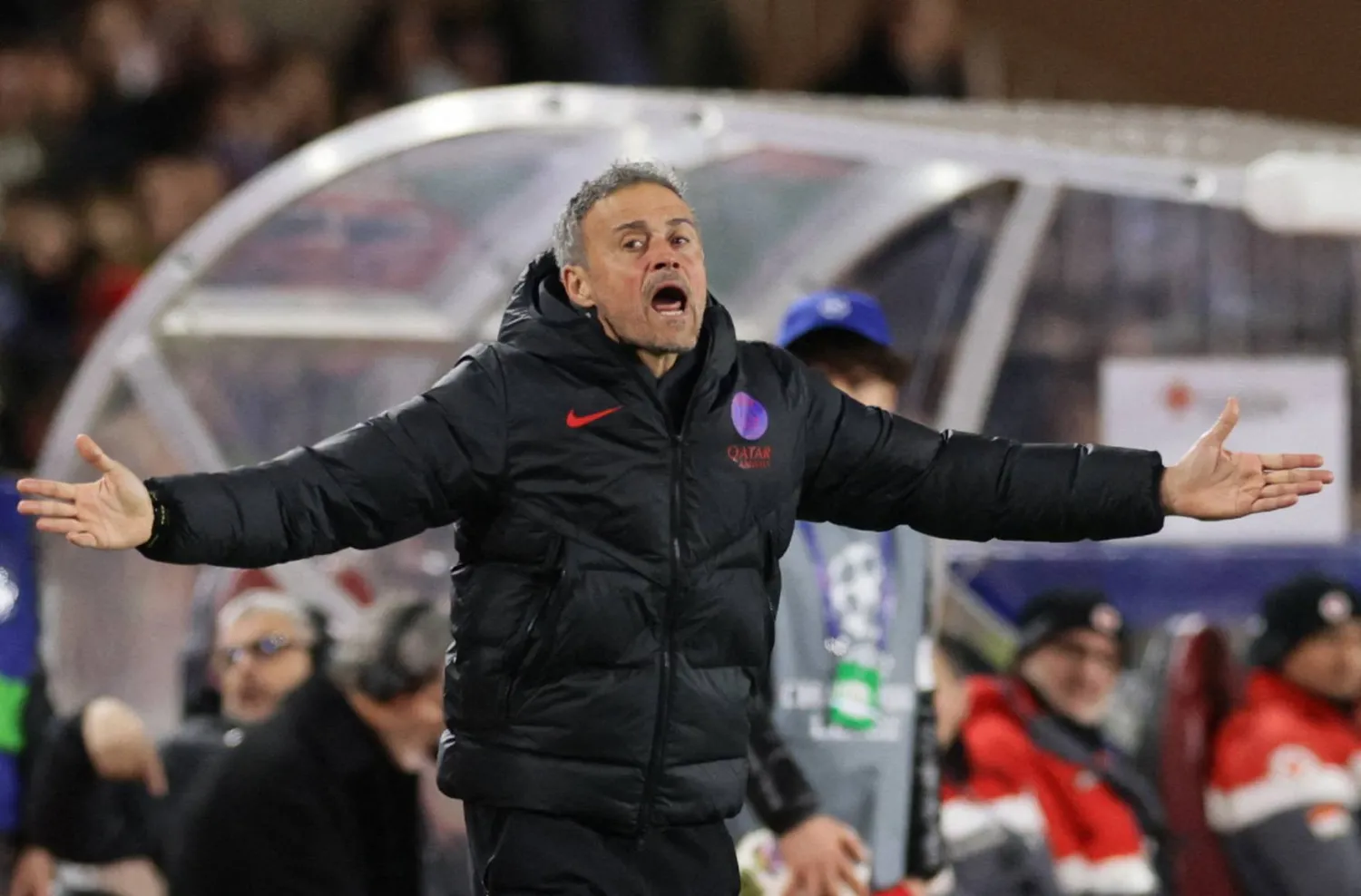


PSG’s Mental Strength Hailed as they Come from Behind to Win at Monaco

Soccer Football - UEFA Champions League - Play Off - First Leg - AS Monaco v Paris St Germain - Stade Louis II, Monaco - February 17, 2026 Paris St Germain coach Luis Enrique reacts REUTERS/Manon Cruz
TT

PSG’s Mental Strength Hailed as they Come from Behind to Win at Monaco

Soccer Football - UEFA Champions League - Play Off - First Leg - AS Monaco v Paris St Germain - Stade Louis II, Monaco - February 17, 2026 Paris St Germain coach Luis Enrique reacts REUTERS/Manon Cruz

Paris Saint-Germain coach Luis ‌Enrique hailed the mental strength of his side in coming from two goals down to win 3-2 away at Monaco in the Champions League on Tuesday, but warned the knockout round tie was far from finished.

The first leg clash between the two Ligue 1 clubs saw Folarin Balogun score twice for the hosts in the opening 18 minutes before Vitinha had his penalty saved to compound matters.

But after Desire Doue came on for injured Ousmane Dembele, the ‌match turned ‌and defending champions PSG went on to ‌secure ⁠a one-goal advantage ⁠for the return leg.

"Normally, when a team starts a match like that, the most likely outcome is a loss,” Reuters quoted Luis Enrique as saying.

“It was catastrophic. It's impossible to start a match like that. The first two times they overcame our pressure and entered our half, they scored. They ⁠made some very good plays.

“After that, it's difficult ‌to have confidence, but we ‌showed our mental strength. Plus, we missed a penalty, so ‌it was a chance to regain confidence. In the ‌last six times we've played here, this is only the second time we've won, which shows how difficult it is.”

The 20-year-old Doue scored twice and provided a third for Achraf Hakimi, just ‌days after he had turned in a poor performance against Stade Rennais last Friday ⁠and was ⁠dropped for the Monaco clash.

“I'm happy for him because this past week, everyone criticized and tore Doue apart, but he was sensational, he showed his character. He helped the team at the best possible time.”

Dembele’s injury would be assessed, the coach added. “He took a knock in the first 15 minutes, then he couldn't run.”

The return leg at the Parc des Princes will be next Wednesday. “Considering how the match started, I'm happy with the result. But the match in Paris will be difficult, it will be a different story,” Luis Enrique warned.


Mbappe Calls for Prestianni Ban over Alleged Racist Slur at Vinicius

TOPSHOT - Real Madrid's French forward #10 Kylian Mbappe talks with SL Benfica's Portuguese head coach Jose Mourinho during the UEFA Champions League knockout round play-off first leg football match between SL Benfica and Real Madrid CF at Estadio da Luz in Lisbon on February 17, 2026. (Photo by PATRICIA DE MELO MOREIRA / AFP)
TT

Mbappe Calls for Prestianni Ban over Alleged Racist Slur at Vinicius

TOPSHOT - Real Madrid's French forward #10 Kylian Mbappe talks with SL Benfica's Portuguese head coach Jose Mourinho during the UEFA Champions League knockout round play-off first leg football match between SL Benfica and Real Madrid CF at Estadio da Luz in Lisbon on February 17, 2026. (Photo by PATRICIA DE MELO MOREIRA / AFP)

Real Madrid forward Kylian Mbappe said Benfica's Gianluca Prestianni should be banned from the Champions League after the Argentine was accused of directing a racist slur at Vinicius Jr during the Spanish side's 1-0 playoff first-leg win on Tuesday.

Denying the accusation, Prestianni said the Brazilian misheard him.

The incident occurred shortly after Vinicius had curled Real into the lead five minutes into the second half in Lisbon.

Television footage showed the Argentine winger covering his mouth with his shirt before making a comment that Vinicius and nearby teammates interpreted as a racial ‌slur against ‌the 25-year-old, with referee Francois Letexier halting the match for ‌11 ⁠minutes after activating ⁠FIFA's anti-racism protocols.

The footage appeared to show an outraged Mbappe calling Prestianni "a bloody racist" to his face, Reuters reported.

The atmosphere grew hostile after play resumed, with Vinicius and Mbappe loudly booed by the home crowd whenever they touched the ball. Despite the rising tensions, the players were able to close out the game without further interruptions.

"I want to clarify that at no time did I direct racist insults to Vini Jr, ⁠who regrettably misunderstood what he thought he heard," Prestianni wrote ‌on his Instagram account.

"I was never racist with ‌anyone and I regret the threats I received from Real Madrid players."

Mbappe told reporters he ‌heard Prestianni direct the same racist remark at Vinicius several times, an allegation ‌also levelled by Real's French midfielder Aurelien Tchouamen.

Mbappe said he had been prepared to leave the pitch but was persuaded by Vinicius to continue playing.

"We cannot accept that there is a player in Europe's top football competition who behaves like this. This guy (Prestianni) doesn't ‌deserve to play in the Champions League anymore," Mbappe told reporters.

"We have to set an example for all the children ⁠watching us at ⁠home. What happened today is the kind of thing we cannot accept because the world is watching us.

When asked whether Prestianni had apologized, Mbappe laughed.

"Of course not," he said.

Vinicius later posted a statement on social media voicing his frustration.

"Racists are, above all, cowards. They need to cover their mouth with their shirt to show how weak they are. But they have the protection of others who, theoretically, have an obligation to punish them. Nothing that happened today is new in my life or my family's life," Vinicius wrote.

The Brazilian has faced repeated racist abuse in Spain, with 18 legal complaints filed against racist behavior targeting Vinicius since 2022.

Real Madrid and Benfica will meet again for the second leg next Wednesday at the Bernabeu.


Second Season of ‘Kings League–Middle East' to Kick off in March in Riyadh 

The second season of the Kings League-Middle East will kick off in Riyadh on March 27. (Kings League-Middle East on X)
TT

Second Season of ‘Kings League–Middle East' to Kick off in March in Riyadh 

The second season of the Kings League-Middle East will kick off in Riyadh on March 27. (Kings League-Middle East on X)

The Kings League-Middle East announced that its second season will kick off in Riyadh on March 27.

The season will feature 10 teams, compared to eight in the inaugural edition, under a format that combines sporting competition with digital engagement and includes the participation of several content creators from across the region.

The Kings League-Middle East is organized in partnership with SURJ Sports Investments, a subsidiary of the Public Investment Fund (PIF), as part of efforts to support the development of innovative sports models that integrate football with digital entertainment.

Seven teams will return for the second season: DR7, ABO FC, FWZ, Red Zone, Turbo, Ultra Chmicha, and 3BS. Three additional teams are set to be announced before the start of the competition.

Matches of the second season will be held at Cool Arena in Riyadh under a single round-robin format, with the top-ranked teams advancing to the knockout stages, culminating in the final match.

The inaugural edition recorded strong attendance and wide digital engagement, with approximately a million viewers following the live broadcasts on television and digital platforms.
