Rami Makhlouf Relinquishes Seized Assets to his Charityhttps://english.aawsat.com/home/article/2307381/rami-makhlouf-relinquishes-seized-assets-his-charity
Rami Makhlouf Relinquishes Seized Assets to his Charity
A Facebook video of Syrian businessman Rami Makhlouf on a mobile in Syria's capital Damascus. (AFP)
Syrian businessman and president Bashar Assad’s cousin, Rami Makhlouf announced on Thursday that he was relinquishing his shares in several banks and insurance companies to his charity, Ramak Humanitarian.
He said such shares cannot be sold or passed on to others, adding that their revenues will now “completely” go to charitable work.
Rights sources in Damascus told Asharq Al-Awsat that Makhlouf’s move is aimed avoiding the government’s seizure of his assets, explaining that taxes are not applied to charities.
Makhlouf, one of Syria’s richest men, had his assets ordered seized earlier this month. The government says his telecommunications company, Syriatel, owes 134 billion pounds, around $77 million at the current exchange rate on the parallel market.
Makhlouf has addressed the dispute in a series video messages on his Facebook page in which he appealed to Assad himself to help save his firm. In one appearance, Makhlouf said he had been told to quit as the head of Syriatel.
Last week, the government placed a temporary travel ban against him. The court order said the travel ban comes after a request made by the ministry of telecommunications and would be dropped if Makhlouf paid the arrears, without specifying the amount.
In announcing that he was transferring his shares in banks and insurance companies to the charity, Makhlouf, in another video, said he was “very relieved and euphoric” because abandoning ownership is “very difficult, but giving it to a humanitarian charity is an indescribable joy.”
He said he has returned the money to the relatives of the pro-regime fighters who were killed or wounded in the Syrian conflict.
Palestinians wait to receive donated food at a distribution center in Khan Younis, Gaza Strip, Wednesday, May 27, 2026. (AP Photo/Abdel Kareem Hana)
For the third year in a row, Gaza residents marked Eid al-Adha with the same bitter question, “In what state have you returned, Eid?”
Joy was again absent from the Gaza Strip, replaced by fear over the security situation, assassinations, and Israeli escalation, as fighter jets flew heavily overhead and carried out strikes.
That mood shaped the first day of Eid al-Adha on Wednesday. Residents moved cautiously, and family visits were limited by fears of renewed Israeli bombardment, which had intensified on Tuesday, the Day of Arafat, killing more than 15 Palestinians.
The latest developments overshadowed the third consecutive Eid to pass under harsh conditions in Gaza, amid war and continued escalation following the ceasefire that took effect on Oct. 10, 2025.
Remote greetings
Nabil Tareq, 41, a Gaza resident from the Jabalia refugee camp in the north, who is displaced west of Gaza City, settled for calling his sister and cousins to greet them on Eid al-Adha.
He had decided not to travel to the central Gaza Strip because of the security situation and the sudden Israeli strikes Gaza has seen in recent days.
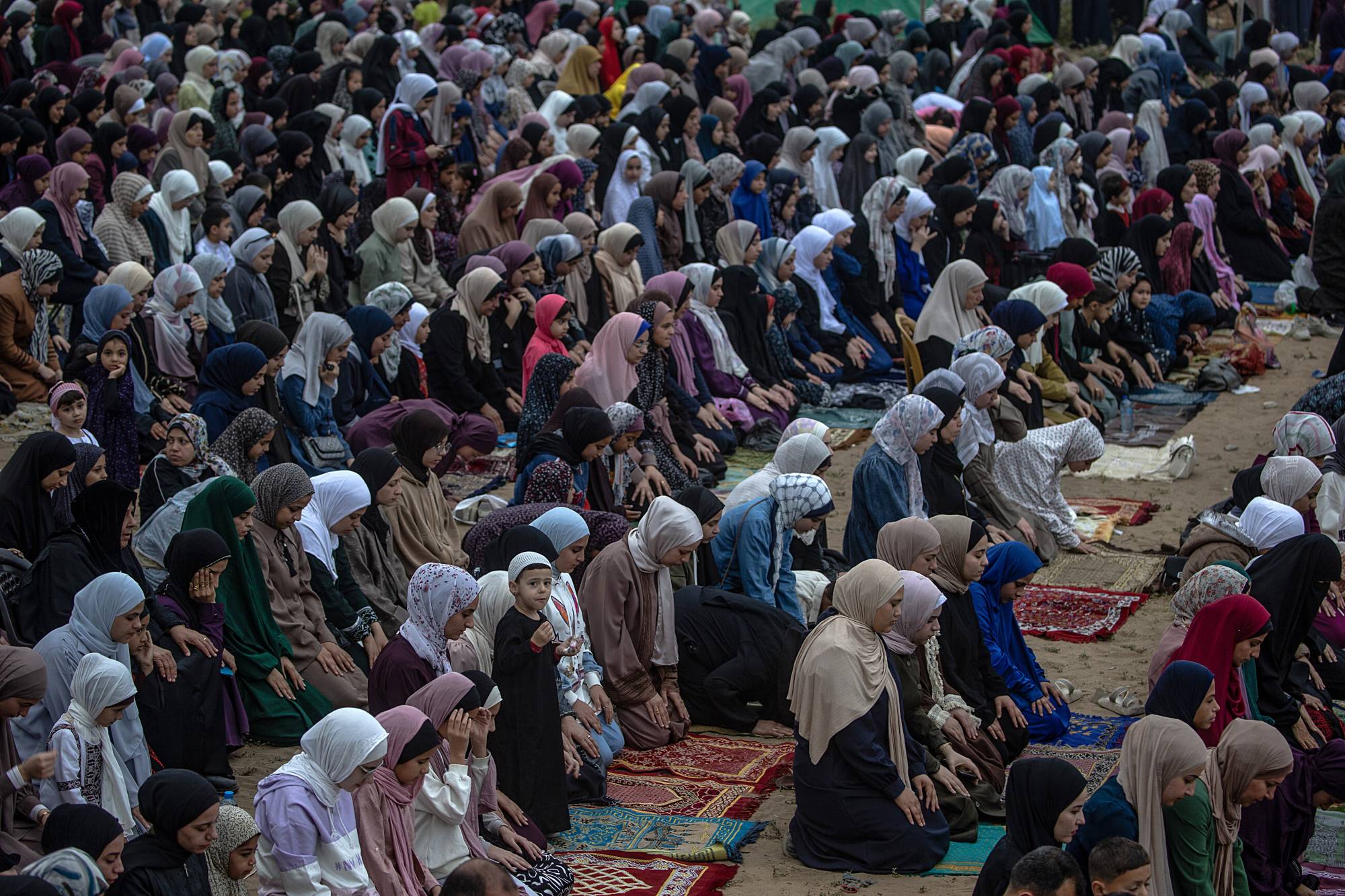
Internally displaced Palestinian women attend Eid al-Adha prayer in Gaza City, 27 May 2026. EPA/MOHAMMED SABER
Tareq told Asharq Al-Awsat that he only visited his brothers and relatives in western Gaza. The visit was brief, he said, so he could return to the tent where he is displaced and remain with his family, fearing for his life and theirs.
He said the security situation and the transport crisis kept him from visiting relatives in more distant areas.
Trying to adapt
Sama Hamdan, 23, from Gaza City and displaced to Nuseirat camp in the central Gaza Strip, traveled to her hometown in a rundown vehicle to see her uncles and greet them for Eid.
She was accompanied by her young brothers, who had been longing to play with their cousins.
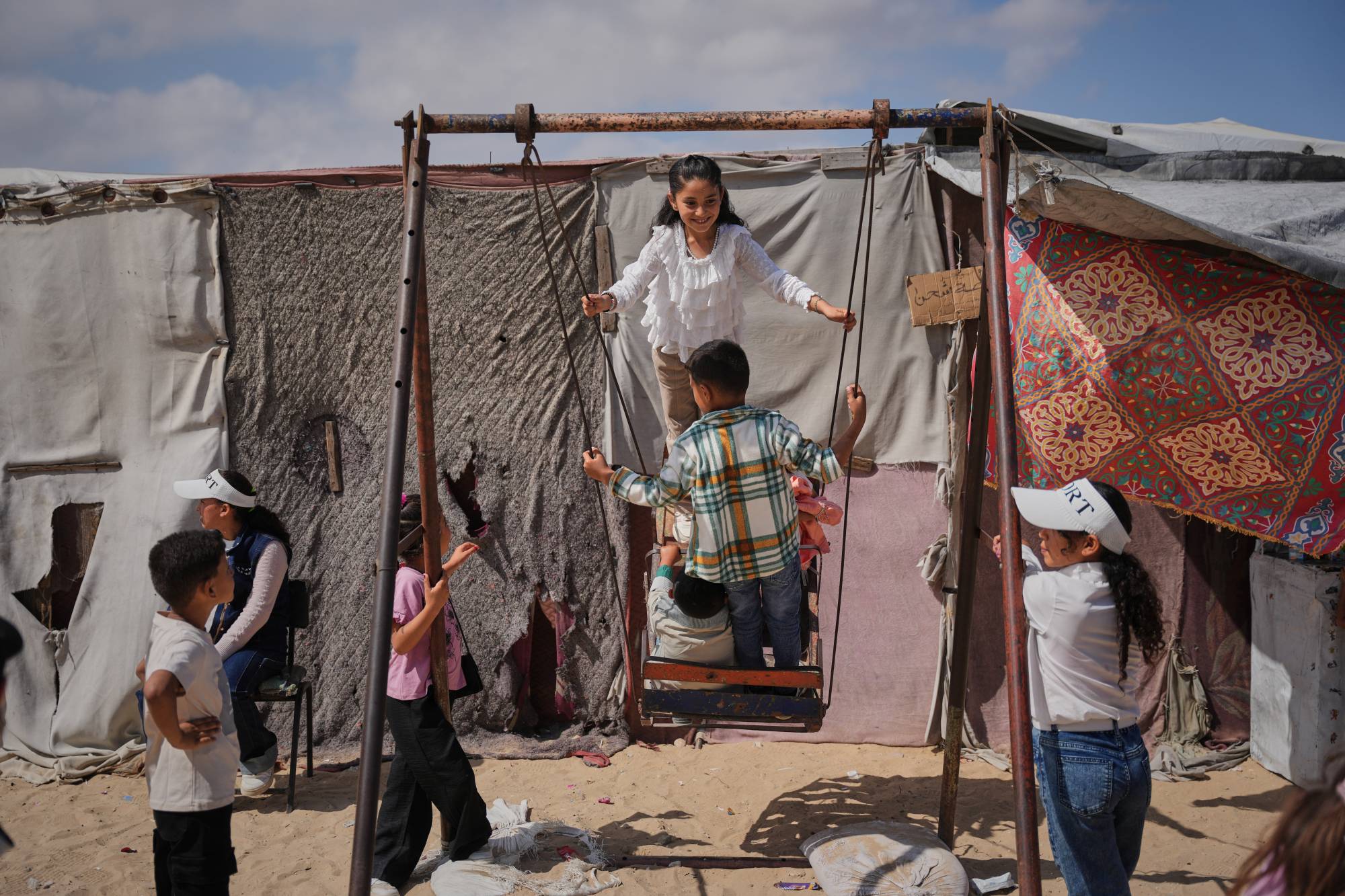
Displaced Palestinian children play on a swing at a tent camp during the Muslim holiday of Eid al-Adha in Khan Younis, southern Gaza Strip, Wednesday, May 27, 2026. (AP Photo/Abdel Kareem Hana)
Hamdan said she made the trip to ease the burden on her uncles, especially the elderly, amid Gaza’s harsh conditions, particularly the shortage of transport and high fares.
“Our lives have changed since the war, and no longer have meaning. All the conditions are discouraging and impose a state of despair on us, but we are trying to adapt to the new reality as much as possible despite the ongoing war by the occupation, which has not stopped bombing and destroying despite claims that there is a truce in Gaza,” Hamdan said.
An ongoing war
In a vehicle carrying several Gazans from the Rimal neighborhood to Sheikh Radwan in northern Gaza City, residents spoke of Israeli bombardment, the targeting of homes and the return of assassinations.
Saed Abu Safiya, 23, who started the conversation in the vehicle where Asharq Al-Awsat’s correspondent was present, said Israel would not halt its raids until Palestinian factions surrendered their weapons.
Salman Abu Khuwayter, a Gaza resident from Jabalia who is displaced in Sheikh Radwan, disagreed. He said the war would not stop even if Hamas and the factions handed over their weapons.
He said Israeli Prime Minister Benjamin Netanyahu and Israel aimed to displace Gaza’s population, pressure the factions and strip them not only of their weapons, but also eliminate all their members or move them out of the enclave.
Funerals on Eid
As family visits remained limited across Gaza, Palestinian families buried relatives killed in a series of strikes on Tuesday.
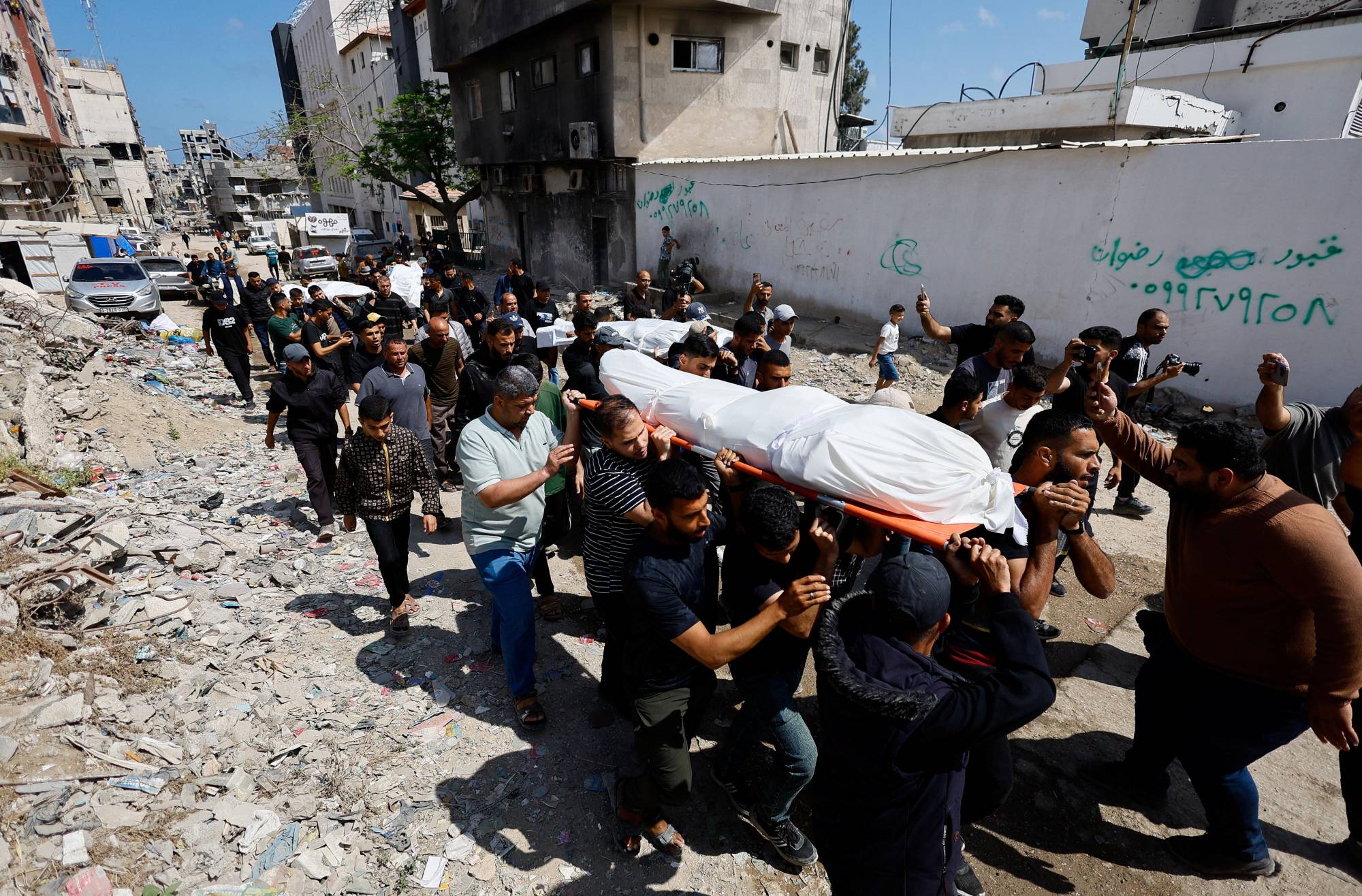
People carry bodies identified by mourners as Hamas' military wing commander Mohammad Odeh, who was killed in an Israeli strike on Tuesday, and his wife and children, during a funeral, in Gaza City, May 27, 2026. REUTERS/Mahmoud Issa
About 15 people were killed, including Mohammad Odeh, a commander in the Qassam Brigades, the armed wing of Hamas, his wife and three members of his family.
Grief marked the funerals held across southern, central and northern Gaza. Crowds joined processions that set out from different hospitals across the enclave.
At Odeh’s funeral, mourners chanted angry slogans demanding revenge for him and for all those killed in the escalating Israeli attacks on Gaza.
The number of Palestinian victims since the ceasefire has risen to more than 910.
The first day of Eid al-Adha was not quiet. Drones, warplanes, and helicopters kept flying over different parts of the enclave.
Explosions were heard in Khan Younis in southern Gaza and were later found to have been caused by mock raids off the city’s coast.
Shortly before Wednesday afternoon, a drone struck three Palestinians, wounding them. One injury was described as serious.
UN Raises Alarm over Israel's Killings of Gazans Near Armistice Linehttps://english.aawsat.com/arab-world/5277825-un-raises-alarm-over-israels-killings-gazans-near-armistice-line
People carry bodies identified by mourners as Hamas' military wing commander Mohammad Odeh, who was killed in an Israeli strike on Tuesday, and his wife and children, during a funeral, in Gaza City, May 27, 2026. REUTERS/Mahmoud Issa
UN Raises Alarm over Israel's Killings of Gazans Near Armistice Line
People carry bodies identified by mourners as Hamas' military wing commander Mohammad Odeh, who was killed in an Israeli strike on Tuesday, and his wife and children, during a funeral, in Gaza City, May 27, 2026. REUTERS/Mahmoud Issa
About a third of Palestinians killed by Israel since an October truce were in areas near the military's armistice line with Hamas, raising concerns that troops may be shooting at civilians merely for approaching the area, the UN human rights office said.
The office said such actions would constitute unlawful killings and thus war crimes. Israel's military, which says fire by its troops near the armistice line aims to thwart militant threats, did not immediately provide comment on the allegations.
Israel has demarcated its armistice boundary with Hamas since the truce with a "yellow line" marked on the ground with spaced out concrete blocks. Israeli troops remain deployed to its east, with Hamas in control in a coastal strip of land. But the military has frequently shifted those blocks deeper into Hamas-controlled territory, and Israeli maps show a widened restricted zone of military control now covers nearly two-thirds of Gaza. Israel's expanding zone of control has stirred fears among displaced Palestinians living in tent encampments and bombed out homes near the yellow line that they may be deemed military targets, as the population is squeezed into an even smaller area.
UN SAYS KILLINGS MAY BE UNLAWFUL
The UN data, shared exclusively with Reuters, includes 453 verified killings since the ceasefire through to February 5. Of those, 152 Palestinians - comprising 102 men, 15 women, 24 boys and 11 girls - were near the boundary, it said. "The available information raises serious concerns that the Israeli army is shooting at and killing presumed civilians simply on the basis of their proximity to the so-called yellow line, which would amount to unlawful killings and thus war crimes," said Ajith Sunghay, head of the UN Human Rights Office in the occupied Palestinian territory, calling the pattern alarming.
"Civilians do not appear to have posed any risk to the life of the Israeli military, including some cases in which they appear to have been shot while carrying out daily activities or having approached or crossed Israel's so-called yellow line," he said.
The boundary location was often not clear to Palestinians, he added. "Nobody clearly knows exactly where it starts, where it ends, and how it moves, and when it moves." Israeli officials describe the territory they've seized in Gaza, Syria and Lebanon as "buffer zones" that can stave off potential militant attacks following the October 7, 2023 Hamas-led assault that set off the Gaza war. The ceasefire brokered by US President Donald Trump has failed to halt Israeli attacks in Gaza, and Israel has continued to target Hamas leaders, killing two in the past two weeks. Overall, some 900 Palestinians have been killed in Israeli strikes since the truce, Gaza health authorities say, without giving a breakdown by location.
War and Displacement Rob Beirut of Eid al-Adha Joyhttps://english.aawsat.com/arab-world/5277804-war-and-displacement-rob-beirut-eid-al-adha-joy
A woman tosses sweets to displaced children at a makeshift camp for displaced people at Beirut's waterfront during Eid al-Adha, the Feast of Sacrifice, in Beirut, Lebanon, 27 May 2026. EPA/WAEL HAMZEH
War and Displacement Rob Beirut of Eid al-Adha Joy
A woman tosses sweets to displaced children at a makeshift camp for displaced people at Beirut's waterfront during Eid al-Adha, the Feast of Sacrifice, in Beirut, Lebanon, 27 May 2026. EPA/WAEL HAMZEH
The shape of Eid al-Adha has changed for many Lebanese as the war continues, along with the escalation, warnings, and daily anxiety accompanying it. Security developments resulting from the conflict have disrupted family gatherings that have become increasingly limited, while fear and anxiety continue to deepen despite attempts to preserve what remains of Eid traditions.
Lebanese speak of what resembles a slow “psychological death” caused by the ongoing developments, a feeling not limited to those displaced from the south and Beirut’s southern suburbs, but extending to Lebanese across different regions.
Relentless Fear
Ramia Salman says last Eid al-Adha and this year’s holiday no longer carry the same meanings of joy for many Lebanese, as the atmosphere has become more associated with fear than with the happiness that once accompanied such occasions.
She adds: “Last Eid al-Adha, as with this year’s Eid, the scene felt completely different from what we had known for many years. Holidays were always associated with preparing for family visits, buying Eid necessities, welcoming relatives, and even the small details that gave people a different feeling about the occasion. But what is happening today has greatly changed that feeling.”
She told Asharq Al-Awsat: “Two days before Eid, especially with the escalation witnessed in the western Bekaa, we felt deep fear from the very idea of Eid itself. Instead of waiting for the occasion with joy, we found ourselves simply hoping these days would pass safely. The concern is no longer how we will spend Eid or celebrate it, but how we will get through this phase safely.”
She believes even the traditions of Eid eve have changed noticeably, saying: “Eid night was always a space for joy, movement in the markets, family gatherings, and the feeling that there was an occasion everyone was waiting for. Today the scene has changed dramatically. Gatherings have shifted from meetings tied to joy into gatherings dominated by anxiety, fear, and questions.”
She adds: “Sometimes we feel as though the Israeli army is constantly manipulating our nervous system. The issue is not only related to airstrikes or direct attacks, but to the permanent state of anticipation imposed on people.”
She continues: “Fear and panic are no longer temporary feelings tied to a specific moment. They have become part of daily life. Sometimes we feel we are not just living in fear of a particular event, but enduring a form of continuous internal exhaustion, as if something inside a person is gradually fading away.”
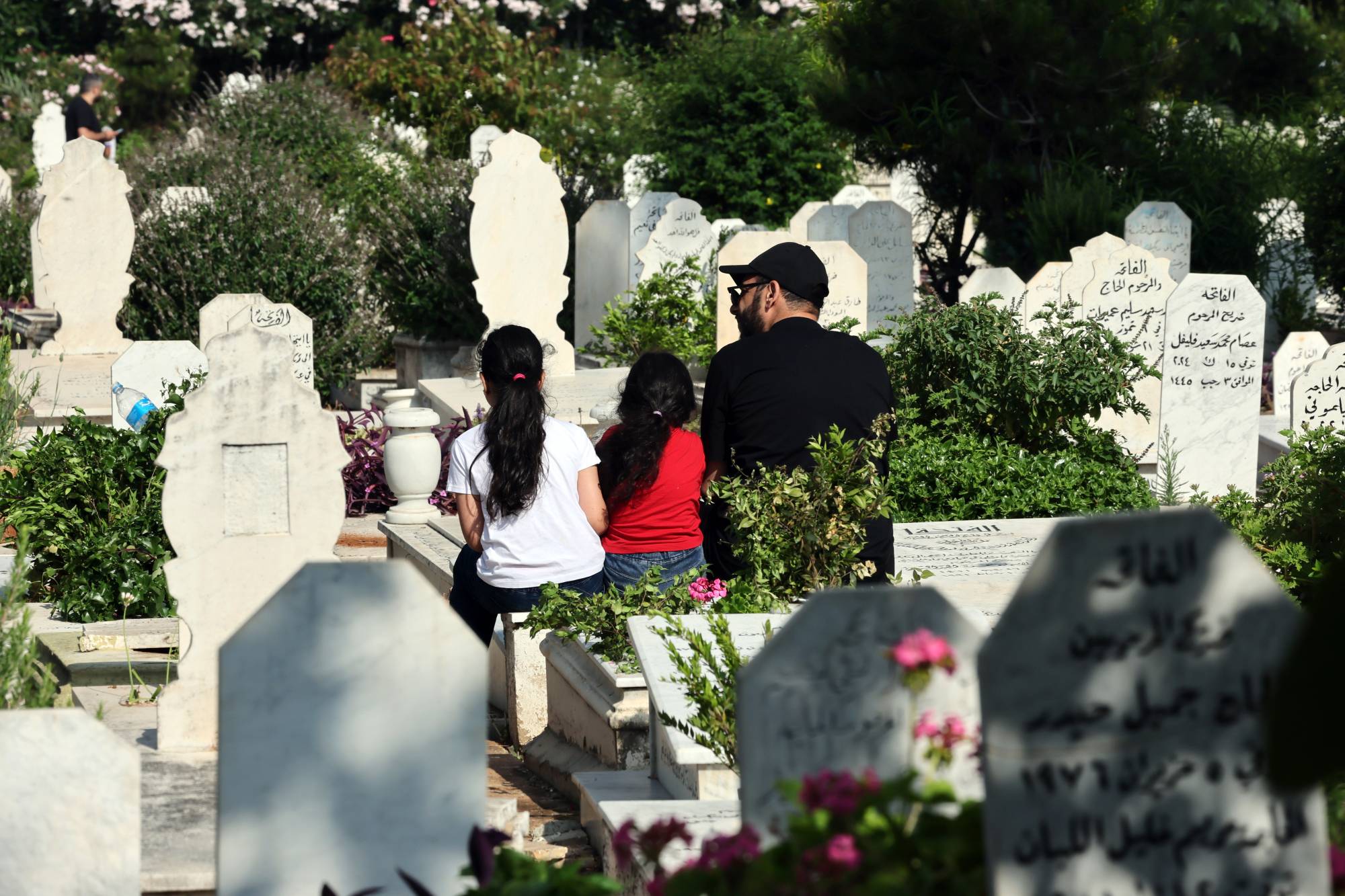
People visit the graves of their loved ones at a local cemetery on Eid al-Adha, the Feast of Sacrifice, in Beirut, Lebanon, 27 May 2026. EPA/WAEL HAMZEH
The Meaning of Eid
For her part, Zeinab Tahmaz says holidays had already begun losing part of their traditions in recent years, but the war accelerated that transformation even further.
She told Asharq Al-Awsat that “since last Eid al-Adha, the atmosphere has been almost nonexistent.” Recalling scenes from last year, she says: “At the time, warnings were issued and we saw how many areas, especially in the southern suburbs, were evacuated. That was proof that people no longer had the desire to go out or even visit their villages.”
She continues: “We had the scent of Eid, the village, our grandfather’s house, and family gatherings. These were things we once took for granted. But this year, even those things have been taken away from us.”
She says: “Sometimes I feel the war is not only taking away our sense of safety or the atmosphere itself, but also our ability to feel things the same way. The things we once waited for with excitement are no longer awaited in the same way.”
Fear Changed Eid Plans
Ali Al-Husseini says the escalation has not only changed the atmosphere of Eid, but also altered personal and family decisions that once seemed settled.
He told Asharq Al-Awsat: “I had planned to spend Eid with my family in the Bekaa, and the idea was tied to returning, even briefly, to the atmosphere we used to know.” He noted that “the escalation in the days leading up to Eid had the exact opposite psychological effect. Instead of making us think about Eid, it created feelings of fear and anxiety.”
He says: “I decided to remain with my children in our place of displacement in Mount Lebanon out of fear of any new escalation or warnings, and concern that developments could spiral in a way that would prevent me from returning to Beirut for medical treatment.”
A Slow Death
Saeed Shehab believes the war has not only stripped people of the details of Eid, but also forced them to reconsider even the things that once seemed self-evident.
He told Asharq Al-Awsat: “Under these circumstances, Eid itself feels absent, whether there is a warning or not,” adding: “People have started clinging to the simplest things and saying thank God they still have a house they can sit in, a house that has not been destroyed and where they are still able to remain.”
He continues: “Beyond the feeling that you have already been deprived of many things, you hear reports about the possibility that the area where you are staying could be targeted, and you feel that even the last sense of safety you cling to could be taken away from you.”
He says: “You can lose your hometown, lose people and details that once meant something to you, and then feel that even the house giving you some reassurance could also become threatened.”
He adds: “The problem is not only what is happening outside, but what remains inside a person. A person does not only lose a house or a place, but sometimes feels they are losing part of themselves as well. There is sorrow that remains inside them, and psychological exhaustion that accumulates, as though over time you are living through a kind of slow death of the feelings and things that once gave you hope or a sense of life.”
لم تشترك بعد
انشئ حساباً خاصاً بك لتحصل على أخبار مخصصة لك ولتتمتع بخاصية حفظ المقالات وتتلقى نشراتنا البريدية المتنوعة