


Bundesliga May Have Pressing Problems but It's at the Tactical Forefront

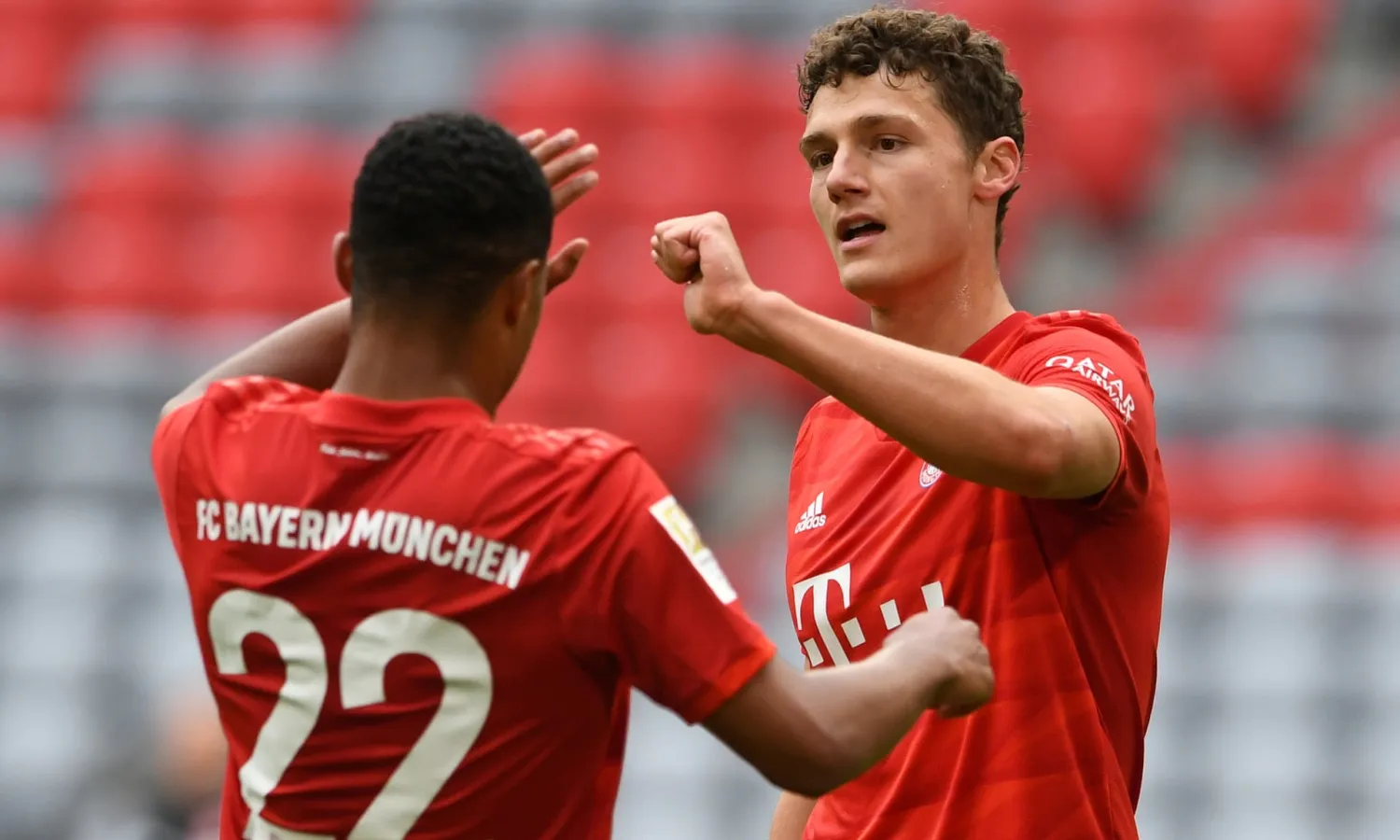
Following their heavy defeat of Borussia Dortmund, Bayern dished out the same treatment to Fortuna Düsseldorf on Saturday. Photograph: Reuters
TT

Bundesliga May Have Pressing Problems but It's at the Tactical Forefront

Following their heavy defeat of Borussia Dortmund, Bayern dished out the same treatment to Fortuna Düsseldorf on Saturday. Photograph: Reuters

All sporting events have their myths, the useful narratives hung on them as the flags are lowered on the final day and we have to work out what the past month, all that effort, all that emotion, all that money, was for. Remember how the 2012 Olympics in London brought us together as an open, multicultural nation inspired to a more active future? The 2006 World Cup, we were told, was about the patriotic celebration of a new Germany. And perhaps it was.

However immersion in the Bundesliga over the past three weeks suggests the most tangible legacy was the wholesale adoption of pressing.

It is hard to believe that even 20 years ago Germany was a footballing culture skeptical of pressing. That when the then Hoffenheim manager Ralf Rangnick tried to explain zonal marking on television he was dismissed as a boffinish crank. That the grand old men of German punditry insisted the game was all about character.

Then, as the national team of Jürgen Klinsmann and Jogi Löw reached the semi-final playing bright modern football and Jürgen Klopp explained it all on TV, the nation underwent mass revelation.

German football presses now with a convert’s zeal, to the extent that much tactical discussion focuses on variations of pressing. At Borussia Dortmund, Lucien Favre’s style is broadly accepted. What is questioned is whether he has the psychological edge in the biggest matches, a return of the concerns of the old-school pundits within a context that takes pressing as a given.

It’s not only pioneers such as RB Leipzig’s Julian Nagelsmann and Borussia Mönchengladbach’s Marco Rose, whose side are in action on Sunday, along with Borussia Dortmund. Every game is highly percussive and attacking. Bayern Munich’s victory over Dortmund on Tuesday was not only a tense title decider, it was also an overtly modern game of exceptional quality.

German coaches, or those with Bundesliga experience, seem the most forward-thinking and innovative in the world. Klopp is at the forefront of that. Liverpool’s victory in the Champions League last season confirmed the pre-eminence of that style of play at elite level.

Of course, it’s a little more complex than that. If they need to, Liverpool – or Bayern, or Dortmund, or Leipzig – are capable of holding possession. Pep Guardiola’s sides have always pressed and countered and the Manchester City manager himself has become more direct over the past decade. But still, the basic principle remains: Klopp would never talk, as Guardiola has, of how it takes 15 passes – if an immediate counter isn’t on – for his side to set itself.

And so one of the basic dialectics that seems to govern tactical evolution – attack v defense, individuality v collective organization, possession v position, and, here, physique v technique – swung back again. How else, after all, could a deft touch, precision passing, and astute movement be overcome but by devising a means of playing harder and faster (and smarter) to win the ball back?

International teams almost never have time to gain those levels of mutual understanding
Which is fine for the club game. But to press like Liverpool, Leipzig, Dortmund or Gladbach is very difficult, if not impossible, without regular drilling. It’s been notable since the resumption how defenses in the Bundesliga have struggled, as if the COVID lay-off and subsequent restrictions on training have disrupted their coherence and they’re having to refamiliarise themselves with the organization that is usually almost instinctive.

International teams almost never have time to gain those levels of mutual understanding, which is why club and international football increasingly seem different games. That perhaps explains how Portugal were able to win the Euros and France the World Cup without aggressive pressing and without adopting a particularly complex pattern of attacking play.

“Football is constantly evolving,” Gérard Houllier says in Matt Spiro’s new book, Sacré Bleu. “Spain had a philosophy that worked. In 2014, Germany took the best out of the Spanish possession game, and they added in their own physical, powerful qualities. France added speed. Back when Spain dominated, we thought you needed 70% of the possession to win, but France showed you can be dangerous with only 30%.”

Spain in 2010, with a side drawn largely from Barcelona, played a pragmatic variant of guardiolista football, one that used possession as a tool of attrition. Germany in 2014, with a side drawn largely from Bayern, arguably weren’t quite as good as they had been four years earlier when Spain had ground them down in the semi-final, but were highly effective at counterattacking (Löw feels almost old-fashioned by modern German standards). France’s success in 2018 was largely the result of a solid defense (despite the chaotic 4-3 win over Argentina and the 4-2 victory in the final) and the lighting pace of Kylian Mbappé.

Whether that constitutes evolution is debatable. That France side had no basis at one club and was not in any sense a reinterpretation of a pre-existing style for international football. Didier Deschamps’s achievement, as Spiro’s book makes clear, was to rebuild after the disgrace of the player rebellion in 2010 and Laurent Blanc’s subsequent gaffes, fostering a cohesive squad with genuine spirit.

In part, that was achieved by jettisoning various members of the talented but troublesome Génération 87, players such as Karim Benzema, Hatem Ben Arfa, Samir Nasri, and Jérémy Ménez, something that wasn’t necessarily an issue of character. “We did too much technique with them,” Houllier suggests. “We needed to adjust our training methods, become more like the Spanish by focusing more on collective training exercises and collective play.”

And that, perhaps, is the greatest change over the past 10-15 years. At its best, football has become more team-based, both from an attacking and a defensive point of view. That is the essence of both Guardiola’s work on positioning and Klopp’s pressing strategies. But still, Deschamps’s success came with nothing more complex than basic counterattacking.

There is no discernible French school. It is not insignificant that the only French manager in one of Europe’s top four leagues is Zinedine Zidane (which is still one more than there are English managers working at elite foreign clubs).

Germany may have gone out in the first round of the last World Cup but the Bundesliga represents the avant-garde. Watch Rose’s Gladbach or Favre’s Dortmund on Sunday afternoon: that is modern football.

(The Guardian)


Mbappe Calls for Prestianni Ban over Alleged Racist Slur at Vinicius

TOPSHOT - Real Madrid's French forward #10 Kylian Mbappe talks with SL Benfica's Portuguese head coach Jose Mourinho during the UEFA Champions League knockout round play-off first leg football match between SL Benfica and Real Madrid CF at Estadio da Luz in Lisbon on February 17, 2026. (Photo by PATRICIA DE MELO MOREIRA / AFP)
TT

Mbappe Calls for Prestianni Ban over Alleged Racist Slur at Vinicius

TOPSHOT - Real Madrid's French forward #10 Kylian Mbappe talks with SL Benfica's Portuguese head coach Jose Mourinho during the UEFA Champions League knockout round play-off first leg football match between SL Benfica and Real Madrid CF at Estadio da Luz in Lisbon on February 17, 2026. (Photo by PATRICIA DE MELO MOREIRA / AFP)

Real Madrid forward Kylian Mbappe said Benfica's Gianluca Prestianni should be banned from the Champions League after the Argentine was accused of directing a racist slur at Vinicius Jr during the Spanish side's 1-0 playoff first-leg win on Tuesday.

Denying the accusation, Prestianni said the Brazilian misheard him.

The incident occurred shortly after Vinicius had curled Real into the lead five minutes into the second half in Lisbon.

Television footage showed the Argentine winger covering his mouth with his shirt before making a comment that Vinicius and nearby teammates interpreted as a racial ‌slur against ‌the 25-year-old, with referee Francois Letexier halting the match for ‌11 ⁠minutes after activating ⁠FIFA's anti-racism protocols.

The footage appeared to show an outraged Mbappe calling Prestianni "a bloody racist" to his face, Reuters reported.

The atmosphere grew hostile after play resumed, with Vinicius and Mbappe loudly booed by the home crowd whenever they touched the ball. Despite the rising tensions, the players were able to close out the game without further interruptions.

"I want to clarify that at no time did I direct racist insults to Vini Jr, ⁠who regrettably misunderstood what he thought he heard," Prestianni wrote ‌on his Instagram account.

"I was never racist with ‌anyone and I regret the threats I received from Real Madrid players."

Mbappe told reporters he ‌heard Prestianni direct the same racist remark at Vinicius several times, an allegation ‌also levelled by Real's French midfielder Aurelien Tchouamen.

Mbappe said he had been prepared to leave the pitch but was persuaded by Vinicius to continue playing.

"We cannot accept that there is a player in Europe's top football competition who behaves like this. This guy (Prestianni) doesn't ‌deserve to play in the Champions League anymore," Mbappe told reporters.

"We have to set an example for all the children ⁠watching us at ⁠home. What happened today is the kind of thing we cannot accept because the world is watching us.

When asked whether Prestianni had apologized, Mbappe laughed.

"Of course not," he said.

Vinicius later posted a statement on social media voicing his frustration.

"Racists are, above all, cowards. They need to cover their mouth with their shirt to show how weak they are. But they have the protection of others who, theoretically, have an obligation to punish them. Nothing that happened today is new in my life or my family's life," Vinicius wrote.

The Brazilian has faced repeated racist abuse in Spain, with 18 legal complaints filed against racist behavior targeting Vinicius since 2022.

Real Madrid and Benfica will meet again for the second leg next Wednesday at the Bernabeu.


Second Season of ‘Kings League–Middle East' to Kick off in March in Riyadh 

The second season of the Kings League-Middle East will kick off in Riyadh on March 27. (Kings League-Middle East on X)
TT

Second Season of ‘Kings League–Middle East' to Kick off in March in Riyadh 

The second season of the Kings League-Middle East will kick off in Riyadh on March 27. (Kings League-Middle East on X)

The Kings League-Middle East announced that its second season will kick off in Riyadh on March 27.

The season will feature 10 teams, compared to eight in the inaugural edition, under a format that combines sporting competition with digital engagement and includes the participation of several content creators from across the region.

The Kings League-Middle East is organized in partnership with SURJ Sports Investments, a subsidiary of the Public Investment Fund (PIF), as part of efforts to support the development of innovative sports models that integrate football with digital entertainment.

Seven teams will return for the second season: DR7, ABO FC, FWZ, Red Zone, Turbo, Ultra Chmicha, and 3BS. Three additional teams are set to be announced before the start of the competition.

Matches of the second season will be held at Cool Arena in Riyadh under a single round-robin format, with the top-ranked teams advancing to the knockout stages, culminating in the final match.

The inaugural edition recorded strong attendance and wide digital engagement, with approximately a million viewers following the live broadcasts on television and digital platforms.


Shakhtar Boss Pays Ukrainian Racer $200,000 After Games Disqualification

Ukrainian President Volodymyr Zelenskiy holds helmet as he meets with a Ukrainian skeleton racer Vladyslav Heraskevych , who was disqualified from the Olympic skeleton competition over his "helmet of remembrance" depicting athletes killed since Russia's invasion and his father and coach, Mykhailo Heraskevych, amid Russia's attack on Ukraine, in Munich, Germany February 13, 2026. (Ukrainian Presidential Press Service/Handout via Reuters)
TT

Shakhtar Boss Pays Ukrainian Racer $200,000 After Games Disqualification

Ukrainian President Volodymyr Zelenskiy holds helmet as he meets with a Ukrainian skeleton racer Vladyslav Heraskevych , who was disqualified from the Olympic skeleton competition over his "helmet of remembrance" depicting athletes killed since Russia's invasion and his father and coach, Mykhailo Heraskevych, amid Russia's attack on Ukraine, in Munich, Germany February 13, 2026. (Ukrainian Presidential Press Service/Handout via Reuters)

The owner of ‌Ukrainian football club Shakhtar Donetsk has donated more than $200,000 to skeleton racer Vladyslav Heraskevych after the athlete was disqualified from the Milano Cortina Winter Games before competing over the use of a helmet depicting Ukrainian athletes killed in the war with Russia, the club said on Tuesday.

The 27-year-old Heraskevych was disqualified last week when the International Bobsleigh and Skeleton Federation jury ruled that imagery on the helmet — depicting athletes killed since Russia invaded Ukraine in 2022 — breached rules on athletes' expression at ‌the Games.

He ‌then lost an appeal at the Court ‌of ⁠Arbitration for Sport hours ⁠before the final two runs of his competition, having missed the first two runs due to his disqualification.

Heraskevych had been allowed to train with the helmet that displayed the faces of 24 dead Ukrainian athletes for several days in Cortina d'Ampezzo where the sliding center is, but the International Olympic Committee then ⁠warned him a day before his competition ‌started that he could not wear ‌it there.

“Vlad Heraskevych was denied the opportunity to compete for victory ‌at the Olympic Games, yet he returns to Ukraine a ‌true winner," Shakhtar President Rinat Akhmetov said in a club statement.

"The respect and pride he has earned among Ukrainians through his actions are the highest reward. At the same time, I want him to ‌have enough energy and resources to continue his sporting career, as well as to fight ⁠for truth, freedom ⁠and the remembrance of those who gave their lives for Ukraine," he said.

The amount is equal to the prize money Ukraine pays athletes who win a gold medal at the Games.

The case dominated headlines early on at the Olympics, with IOC President Kirsty Coventry meeting Heraskevych on Thursday morning at the sliding venue in a failed last-minute attempt to broker a compromise.

The IOC suggested he wear a black armband and display the helmet before and after the race, but said using it in competition breached rules on keeping politics off fields of play. Heraskevych also earned praise from Ukraine President Volodymyr Zelenskiy.
