


Aoun Calls for National Meeting as Berri, Hariri Stress Civil Peace as Priority

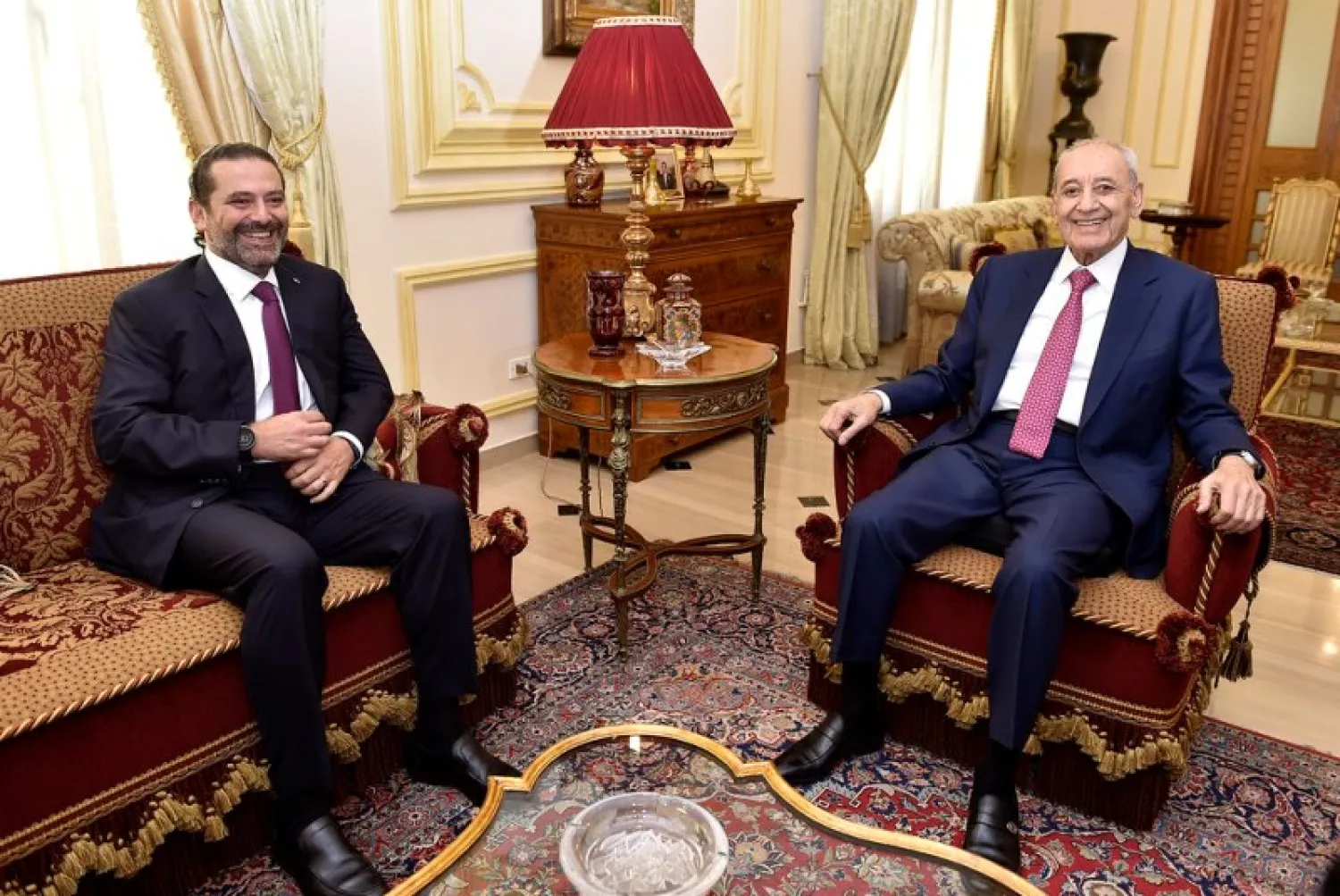
Speaker Nabih Berri meets with former PM Saad Hariri on Tuesday. (NNA)
TT

Aoun Calls for National Meeting as Berri, Hariri Stress Civil Peace as Priority

Speaker Nabih Berri meets with former PM Saad Hariri on Tuesday. (NNA)

The Lebanese Presidency kicked off Tuesday preparations for holding a “comprehensive national meeting” scheduled for June 25 to discuss political, economic and financial issues as officials carried out numerous meetings to contain mounting tensions.

Presidential sources told Asharq Al-Awsat that the meeting will be held at the Presidential Palace in Baabda at the proposal of President Michel Aoun following talks with Prime Minister Hassan Diab and Speaker Nabih Berri on the latest developments in the country.

The sources said former presidents and prime ministers, the heads of political parties and parliamentary blocs and the deputy speaker would be invited.

Deputy Speaker Elie Ferzli told Asharq Al-Awsat that the meeting “would discuss the political, economic, financial and monetary crises in the country.”

Asked if political leaders would attend this meeting, Ferzli said: “They should comply with this invitation at this sensitive phase. Those who will refuse to attend will be held responsible for their decision.”

MP Eli Hankash, of the Kataeb, told Asahrq Al-Awsat that the party would positively receive the invitation. “A final decision would be taken during a party meeting,” he said.

The Lebanese Forces (LF) echoed the same position.

“The decision of our participation would be taken later after consultations between the bloc and the party,” LF media and communication official Charles Jabbour told Asahrq Al-Awsat.

On Tuesday, former Prime Minister Saad Hariri visited Berri at his Ain-el-Tineh residence to discuss the current situation and the latest developments in the country.

In a joint statement, the pair affirmed that preserving civil peace is the top priority, highlighting the need to intensify efforts to thwart any attempt to sow sedition.

They also condemned attacks on public and private properties and insults against religious figures.

Earlier this month, hundreds of protesters took to the streets to voice outrage over the government’s handling of a deep economic crisis, with security forces firing tear gas and rubber bullets to disperse them. The protests then turned violent when clashes erupted between supporters and opponents of the Hezbollah party.

Last week in downtown Beirut, dozens of young men on motorcycles caused extensive damage to shops and set a local bank branch on fire as they vented their anger over the stifling crisis.



Deadly Clashes in Syria’s Aleppo Deepen Rift Between Govt, Kurdish Forces

Smoke billows in the distance, in Aleppo, northern Syria, 07 January 2026. (EPA)
TT

Deadly Clashes in Syria’s Aleppo Deepen Rift Between Govt, Kurdish Forces

Smoke billows in the distance, in Aleppo, northern Syria, 07 January 2026. (EPA)

Fierce fighting in Syria's northern city of Aleppo between government forces and Kurdish fighters killed at least four people on Wednesday and drove thousands of civilians from their homes, with Washington reported to be mediating a de-escalation.

The violence, and statements trading blame over who started it, signaled that a stalemate between Damascus and Kurdish authorities that have resisted integrating into the central government was deepening and growing deadlier.

Clashes broke out on Tuesday, when at least six people were killed, including two women and a child, in an exchange of shelling between Syrian government troops and the Kurdish-led Syrian Democratic Forces (SDF).

After relative calm ‌overnight, shelling ‌resumed on Wednesday and intensified in the afternoon, Reuters reporters in ‌the ⁠city said. Aleppo's health ‌directorate said a further four people were killed and more than two dozen wounded.

By evening, fighting had subsided, the Reuters reporters said.

Ilham Ahmed, who heads the foreign affairs department of the Kurdish administration, told Reuters that international mediation efforts were underway to de-escalate. A source familiar with the matter told Reuters the US was mediating.

THOUSANDS OF CIVILIANS FLEE

The Syrian army announced that military positions in the Kurdish-held neighborhoods of Sheikh Maqsoud and Ashrafiyah were "legitimate military targets." Two Syrian security officials told Reuters that they expected a ⁠significant military operation in the city.

The government opened humanitarian corridors for civilians to flee flashpoint neighborhoods, ferrying them out on city buses. A ‌source from the government's civil defense rescue force said an ‍estimated 10,000 people had fled.

"We move them ‍safely to the places they want to go to according to their desire or to ‍displaced shelters," said Faisal Mohammad Ali, operations chief of the civil defense force in Aleppo.

The latest fighting has disrupted civilian life in what is a leading Syrian city, closing the airport and a highway to Türkiye, halting operations at factories in an industrial zone and paralyzing major roads into the city center.

The Damascus government said its forces were responding to rocket fire, drone attacks and shelling from Kurdish-held neighborhoods.

Kurdish forces said they held Damascus "fully and directly responsible for ... the dangerous escalation that threatens ⁠the lives of thousands of civilians and undermines stability in the city."

During Syria's 14-year civil war, Kurdish authorities began running a semi-autonomous zone in northeast Syria, as well as in parts of Aleppo city.

They have been reluctant to give up those zones and integrate fully into the government that took over after ex-President Bashar al-Assad's ousting in late 2024.

Last year, the Damascus government reached a deal with the SDF that envisaged a full integration by the end of 2025, but the two sides have made little progress, each accusing the other of stalling or acting in bad faith.

The US has stepped in as a mediator, holding meetings as recently as Sunday to try to nudge the process forward. Sunday's meetings ended with no tangible progress.

Failure to integrate the SDF into Syria's army risks further violence and ‌could potentially draw in Türkiye, which has threatened an incursion against Kurdish fighters it views as terrorists.


Presidential Adviser to Asharq Al-Awsat: Security Stable in Yemen’s Aden

Presidential Leadership Council member Abdul Rahman Al-Mahrami Abou Zaraa during a previous meeting with the Hadhramaut governor, attended by adviser Jaber Mohammed. (Photo courtesy of Abu Zaraa’s office)
TT

Presidential Adviser to Asharq Al-Awsat: Security Stable in Yemen’s Aden

Presidential Leadership Council member Abdul Rahman Al-Mahrami Abou Zaraa during a previous meeting with the Hadhramaut governor, attended by adviser Jaber Mohammed. (Photo courtesy of Abu Zaraa’s office)

Security in Yemen’s interim capital, Aden, was stable on Wednesday, a senior official said, after security forces moved swiftly to deploy across the city and secure key government institutions.

Jaber Mohammed, a presidential adviser and director of the office of Presidential Leadership Council member Abdul Rahman Al-Mahrami, also known as Abou Zaraa, told Asharq Al-Awsat that the security plan had been implemented within hours.

Since the early morning, brigades of the Giants Forces have deployed across Aden’s main streets, securing vital government institutions. “The security situation is calm and stable,” Mohammed said.

Meanwhile, Mohammed al-Ghaithi, a member of the Southern Transitional Council delegation that arrived in Riyadh, said the atmosphere was positive and that preparations were underway to launch a series of meetings related to intra-Southern dialogue.

In a post on X, he stated that he arrived with colleagues from Aden in Riyadh.

“In a positive atmosphere, we will begin a series of meetings to prepare for intra-southern dialogue under the sponsorship of our brothers in the Kingdom of Saudi Arabia,” he added.

Earlier, Presidential Leadership Council member Abdullah al-Alimi said that developments in the south represented a restoration of the state's authority, its institutions, legitimacy, and reference frameworks.

Al-Alimi said this was aimed at preserving stability and public calm, and clarifying the truth, free from the logic of conflicts and illusory victories.

The Presidential Leadership Council had decided to revoke the membership of Aidarous al-Zubaidi and refer him to the public prosecutor over accusations including high treason, undermining Yemen’s political and economic standing, obstructing state efforts to confront the coup, and fueling internal strife.

In another post on X, al-Alimi stated that the responsibility for maintaining security and stability rested with state institutions, local authorities, and all loyal citizens, in a manner that ensured the rule of law and protected civilians.

“What is happening today in the southern governorates after the rebellion of Aidrous al-Zubaidi, despite all the sincere efforts made by our brothers in the Kingdom of Saudi Arabia and the Presidential Leadership Council to prevent reaching this stage, is not what we had hoped for, and we are not happy with what has happened,” he said.

The Saudi-led coalition backing Yemen’s legitimate government later announced new details surrounding the movements of al-Zubaidi, following military escalation by forces affiliated with the council in Hadhramaut and Al-Mahra.

Coalition spokesman Major General Turki al-Maliki stated that the coalition had informed al-Zubaidi on January 4 to travel to Saudi Arabia within 48 hours to meet with Presidential Leadership Council Chairman Rashad al-Alimi and coalition leaders to discuss the reasons behind the recent military escalation.

He said arrangements had been made for al-Zubaidi to travel on a Yemenia Airways flight, but the flight was delayed for several hours before being canceled, followed by heightened tensions and the appearance of gunmen and military vehicles near civilian facilities around the airport.

Al-Maliki added that forces affiliated with the Southern Transitional Council then moved to impose measures in Aden, including a military deployment, obstruction of movement inside the airport, the closure of some roads, and armed deployments across the city, which the coalition described as an “unjustified escalation” that threatened security and stability.


Cairo to Host Hamas Delegation Next Week to Advance Gaza Ceasefire Deal

Palestinians walk through the ruins of destroyed buildings in Gaza City, Sunday, Jan. 4, 2026. (AP)
TT

Cairo to Host Hamas Delegation Next Week to Advance Gaza Ceasefire Deal

Palestinians walk through the ruins of destroyed buildings in Gaza City, Sunday, Jan. 4, 2026. (AP)

A Palestinian source told Asharq Al-Awsat on Tuesday that Cairo will host a delegation from Hamas next week for talks aimed at advancing a ceasefire agreement in Gaza.

The source, who is close to Hamas, said the visit is expected to focus on the provisions of the second phase of the ceasefire deal, most notably finalizing the names of a technocratic committee to administer Gaza, in an effort to move forward with implementation of the agreement.

The talks will be led by senior Hamas figure and chief negotiator Khalil al-Hayya, though no exact date for the meeting has been announced.

Two Palestinian sources close to Fatah also stressed the importance of Egypt’s role in shaping arrangements for the second phase of the deal, particularly in the face of obstacles posed by Israeli Prime Minister Benjamin Netanyahu.

On Tuesday, Netanyahu said the Rafah border crossing would not be reopened until the return of the last remaining body.

Israel’s public broadcaster reported that the Israeli premier is insisting the crossing between Gaza and Egypt remain closed until the body of the final Israeli captive held in the enclave, Ran Gvili, is returned.

He was quoted as saying that agreements with the US administration underpin this position.

The move marks a reversal from earlier expectations that the crossing would reopen at the start of the first phase of the Gaza agreement on Oct. 10.

It follows a report published Sunday by the Israeli daily Haaretz, which cited informed sources as saying the Rafah crossing was set to reopen soon in both directions, with European forces playing a main role in running it.

Those forces had already arrived in Israel and were ready to deploy in the area, it revealed.