

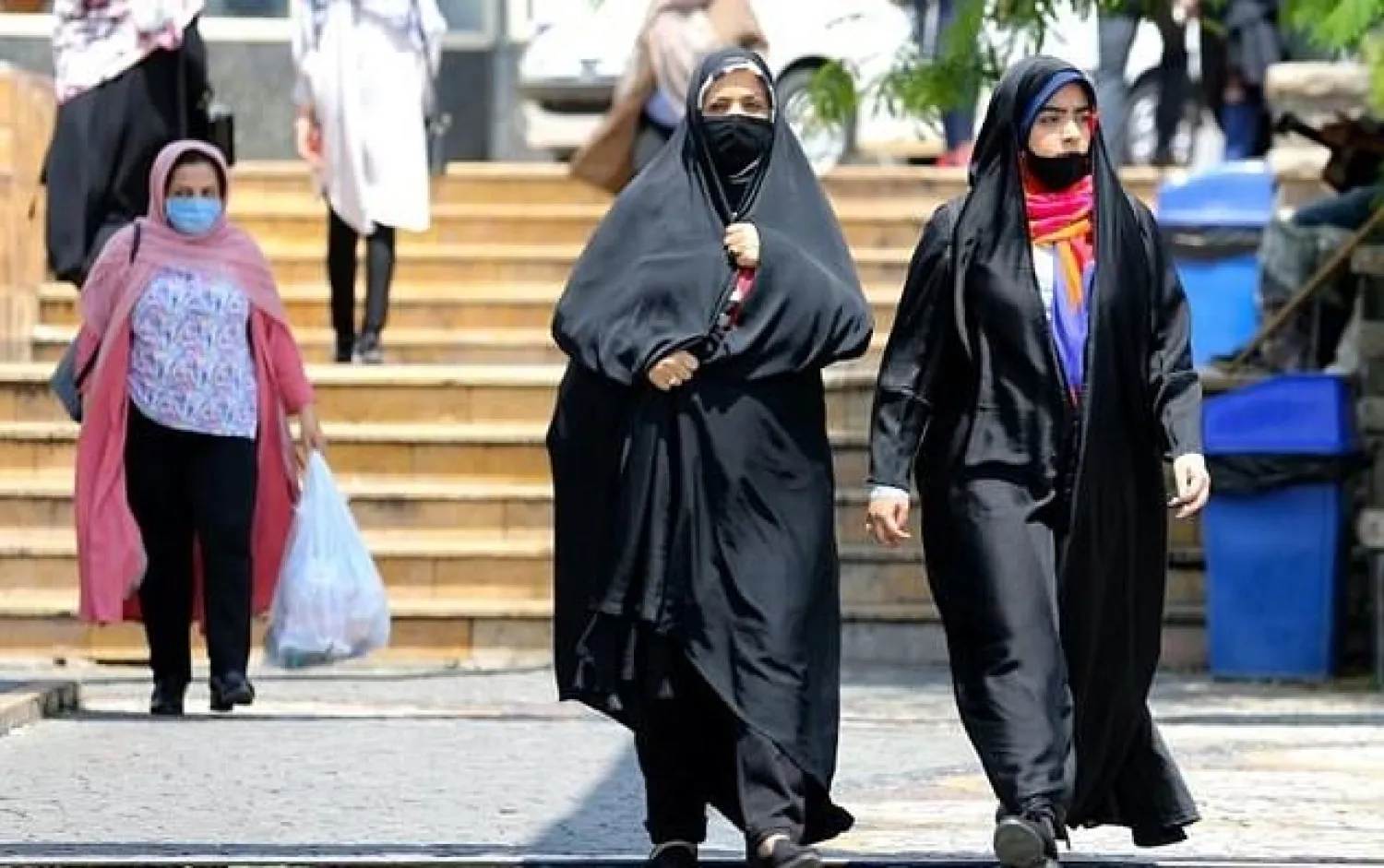

Iran Says Masks to Become Compulsory Starting Next Week

Mask-wearing will be obligatory in covered spaces and gathering places, Iranian authorities announced after a rise in virus cases. AFP
TT

Iran Says Masks to Become Compulsory Starting Next Week

Mask-wearing will be obligatory in covered spaces and gathering places, Iranian authorities announced after a rise in virus cases. AFP

Iranian President Hassan Rouhani said Sunday mask-wearing will become mandatory in certain areas as the novel coronavirus deaths kept on rising.

The new steps were announced as the country recorded 144 new fatalities from the COVID-19, its highest death toll for a single day in almost three months.

Also, virus-hit provinces were allowed to reimpose restrictions.

Rouhani said Iran would have to live with the virus for the "long haul", as he announced the latest measures to combat it, AFP reported.

Mask-wearing would be "obligatory in covered spaces where there are gatherings", he said during a televised meeting of the country's anti-virus taskforce.

The measure would come into force as of next week, continue until July 22 and would be extended if necessary, he noted.

Rouhani also said the health ministry had devised "a clear list" of the types of spaces and gatherings deemed high-risk, but he did not elaborate.

He did not say what the penalty would be for those who fail to observe the measure.

According to deputy health minister Iraj Harirchi, services would not be provided to those without masks in areas such as government organisations and shopping malls.

But implementing the measure may be difficult, as according to Tehran's mayor, many do not wear masks in places like the capital's public transport network, where it is already mandatory.

"Fifty percent of metro passengers wear masks... and even fewer in buses," Mayor Pirouz Hanachi was quoted as saying by the semi-official ISNA news agency.

"We can't forcefully confront people without masks," he added.

Iran's health ministry on Sunday announced 144 virus deaths in the past 24 hours, its highest for a single day since April 5, raising the total to 10,508.

Spokeswoman Sima Sadat Lari also raised total confirmed infections to 222,669, with 2,489 new cases during the same period.

Iran closed schools, cancelled public events and banned movement between its 31 provinces in March, but the government progressively lifted restrictions from April to try to reopen its sanctions-hit economy.



Ex-Philippine President to Face Trial on Crimes Against Humanity Charges

FILE - In this Oct. 26, 2016 file photo, Philippine President Rodrigo Duterte delivers a speech at the Philippine Economic Forum in Tokyo. (AP Photo/Eugene Hoshiko, File)
TT

Ex-Philippine President to Face Trial on Crimes Against Humanity Charges

FILE - In this Oct. 26, 2016 file photo, Philippine President Rodrigo Duterte delivers a speech at the Philippine Economic Forum in Tokyo. (AP Photo/Eugene Hoshiko, File)

Judges at the International Criminal Court on Thursday confirmed crimes against humanity charges against former Philippine president Rodrigo Duterte for deadly anti-drugs crackdowns he allegedly oversaw while in office.

A three-judge panel found unanimously there were “substantial grounds” to believe the ex-leader was responsible for dozens of murders, first as mayor of the southern Philippine city of Davao and later as president.

Duterte, 80, was arrested in the Philippines last year and denies the charges against him.

In their 50-page decision, judges found that the evidence shows that Duterte “developed, disseminated and implemented” a policy “to ‘neutralize’ alleged criminals,” The Associated Press reported.

According to prosecutors, police and hit squad members carried out dozens of murders at Duterte’s behest, motivated by the promise of money or to avoid becoming targets themselves.

“For some, killing reached the level of a perverse form of competition,” deputy prosecutor Mame Mandiaye Niang told the court in pretrial hearings in February.

A date for the start of the trial has not yet been set.

Duterte's lead defense lawyer Nick Kaufman told judges during the February hearings that he “stands behind his legacy resolutely, and he maintains his innocence absolutely."

Kaufman argued that the prosecution “cherry-picked” examples of Duterte's “bombastic rhetoric,” and his client’s words were never intended to incite violence.

Estimates of the death toll during Duterte’s presidential term vary, from the more than 6,000 that the national police have reported to up to 30,000 claimed by human rights groups.

Duterte has not been present in the courtroom for any hearings, having waived his right to appear. Last month judges found he was fit to stand trial, after postponing an earlier hearing over concerns about his health.

ICC prosecutors said in 2018 that they would open a preliminary investigation into the violent drug crackdowns. In a move that human rights activists say was aimed at avoiding accountability, Duterte, who was president at the time, announced a month later that the Philippines would leave the court.

On Wednesday, appeals judges rejected a request from Duterte’s legal team to throw out the case on the grounds that the court did not have jurisdiction because of the Philippine withdrawal.


Denmark: Train Collision Leaves 17 Injured, 5 Are in Critical Condition

Damages at the accident scene after two trains collided between Hillerod and Kagerup at Isteroedvejen, Denmark, 23 April 2026. EPA/STEVEN KNAP
TT

Denmark: Train Collision Leaves 17 Injured, 5 Are in Critical Condition

Damages at the accident scene after two trains collided between Hillerod and Kagerup at Isteroedvejen, Denmark, 23 April 2026. EPA/STEVEN KNAP

Two commuter trains collided head-on near the Danish capital on Thursday injuring 17, of whom five were in critical condition, emergency services said.

"We can't provide any details for now about the cause of the accident," police official Morten Kaare Pedersen told reporters.

He said police were alerted to the accident at 6:29 am (0429 GMT), which occurred about 40 kilometers (25 miles) north of Copenhagen between the towns of Hillerod and Kagerup.

Officials originally said four people were critically injured but revised that figure hours after the crash. It was not immediately clear whether the train's drivers were among the victims.

Investigators are looking into what caused the collision. Photos from the scene show the front ends of the trains smashed, though both remained upright on the tracks.

The mayor of the nearby town of Gribskov, Trine Egetved, in a post on Facebook, said some of the injured were flown to the hospital.

She said the crash occurred on a local rail line that's used by many Gribskov residents, employees and schoolchildren.


Report: Clearing Hormuz Strait Mines Could Take 6 Months

Ships and boats in the Strait of Hormuz, Musandam, Oman, April 22, 2026. REUTERS/Stringer
TT

Report: Clearing Hormuz Strait Mines Could Take 6 Months

Ships and boats in the Strait of Hormuz, Musandam, Oman, April 22, 2026. REUTERS/Stringer

A Pentagon assessment said it could take six months to completely clear the Strait of Hormuz of Iranian-laid mines, which could keep oil prices high, the Washington Post reported on Wednesday.

Iran has all but blocked the vital waterway since the start of a war with the United States and Israel, sharply driving up oil and gas prices and disrupting the global economy.

The strait -- through which one-fifth of the world's oil and gas passes in peacetime -- has remained largely closed during a shaky ceasefire, with the US imposing its own blockade.

Even if hostilities end and the blockade lifts, it could take months to clear the waterway of mines, according to a Pentagon assessment, the Washington Post reported citing officials close to the discussion.

The assessment added that it was unlikely such an operation would begin before the end of the war.

The six-month estimate was shared with members of the House Armed Services Committee during a classified briefing, the Post reported.

Lawmakers were told that Iran may have placed 20 or more mines in and around the strait, some floated remotely using GPS technology which makes them harder to detect, according to the report.

AFP has contacted the Department of Defense for comment.

Pentagon spokesman Sean Parnell told the Washington Post that its information was "inaccurate."

Iran's Revolutionary Guards have warned of a "danger zone" covering 1,400 square kilometers -- 14 times the size of Paris -- where mines may be present.

Iran's parliament speaker said his country would not reopen the strait as long as the US naval blockade remained.

A spokesman for German transportation giant Hapag-Lloyd cautioned last week that shippers needed details on viable routes as they remain fearful of mines.

When the Hormuz strait briefly reopened at the start of the ceasefire this month, only a few ships trickled through amid fears of attacks or mines.

Earlier in April, the US Navy said its ships transited the waterway to begin removing the mines, but that claim was denied by Iran's Revolutionary Guard, which threatened any military vessels attempting to cross the channel.

London hosted talks with military planners from over 30 countries starting Wednesday on a UK and France-led multinational mission to protect navigation in the Strait of Hormuz once hostilities end.

The "defensive" coalition is set to discuss plans to reopen the strait and conduct mine clearance operations.