


WHO Sees First Results from COVID Drug Trials within 2 Weeks

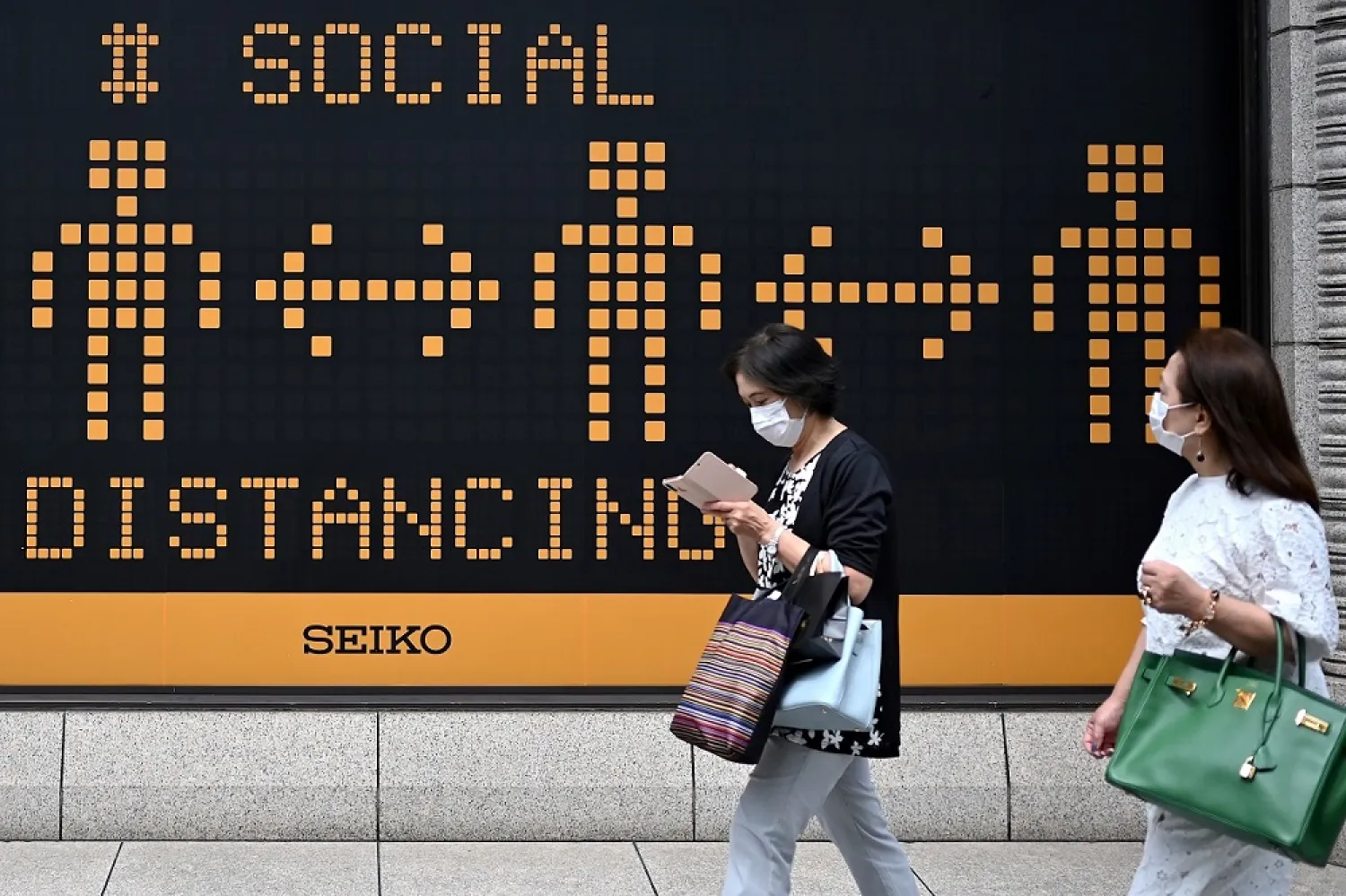
Masked pedestrians walk past a billboard reminding people on social distancing practices amid the COVID-19 coronavirus pandemic in Tokyo. (AFP)
TT

WHO Sees First Results from COVID Drug Trials within 2 Weeks

Masked pedestrians walk past a billboard reminding people on social distancing practices amid the COVID-19 coronavirus pandemic in Tokyo. (AFP)

The World Health Organization (WHO) should soon get results from clinical trials it is conducting of drugs that might be effective in treating COVID-19 patients, its Director General Tedros Adhanom Ghebreyesus said on Friday.

"Nearly 5,500 patients in 39 countries have so far been recruited into the Solidarity trial," he told a news briefing, referring to clinical studies the UN agency is conducting. "We expect interim results within the next two weeks."

The Solidarity Trial started out in five parts looking at possible treatment approaches to COVID-19: standard care; remdesivir; the anti-malaria drug touted by US President Donald Trump, hydroxychloroquine; the HIV drugs lopinavir/ritonavir; and lopanivir/ritonavir combined with interferon.

Earlier this month, it stopped the arm testing hydroxychloroquine, after studies indicated it showed no benefit in those who have the disease, but more work is still needed to see whether it may be effective as a preventative medicine.

Mike Ryan, head of the WHO's emergencies program, said it would be unwise to predict when a vaccine could be ready against COVID-19, the respiratory disease caused by the novel coronavirus that has killed more than half a million people.

While a vaccine candidate might show its effectiveness by year's end, the question was how soon it could be mass produced, he told the UN journalists' association ACANU in Geneva.

There is no proven vaccine against the disease now, while 18 potential candidates are being tested on humans.

WHO officials defended their response to the virus that emerged in China last year, saying they had been driven by the science as it developed. Ryan said what he regretted was that global supply chains had broken, depriving medical staff of protective equipment.

"I regret that there wasn't fair, accessible access to COVID tools. I regret that some countries had more than others, and I regret that front-line workers died because of (that)," he said.

He urged countries to get on with identifying new clusters of cases, tracking down infected people and isolating them to help break the transmission chain.

"People who sit around coffee tables and speculate and talk (about transmission) don't achieve anything. People who go after the virus achieve things," he said.



Russian Drone Strikes Kill Two in Ukraine

 Police experts work at the site of an apartment building destroyed by a Russian drone strike, amid Russia's attack on Ukraine, in Zaporizhzhia, Ukraine June 4, 2026. (Reuters)
Police experts work at the site of an apartment building destroyed by a Russian drone strike, amid Russia's attack on Ukraine, in Zaporizhzhia, Ukraine June 4, 2026. (Reuters)
TT

Russian Drone Strikes Kill Two in Ukraine

 Police experts work at the site of an apartment building destroyed by a Russian drone strike, amid Russia's attack on Ukraine, in Zaporizhzhia, Ukraine June 4, 2026. (Reuters)
Police experts work at the site of an apartment building destroyed by a Russian drone strike, amid Russia's attack on Ukraine, in Zaporizhzhia, Ukraine June 4, 2026. (Reuters)

Russian drone strikes killed two people in Ukraine, officials said Sunday, as world leaders gathered in London to discuss piling pressure on Moscow over its four-year war.

Ukrainian President Volodymyr Zelensky will meet the leaders of France, Germany and Britain on Sunday for talks on the way forward as Russia suffers military setbacks in the invasion of its neighbor.

A Russian drone strike killed a 56-year-old man working as a minibus driver in Ukraine's southern Zaporizhzhia region, the State Emergency Service of Ukraine wrote on Telegram on Sunday.

A 59-year-old man was killed in a separate attack in the central Dnipropetrovsk region, when Russian drones and aerial bombs rained down over two districts, regional military chief Oleksandr Ganzha posted on Telegram on Sunday.

The attacks wounded a 35-year-old man and damaged infrastructure, Ganzha said.

Ukraine recaptured more territory than it lost to Russian forces in May for the second straight month, AFP analysis of data from the Institute for the Study of War (ISW) showed earlier this month.

Russia's offensive has meanwhile led to rising prices, tax hikes, two-decade-high borrowing costs, business shutdowns and labor shortages, putting the economy in its trickiest spot since the full-scale invasion of Ukraine in February 2022.

Zelensky proposed a face-to-face meeting with Vladimir Putin in an open letter to the Russian leader on Thursday, saying he was also ready for a "full ceasefire".

Putin, speaking at Russia's flagship economic forum on Friday, rejected suggestions the Russian economy had collapsed, saying "we have descended to the same level at which Eurozone countries have been experiencing growth for the past few years."


With China’s Xi in North Korea, Kim to Project Confidence, Defiance

North Korean leader Kim Jong Un and Chinese President Xi Jinping shake hands on the day of their bilateral summit in Beijing, China, September 4, 2025, in this picture released by North Korea's official Korean Central News Agency. (KCNA via Reuters)
TT

With China’s Xi in North Korea, Kim to Project Confidence, Defiance

North Korean leader Kim Jong Un and Chinese President Xi Jinping shake hands on the day of their bilateral summit in Beijing, China, September 4, 2025, in this picture released by North Korea's official Korean Central News Agency. (KCNA via Reuters)

North Korean leader Kim Jong Un welcomes Chinese President Xi Jinping to Pyongyang on Monday, feeling in a position of strength with a firm ally in Russia, a nuclear arsenal and little apparent appetite to engage with Washington.

For Xi, leader of the world's second-biggest economy, the two-day visit to China's neighbor, his first in seven years, is part of an effort to draw Pyongyang back into its orbit.

Xi hosted Kim, among other leaders, at a massive military parade in Beijing last year, and the two countries have since resumed some passenger rail and air services.

This week's summit is likely to present a contrast to Xi's first visit to the isolated state in 2019 - months after a meeting between Kim and US President Donald Trump fell apart over denuclearizing North Korea and sanctions relief.

XI'S VISIT 'A BIG DEAL' FOR NORTH AFTER 'COMEBACK'

Since then, Kim has forged closer military and trade ties with Moscow, bolstered by his dispatch of troops to fight for Russia in the ‌Ukraine war, continued ‌to build up his nuclear capabilities in defiance of UN sanctions and locked down the North Korean ‌border ⁠to stop the ⁠flow of escapees.

North Korea has sought to flex its strength on the eve of Xi's arrival, announcing plans on Saturday for a 10,000-ton naval destroyer and reaffirming its status as a nuclear-armed state on Sunday.

"Having Xi visit Pyongyang is a big deal and the culmination of a good couple of 'comeback' years for Kim," said Andrew Gilholm, an analyst at consultancy Control Risks.

In 2019 Kim gave Xi a lavish reception that included thousands of people holding up placards that formed a picture of Xi's face and the Chinese flag, and a performance of the song "I Love Thee, China".

But relations between the two have been strained at times, particularly over North Korea's nuclear program. Beijing has publicly opposed Pyongyang's nuclear tests and called for it ⁠to give up its nuclear weapons.

North Korea has been cautious about becoming over-reliant on China, with which ‌it shares an 1,400-km (880-mile) border. Support from Russia is likely providing some balance.

"North Korea ‌is certainly gaining economically from what they're able to provide militarily to Russia," said John Delury, a senior fellow of the Asia Society. "That actually puts ‌North Korea in a position where they may feel more confident to increase the volume of trade and investment with China."

PUSH FOR ‌TOURISM, RED LINE ON NUCLEAR PROGRAM

Any substantive outcome of the meeting is likely to be about economic cooperation, a regional diplomat said, as North Korea starts a five-year development plan that includes expanding tourism into a solid industry and building more housing.

North Korea shut its borders to foreign tourists in early 2020 as it imposed some of the world's strictest COVID-19 controls, cutting off a modest but important source of hard currency.

Before the pandemic, Chinese tourists were ‌the backbone of North Korea's tourism industry, accounting for 90% of foreign tourists by some estimates. The first known leisure tourists allowed back after COVID were about 100 from Russia's Far East in February ⁠2024, according to Russian provincial ⁠authorities and a Western tour guide.

North Korea has managed to make economic progress, Singapore's foreign minister said after visit last month. He said Pyongyang appeared to have little interest in engaging with the United States or South Korea.

North Korea has rejected reunification with South Korea, which had long been a goal of both nations, divided since the 1950-1953 Korean War. South Korean President Lee Jae Myung, however, remains keen on dialogue and has asked Xi to assist his efforts.

"Improving inter-Korean relations through the mediation of President Xi Jinping, we are hoping that President Xi would play that kind of role," said Moon Chung-in, a professor at Yonsei University in Seoul who was national security adviser to a previous South Korean president.

Kim has drawn some red lines, including on his nuclear program. In addition to Sunday's announcement, he called on Thursday for an "exponential" expansion of the country's atomic arsenal.

Yang Moo-jin, president of the University of North Korean Studies in Seoul, said Kim was likely to continue expanding fissile-material production, increase and deploy nuclear weapons and emphasize the legitimacy of strengthening Pyongyang's nuclear deterrent.

"Kim is emboldened," said Christopher Green, a Korea specialist at Leiden University in the Netherlands.

"He feels able to publicly pursue a marked expansion of North Korea’s nuclear arsenal with a confidence that comes from knowing that as long as he doesn’t foment outright instability in the region, Beijing will not try to stop him."


Pentagon Raises Threat of Israeli Spying to 'Critical', According to US Media

The Pentagon (AP)
The Pentagon (AP)
TT

Pentagon Raises Threat of Israeli Spying to 'Critical', According to US Media

The Pentagon (AP)
The Pentagon (AP)

The Pentagon has raised its counterintelligence threat level for Israel to its highest level, US media reported on Saturday.

The Pentagon's Defense Intelligence Agency (DIA) said Israel's "ability to conduct human espionage and technical collection is at a 'critical level'," NBC News said, citing US officials.

The move came after concerns that Israel had been attempting to spy on top US officials to get information on "the Trump administration's internal deliberations and decision-making on the conflicts in the Middle East," the American network said.

The New York Times cited reports of Israeli efforts to eavesdrop on senior officials, including President Donald Trump's top negotiator, Steve Witkoff, and the Pentagon's top policy official, Elbridge Colby.

The United States and Israel launched joint strikes on Iran on February 28, triggering the war.

Since then, Trump and Israeli Prime Minister Benjamin Netanyahu's relationship appears to be under strain, AFP says.

Trump unleashed a profanity-laced tirade over the phone at Netanyahu over Israel's threats to bomb the Lebanese capital Beirut, fearing it would undermine talks with Tehran, the Axios news outlet and ABC News reported earlier in the week.