


Taking a Knee Is Important but Football Must Do More on Racial Equality

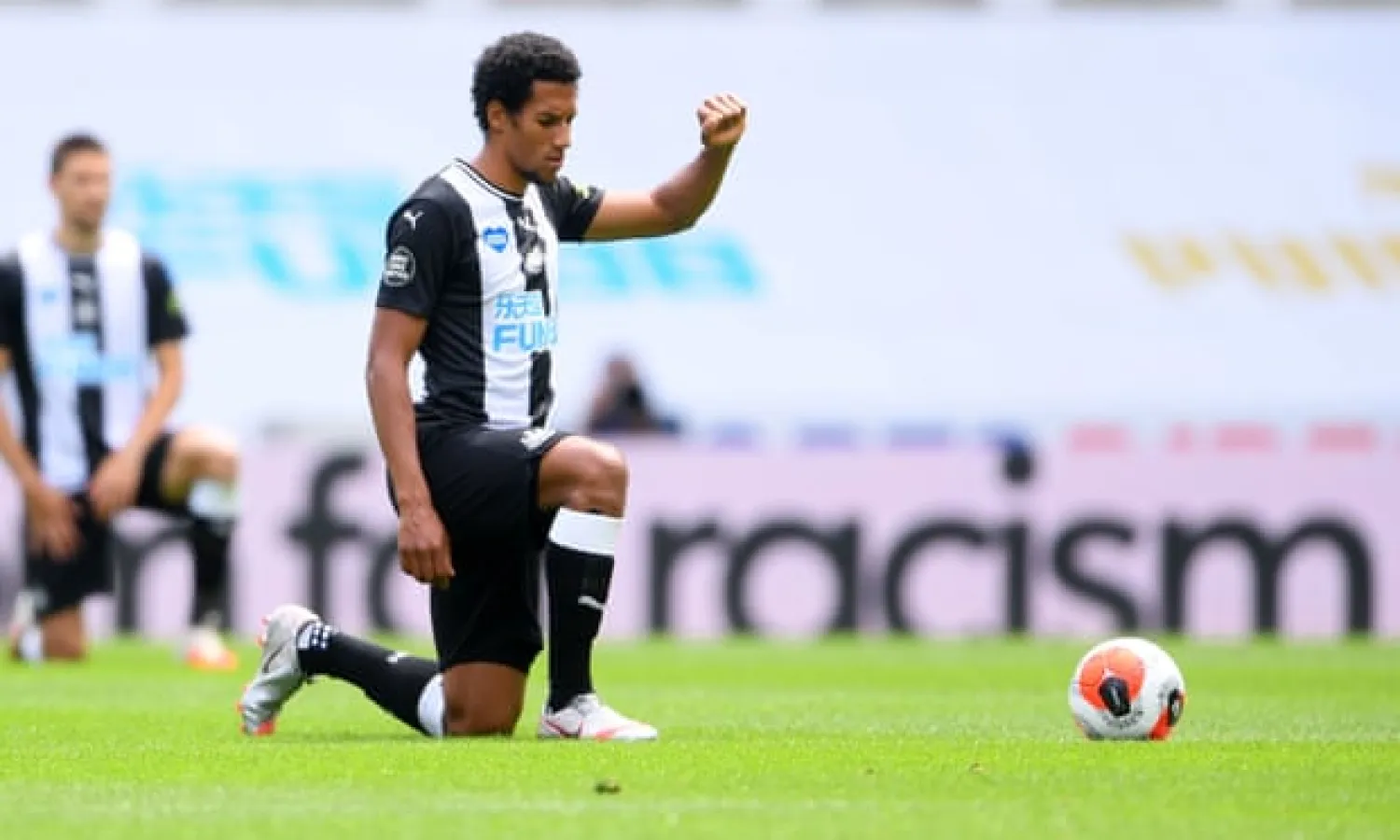
 Newcastle United midfielder Isaac Hayden takes a knee at the start of the Premier League match against Sheffield United at St James’ Park on Sunday. Photograph: Laurence Griffiths/AFP/Getty Images
Newcastle United midfielder Isaac Hayden takes a knee at the start of the Premier League match against Sheffield United at St James’ Park on Sunday. Photograph: Laurence Griffiths/AFP/Getty Images
TT

Taking a Knee Is Important but Football Must Do More on Racial Equality

 Newcastle United midfielder Isaac Hayden takes a knee at the start of the Premier League match against Sheffield United at St James’ Park on Sunday. Photograph: Laurence Griffiths/AFP/Getty Images
Newcastle United midfielder Isaac Hayden takes a knee at the start of the Premier League match against Sheffield United at St James’ Park on Sunday. Photograph: Laurence Griffiths/AFP/Getty Images

The Premier League has restarted with every player wearing a Black Lives Matter badge on his sleeve, and with those words replacing the names on their backs. At the start of each game every player, referee and member of staff has taken a knee. It has been incredibly powerful and moving and left me speechless, understanding that the eyes of the world were watching an unprecedented statement of unity against racism during what has been an unprecedented time.

As a symbolic gesture of support for the fight for racial equality it is a huge statement by the Premier League, for me the best league in the world and the strongest global football brand. But the gesture cannot distract us from the genuine work and significant change that still has to be done by the league and its clubs.

The fact is that 35% of the people on the pitch are black, but there is nowhere near the same percentage in executive, managerial or leadership positions. There are phrases that can be used to describe this situation that are heavy with politics and history, such as white privilege and white supremacy – but they accurately reflect the current situation in English football.

The old-fashioned stereotype of black men is that they are by nature strong, powerful athletes and the fact is that they are still not being trusted to manage budgets and people. These are ingrained prejudices and confronting them will be a lot more uncomfortable than sticking a badge on a sleeve, but without dealing with them the lack of diversity in Premier League dugouts and boardrooms will never change. The time to put the wheels of change into motion is now.

I believe in football meritocracy, but I also cannot accept that every single white person in a managerial or executive role in the game deserved to be appointed more than any single black person. There will be some people whose opportunities came because they are white and well connected. The statistics are embarrassing, and nothing will change unless what they reveal is accepted and confronted.

Last week the Professional Footballers’ Association released the results of an audit of the organisation, revealing precisely what proportion of employees at every level is black and calling on others to be equally transparent. Across the PFA about 30% of people are black and that’s the way it should be – the players’ union should reflect its membership. The Premier League should also reflect theirs.

I heard Jermain Defoe questioning whether it was worth him doing his coaching badges, because none of the black players he has looked up to in his life are working in management, leaving him feeling like the opportunities simply are not there for people like him. Gareth Southgate, Frank Lampard and Steven Gerrard walked into excellent coaching positions at the end of their playing careers, and while I would say they absolutely deserve them – they were great players and leaders, and would lose those jobs pretty quickly if they were failing – we must start confronting why black players find it so hard to take the same path.

The talent pool is enormous, and it isn’t just the 35% of players on Premier League pitches. Of the great Premier League managers of this century so far – Alex Ferguson, Arsène Wenger, José Mourinho, Pep Guardiola and Jürgen Klopp – most had unimpressive playing careers. Mourinho’s big break came as a translator, and I know there are intelligent black guys out there who can speak six languages and understand and love the game like Mourinho does. At what point do we also look beyond footballers? There will be fantastic black sports scientists and performance analysts, but if you’re not looking for a potential black Guardiola you’re not going to find one.

This is why I support something like the NFL’s Rooney rule. Put simply, no club should feel they must appoint a black manager, but they should be expected to engage with a wider range of people. There could be a target, perhaps that a third of candidates for managerial and executive roles have to come from black or other ethnic minority backgrounds. It’s not about handing anyone a job on a plate, it’s to do with fishing in a different sea to the one you’ve always fished in.

It is no different to the homegrown player rules, a quota that was brought in very quickly and without protest and had a massive impact: academy investment went up, academy managers felt it justified the work they were doing and were incentivised to work harder, young players at big clubs got more opportunities and recruitment practices changed. Now we need to create a policy that encourages the next generation of black coaches and executives to push themselves so they are competitive candidates when the time comes to go into management, rather than giving up because they don’t see the pathway.

Aston Villa, where I work as the sporting director for women’s football, are based in the most culturally diverse city in the country, and we have a chief executive in Christian Purslow who wants to engage that community. I am grateful for the position I’m in, and I would like to think I got the job based on a range of factors with the fact I am a black woman incidental, but the fact is I was given a fantastic opportunity, and I am now in a position to inspire another black person from the diverse community that we serve to go into football, or another club to take a chance on someone who doesn’t look the same as all the other sporting directors.

Nobody is asking for 20 black Premier League managers. I would just like to see a level of representation that is not embarrassing, that reflects the diversity on the pitch and the communities we serve across British society. The badge the players are wearing on their sleeves is not only a gesture of the Premier League’s solidarity, but also a signal that there is more work to do.

The Guardian Sport


Shakhtar Boss Pays Ukrainian Racer $200,000 After Games Disqualification

Ukrainian President Volodymyr Zelenskiy holds helmet as he meets with a Ukrainian skeleton racer Vladyslav Heraskevych , who was disqualified from the Olympic skeleton competition over his "helmet of remembrance" depicting athletes killed since Russia's invasion and his father and coach, Mykhailo Heraskevych, amid Russia's attack on Ukraine, in Munich, Germany February 13, 2026. (Ukrainian Presidential Press Service/Handout via Reuters)
TT

Shakhtar Boss Pays Ukrainian Racer $200,000 After Games Disqualification

Ukrainian President Volodymyr Zelenskiy holds helmet as he meets with a Ukrainian skeleton racer Vladyslav Heraskevych , who was disqualified from the Olympic skeleton competition over his "helmet of remembrance" depicting athletes killed since Russia's invasion and his father and coach, Mykhailo Heraskevych, amid Russia's attack on Ukraine, in Munich, Germany February 13, 2026. (Ukrainian Presidential Press Service/Handout via Reuters)

The owner of ‌Ukrainian football club Shakhtar Donetsk has donated more than $200,000 to skeleton racer Vladyslav Heraskevych after the athlete was disqualified from the Milano Cortina Winter Games before competing over the use of a helmet depicting Ukrainian athletes killed in the war with Russia, the club said on Tuesday.

The 27-year-old Heraskevych was disqualified last week when the International Bobsleigh and Skeleton Federation jury ruled that imagery on the helmet — depicting athletes killed since Russia invaded Ukraine in 2022 — breached rules on athletes' expression at ‌the Games.

He ‌then lost an appeal at the Court ‌of ⁠Arbitration for Sport hours ⁠before the final two runs of his competition, having missed the first two runs due to his disqualification.

Heraskevych had been allowed to train with the helmet that displayed the faces of 24 dead Ukrainian athletes for several days in Cortina d'Ampezzo where the sliding center is, but the International Olympic Committee then ⁠warned him a day before his competition ‌started that he could not wear ‌it there.

“Vlad Heraskevych was denied the opportunity to compete for victory ‌at the Olympic Games, yet he returns to Ukraine a ‌true winner," Shakhtar President Rinat Akhmetov said in a club statement.

"The respect and pride he has earned among Ukrainians through his actions are the highest reward. At the same time, I want him to ‌have enough energy and resources to continue his sporting career, as well as to fight ⁠for truth, freedom ⁠and the remembrance of those who gave their lives for Ukraine," he said.

The amount is equal to the prize money Ukraine pays athletes who win a gold medal at the Games.

The case dominated headlines early on at the Olympics, with IOC President Kirsty Coventry meeting Heraskevych on Thursday morning at the sliding venue in a failed last-minute attempt to broker a compromise.

The IOC suggested he wear a black armband and display the helmet before and after the race, but said using it in competition breached rules on keeping politics off fields of play. Heraskevych also earned praise from Ukraine President Volodymyr Zelenskiy.


Speed Skating-Italy Clinch Shock Men’s Team Pursuit Gold, Canada Successfully Defend Women’s Title

 Team Italy with Davide Ghiotto, Andrea Giovannini, Michele Malfatti, celebrate winning the gold medal on the podium of the men's team pursuit speed skating race at the 2026 Winter Olympics, in Milan, Italy, Tuesday, Feb. 17, 2026. (AP)
Team Italy with Davide Ghiotto, Andrea Giovannini, Michele Malfatti, celebrate winning the gold medal on the podium of the men's team pursuit speed skating race at the 2026 Winter Olympics, in Milan, Italy, Tuesday, Feb. 17, 2026. (AP)
TT

Speed Skating-Italy Clinch Shock Men’s Team Pursuit Gold, Canada Successfully Defend Women’s Title

 Team Italy with Davide Ghiotto, Andrea Giovannini, Michele Malfatti, celebrate winning the gold medal on the podium of the men's team pursuit speed skating race at the 2026 Winter Olympics, in Milan, Italy, Tuesday, Feb. 17, 2026. (AP)
Team Italy with Davide Ghiotto, Andrea Giovannini, Michele Malfatti, celebrate winning the gold medal on the podium of the men's team pursuit speed skating race at the 2026 Winter Olympics, in Milan, Italy, Tuesday, Feb. 17, 2026. (AP)

An inspired Italy delighted the home crowd with a stunning victory in the Olympic men's team pursuit final as

Canada's Ivanie Blondin, Valerie Maltais and Isabelle Weidemann delivered another seamless performance to beat the Netherlands in the women's event and retain their title ‌on Tuesday.

Italy's ‌men upset the US who ‌arrived ⁠at the Games ⁠as world champions and gold medal favorites.

Spurred on by double Olympic champion Francesca Lollobrigida, the Italian team of Davide Ghiotto, Andrea Giovannini and Michele Malfatti electrified a frenzied arena as they stormed ⁠to a time of three ‌minutes 39.20 seconds - ‌a commanding 4.51 seconds clear of the ‌Americans with China taking bronze.

The roar inside ‌the venue as Italy powered home was thunderous as the crowd rose to their feet, cheering the host nation to one ‌of their most special golds of a highly successful Games.

Canada's women ⁠crossed ⁠the line 0.96 seconds ahead of the Netherlands, stopping the clock at two minutes 55.81 seconds, and

Japan rounded out the women's podium by beating the US in the Final B.

It was only Canada's third gold medal of the Games, following Mikael Kingsbury's win in men's dual moguls and Megan Oldham's victory in women's freeski big air.


Lindsey Vonn Back in US Following Crash in Olympic Downhill 

Milano Cortina 2026 Olympics - Alpine Skiing - Women's Downhill 3rd Official Training - Tofane Alpine Skiing Centre, Belluno, Italy - February 07, 2026. Lindsey Vonn of United States in action during training. (Reuters)
TT

Lindsey Vonn Back in US Following Crash in Olympic Downhill 

Milano Cortina 2026 Olympics - Alpine Skiing - Women's Downhill 3rd Official Training - Tofane Alpine Skiing Centre, Belluno, Italy - February 07, 2026. Lindsey Vonn of United States in action during training. (Reuters)

Lindsey Vonn is back home in the US following a week of treatment at a hospital in Italy after breaking her left leg in the Olympic downhill at the Milan Cortina Games.

“Haven’t stood on my feet in over a week... been in a hospital bed immobile since my race. And although I’m not yet able to stand, being back on home soil feels amazing,” Vonn posted on X with an American flag emoji. “Huge thank you to everyone in Italy for taking good care of me.”

The 41-year-old Vonn suffered a complex tibia fracture that has already been operated on multiple times following her Feb. 8 crash. She has said she'll need more surgery in the US.

Nine days before her fall in Cortina d'Ampezzo, Italy, Vonn ruptured the ACL in her left knee in another crash in Switzerland.

Even before then, all eyes had been on her as the feel-good story heading into the Olympics for her comeback after nearly six years of retirement.
