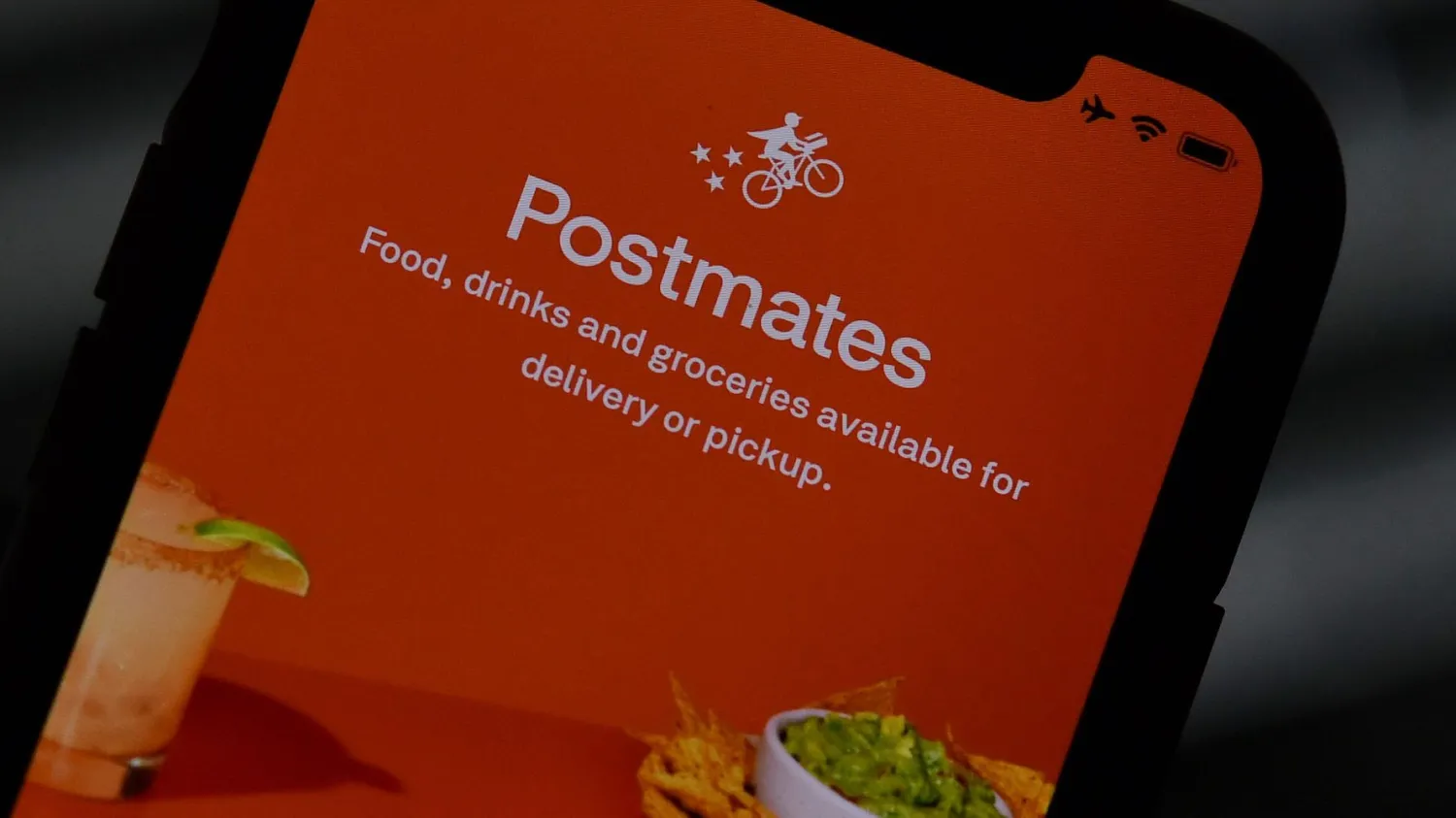
Uber Reportedly Agrees Deal to Buy Food Delivery App Postmates

Uber agreed to buy the delivery app Postmates. AFP via Getty Images
TT

Uber Reportedly Agrees Deal to Buy Food Delivery App Postmates

Uber agreed to buy the delivery app Postmates. AFP via Getty Images

Uber has agreed to buy food delivery app Postmates in a multibillion dollar deal, according to Bloomberg.

The San Francisco-based rideshare giant has been badly affected by the coronavirus pandemic -- cutting a quarter of its global workforce in May -- and has been looking to boost its growing food delivery service Uber Eats.

Bloomberg reported an expected $2.65 billion deal with start-up Postmates will be announced on Monday morning in the US, citing people familiar with the matter.

The deal would bolster Uber and help Postmates, a nine-year-old firm that has struggled against larger food delivery rivals, the New York Times has previously reported.

A $6 billion Uber offer this year to acquire Grubhub -- another US food delivery app -- fell through. Grubhub was later bought by European competitor Just Eat Takeaway.

Uber said in its quarterly update earlier this year that it lost nearly $3 billion and its rides business was down some 80 percent in April.

The company noted however, that it was seeing strong revenue growth for its Eats food delivery operation.

Neither Uber nor Postmates have commented on the potential deal.


Norway Imposes Near Ban on AI in Elementary School

Norway's Prime Minister Jonas Gahr Store of the Labour Party speaks during the semi-annual summary press conference at the government's representative facilities in Parkveien, Oslo, Norway, 19 June 2026. (EPA)
TT

Norway Imposes Near Ban on AI in Elementary School

Norway's Prime Minister Jonas Gahr Store of the Labour Party speaks during the semi-annual summary press conference at the government's representative facilities in Parkveien, Oslo, Norway, 19 June 2026. (EPA)

Norway is imposing ‌a near ban on the use of generative AI tools by elementary school pupils while also restricting their use in the education of older children to prevent a negative impact on learning, the country's prime minister said on Friday.

Facing a broad decline in education test scores, the government in 2024 banned smartphones from schools and has given teachers back more powers to enforce discipline in the classroom.

Using AI increases the ‌risk that young ‌children skip important steps in their ‌education, ⁠Prime Minister Jonas ⁠Gahr Stoere told a press conference on Friday.

"The most important thing in school is that our children learn to read, write and do mathematics," Stoere said, adding that the new standards will be imposed from the new school year beginning in late August.

Pupils ⁠from first through seventh grade, aged 6 ‌to 13, should as a ‌general rule not be using AI, while those in ‌lower secondary school, aged 14 to 16, can ‌cautiously adopt tools under teachers' supervision, the government said.

In upper secondary education, from ages 17 to 19, students should learn to use AI appropriately so that they are ‌prepared for further education and work, it added.

Norway began adopting computers in classrooms in ⁠the ⁠1990s and tablets after the introduction of the iPad from 2010 onwards, reducing the reliance on books and handwriting.

But in a related statement on Friday, the government also said it will propose legislation to fund the use of more books in classrooms, reversing the trend towards computer tablets.

The Norwegian government in April also announced plans to ban children from using social media until they turn 16, following a trend pioneered by Australia and some other nations to reduce young people's use of electronic devices.


European Robotics Start-ups Go Up Against Chinese Heavyweights

The humanoid robot Alter-Ego, designed by the Italian Institute of Technology, assists patient Daniel Senna through remote interaction at the IRCSS Maugeri hospital in Milan on June 12, 2026. (Photo by MARCO BERTORELLO / AFP)
TT

European Robotics Start-ups Go Up Against Chinese Heavyweights

The humanoid robot Alter-Ego, designed by the Italian Institute of Technology, assists patient Daniel Senna through remote interaction at the IRCSS Maugeri hospital in Milan on June 12, 2026. (Photo by MARCO BERTORELLO / AFP)

Humanoid robots able to perform tasks from grape harvesting to welcoming visitors were front and center at France's Vivatech trade fair this week, with European firms looking to fill niches beyond what dominant Chinese giants can offer.

French company Enchanted Tools was showing off its Mirokai, a "social" robot with long orange ears and wide blue eyes, AFP reported.

Able to communicate in over 50 languages, prototypes of the Paris-based firm's machine are already out in the wild welcoming people to hospitals and airports, marketing chief Richard Malterre said on a Vivatech stage.

The start-up hopes its first mass-produced models will arrive by the end of this year.

"At least 60 percent of the robot is manufactured in Europe, and we're fighting to keep it that way," Malterre told AFP.

But some of the AI robotics know-how is "not necessarily available" in Europe, he said, such as the graphics processors from American chip giant Nvidia that power Mirokai's brain as well as the broader generative AI boom.

When it comes to sheer robotics production capacity, China is unrivalled thanks to companies including Unitree and Agibot.

Their androids' tightly choreographed displays wowed visitors to Vivatech, the latest fair to show them off in recent months.

Around 87 percent of the 13,000 humanoid robots deployed worldwide in 2025 rolled off a Chinese production line, according to the UK-based consultancy Omdia.

"China is definitely on the forefront" as its companies increasingly show off "dark factories" where robots work largely without human supervision, said Joern Buss, a robotics expert at the consultancy Arthur D. Little.

Nevertheless, Europe is "catching up" behind Japan and Korea, he added, boasting "some good robotics players" including longstanding firms.

New players on the European scene include Germany's Neura, which builds humanoid industrial and household robots as well as a platform for training them to carry out human tasks.

The company recently announced it had raised $1.4 billion.

"We get requests for everything, even dentists, everyone is calling us and asking if they can have a robot as a supporter, because they can't find people," chief executive David Reger told AFP.

Like other advanced economies around the world, Europe faces an aging population that could squeeze the labor supply in both manufacturing and services.

Reger called robots like Neura's the continent's "last chance", saying "Europe does require this economic pillar to sustain" itself.

He cited familiar challenges for European tech firms including tight regulation and a tougher search for financing than competitors in the United States.

But Reger has no plans to uproot Neura's business, which is collaborating with German car component suppliers Bosch and Schaeffler on factory automation.

He vaunts Neura's order book of over $1 billion.

"If all robot production goes to Japan or China, that could be a big problem when it comes to sovereignty," said Francesco Ferro, chief executive of Spain's PAL Robotics.

His company was at Vivatech showing off its latest models bolted together in Barcelona.

One is a black biped that has been dubbed Kangaroo, while the Tiago machine is fitted with jointed arms that have been put to use in logistics as well as picking grape harvests.

Robotics developers use vast quantities of data to train their machines' movements, and they collect still more information as they carry out their tasks.

The continent should aim to create "a totally European supply chain, without thinking only about price", as that could lead prospective clients to buy Chinese robots, Ferro said.

That would risk seeing valuable or sensitive data "falling into the wrong hands", he warned.

French-American start-up Genesis AI plans to re-shore production of its Eno multifunctional robot next year after making it in China.

Prospective customers include "the big industrial base in France, Italy and Germany," co-founder Theophile Gervet told AFP.

Enchanted Tools' Malterre also believes the demand exists, and "I'm confident in our ability and creativity to endure".

"We need to be ready for a fight, not throw in the towel."


Sweden May Oppose Tesla's Supervised Self-driving Tech in Europe over Speeding Concerns

A Tesla Robotaxi travels down Congress Avenue in downtown Austin, Tuesday, June 16, 2026.  (Mikala Compton/Austin American-Statesman via AP)
A Tesla Robotaxi travels down Congress Avenue in downtown Austin, Tuesday, June 16, 2026. (Mikala Compton/Austin American-Statesman via AP)
TT

Sweden May Oppose Tesla's Supervised Self-driving Tech in Europe over Speeding Concerns

A Tesla Robotaxi travels down Congress Avenue in downtown Austin, Tuesday, June 16, 2026.  (Mikala Compton/Austin American-Statesman via AP)
A Tesla Robotaxi travels down Congress Avenue in downtown Austin, Tuesday, June 16, 2026. (Mikala Compton/Austin American-Statesman via AP)

A Swedish transport authority is recommending a vote against the Europe-wide rollout of Tesla's supervised self-driving software, unless the U.S. EV maker disables its ability to exceed legal speed limits, a regulatory letter shows.

In a previously unreported letter dated April 30, obtained through a freedom of information request, the Swedish Transport Administration (TRV) said Tesla's Full Self-Driving (Supervised) feature should not be approved for European Union roads unless its ability to ignore speed limits is removed.

The letter was sent to the EU's Technical Committee on Motor Vehicles (TCMV), which is due to meet again on June 30 to discuss the matter, ahead of a vote at a later date on whether to roll out the technology across the bloc.

Tesla has already secured approval in some European countries for FSD, which allows vehicles ⁠to steer themselves ⁠on city streets and highways under human supervision. EU-wide approval would support Tesla's sales in the region, where it faces growing competition from Chinese EV makers.

Tesla, led by CEO Elon Musk, did not respond to requests for comment. Its user manual says drivers should not rely solely on the system for speed limits and must "drive at a safe speed based on traffic and road conditions".

FSD allows users to set a "Speed Offset", letting the vehicle exceed posted limits by a driver-defined margin.

In its letter, the TRV said that "allowing automated systems to systematically exceed legal speed limits ... risks undermining both the ⁠legal framework and the expected safety benefits of vehicle automation".

It called for the feature to be removed. "Failing this, the Swedish Transport Administration recommends that TCMV vote against the proposed introduction," it said.

Internal documents reviewed by Reuters show the Swedish Transport Agency (STA), the country's national type approver, has raised concerns with Tesla and Dutch regulator RDW, including in a two-hour meeting on June 4. The RDW approved the use of FSD in April and is backing an EU-wide rollout.

A TRV spokesperson said its position had not changed since the April letter and that it was aligned with the STA.

"It is my understanding that Sweden's representative in TCMV will only vote in favor if Tesla's speeding functionality is removed," the person said.

The STA, which represents Sweden at the TCMV, said discussions were ongoing within the EU committee and it was "assessing the matter to establish a Swedish position".

Tesla's ⁠FSD uses cameras and ⁠map data to detect speed limits. In the US, it can exceed those limits, offering a range of driving modes such as Sloth, Chill, Standard, Hurry and Mad Max.

Those options are not offered in Europe. Instead, Tesla provides "Contextual Max Speed", which adjusts to traffic flow, and "Speed Offset", allowing speeds above the legal limit.

Other Nordic countries, including Finland and Norway, have also raised concerns, though Lithuania, Estonia, Denmark, and Belgium have recently allowed FSD, following the Netherlands.

An Estonian transport official said speeding remained a concern but that the country approved FSD because the driver retains ultimate responsibility under the supervised system. Estonia has yet to decide how it will vote.

A spokesperson for Denmark's road authority said drivers have full responsibility when using FSD, including adhering to speed limits.

EU approval requires a qualified majority of 15 of the bloc's 27 member states representing at least 65% of the population.

If rejected, the Dutch provisional approval would lapse after six months, and national approvals based on it would also be withdrawn, according to the Danish road authority.