


Africa Starts Opening Airspace Even as COVID-19 Cases Climb

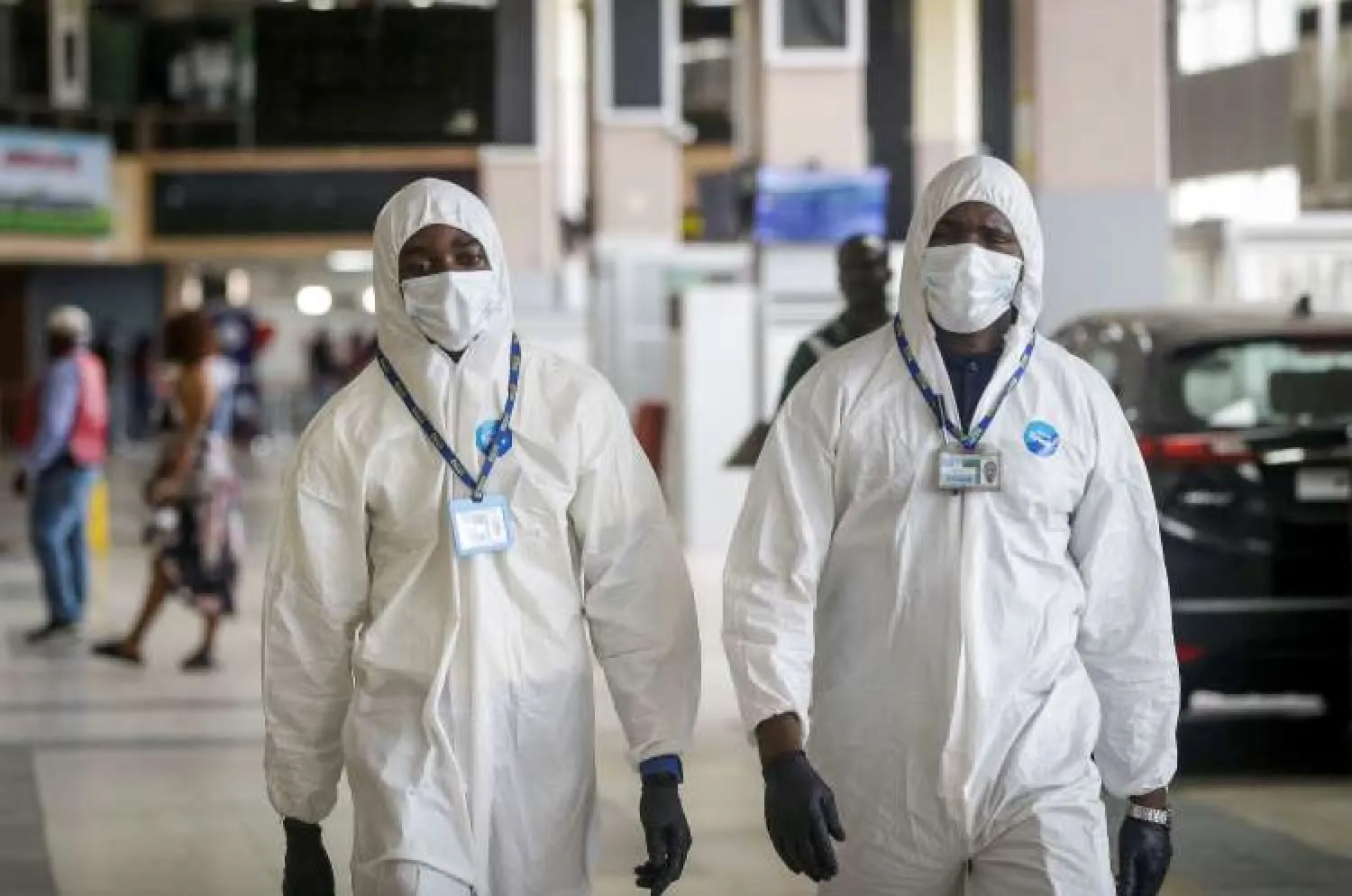
In this Tuesday, April 7, 2020 file photo, Nigerian aviation workers wear protective clothing as US citizens queue to check in and be repatriated aboard an evacuation flight arranged by the US embassy and chartered with Delta Air Lines, at the Murtala Mohammed International Airport in Lagos, Nigeria. (AP Photo/Sunday Alamba, File)
TT

Africa Starts Opening Airspace Even as COVID-19 Cases Climb

In this Tuesday, April 7, 2020 file photo, Nigerian aviation workers wear protective clothing as US citizens queue to check in and be repatriated aboard an evacuation flight arranged by the US embassy and chartered with Delta Air Lines, at the Murtala Mohammed International Airport in Lagos, Nigeria. (AP Photo/Sunday Alamba, File)

As COVID-19 cases surged in many parts of the world, the island nation of the Seychelles was looking good: 70-plus straight days without a single infection. Then the planes arrived.

Two chartered Air Seychelles flights carrying more than 200 passengers also brought the coronavirus. A few tested positive. Then, between June 24 and 30, the country´s confirmed cases shot from 11 to 81.

Now the Indian Ocean nation has delayed reopening for commercial flights for its lucrative tourism industry until Aug. 1, if all goes well.

African nations face a difficult choice as infections are rapidly rising: Welcome the international flights that originally brought COVID-19 to the ill-prepared continent, or further hurt their economies and restrict a lifeline for badly needed humanitarian aid.

"This is a very important moment," the World Health Organization´s Africa chief, Matshidiso Moeti, told reporters on Thursday, a day after Egypt reopened its airports for the first time in more than three months.

Other countries are preparing to follow. That´s even as Africa had more than 463,000 confirmed virus cases as of Sunday and South Africa, its most developed economy, already struggles to care for COVID-19 patients.

But Africa's economies are sick, too, its officials say. The continent faces its first recession in a quarter-century and has lost nearly $55 billion in the travel and tourism sectors in the past three months, the African Union says. Airlines alone have lost about $8 billion and some might not survive.

Most of Africa´s 54 countries closed their airspace to ward off the pandemic. That bought time to prepare, but it also hurt efforts to deliver life-saving medical supplies such as vaccines against other diseases. Shipments of personal protective gear and coronavirus testing materials, both in short supply, have been delayed.

"Many governments have decided travel needs to resume," the WHO's Africa chief said.

Africa has seen far fewer flights than other regions during the pandemic. Sometimes the entire West and Central African region saw just a single daily departure, according to International Civil Aviation Organization data.

While Asia, Europe and North America averaged several hundred departures a day from international airports, the African continent averaged a couple or few score daily.

Last week, the number of global flights jumped significantly. In the three-day period between June 30 and July 2, the daily number of departures increased from 3,960 to 6,508 as countries loosened restrictions, the data show.

African nations want to join the crowd. Senegal´s president has said international flights will begin on July 15. The 15-member Economic Community of West African States is expected to reopen its airspace on July 21. Nigeria has said domestic flights resume on July 8 and Rwanda on Aug. 1.

Kenya Airways wants to resume international flights. South Africa and Somalia are open for domestic ones, and Cameroon, Equatorial Guinea, Tanzania, and Zambia now have commercial flights. Tanzania opened its skies weeks ago, hoping for a tourism boost despite widespread concern it´s hiding the extent of infections. It hasn´t updated case numbers since April.

"It´s good to be back!" Africa´s largest carrier, Ethiopian Airlines, declared late last month. After scrambling to revamp its services for cargo and repatriation flights in the past few months, it now wants to play a leading role in "the new normal."

That means face masks are mandatory on board. But the WHO´s Africa chief hopes to see all airlines do more.

"Physical distancing should be encouraged by leaving seats vacant," Moeti said. And she suggested that "when we see a flare-up that is unacceptable" in virus cases, the loosening of travel restrictions could be reversed.

The WHO recommends that countries look at whether the need to fight widespread virus transmission outweighs the economic benefits of opening borders. "It is also crucial to determine whether the health system can cope with a spike in imported cases," it says.

Regional leaders of the International Air Transport Association and Airports Council International are ready to go. In an open letter to African ministers last month, they welcomed global guidelines developed by the ICAO for the return to travel after the aviation industry´s "biggest challenge of its history."

They also urged African countries to "identify every opportunity where travel restrictions could be lifted ... as soon as the epidemiological situation allows for it."

As the continent slowly takes flight, some European nations and others are limiting entry to people from countries they feel are doing a good job of containing the virus. African nations can seize the moment and do more tourism at home, Amani Abou-Zeid, AU commissioner for infrastructure and energy, told reporters last week.

"This is an opportunity to encourage Africans to see Africa," she said.

Not always. The 70 recently infected people in the Seychelles, all crew members from West African countries meant to work on tuna fishing vessels, were isolated on boats in a special quarantine zone in the harbor in the capital.



Energy Secretary: US to Stop Iran's Nuclear Ambitions 'One Way or the Other'

US Secretary of Energy Chris Wright speaks during a press conference after a meeting with Venezuela's acting president Delcy Rodriguez at the Miraflores Presidential Palace in Caracas on February 11, 2026. (Photo by Juan BARRETO / AFP)
TT

Energy Secretary: US to Stop Iran's Nuclear Ambitions 'One Way or the Other'

US Secretary of Energy Chris Wright speaks during a press conference after a meeting with Venezuela's acting president Delcy Rodriguez at the Miraflores Presidential Palace in Caracas on February 11, 2026. (Photo by Juan BARRETO / AFP)

The United States will deter Iran from acquiring nuclear weapons "one way or the other", US Energy Secretary Chris Wright warned on Wednesday.

"They've been very clear about what they would do with nuclear weapons. It's entirely unacceptable," Wright told reporters in Paris on the sidelines of meetings of the International Energy Agency.

"So one way or the other, we are going to end, deter Iran's march towards a nuclear weapon," Wright said.

US and Iranian officials held talks in Geneva on Tuesday aimed at averting the possibility of US military intervention to curb Tehran's nuclear program.

Iran said following the talks that they had agreed on "guiding principles" for a deal to avoid conflict.

US Vice President JD Vance, however, said Tehran had not yet acknowledged all of Washington's red lines.


Iran, Russia to Conduct Joint Drills in the Sea of Oman 

This handout photo released by Iran's Revolutionary Guards Corps (IRGC)'s official website Sepanews on February 17, 2026, shows boats maneuvering around a tanker vessel during a military exercise by members of the IRGC and navy in the Strait of Hormuz. (Sepahnews / AFP)
TT

Iran, Russia to Conduct Joint Drills in the Sea of Oman 

This handout photo released by Iran's Revolutionary Guards Corps (IRGC)'s official website Sepanews on February 17, 2026, shows boats maneuvering around a tanker vessel during a military exercise by members of the IRGC and navy in the Strait of Hormuz. (Sepahnews / AFP)

Iran and Russia will conduct naval maneuvers in the Sea of Oman on Thursday, following the latest round of talks between Tehran and Washington in Geneva, Iranian media reported.

On Monday, the Revolutionary Guards, the ideological arm of Iran's military, also launched exercises in the strategic Strait of Hormuz, a challenge to US naval forces deployed in the region.

"The joint naval exercise of Iran and Russia will take place tomorrow (Thursday) in the Sea of Oman and in the northern Indian Ocean," the ISNA agency reported, citing drill spokesman, Rear Admiral Hassan Maghsoudloo.

"The aim is to strengthen maritime security and to deepen relations between the navies of the two countries," he said, without specifying the duration of the drill.

The war games come as Iran struck an upbeat tone following the second round of Oman-mediated negotiations in Geneva on Tuesday.

Previous talks between the two foes collapsed following the unprecedented Israeli strike on Iran in June 2025, which sparked a 12-day war that the United States briefly joined.

US President Donald Trump has deployed a significant naval force in the region, which he has described as an "armada."

Iranian officials have repeatedly threatened to block the Strait of Hormuz, particularly during periods of tension with the United States, but it has never been closed.

A key passageway for global shipments of oil and liquefied natural gas, the Strait of Hormuz has been the scene of several incidents in the past and has returned to the spotlight as pressure has ratcheted amid the US-Iran talks.

Iran announced on Tuesday that it would partially close it for a few hours for "security" reasons during its own drills in the strait.


First European Flight Lands in Venezuela Since Maduro’s Ouster 

A man holds up a Venezuelan flag while taking part in a march calling for amnesty for political prisoners and to mark Youth Day, in Caracas, Venezuela, February 12, 2026. (Reuters)
TT

First European Flight Lands in Venezuela Since Maduro’s Ouster 

A man holds up a Venezuelan flag while taking part in a march calling for amnesty for political prisoners and to mark Youth Day, in Caracas, Venezuela, February 12, 2026. (Reuters)

A plane from Spain's Air Europa landed in Venezuela Tuesday, according to a flight tracking monitor, the first European commercial flight to arrive in the country since the United States toppled president Nicolas Maduro.

A slew of international carriers stopped flying to Venezuela after the United States warned of possible military activity there in late November -- a prelude to its surprise attack on January 3.

The Boeing 787-9 Dreamliner landed at Simon Bolivar International Airport, which serves the Venezuelan capital Caracas, at 9:00 pm (0100 GMT).

Since US forces raided Venezuela and captured Maduro, US President Donald Trump has struck a cooperative relationship with interim president Delcy Rodriguez.

Late last month he called for flights to resume to the country.

Spanish airline Iberia is evaluating security guarantees before announcing a return, according to the Spanish press.

Portugal's TAP has said it will resume flights. Colombian airline Avianca and Panama's Copa have already restarted operations.

Hoping to prompt US flights, the Trump administration has lifted a 2019 ban on US airlines flying to the country.