

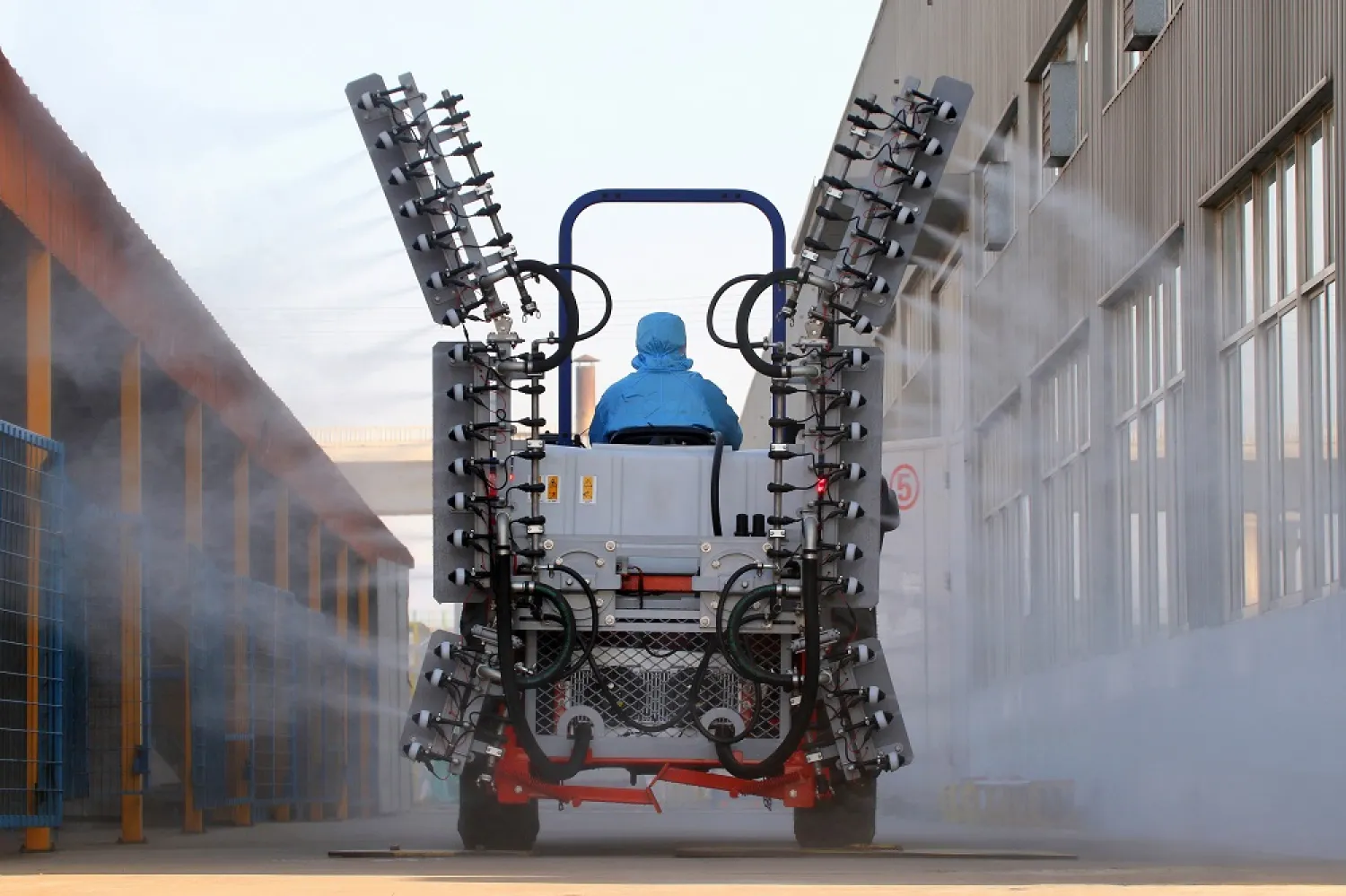

Who You Gonna Call? Germbusters! Pandemic Drives Boom in Spray Machines

A worker operates a machine to spray disinfectants at an industrial park following an outbreak of the coronavirus in the country, in Yantai, Shandong province, China February 9, 2020. (Reuters)
TT

Who You Gonna Call? Germbusters! Pandemic Drives Boom in Spray Machines

A worker operates a machine to spray disinfectants at an industrial park following an outbreak of the coronavirus in the country, in Yantai, Shandong province, China February 9, 2020. (Reuters)

Timothy Kane, CEO of Goodway Technologies Corp, has never been so popular. Making machines that spray disinfectant, once a niche business, is now an essential service - and the phone is ringing off the hook.

“Our orders jumped 50-fold in April, it was like a switch got flipped,” said Kane.

Goodway, which has a factory in Stamford, Connecticut, builds machines that spray an alcohol-infused mist to sanitize surfaces. Until a few months ago, those devices were just a tiny part of its business, catering mostly to places like industrial bakeries that had to constantly clean surfaces.

Now, as the COVID-19 pandemic grips the United States, everyone wants one.

Kane, who employs 110 workers in the family-owned company, has fielded calls from hotels, gyms and casinos, as well as factories and warehouses. Many would previously never have thought they needed such machines, which often look much like souped-up vacuum cleaners.

The rise of this industry is one example of a sector that is booming during a pandemic that has laid waste to so many parts of the economy.

America’s battle against the novel coronavirus is driving demand for everything from hand sanitizer and masks to thermometer guns and plexiglass. But one enduring image of this crisis may be the foggers and spraying machines that are now being set loose in airports, sports arenas and subways.

Yvon Brunache bought a Goodway sprayer to help his Florida construction business because clients fearing COVID-19 were reluctant to have his team in their buildings. “My customers are asking more and more for the space to be sanitized,” he said.

The surge of business is, however, putting strain on producers that never envisaged such a situation and their supply chains.

Victory Innovations, another maker of hi-tech spray machines, is sold out through September. Its shipments have surged 10-fold since the start of the pandemic, to about 100,000 units a month, according to the company, based in Eden Prairie, Minnesota.

Robot fleet
Servpro Industries LLC has completed 10,000 coronavirus-related deep cleaning operations in the last 90 days, according to Chief Operating Officer John Sooker.

“We’ve always done biohazard cleaning, but never at this scale.”

Servpro, based in Gallatin, Tennessee, is majority owned by the Blackstone Group and runs franchised cleaning businesses across the United States and Canada.

The company, which had sales of about $3 billion last year, figures biohazard cleaning - such as sanitizing a cruise ship after an outbreak of illness - constituted only about 5% of its business then, or $150 million.

Sooker said he expects COVID-19-related cleaning alone to bring in at least $250 million to $300 million this year.

The crisis is sparking innovation.

Albuquerque’s airport has just introduced a fleet of four robots, each about the size of a small trash can on wheels, which trundle around the terminals every night spraying a disinfectant mist.

“It costs a fraction of what it would cost to have a team of people doing it,” said Kimberly Corbitt, chief commercial officer of Build With Robots, one of the machines’ developers, although she declined to reveal the cost.

The airport emphasized that none of its janitors would get laid off as a result, since the fogging is an added layer of overnight cleaning.

Flamethrower
Sophisticated spraying machines don’t come cheap, though, even the less automated ones; a small human-operated sprayer mounted in a backpack can set you back about $5,000.

Biomist Inc., a manufacturer in Wheeling, Ill., has installed spraying systems custom-designed for a facility that cost over $50,000, said Robert Cook, a vice president.

Goodway, meanwhile, has doubled the number of models it is selling to six, creating designs tailored to specific uses such as restaurants and health clubs.

Workers at its factory can be seen hunched over a row of curved stainless-steel machines mounted on wheels being built on the production floor.

CEO Kane said there were many ways to spray disinfectants, and that the process could be surprisingly complex, and even potentially dangerous.

Some machines use water-based cleansers, which take time to dry or must be followed by people wiping the surfaces. Other devices, like those made by Goodway, mix alcohol - which dries almost instantly - with the same chemicals used in fire extinguishers, Kane said.

“If you don’t do it right, you can end up with a flamethrower.”


Saudi Arabia Showcases Responsible Use of AI at AI Impact Summit in India

Saudi Arabia took part in a high-level session on harnessing artificial intelligence on the sidelines of the AI Impact Summit 2026 hosted by India.
TT

Saudi Arabia Showcases Responsible Use of AI at AI Impact Summit in India

Saudi Arabia took part in a high-level session on harnessing artificial intelligence on the sidelines of the AI Impact Summit 2026 hosted by India.

Saudi Arabia, represented by the Saudi Data and Artificial Intelligence Authority (SDAIA), took part in a high-level session on harnessing artificial intelligence for people, planet, and progress on the sidelines of the AI Impact Summit 2026 hosted by India, the Saudi Press agency reported on Wednesday.

The event drew participation from more than 70 countries and 25 international organizations, as well as senior decision-makers and technology experts.

The Saudi delegation, led by SDAIA President Dr. Abdullah Alghamdi, included Saudi Ambassador to India Haitham Al-Maliki and officials from relevant government entities.

The session aimed to launch a global network of specialized AI scientific institutions, accelerate discovery through advanced technologies, strengthen international cooperation among states and research bodies, and support the deployment of artificial intelligence to address global challenges and advance the United Nations Sustainable Development Goals (SDGs) 2030.

Deputy Chief Strategy Officer at SDAIA Dr. Abdulrahman Habib emphasized the need to unify international efforts to promote the responsible and ethical use of artificial intelligence, ensuring a sustainable, positive impact on societies and economies worldwide and supporting the 2030 SDGs.

He also reviewed Saudi Arabia’s data and AI initiatives, highlighting efforts to develop regulatory frameworks and national policies that balance innovation with the governance of emerging technologies, as well as applied models that have enhanced quality of life, improved government service efficiency, and advanced environmental sustainability.

SDAIA's participation in the summit underscores Saudi Arabia’s role in shaping the global future of AI and in strengthening its presence in international forums focused on advanced technologies, in line with the objectives of Saudi Vision 2030, which prioritizes digital transformation and innovation.


Google Says to Build New Subsea Cables from India in AI Push

A logo of Google is on display at Bharat Mandapam, one of the venues for AI Impact Summit, in New Delhi, India, February 17, 2026. REUTERS/Bhawika Chhabra
TT

Google Says to Build New Subsea Cables from India in AI Push

A logo of Google is on display at Bharat Mandapam, one of the venues for AI Impact Summit, in New Delhi, India, February 17, 2026. REUTERS/Bhawika Chhabra

Google announced Wednesday it would build new subsea cables from India and other locations as part of its existing $15 billion investment in the South Asian nation, which is hosting a major artificial intelligence summit this week.

The US tech giant said it would build "three subsea paths connecting India to Singapore, South Africa, and Australia; and four strategic fiber-optic routes that bolster network resilience and capacity between the United States, India, and multiple locations across the Southern Hemisphere".


Mark Zuckerberg Set to Testify in Watershed Social Media Trial 

Meta's CEO Mark Zuckerberg testifies during the Senate Judiciary Committee hearing on online child sexual exploitation at the US Capitol in Washington, US, January 31, 2024. (Reuters)
TT

Mark Zuckerberg Set to Testify in Watershed Social Media Trial 

Meta's CEO Mark Zuckerberg testifies during the Senate Judiciary Committee hearing on online child sexual exploitation at the US Capitol in Washington, US, January 31, 2024. (Reuters)

Mark Zuckerberg will testify in an unprecedented social media trial that questions whether Meta's platforms deliberately addict and harm children.

Meta's CEO is expected to answer tough questions on Wednesday from attorneys representing a now 20-year-old woman identified by the initials KGM, who claims her early use of social media addicted her to the technology and exacerbated depression and suicidal thoughts. Meta Platforms and Google’s YouTube are the two remaining defendants in the case, which TikTok and Snap have settled.

Zuckerberg has testified in other trials and answered questions from Congress about youth safety on Meta's platforms, and he apologized to families at that hearing whose lives had been upended by tragedies they believed were because of social media.

This trial, though, marks the first time Zuckerberg will answer similar questions in front of a jury. and, again, bereaved parents are expected to be in the limited courtroom seats available to the public.

The case, along with two others, has been selected as a bellwether trial, meaning its outcome could impact how thousands of similar lawsuits against social media companies would play out.

A Meta spokesperson said the company strongly disagrees with the allegations in the lawsuit and said they are “confident the evidence will show our longstanding commitment to supporting young people.”

One of Meta's attorneys, Paul Schmidt, said in his opening statement that the company is not disputing that KGM experienced mental health struggles, but rather that Instagram played a substantial factor in those struggles.

He pointed to medical records that showed a turbulent home life, and both he and an attorney representing YouTube argue she turned to their platforms as a coping mechanism or a means of escaping her mental health struggles.

Zuckerberg's testimony comes a week after that of Adam Mosseri, the head of Meta's Instagram, who said in the courtroom that he disagrees with the idea that people can be clinically addicted to social media platforms.

Mosseri maintained that Instagram works hard to protect young people using the service, and said it's “not good for the company, over the long run, to make decisions that profit for us but are poor for people’s well-being."

Much of Mosseri's questioning from the plaintiff's lawyer, Mark Lanier, centered on cosmetic filters on Instagram that changed people’s appearance — a topic that Lanier is sure to revisit with Zuckerberg.

He is also expected to face questions about Instagram’s algorithm, the infinite nature of Meta’ feeds and other features the plaintiffs argue are designed to get users hooked.
