

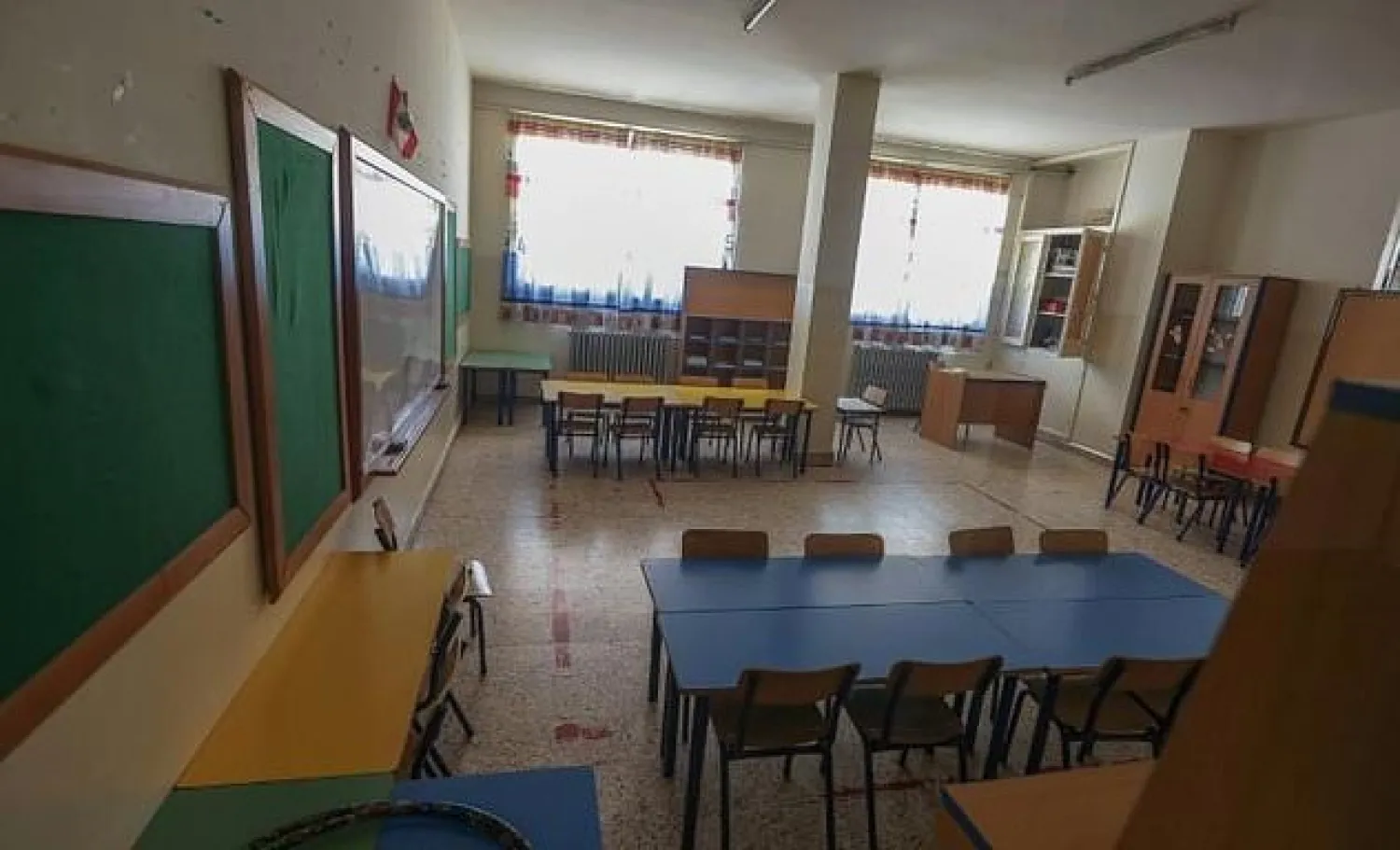

French-language Schools at Risk of Closure amid Lebanon's Crisis

Lebanon, where Arabic is the official language, has a long tradition of education in French. AFP
TT

French-language Schools at Risk of Closure amid Lebanon's Crisis

Lebanon, where Arabic is the official language, has a long tradition of education in French. AFP

Inside the French-language school she has run for years in east Lebanon, Sister Colette Moughabghab welcomed parents devastated by the news the century-old establishment was locking up its classrooms.

Books are stacked by the stairs leading to the playground that will no longer see pupils flood in autumn, after the school became the latest victim of a crippling economic crisis.

"I did everything to obtain financial aid... but in vain," said Moughabghab, who has run Our Lady of Lourdes in the eastern town of Zahle for four years, AFP reported.

"It's like closing up a home," she added.

In Lebanon, the first French schools were set up in the 19th century before the country came under French mandate in 1920 until its independence in 1943.

Until recent years, Lebanon's French-speaking schools, mostly private, taught 500,000 children -- equivalent to around half of all pupils nationwide. But the country's worst economic crisis since the 1975-1990 civil war has left them battling to stay afloat as parents struggle to pay fees.

"It's catastrophic," says Father Boutros Azar.

"Fifty to 70 schools in our network risk closing" by September, Azar said.

"Without the Catholic schools, there will be no French-speaking education in Lebanon."

According to AFP, Lebanon's economic crisis has seen tens of thousands of Lebanese lose their jobs or take pay cuts since the autumn.

With banks capping dollar withdrawals, the Lebanese pound has lost up to 80 percent of its value on the black market, sparking alarming inflation and plunging a large segment of the population into poverty.

In Sister Colette's office in Zahle, the parents of seven-year-old Julien and his younger brother are worried about the future.

Other parents plan to send their children to other private schools when the new term begins, but Julien's father Samer said he is cash strapped.

"I make about 1.2 million Lebanese pounds a month, which is now worth just a little more than 150 dollars," instead of 800 a year ago, said Samer, who declined to give his surname.

"I won't be able to pay for my second son to go to (private) school next year," said the 47-year-old.

A source at the education ministry said 120,000 pupils were expected to join state-run schools next year, as their parents could no longer afford sending them to private ones.

But that would be an added burden on the public education system.


SpaceX Starship Test to Attempt First-Ever Spaceship ‘Catch'

SpaceX's mega rocket Starship is stacked and prepared for a test flight from Starbase, Texas, Thursday, Nov. 12, 2026. (AP)
TT

SpaceX Starship Test to Attempt First-Ever Spaceship ‘Catch'

SpaceX's mega rocket Starship is stacked and prepared for a test flight from Starbase, Texas, Thursday, Nov. 12, 2026. (AP)

Elon Musk's SpaceX was poised Friday to carry out its latest test of the world's biggest and most powerful rocket, the Starship, with plans for a groundbreaking "catch" of the spaceship following a day in orbit.

A successful capture of the Starship upper stage would mark a significant milestone in the space industry's decades-long pursuit of fully reusable spacecraft that can drastically reduce mission costs and make frequent travel possible.

"If successful, this will mark the first full recovery of an orbital launch system and a breakthrough moment in making Starship a reliable, rapidly reusable rocket," SpaceX said.

For the 15th Starship test flight Friday, SpaceX aims to recover both stages of the massive 124-meter (407-foot) launch vehicle.

The company has caught the booster, dubbed Super Heavy, on three previous occasions, with the first stage descending vertically back to the launch site shortly after blastoff and nestling into mechanical "chopstick" arms.

It will now attempt to do the same with the spaceship. Some versions of the vessel are designed to launch internet satellites and data centers into orbit, while others will be made to ferry people to the Moon and Mars.

A spacecraft that can be fully reused is the "Holy Grail" of the space industry, said Clayton Swope, an aerospace expert at the Center for Strategic and International Studies.

"No one's really been able to do that so far," he said. "People have been trying to do that since the (NASA) space shuttle. But the space shuttle ended up being kind of a compromise because a lot of the vehicle wasn't reusable."

Reusing the Starship spacecraft would require the vessel to withstand the extreme heat of reentering Earth's atmosphere and then return to service without extensive refurbishment.

- Refueling challenge -

Musk, the world's richest person, has already revolutionized the space sector with the partially reusable Falcon rockets, which are regularly employed to launch satellites and carry astronauts to the International Space Station.

The Starship project, however, has been plagued by years-long delays as SpaceX grapples with novel engineering challenges -- even as NASA is counting on the spaceship to serve as a lunar lander for its Artemis program.

Other technical challenges include transferring fuel to Starship in orbit -- a requirement for any journey to the Moon or Mars.

Following SpaceX's high-profile stock market debut in June, the company carried out the first orbital flight of Starship in September, though the mission was cut short due to an engine issue.

It is also investing heavily in additional launch sites for its mega-rocket in Louisiana and Florida.

- Complex capture -

Friday's launch is scheduled to take place at SpaceX's "Starbase" in southern Texas at 4:45 pm (2245 GMT).

Following liftoff and the mid-air separation of the two stages, SpaceX plans to bring Super Heavy back to Earth six and a half minutes later, catching it at the launch site on the Gulf of Mexico coastline.

The spaceship will continue to reach Earth's orbit, where it will deploy 26 satellites into Musk's Starlink satellite internet constellation that has become a major revenue stream for SpaceX.

It will then circle the planet 14 times, before returning 22 hours later and -- SpaceX hopes -- descending safely into the chopstick arms.

This capture attempt is more complex than that of the booster, as the spaceship will be descending much faster and from a much greater altitude.

SpaceX has said it would proceed with these maneuvers only if conditions are optimal, and in the past has made last-minute changes to test flights under Musk's "fail fast" strategy of learning through crashes, explosions and other mishaps.

As of late Thursday, the US Federal Aviation Administration had not yet given its final approval for the test flight.


Delhi Overtakes Lahore as World’s Most Polluted City as Air Quality Drops

Traffic moves on a smoggy morning as air pollution spikes in New Delhi, India, November 13, 2026. (Reuters)
TT

Delhi Overtakes Lahore as World’s Most Polluted City as Air Quality Drops

Traffic moves on a smoggy morning as air pollution spikes in New Delhi, India, November 13, 2026. (Reuters)

India's capital Delhi overtook Lahore in Pakistan to become the world's most polluted city on Friday, with air quality reaching hazardous levels and visibility dropping as smog blanketed the city of 20 million people.

Air quality index (AQI) in Delhi was "hazardous" at 334, making ‌it the ‌most polluted global major ‌city, ⁠according to Swiss group ⁠IQAir, which measures air quality levels based on the concentration of toxins.

An AQI reading up to 50 is considered good with little or no ⁠health risk.

India's official ‌Central Pollution ‌Control Board pegged the AQI higher at ‌403 and rated it "severe".

The ‌Swiss and Indian readings vary due to the different AQI scales and methodologies used to calculate and ‌classify air pollution levels.

Cars and motorcycles emerged from dense ⁠smog, ⁠which also appeared to obscure streetlights on the city's main roads, videos from news agency ANI showed.

Pollution is a seasonal problem in many parts of northern India and neighboring Pakistan, as the cold, heavy air of winter traps vehicle emissions, construction dust and smoke from agricultural burning.


Study Reveals Why Cats Meow More Around Humans

The findings confirm that meowing is not simply an involuntary expression of emotion, but can be an audience-directed form of communication. (Getty Images)
TT

Study Reveals Why Cats Meow More Around Humans

The findings confirm that meowing is not simply an involuntary expression of emotion, but can be an audience-directed form of communication. (Getty Images)

Domestic cats meow differently depending on whether their human caretakers are present in the room or not, scientists confirm in a new study published by The Independent.

Cats meow for a variety of reasons, mostly when they are hungry or excited, and communicate through non-verbal cues like slow blinking or brushing themselves against their caregivers.

But, according to a 2020 study, humans are bad at telling apart food meows from other types of cat vocalizations.

“The domestic cat uses the meow more frequently in interactions with humans than with other cats,” researchers noted in the new study published in the journal Animal Behaviour. “However, it remains unclear whether this vocalisation serves a truly communicative purpose.”

The research confirms that cats tend to meow far more when their human companions are around than when they are alone or just surrounded by other cats.

For the study, researchers from the University of Sao Paulo in Brazil recruited 38 domestic cats known to be particularly vocal around food.

They presented each cat with their favorite treat sealed inside a small plastic container that they could see and smell, but not reach. Scientists then observed each for a minute under two conditions: with an attentive human present and with no one in the room.

They found that each cat made about 20 meows when it was alone, but over four times as many when a human companion was present.

The study concluded that the odds of cats meowing were several times higher with a person present.

Cats also frequently looked directly at the present caregiver, alternating their gaze between the person and the inaccessible treat.

This form of communication called “gaze alternation” is observed in several animals, including dogs and primates.

In contrast, cats simply spent more time standing still when they were alone.

“In the human-absent condition, cats stood still and gazed at the door significantly more, suggesting they discriminated which behavior was more effective with an audience,” scientists noted.

The findings confirm that meowing is not simply an involuntary expression of emotion, but can be an audience-directed form of communication.

“These results are consistent with meowing playing a communicative role in cat–human interactions,” researchers said.

Meowing also appears to be a flexible toolkit for cats that is shaped by their immediate surroundings and needs.

Scientists said that living alongside humans likely favored cats to evolve more flexible meows across different situations.
