COVID-19 Has Silver Lining for Iraq: Food Self-Sufficiency

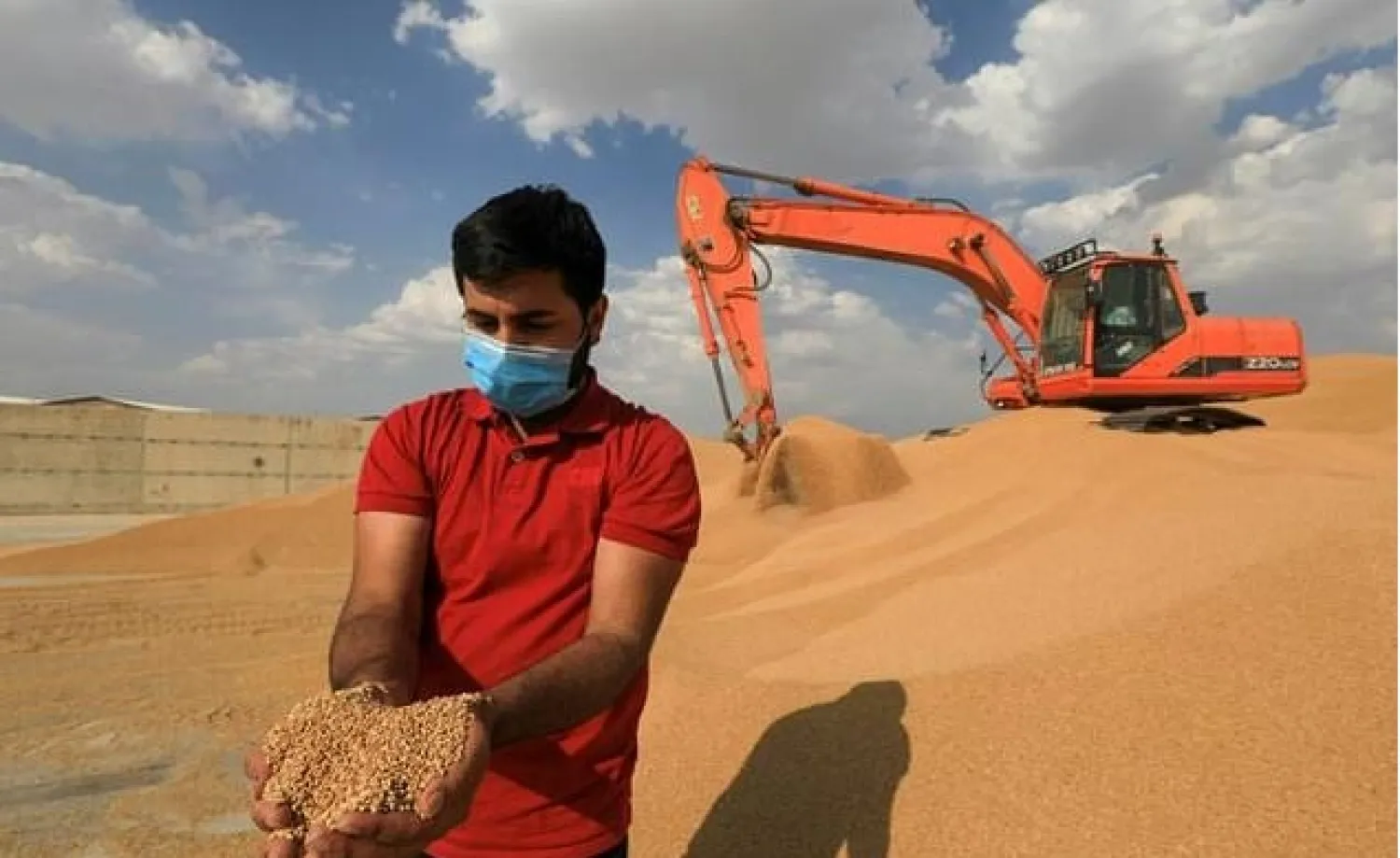
A third of Iraq's 40 million people rely on farming to live and farmers usually provide about five million tonnes of wheat products yearly. AFP
TT

COVID-19 Has Silver Lining for Iraq: Food Self-Sufficiency

A third of Iraq's 40 million people rely on farming to live and farmers usually provide about five million tonnes of wheat products yearly. AFP

Unlike in years past, Iraqi farmer Ahmed Mohsen now walks past his local market with a smile on his face. The pale green melons he harvested are selling fast, thanks to the coronavirus pandemic.

Iraq, in a bid to prevent the spread of the deadly COVID-19 pandemic, shut its 32 border crossings to goods and people in mid-March.

That helped Iraq's agriculture ministry accelerate a campaign to make Iraqi food markets self-sustainable, after they had spent years relying on foreign imports for half of their supply.

The land fit for farming in Iraq is roughly 9.3 million hectares (23 million acres).

"For years, farmers have been working at a loss with little support from the state," said Mohsen, who lives in Iraq's agricultural heartland, the southern province of Diwaniyah, AFP reported.

"But with the new coronavirus, the authorities have begrudgingly been forced to close the border."

Every year, Iraq would buy $2.8 billion in goods from Turkey, with Iranian imports coming in second with $2.2 billion in products sold to Baghdad.

It was a grim reality for a country whose ancestral civilization, Mesopotamia, has been hailed for its pioneering agricultural and irrigation technologies for thousands of years.

The land of two rivers is now making a small comeback. Every day, Mohsen's melons make their way from his home village of Afak to be sold en masse to the rest of the country.

"The authorities didn't want to help farmers, but in the end they allowed us to prove that we can provide for the nutrition needs of Iraqis," said Mohsen, a 32-year-old farming engineer.

A third of Iraq's 40 million people still rely on farming to live, but the industry is riddled with inefficiencies.

The government provides subsidies in water, fertilizer and equipment and purchases certain products -- particularly wheat, barley and lentils -- from Iraqi farmers at a price above the market rate.

But the state usually also imports cheap foodstuffs from Iran and Turkey at huge volume, causing an imbalance in the market, experts wrote in the "Sustainability" environmental magazine last year.

Their research found that Iraqi farmers often opted not to work their land because they did not expect to sell the harvest, given the oversupply from neighboring countries.

Local farmers usually provide about five million tonnes of wheat products yearly, complemented by around three million tonnes imported from neighboring countries, mostly flour.

Those who did sell their harvest to the government reported months-long delays in getting paid, which are still ongoing today.

That's why the coronavirus, despite bringing death and suffering to many, was also a blessing in disguise for their sector, farmers told AFP.

"Each year, the state is late in paying farmers and this slaps us with losses," said Khashan Karayiz, 70.

He comes from a long line of wheat farmers and this year, for the first time he can remember, he has already sold all of his harvest by July.

"I hope Baghdad will stop imports, in order to financially and morally support Iraqi farmers," Karayiz said.


What to Know About the US-Iran Peace Deal

A US Air Force F-16 fighter jet patrols the skies above the Middle East as American forces maintain regional presence and vigilance (CENTCOM)
TT

What to Know About the US-Iran Peace Deal

A US Air Force F-16 fighter jet patrols the skies above the Middle East as American forces maintain regional presence and vigilance (CENTCOM)

Washington: The New York Times

The United States and Iran said they were close to reaching a deal toward ending the war that has upended the Middle East for more than three months and disrupted the global economy.

Iran’s foreign minister, Abbas Araghchi, has said that an agreement had “never been closer.”

US officials signaled on Friday that a potential framework deal could be signed within days.

According to two Iranian officials and one regional official briefed on the terms of the agreement, Tehran and Washington have agreed to a preliminary deal that would end the fighting, reopen the crucial Strait of Hormuz and lift the US naval blockade on Iranian ports.

Both the US and Iran have sought to frame the emerging deal as a diplomatic victory.

Yet the agreement appears to push many of the thorniest issues to a 60-day negotiation period, including Iran’s nuclear program, about which major differences remain and both sides have so far held firm to longstanding red lines.

A deal would cap a week of diplomatic talks punctuated by airstrikes and Israel’s ongoing campaign in southern Lebanon.

What’s in the deal?

The two Iranian officials and one regional official briefed on the terms of the agreement gave a broad outline of the agreement. The United States has not confirmed these details:
Iran would open the Strait of Hormuz for the passage of ships and the United States would lift the naval blockade on Iran’s ports in the Arabian Gulf.

Iran and the United States would start negotiations on Iran’s nuclear program. The negotiations would last a maximum of 60 days and the war would stop on all fronts, including Lebanon, for that period.

During the 60-day negotiation period, Iran and countries in the region would discuss the future management of the strait.

The two Iranian officials said the next phase of talks would include discussion of the lifting of American sanctions, including on Iran’s oil sales and international banking transactions, in exchange for concessions on the Iranian nuclear program.

Speaking on state television Friday, Araghchi said there would be a two-part agreement to end the war: The first would be the signing of a memorandum of understanding between Tehran and Washington, and the second would be for a lasting peace deal. “The nuclear issue has been left for the second round and a final agreement,” Araghchi said.

Araghchi added that the Strait of Hormuz would reopen as part of the initial agreement between the US and Iran, but the economically vital waterway would not return to its prewar status.

He told Iranian state television that all commercial ships would be guaranteed safe passage, but said Tehran would maintain its control of the passage and would eventually charge a “service fee” for vessels passing through, an arrangement the Trump administration had previously warned against.

Framework for Nuclear Talks

According to US officials and diplomats, there are four major points of negotiation on a nuclear agreement between the United States and Iran:

1. A lengthy suspension of uranium enrichment
The United States has demanded for months that Iran agree to conduct no uranium enrichment for at least 20 years. The Iranians have countered by offering a 10-year halt, but American officials believe Tehran would settle for 15 years.

2. Iran’s current stockpile of enriched uranium is diluted, or “downblended”
The United States would work with the International Atomic Energy Agency, the UN inspection body, to dilute or “downblend” Iran’s stockpile of enriched uranium, according to two US officials familiar with the negotiations. American officials envision an active role in handling the nuclear material. Iranian officials say the United States would serve only as an observer.

Secretary of State Marco Rubio has said repeatedly in recent weeks that any agreement would have to cover all 11 tons of enriched uranium in Iran’s possession, not just the half-ton of near-bomb-grade fuel.

The Iranians have not talked publicly about whether they are willing to give up their entire existing stockpile. But if it was downblended, rather than shipped outside the country, Iran’s leaders could say they still have possession of the fuel.

3. Iran dismantles its nuclear sites
The United States has demanded that Iran dismantle its three major nuclear sites at Natanz, Fordo and Isfahan. The United States struck all three nearly a year ago, severely damaging them.

Iran has discussed dismantling two facilities but insists on leaving one open, in part to demonstrate it has not surrendered what it views as a “right to enrich.” That could prove problematic: Critics of the Obama-era nuclear agreement with Iran focused on its failure to close down Fordo, a deep underground site, which the Iranians later revived to produce near-bomb-grade fuel.

4. Iran agrees to “snap” inspections
The United States wants international inspectors to be able to conduct “snap” inspections, anytime and anyplace inside Iran. It is not clear if the Iranian government will agree. Many of the nuclear sites are inside Revolutionary Guards military bases, where inspectors have frequently been barred at the gates.


Growing Egypt-Russia Partnership Raises Alarm in Israel

The Egyptian prime minister visits the construction site of the El Dabaa Nuclear Power Plant in July 2025. (Egyptian government)
TT

Growing Egypt-Russia Partnership Raises Alarm in Israel

The Egyptian prime minister visits the construction site of the El Dabaa Nuclear Power Plant in July 2025. (Egyptian government)

Egypt’s El Dabaa Nuclear Power Plant has yet to begin operations on the country’s Mediterranean coast, but Israeli media outlets supportive of Prime Minister Benjamin Netanyahu have intensified warnings that the project could pave the way for a major Russian nuclear presence in the Middle East.

Those concerns over Egypt’s capabilities, as well as its regional partnerships, which have grown since the outbreak of the Gaza war in 2023, are unlikely to subside, according to experts interviewed by Asharq Al-Awsat.

They said that the rhetoric is tied to Israeli domestic politics, electoral competition and efforts to create new security threats for Israeli voters, while also exerting pressure on Cairo and its partners at a time when Israel is seeking to capitalize on tensions between Washington and Moscow.

Although Egypt’s nuclear program dates back to a 1956 agreement with the Soviet Union, the country’s first nuclear power project effectively began on Nov. 19, 2015, when Egypt and Russia signed an agreement to build the El Dabaa Nuclear Power Plant in the Matrouh governorate on the Mediterranean coast. The project is valued at $30 billion, including a $25 billion Russian loan that Egypt is due to begin repaying in October 2029 over a 35-year period at an annual interest rate of 3%.

The plant, which is designed to generate 4,800 megawatts of electricity, will comprise four nuclear reactors. It is expected to operate for more than 60 years and is projected to supply about 10% of Egypt’s electricity needs once its first reactor comes online, currently expected between late 2027 and mid-2028.

Israeli website Natziv.net recently claimed that El Dabaa is more than an electricity-generation project, describing it as “a potential nuclear foothold for Moscow” in the Middle East. The outlet said Russia’s financing of 85% of the project’s cost - about $25 billion - along with its responsibility for fuel supplies and nuclear waste management for 60 years, could create a “long-term strategic dependence” on Moscow.

The website also warned about plans for a Russian industrial zone near the Suez Canal, describing it as a permanent presence at a key global trade hub and a sign of Cairo’s drift away from the West toward a Russia-China axis within the BRICS group, which Egypt joined in January 2024.

Despite the project’s civilian nature, the outlet claimed that the infrastructure and expertise acquired through El Dabaa could one day provide Egypt with a shorter path toward military nuclear options or fuel enrichment capabilities.

It suggested that any radioactive leak could affect Israel’s coastline and desalination facilities, while closer Egyptian-Russian ties could narrow Israel’s strategic room for maneuver and weaken traditional US influence in the region.

Similar arguments appeared in an analysis published last week by Israel’s Yedioth Ahronoth following Russian President Vladimir Putin’s announcement that the plant’s first reactor could begin operating in 2027.

It described the notion that El Dabaa is solely an energy project as a “grave misreading,” portraying it instead as a slow-moving strategic encirclement effort in which “Israel is not incidental to the picture, but the target.”

Raouf Saad, Egypt’s former ambassador to Russia and a former assistant foreign minister, said the reports should be read within their political context. He added that Netanyahu has sought to disrupt efforts toward regional peace and has repeatedly attempted to provoke Egypt since the Gaza war, without success.

Saad dismissed the Israeli allegations as “naive and transparent” aimed at warning the United States about Russia’s return to the region, saying they reflected the weakness of Netanyahu’s position rather than any genuine security threat.

Retired Major General Samir Farag, a military and strategic analyst, said such reports are part of recurring attempts to manufacture crises and are likely to intensify as Israel approaches elections.

“Netanyahu-aligned media outlets have long tried to convince the Israeli public that Egypt seeks to acquire nuclear capabilities and pursue militarization,” Farag said, describing the claims as an effort to exploit the issue politically and divert attention from Israel’s actions in the region.

While Egypt has not officially responded to the allegations, officials and analysts continued to stress that the peaceful use of nuclear energy is a legitimate right under international law.

They noted that Egypt is fully committed to the 1968 Nuclear Non-Proliferation Treaty and that the El Dabaa project, like the country’s Inshas Nuclear Center, is subject to comprehensive oversight by the International Atomic Energy Agency.


Trump Faces G7 After Year of Trade Wrath, Diplomatic Bluster

People stand outside the Palais Lumiere ahead of the G7 summit in Evian-les-Bains, France, June 12, 2026. (Reuters)
TT

Trump Faces G7 After Year of Trade Wrath, Diplomatic Bluster

People stand outside the Palais Lumiere ahead of the G7 summit in Evian-les-Bains, France, June 12, 2026. (Reuters)

Little is known about what President Donald Trump's intentions are for the G7 summit in Evian, France next week, except maybe the obvious: the American president will impose his schedule and his mood.

The latter may depend largely on the peace agreement discussions with Iran, which were gathering steam Friday.

"It is not possible to 'manage Trump' the way it has been possible during his first term," Liana Fix, associate fellow at the Council on Foreign Relations, told AFP ahead of the summit that will bring the US face-to-face with France, Germany, Canada, Italy, Japan and the United Kingdom.

All these countries' leaders have been on the receiving end of Trump's trade wrath or diplomatic intimidation -- with the exception of Japan's Prime Minister Sanae Takaichi, who he is very fond of.

Every other leader expected on the shores of Lake Geneva has been the target of attacks, criticism or mockery from the Republican billionaire.

- 'Expect the worst' -

Neither growing unpopularity that could cost Trump control of Congress in November, nor the Supreme Court's annulment of his across-the-board tariffs is likely to soften his bruising stance toward global partners.

European leaders in particular have learned, through the Greenland episode, trade conflicts, and the Iran war, "to hope for the best but to expect the worst," Fix said.

Moreover, the US has informed Europeans of their intentions to significantly reduce the number of planes and warships made available to NATO in Europe, the New York Times reported.

"I don't think you're going to see a weakened president," Jackson James, senior fellow at German Marshall Fund of the US, told AFP.

"I think he's going to go over there and do what he always does, which is just try to bully his way through these very, very complicated issues and try to get the American agenda, as he sees it, fulfilled."

Trump "says he doesn't like these multilateral meetings," but "cannot bear for an assembly of world leaders to meet and he not being there," Victor Cha, an expert for the Center for Strategic and International Studies, said during a press conference.

"So he shows it up at these things and he leaves early," Cha said, as he did during the last G7.

- Versailles -

Still, French president Emmanuel Macron hopes to persuade the impatient American president to stay for a dinner at Versailles on Wednesday evening, playing to the 79-year-old's fascination with monarchy and ornate trappings of luxury.

France has already tried to cater to the American president by changing the dates of the summit so it would not coincide with his 80th birthday and the celebratory mixed martial arts tournament Trump will host at the White House on Sunday.

Some experts also consider it a concession to Washington that South Africa, which was being considered for participation in the G7 summit, will not be participating.

Paris insists, however, that there was no pressure to withdraw the invitation to South Africa -- a nation Trump accuses, without evidence, of broad persecution of its white population.

Several analysts say at least one issue that France has put on the table for discussion may attract Trump's interest: trade relations with China.

- Ukraine -

The balance of power has also shifted somewhat when it comes to Ukraine, where the situation has not fundamentally changed since Trump began his second term.

In 2025 "Europeans just sort of agreed that they had to bend the knee to Trump because of Ukraine" and its need for US military support, but now "we're just in a different dynamic where Ukraine is not as dependent on the United States," said Max Bergmann, a CSIS Europe expert, said at a briefing.

Ukrainian President Volodymyr Zelensky, who probably knows better than anyone how quickly a meeting with Trump can spiral out of control, has been invited to a discussion session in Evian.