


UAE Plans to Launch Mars Probe Friday after Weather Delay

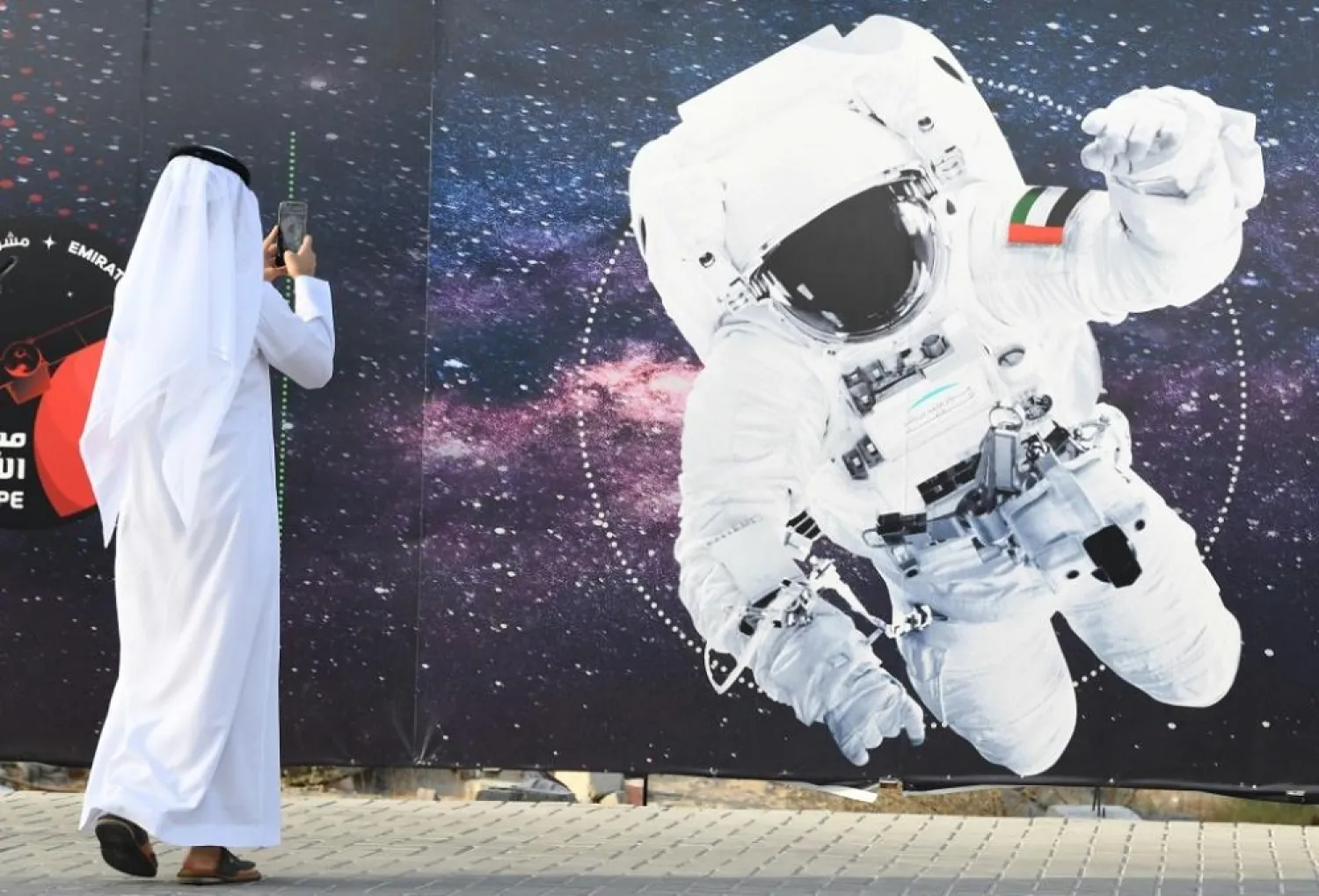
In this file photo from September 2019 a man takes a picture of an illustration of an astronaut with the Emirati national flag outside Dubai's Mohammed Bin Rashid Space Center. (AFP)
TT

UAE Plans to Launch Mars Probe Friday after Weather Delay

In this file photo from September 2019 a man takes a picture of an illustration of an astronaut with the Emirati national flag outside Dubai's Mohammed Bin Rashid Space Center. (AFP)

The United Arab Emirates said it plans to launch its "Hope" Mars probe on Friday local time from Japan's Tanegashima Space Center after a two-day delay due to poor weather there.

A rocket is due to blast off at 5:43 am local time (2043 GMT Thursday) carrying the unmanned spacecraft that is bound to orbit the Red Planet in the Arab world's first interplanetary mission.

The launch was postponed from 2051 GMT Tuesday because of inclement weather at the remote Japanese launch site, but remains well within the launch window which runs until August 13.

The Emirati project is one of three racing to Mars, including Tianwen-1 from China and Mars 2020 from the United States, taking advantage of the period when the Earth and Mars are nearest: some 55 million kilometers (34 million miles) apart.

"Hope" -- or Al-Amal in Arabic -- is expected to reach Mars's orbit by February 2021, marking the 50th anniversary of the unification of the UAE, an alliance of seven emirates.

Once there, it will loop the planet for a whole Martian year, or 687 days.

The probe is expected to detach from the launch rocket about an hour after blast-off, which is when the UAE Mars mission's deputy project manager Sarah al-Amiri said the real excitement will begin.

"In my heart of hearts, I'm looking forward to the initial 24 hours after separation, and that's where we see the results of our work," said Amiri, who is also Minister of State for Advanced Sciences.

"It is when we first get the signal, when we know that every part of the spacecraft is functioning, when the solar panels are deployed, when we hit our trajectory and are headed towards Mars," she told AFP earlier this month.

Keiji Suzuki from Mitsubishi Heavy Industries, which is carrying the Hope probe into space, had already warned on Monday that thunderstorms forecast could delay the launch.

Big ambitions
While the objective of the Mars mission is to provide a comprehensive image of the weather dynamics in the Red Planet's atmosphere, the probe is a foundation for a much bigger goal -- building a human settlement on Mars within the next 100 years.

The UAE also wants the project to serve as a source of inspiration for Arab youth, in a region too often wracked by sectarian conflicts and economic crises.

Dubai has hired architects to imagine what a Martian city might look like and build it in its desert as "Science City", at a cost of around 500 million dirhams (135 million dollars).

And last September, Hazza al-Mansouri became the first Emirati in space, part of a three-member crew that blasted off on a Soyuz rocket from Kazakhstan, returning home after an eight-day mission in which he became the first Arab to visit the International Space Station.

Several dozen probes -- most of them American -- have set off for the Red Planet since the 1960s. Many never made it that far, or failed to land.

The drive to explore Mars flagged until the confirmation less than 10 years ago that water once flowed on its surface.

"What is unique about this mission is that for the first time the scientific community around the world will have a holistic view of the Martian atmosphere at different times of the day at different seasons," the mission's project manager Omran Sharaf told Monday's briefing.

"We have a strategy to contribute to the global effort in developing technologies and science work that will help one day if humanity decides to put a human on Mars."



Lonely Tree in Wales Is an Instagram Star, but its Fate Is Inevitable

The Lonely Tree, often pictured submerged in water, was first planted in 2010. (Getty Images)
TT

Lonely Tree in Wales Is an Instagram Star, but its Fate Is Inevitable

The Lonely Tree, often pictured submerged in water, was first planted in 2010. (Getty Images)

It is one of Wales' most-loved beauty spots - but the time of the so-called Lonely Tree being an Instagram star could be slowly coming to an end.

The birch tree's striking setting at Llyn Padarn in Eryri, also known as Snowdonia, draws photographers to capture the sight through the seasons, according to BBC.

But the local authority Cyngor Gwynedd has raised the prospect of the tree, which was planted around 2010, disappearing within the next decade or so.

A lack of nutrients in the soil means birch trees have “a relatively short lifespan” in the area, typically living for around 30 years, but the fact that The Lonely Tree is sometimes submerged in water means its time could be even shorter.

Thousands of walkers and photographers make their way there each year and the tree has many social media sites dedicated to it, including one with 3,500 members on Facebook.

Marc Lock from Bangor, Gwynedd, said: “The Lonely Tree holds a special place in my heart and that of my family.”

He added: “Nestled down by the Lonely Tree, it's a perfect spot for us to sit, reflect and soak in the breath-taking scenery. We often go paddleboarding there in the summer months.”

However, Lock said the area really became his sanctuary after his wife bought him a camera for Christmas and he took up photography.

It was the place he headed to straight away, and he returns regularly at various times of the day and throughout the seasons.

“It's my go-to spot whenever I have some free time and my camera in hand,” he added. “I can't imagine what I would do if anything devastating happened to it like that at the Sycamore Gap tree at Hadrian's Wall. It's simply unthinkable.”

The Sycamore Gap was a much-loved landmark beside Hadrian's Wall in Northumberland that also drew hikers and photographers from far and wide.

It was more than 100 years old and had been the scene of many proposals, with people making the trip there from around the world.

But it was cut down by vandals in September 2023, causing uproar, with thousands of people leaving tributes and posting messages about their love for the beauty spot.

Two men were jailed for four years and three months after admitting the illegal felling.

While maybe not quite as famous as the Sycamore Gap was, The Lonely Tree is every bit as special to those that hold it dear to their heart.


Four Signs You're Self-Sabotaging Your Joy

Threat or uncertainty can reduce cognitive regulation and increase avoidance behaviors. (Indiana University)
TT

Four Signs You're Self-Sabotaging Your Joy

Threat or uncertainty can reduce cognitive regulation and increase avoidance behaviors. (Indiana University)

Most of us, at some point in our lives, have stood in the way of our own growth.

We make progress on a project, start to feel hopeful about a relationship, or finally get on track with a goal, and then we do something that undermines it.

We fall into a procrastination spiral, pick a fight, or simply quit; in doing so, we talk ourselves out of something that could potentially bring us happiness.

There’s a name for this kind of behavior: self-sabotage.

Dr. Mark Travers, an American psychologist with degrees from Cornell University and the University of Colorado Boulder, wrote an essay at Psychology Today about four well-studied reasons why people sabotage good things, based on research in psychology.

Avoiding blame

According to Travers, one of the most consistently researched patterns in self-sabotage comes from what psychologists call self-handicapping.

He said this is a behavior in which people create obstacles to their own success so that if they fail, they can blame external factors instead of internal ability.

A prime example comes from classic research in which researchers observed students who procrastinated studying for an important test. The ones who failed mostly attributed it to a lack of preparation rather than a lack of organization or discipline.

Self-handicapping is not simply laziness or whimsy. Rather, it is a strategy people use to protect their self-worth in situations where they might perform “poorly” or where they might be perceived as inadequate.

Fear of failure or success

People often think of the fear of failure as the main emotional driver behind self-sabotage.

But research points to the fear of success as an equal, yet less-talked-about engine of the phenomenon. Both fears can push people to undermine opportunities that are actually aligned with their long-term goals.

He said people who worry that failure will confirm their negative self-beliefs are more likely to adopt defensive avoidance tactics, like procrastination or quitting early.

Fear of success, though less widely discussed, operates in a similar fashion. What motivates this fear is the anxiety that comes with the consequences of success.

So, self-sabotaging success can be a way to stay within a comfort zone where expectations are familiar, even if that zone is unsatisfying.

Negative self-beliefs

Self-sabotage is tightly intertwined with how people view themselves. When someone doubts their worth, their ability, or their right to be happy, they may unconsciously act in ways that confirm those negative self-views.

Psychological theories help explain this.

Self-discrepancy theory proposes that people experience emotional discomfort when their actual self does not match their ideal self. This mismatch can lead to negative emotions such as shame, anxiety, or depression.

Coping with stress and anxiety

Self-sabotage often emerges in moments of high stress or emotional threat. When people feel overwhelmed, anxious, or stretched thin, their nervous systems shift into protective modes. Instead of moving forward, they retreat, avoid, or defensively withdraw.

Threat or uncertainty can reduce cognitive regulation and increase avoidance behaviors. In situations of perceived threat, even if the threat is potential success or evaluation, people can default to behaviors that feel safer, even if they undermine long-term goals.


2025 Was the World’s Third-Warmest Year on Record, EU Scientists Say

This photograph taken in Lanester, western France on May 31, 2025, shows smoke rising from a factory. (AFP)
TT

2025 Was the World’s Third-Warmest Year on Record, EU Scientists Say

This photograph taken in Lanester, western France on May 31, 2025, shows smoke rising from a factory. (AFP)

The planet experienced its third-warmest year on record in 2025, and average temperatures have ​exceeded 1.5 degrees Celsius of global warming over three years, the longest period since records began, EU scientists said on Wednesday.

The data from the European Union's European Centre for Medium-Range Weather Forecasts (ECMWF) found that the last three years were the planet's three hottest since records began - with 2025 marginally cooler than 2023, by just 0.01 C.

Britain's national weather service, the UK Met Office, confirmed its own data ranked 2025 as the third-warmest in records going back to 1850. The World Meteorological Organization will publish its temperature ‌figures later ‌on Wednesday.

The hottest year on record was 2024.

EXTREME WEATHER EVENTS

ECMWF ‌said ⁠the ​planet ‌also just had its first three-year period in which the average global temperature was 1.5 C above the pre-industrial era - the limit beyond which scientists expect global warming will unleash severe impacts, some of them irreversible.

"1.5 C is not a cliff edge. However, we know that every fraction of a degree matters, particularly for worsening extreme weather events," said Samantha Burgess, strategic lead for climate at ECMWF.

Governments pledged under the 2015 Paris Agreement to try to avoid exceeding ⁠1.5 C of global warming, measured as a decades-long average temperature compared with the pre-industrial era.

But their failure to reduce ‌greenhouse gas emissions means that level could now be ‍breached before 2030 - a decade earlier than ‍had been predicted when the Paris accord was signed in 2015, ECMWF said.

"We are ‍bound to pass it," said Carlo Buontempo, director of the EU's Copernicus Climate Change Service. "The choice we now have is how to best manage the inevitable overshoot and its consequences on societies and natural systems."

POLITICAL PUSHBACK

Currently, the world's long-term warming level is about 1.4 C above the pre-industrial ​era, ECMWF said. Measured on a short-term basis, the world already breached 1.5 C in 2024.

Exceeding the long-term 1.5 C limit - even if ⁠only temporarily - would lead to more extreme and widespread impacts, including hotter and longer heatwaves, and more powerful storms and floods.

In 2025, wildfires in Europe produced the highest total emissions on record, while scientific studies confirmed specific weather events were made worse by climate change, including Hurricane Melissa in the Caribbean and monsoon rains in Pakistan which killed more than 1,000 people in floods.

Despite these worsening impacts, climate science is facing increased political pushback. US President Donald Trump, who has called climate change "the greatest con job", last week withdrew from dozens of UN entities including the scientific Intergovernmental Panel on Climate Change.

The long-established consensus among the world's scientists is that climate change is real, mostly caused by humans, and getting worse. Its main cause ‌is greenhouse gas emissions from burning fossil fuels such as coal, oil and gas, which trap heat in the atmosphere.