

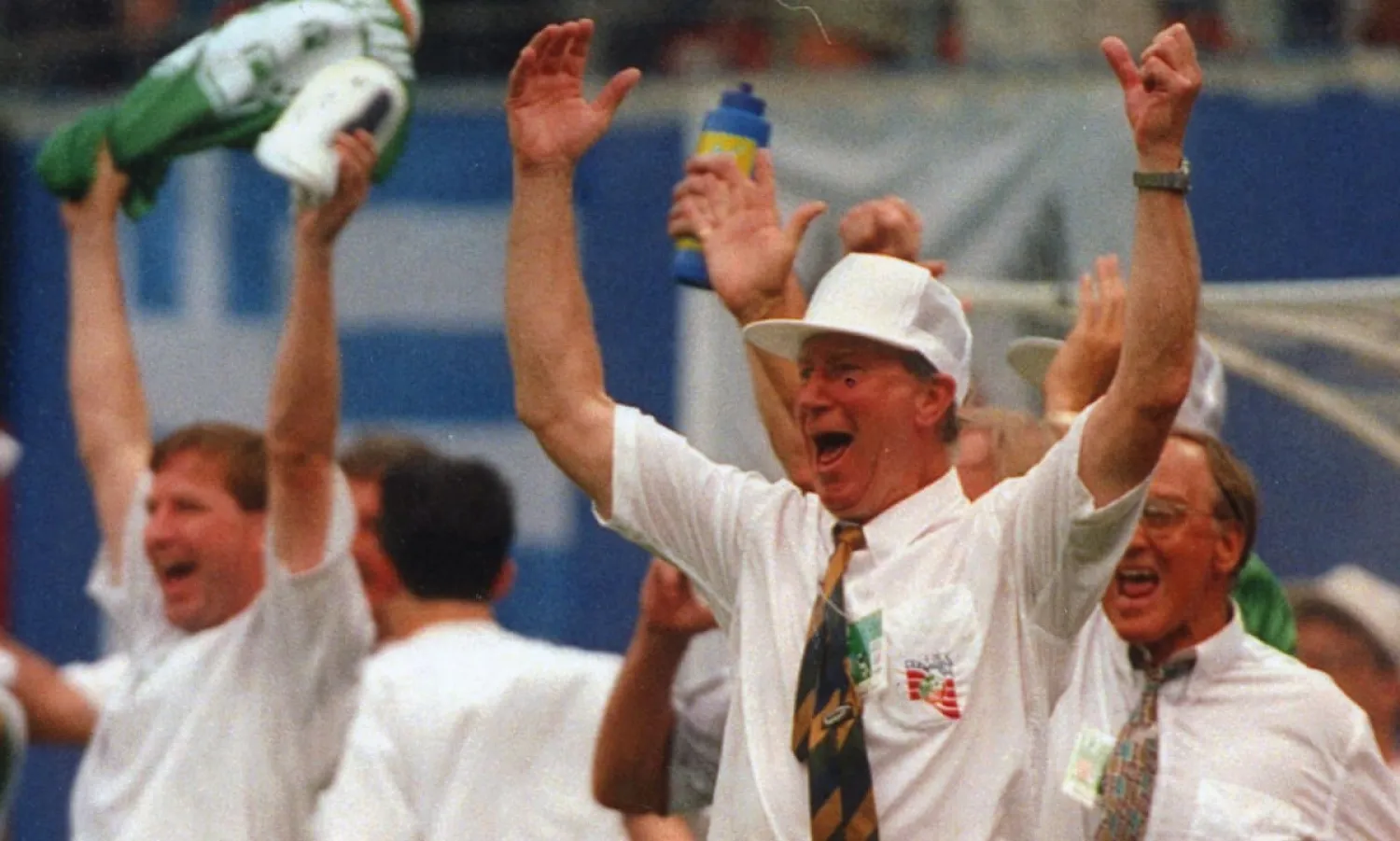

Jack Charlton: An Exceptional Leader Who Had Ireland Dancing in the Streets

Jack Charlton
Jack Charlton
TT

Jack Charlton: An Exceptional Leader Who Had Ireland Dancing in the Streets

Jack Charlton
Jack Charlton

Jack Charlton was to the Republic of Ireland what Pelé was to Brazil. He defined the national team to the world, establishing a style against which all of the country’s sides since have been measured, for better or worse. Charlton, Ireland’s first foreign manager, even helped to alter society.

The beauty of a game depends on the beholder. For nearly 10 years Charlton’s Ireland were hard to watch and harrowing to play against, yet they gave unprecedented joy to millions. He was fortunate that during his reign Ireland had some of the greatest players in their history but it took an exceptional leader to rally them. The manager, a surprising appointment, brought a charisma and a clarity of vision that had been missing.

From the start he showed he would do it his way. At his introduction in Dublin in February 1986, Charlton stormed out after arguing with a journalist and upbraiding the FAI’s general secretary. “If points have to be made,” he later explained, “they are more effectively made on day one.” His manner, like his style of play, split opinion but had the merit of being unambiguous. Players and spectators had to choose whether to join the ride or stay away.

Barely 15,000 fans attended his first match, a 1-0 home friendly defeat by Wales, but by the time of his departure he had earned honorary citizenship after leading the country to two World Cups and a European Championship, inspiring unheard of public jubilation and a cultural expansion.

The celebrations are more memorable than the matches. Charlton unapologetically preached a strategy based on long balls and relentless harassment of opponents. It was not high-brow but it was well thought out. Every player knew his role and if he did not perform it to Charlton’s liking he was ditched, no matter his stature. Liam Brady, an all-time Ireland great, was humiliatingly hauled off 35 minutes into what turned out to be his final international, a friendly against West Germany.

Against Scotland at Hampden Park in 1987, he fielded an unorthodox lineup and achieved Ireland’s most significant away win for nearly 40 years, paving the way for Ireland’s first appearance at a major tournament.

Euro 88 began with an extraordinary triumph against their oldest rivals, England, the country with whom Charlton had won the World Cup as a player but whose Football Association had never given him the courtesy of a reply when he applied for the position of manager after the departure of Don Revie, once his mentor at Leeds. Ray Houghton’s winning goal served as payback and a new dawn.

Charlton’s tactics made even the best teams uncomfortable but his greatest achievement was to get his players to implement his plan with gusto even though many of them were asked to play against the instincts that had made them successful at club level, from John Aldridge being converted from a goal-getter to a ball-fetcher, Ronnie Whelan being made more a runner than a passer and Paul McGrath, like Mark Lawrenson before him, being recast as an outstanding midfielder rather than a world-class center-back. Such players enjoyed playing under Charlton because, as much as his system was rigid and the FAI’s support often shambolic, reporting for international duty felt like going to a theme park. There was a giddiness around the Boys in Green.

While other teams were cloistered away, Ireland’s players were allowed to party in the same pubs and clubs frequented by fans. When they trained it was with a definite purpose but little sophistication: their preparation for the anticipated heat of the 1990 World Cup in Italy involved running around wearing three tracksuits and a big overcoat.

“Under Jack we were mostly ramshackle and part of what made us tick was the disorganization and the joy we got from pretending to the world that we weren’t to be taken seriously,” Niall Quinn wrote in his autobiography.

Being seen to work hard and have fun, while gaining results, made them lovable. A nation was happy to identify with them.

That identification also had liberating implications. Since long before Charlton’s arrival football had been the people’s game in Ireland, especially in urban areas, but many in authority – in schools and churches – had denied that reality, insisting football was an impostor and Gaelic sports were the only true mode of Irish expression. That lie was exposed in the Charlton years, impossible to uphold when the whole country stopped to watch the team play and poured into the streets to welcome them home.

The team’s popularity helped to propagate a more inclusive definition of Irishness in other ways. Charlton was not the first manager to recruit foreign-born players with Irish ancestry but he did so more than any other. There were some heckles about players with English accents but most of the sneers about “plastic Paddies” came from the British media. Generally in Ireland the foreign-born players who chose to represent the country were embraced as sons of the diaspora, especially as the spirit with which they performed invalidated allegations of opportunism.

In later years decisions by Jack Grealish and Declan Rice triggered a sad and hypocritical narrowing of some minds in Ireland but Charlton’s side were seen mostly as every bit as Irish as the London‑born Shane MacGowan, whose band, the Pogues, provided the soundtrack to many a hooley.

With the fairytale of New York in Ireland’s opening match of the 1994 World Cup, they reached their sporting and cultural pinnacle. The Big Apple practically became the capital of Ireland as millions tried to get tickets for a meeting in the Giants Stadium with Italy, another country that had a huge exclave in the US. In the end there were far more Irish in the crowd of 75,000 and Houghton again ignited sessions that are still talked about today.

Ireland did not win another game at USA 94, where they ultimately suffered from the heat and a lack of quality in a couple of key areas. While Charlton benefited from a vintage crop of players, he never had a great goalkeeper and suggestions he should have delivered even better results are not strengthened by the fact Ireland’s best performances – matches in which his side outplayed decent opponents instead of ambushing them – yielded only draws: with the USSR at Euro 88 and away against England and Poland in the qualifiers for Euro 92.

Charlton would have liked to have concluded his reign by taking his team to a tournament in his native country but Ireland, with precious players missing or waning, failed to reach Euro 96.

With more limited players Charlton’s style looked more limited. He showed little inclination to evolve, whereas expectations had changed. After defeat by the Netherlands in a play-off in December 1995, fans sang him a ballad that felt like farewell. Then, with a lack of sentiment that surprised Charlton but of which he might have grudgingly approved, the FAI sacked him just short of his 10th anniversary.

(The Guardian)


Veteran Monfils Exits to Standing Ovation on Australian Open Farewell

Gael Monfils of France acknowledges to the crowds after losing his Men’s Singles first round match against Dane Sweeny of Australia at the Australian Open tennis tournament in Melbourne, Australia, 20 January 2026. (EPA)
TT

Veteran Monfils Exits to Standing Ovation on Australian Open Farewell

Gael Monfils of France acknowledges to the crowds after losing his Men’s Singles first round match against Dane Sweeny of Australia at the Australian Open tennis tournament in Melbourne, Australia, 20 January 2026. (EPA)

French entertainer Gael Monfils was bundled out of the Australian Open in the first round on Tuesday in a brave farewell to a tournament he has lit up so many times.

The 39-year-old, one of the most colorful and popular players in men's tennis, battled all the way but Australian qualifier Dane Sweeny prevailed 6-7 (3/7), 7-5, 6-4, 7-5 in an epic lasting nearly four hours.

There was an on-court presentation and standing ovation afterwards for Monfils, who said: "Somehow it is the finish line, but thank you so much for an amazing ride.

"I have a lot of great memories here."

Monfils, who has won 13 ATP titles in a career stretching back to 2004, said in October that this year would be his last in tennis.

Launching his 20th Australian Open campaign, Monfils outlasted Sweeny, who is 15 years his junior, in an attritional first set.

Roared on by a partisan full house at Melbourne Park, Sweeny fought back to seize the second set and level an enthralling match.

Monfils, now ranked 110 but who rose to six in the world in his pomp, looked to be struggling physically in glaring sunshine.

The French veteran was frequently bent over double between points, one hand on his left knee and the other using his racquet to stay upright.

He alternately grimaced and grinned.

Monfils saw a trainer after losing the second set but still trudged out for the third, and was soon broken on the way to losing the set.

In a raucous party atmosphere, Monfils summoned reserves of energy from somewhere to race into a 4-1 lead in the fourth set, only for Sweeny to peg him back.

Sweeny clinched on his first match point before collapsing to the court.

He faces American eighth seed Ben Shelton in round two.

Paris-born Monfils has never won a Grand Slam but he has frequently gone deep in the biggest tournaments, including making the quarter-finals in Melbourne in 2016 and 2022.

Monfils married Ukrainian player Elina Svitolina in 2021 and they welcomed a daughter, Skai, a year later.


Morocco's Igamane Suffers ACL Injury

Morocco's forward #07 Hamza Igamane reacts as he misses his penatly during the Africa Cup of Nations (CAN) semi-final football match between Nigeria and Morocco at the Prince Moulay Abdellah stadium in Rabat on January 14, 2026. (Photo by FRANCK FIFE / AFP)
TT

Morocco's Igamane Suffers ACL Injury

Morocco's forward #07 Hamza Igamane reacts as he misses his penatly during the Africa Cup of Nations (CAN) semi-final football match between Nigeria and Morocco at the Prince Moulay Abdellah stadium in Rabat on January 14, 2026. (Photo by FRANCK FIFE / AFP)

Lille striker Hamza Igamane suffered an anterior cruciate ligament injury in Morocco's Africa Cup of Nations final against Senegal, the Ligue 1 side announced on Monday, casting doubt over his participation in this year's World Cup.

The 23-year-old was on the bench ‌for the ‌final, which Senegal ‌won ⁠1-0, before ‌coming on in extra time as the sixth substitute. He lasted seven minutes before going off injured, leaving Walid Regragui's side to finish the match with ⁠10 men.

"Tests carried out on the ‌player have unfortunately confirmed ‍a serious ‍injury. Hamza Igamane has indeed ‍suffered a rupture of the anterior cruciate ligament in his right knee," Reuters quoted Lille as saying in a statement.

"Hamza will be unavailable for several months," it added, with ⁠the injury coming five months before the 2026 World Cup, where Morocco will face Brazil, Scotland and Haiti in Group C.

Igamane, who joined Lille from Rangers in the close season, has scored nine goals in 21 games for the French ‌side in all competitions.


Precision-Serving Former Finalist Rybakina Powers on in Melbourne

Kazakhstan's Elena Rybakina signs autographs after her victory against Slovenia's Kaja Juvan in their women's singles match on day three of the Australian Open tennis tournament in Melbourne on January 20, 2026. (AFP)
TT

Precision-Serving Former Finalist Rybakina Powers on in Melbourne

Kazakhstan's Elena Rybakina signs autographs after her victory against Slovenia's Kaja Juvan in their women's singles match on day three of the Australian Open tennis tournament in Melbourne on January 20, 2026. (AFP)

Former finalist Elena Rybakina warned Tuesday if her serve was firing she would be a threat at the Australian Open, after reinforcing her title credentials with a comfortable first-round victory.

The fifth seed, who lost the 2023 final in three tough sets to Aryna Sabalenka, sent Slovenia's Kaja Juvan packing 6-4, 6-3 with her serve proving a potent weapon.

Rybakina won 83 percent of her first-serve points to keep up her record of safely negotiating the first hurdle at every Grand Slam since the 2022 US Open.

"No matter who is on the other side, if the serve is going, then it's perfect," she said after routinely racing to 40-0 leads and holding to love three times.

"Of course, little things (to work on) on the serve. Maybe adjust, be better in the first few shots of the rally, then we will see how it's going to go.

"But I'm happy with the serve, it really worked today."

It was her second serve that truly separated her from Juvan, winning 10 of 18 points behind it and not facing a break point until the final game of the match.

Rybakina, who won Wimbledon in 2022, faces France's Varvara Gracheva next.
