


A Machine at the Peak of Its Power – How Liverpool Became Champions

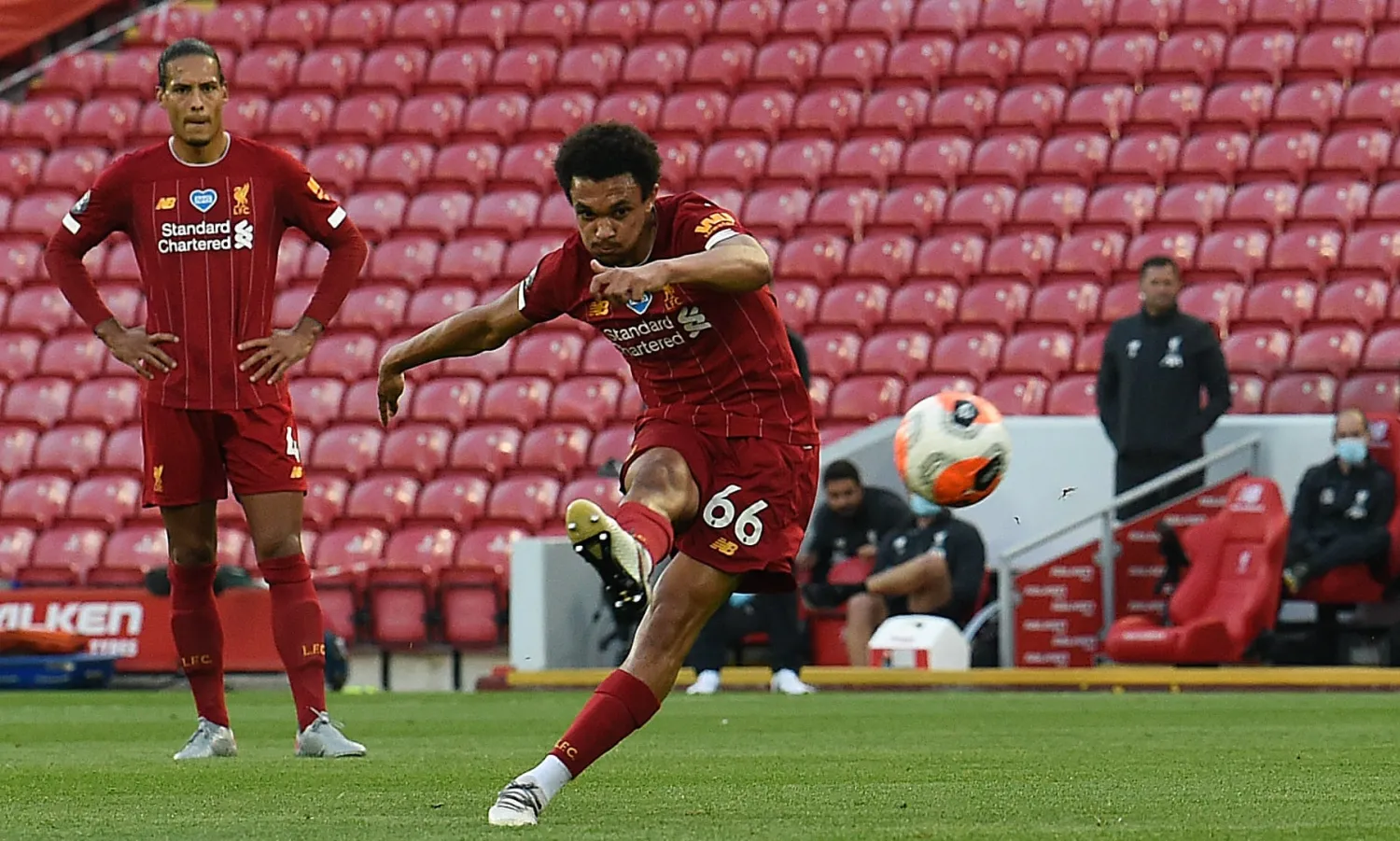
 Trent Alexander-Arnold strikes the free-kick that put Liverpool ahead and sparked a ruthless attacking display. Photograph: John Powell/Liverpool FC/Getty Images
Trent Alexander-Arnold strikes the free-kick that put Liverpool ahead and sparked a ruthless attacking display. Photograph: John Powell/Liverpool FC/Getty Images
TT

A Machine at the Peak of Its Power – How Liverpool Became Champions

 Trent Alexander-Arnold strikes the free-kick that put Liverpool ahead and sparked a ruthless attacking display. Photograph: John Powell/Liverpool FC/Getty Images
Trent Alexander-Arnold strikes the free-kick that put Liverpool ahead and sparked a ruthless attacking display. Photograph: John Powell/Liverpool FC/Getty Images

No asterisks. No caveats. And let’s face it, no contest. For the last few months a theory has been doing the rounds that the ersatz nature of the Premier League endgame, five weeks of press-ganged summerghost-ball, would drain the color from Liverpool’s first league title in 30 years.

Fat chance. Death, plague, and economic collapse may have stalked the land, puncturing sport’s ability to pretend the rest of the world is simply a subplot. But sport has many functions beyond simply flag-waving and Liverpool’s success will be deeply felt at a club where, as with every other club, football has always been a bit more than just football.

Not least for the players, a group of athletes who have achieved a kind of personal ultimacy in each other’s company, reaching out into the very limits of their own powers, and playing these last 18 months through a kind of fury.

Make no mistake, this was an annihilation. Liverpool didn’t just outrun the rest of the field. From late summer into spring they seemed to be operating to a different set of physical laws, marching the Premier League around in a headlock, ruffling its hair, flicking its ears.

The high point remains the 4-0 defeat of Leicester City on Boxing Day, one of those rare performances where each component part of a sporting machine appears to be operating with some intimate, shared knowledge of the other pieces. Either side of this there has at times been an air of double take about Liverpool’s run, of things happening that stretch credibility, that verge on some kind of sporting magic realism.

Here’s a team that won 26 of 27 league games from August to 28 February; that haven’t lost at home in the league in three years; a group of world champions whose best player is an unfussy center-back, whose center-forward can’t score at home, whose most creative force is a junior right-back, who have spent £92m net on transfer fees in the last five years.

This is not the standard version of annihilating success. How to explain it? Certainly, there has been a feeling that Liverpool are in some way cheating, floating above the waves, gaming the system.

Which is in fact the case, albeit in plain sight. This is the culmination of a clear and deliberate process, a vision of an industry with its own historic margins of irrationality and incompetence removed.

Let’s face it, at times watching English football has felt like a version of the sequence in Spinal Tap where the band perform on stage in front of an 18-inch model of Stonehenge. Tap’s manager blames this disaster on design instructions from lead guitarist Nigel Tufnel, which fatally confused inches and feet.

At which point lead vocalist David St Hubbins points out, to general agreement: “But, you’re not as confused as Nigel are you? I mean, it’s not your job to be as confused as Nigel.”

The point being in a dopey, daffy, largely irrational world, sometimes high-level competence can be enough. And English football has been run by Nigels, or dragged into a state of confusion by a sub-cast of Nigels for as long as you care to look back.

Imagine a version where the industry norm is cut away, where a football club is run to the same standards as any other high-functioning global business, where no one is as confused as Nigel. This has been the brilliance of this Liverpool regime. Where are their idiots? And is this actually fair?

In October it will be 10 years since Fenway Sports Group bought Liverpool, John Henry announcing: “We’re here to win,” from the steps of the high court as a deal was forced through. Oh yeah? Liverpool were £351m in debt. A team featuring Paul Konchesky, David N’Gog, and Christian Poulsen were in the bottom three in the Premier League. Nobody knew what to do about Anfield.

And yet Henry was attracted to Liverpool precisely because they were in this state. Here was a commodity bottoming out, a global brand that was all inefficiencies, all development potential. A club, an industry, a hard-won sporting heritage was ready to be money-balled.

It took a while. There was still time to sign Andy Carroll and Charlie Adam, to churn through a cast of minor players, to fail to micro-manage the disastrous Luis Suárez race affair.

Things have been steadily fixed. Two competent, sensible managers have been employed across eight years. A data-driven, non-emotive recruitment policy has registered more hits than misses. Players have been coached and improved rather than discarded or indulged.

There has even been a disruptive element to Jürgen Klopp’s tactics. In this Liverpool team full-backs are attackers, midfielders are defenders, wingers are goalscorers, center-forwards chase, and counterpress.

Physicality has also been key, another margin to be worked, a team where every player is supremely fit and strong, and where opponents have often simply dropped off, exhausted after 70 minutes.

The final steps came in a rush from this powerful base. Two years ago Klopp’s Liverpool were still 25 points behind Manchester City. The current season, a title won with seven games still to play, is an achievement that will stand with any team raised in the modern era.

But it also feels like a summit, something that, even now, will need regearing to sustain this level. No asterisks. No blind spots. No snags within the machine. And no standing still from here.

(The Guardian)


Tirante Topples Top Seed Shelton to Reach Houston ATP Semi-finals

Argentina's Thiago Tirante is through to the semi-finals of the ATP clay court tournament in Houston after an upset win over top-seeded American Ben Shelton. Kenneth Richmond / GETTY IMAGES NORTH AMERICA/AFP
TT

Tirante Topples Top Seed Shelton to Reach Houston ATP Semi-finals

Argentina's Thiago Tirante is through to the semi-finals of the ATP clay court tournament in Houston after an upset win over top-seeded American Ben Shelton. Kenneth Richmond / GETTY IMAGES NORTH AMERICA/AFP

Thiago Tirante stunned top-seeded Ben Shelton 7-6 (7/5), 3-6, 6-4 on Friday to book a semi-final showdown with friend and fellow Argentine Roman Burruchaga at the ATP clay court tournament in Houston, Texas.

Tirante, ranked 83rd in the world, notched his second career win over a top-10 player as he sent the ninth-ranked Shelton packing to reach the second ATP semi-final of his career.

"I knew that Ben was a very difficult player, a great player, so I had to take more risks at some times of the match," said Tirante, who fended off a break point early in the third set and broke Shelton for a 5-4 lead before serving it out with a comfortable hold.

"I did sometimes good, I did sometimes bad, but that's the key. (I had to stay) mentally strong all the time and try to break the serve -- he serves amazing."

Burruchaga, ranked 77th, upset third-seeded American Learner Tien, ranked 22nd in the world, 7-5, 6-4 to reach his first career semi-final.

The son of former soccer player Jorge Burruchaga, who won the World Cup with Argentina in 1986, the 24-year-old had already knocked out another member of the world top 40 on Thursday, 33rd-ranked local favorite Brandon Nakashima.

Second-seeded American Frances Tiafoe saved a match point in the third set tiebreaker to reach the semi-finals with a 3-6, 6-4, 7-6 (8/6) victory over Australian Alexei Popyrin.

Tiafoe will face fourth-seeded Tommy Paul in an All-American semi after Paul beat Argentina's sixth-seeded Tomas Etcheverry 6-4, 6-2.


Saudi Crown Prince Meets FIFA President

Saudi Crown Prince and Prime Minister Prince Mohammed bin Salman bin Abdulaziz Al Saud met with FIFA president Gianni Infantino. (SPA)
TT

Saudi Crown Prince Meets FIFA President

Saudi Crown Prince and Prime Minister Prince Mohammed bin Salman bin Abdulaziz Al Saud met with FIFA president Gianni Infantino. (SPA)

Saudi Crown Prince and Prime Minister, Prince Mohammed bin Salman bin Abdulaziz Al Saud, met with FIFA president Gianni Infantino in Jeddah on Friday to review areas of mutual sports cooperation and explore promising opportunities for further development, the Saudi Press Agency reported on Saturday.

Saudi Minister of Sport Prince Abdulaziz bin Turki bin Faisal and President of the Saudi Arabian Football Federation Yasser Al-Misehal attended the meeting.


Gattuso Out as Italy’s Coach After Team Failed to Qualify for World Cup

Italy's head coach Gennaro Gattuso greets supporters after winning the playoff FIFA World Cup 2026 European qualification semifinal football match between Italy and North Ireland at the Gewiss stadium in Bergamo, on March 26, 2026. (AFP)
TT

Gattuso Out as Italy’s Coach After Team Failed to Qualify for World Cup

Italy's head coach Gennaro Gattuso greets supporters after winning the playoff FIFA World Cup 2026 European qualification semifinal football match between Italy and North Ireland at the Gewiss stadium in Bergamo, on March 26, 2026. (AFP)

Italy coach Gennaro Gattuso left his role by mutual consent on Friday, three days after the national team failed to qualify for a third consecutive World Cup.

The Italian football federation announced the news in a statement thanking Gattuso "for the dedication and passion" during his nine months in charge.

Italy’s chances of reaching this year’s tournament in North America ended on Tuesday after a penalty shootout loss to Bosnia and Herzegovina in a qualifying playoff.

"With pain in my heart, not having achieved the goal we had set ourselves, I consider my experience on the national team bench to be over," Gattuso said.

Gattuso’s departure comes a day after Italy’s football federation president Gabriele Gravina resigned along with Gianluigi Buffon, who was the national team’s delegation chief.

The defeat to Bosnia added more misery for four-time champion Italy after being eliminated by Sweden and North Macedonia, respectively, in the qualifying playoffs for the last two World Cups.

Gattuso took over from the fired Luciano Spalletti in June with the squad already in crisis mode following a defeat at Norway in its opening qualifier.

Spalletti had also overseen a disappointing European Championship campaign in 2024, when titleholder Italy was knocked out in the round of 16 by Switzerland.

"I would like to thank Gattuso once again," Gravina said. "Because, in addition to being a special person, as a coach he has offered a valuable contribution, managing to bring enthusiasm back to the national team in just a few months.

"He has conveyed great pride in the national team jersey to the players and to the whole country."

Under Gattuso, Italy went on a six-match winning streak before another loss to Norway in November to finish second in their group and end up in the playoffs again.

Gattuso had been given a contract until the end of this summer’s World Cup, with an automatic renewal until 2028 if Italy returned to football’s biggest stage.

"The Azzurri shirt is the most precious asset that exists in soccer, which is why it is right to immediately facilitate future coaching staff decisions," Gattuso said.

"It was an honor to be able to lead the national team and do so also with a group of boys who have shown commitment and attachment to the shirt. The biggest thanks go to the fans, to all the Italians who have never failed to show their love and support for the national team in recent months."

Among those being mentioned to replace Gattuso are Roberto Mancini, Simone Inzaghi, Antonio Conte and Massimiliano Allegri.

Mancini coached Italy to the European Championship title in 2021 then failed to get the Azzurri to the next year’s World Cup before bolting to take over Saudi Arabia’s national team. He left that role in October 2024 and is currently coach at Al-Sadd in Qatar.

Inzaghi steered Inter Milan to the Serie A title in 2024 and now manages Saudi club Al-Hilal.

Conte coached Italy at the 2016 European Championship and is currently at Napoli.

Allegri is coach at AC Milan.

Italy will play two friendly matches in June but is unlikely to have a new coach by then, given that the election for a new FIGC president won't take place until June 22.
