




Iran’s foreign ministry said on Thursday foreign governments may have been behind recent cyberattacks on Iranian facilities, but played down the possibility of them having a role in a series of fires and explosions at military and other installations.
Since late June, several fires or explosions have been reported at military, industrial and nuclear sites in Iran as well as at oil refineries, power plants, factories and businesses.
“There are thousands of cyberattacks on the country’s infrastructure on a daily basis - which is nothing new - most of which are repelled by our defence systems,” Iranian media quoted Foreign Ministry spokesman Abbas Mousavi as telling reporters.
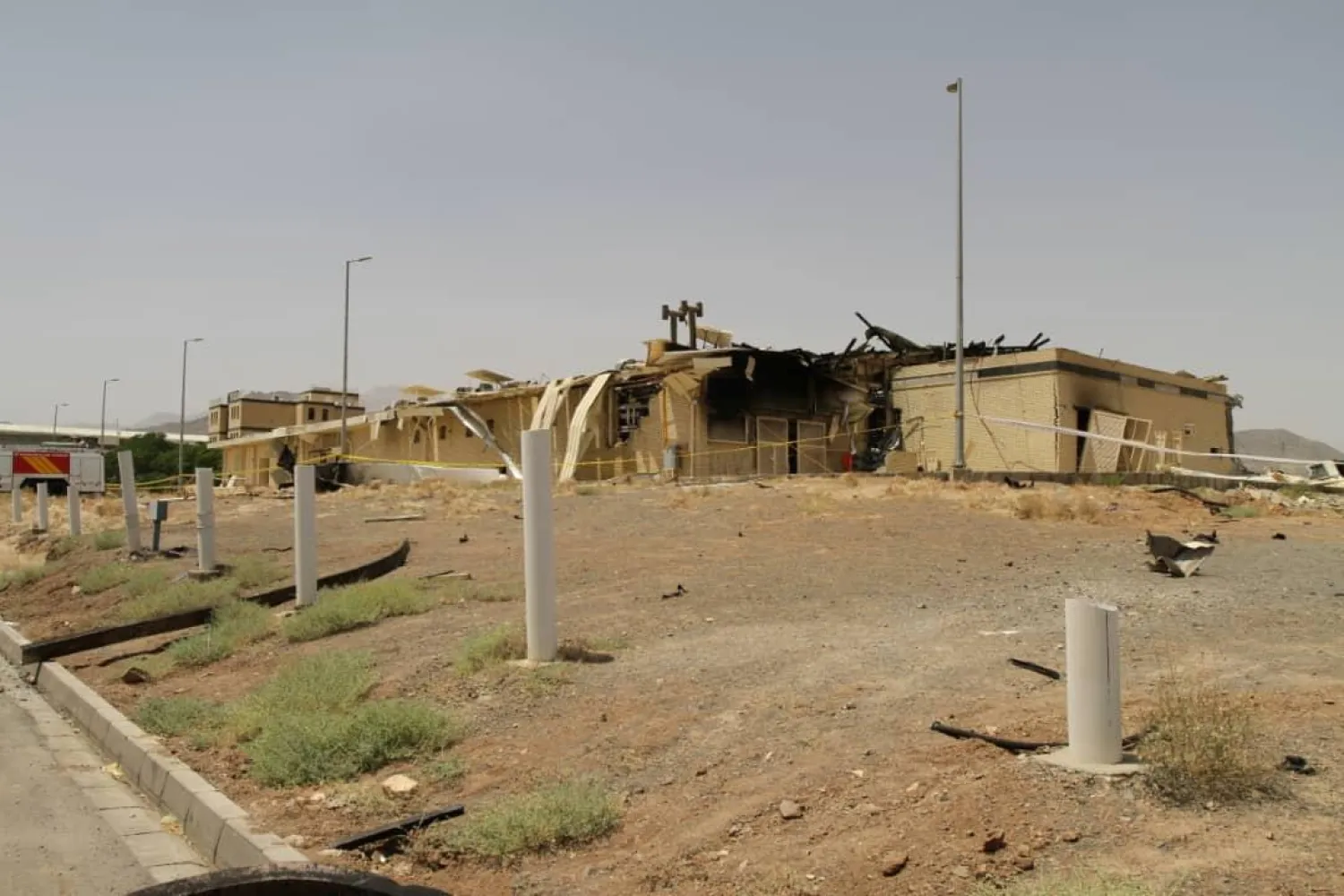
This came following statements by member of the parliamentary national security committee, Javad Karimi-Ghodousi, who said the blast at Iran's nuclear establishment in Natanz, center of the country, on July 2 was caused by a “security breach.”
Ghodousi indicated that a “security breach is our definitive conclusion,” according to the parliament’s website, ICANA. He ruled out that “an object from outside” struck the nuclear facility.
He explained that if an external object had hit the facility, there should have been shrapnel, but based on the investigations, absolutely nothing has been found.
Ghodousi did not provide details on a breach within the security team of the facility, indicating that the members of the parliament inspected Natanz.
Earlier in July, the MP said the incident in Natanz was “sabotage”, but at that time he accused IAEA inspectors of being behind it, pointing out that the site witnessed six rounds of visits by international inspectors visits.
The New York Times quoted on July 5 a member of the Islamic Revolutionary Guard Corps (IRGC) as saying that investigators do not yet know how or when the explosives were sneaked in, “but the attack clearly demonstrated a hole in the facility’s security.”
In addition, a Middle Eastern intelligence official told the newspaper that Israel was responsible for the explosion, adding that it had nothing to do with the other recent incidents.
He said Israel planted a huge bomb in the building where advanced centrifuges were being developed.
Iran’s Supreme National Security Council announced that investigations determined the exact cause of the Natanz incident, but refused to give further information due to security considerations.
Tehran did not accuse Israel directly, but said it would respond in the appropriate time if the investigation showed that external forces played a role in the attack.
Hours after the authorities confirmed the incident at the nuclear facility, “Homeland Panthers” claimed responsibility for the explosion, according to BBC Persian.
The website of BBC Persian said that before any news of the incident had emerged, emails were sent to its journalists claiming they had attacked the facility.
Meanwhile, the spokesperson for the Atomic Energy Organization of Iran (AEOI), Behrouz Kamalvandi, warned that the blast could “slow down Iran’s development and production of advanced centrifuges,” announcing that his country would work to build another larger facility equipped with more advanced equipment instead of the damaged one.
Earlier this month, government Spokesman Ali Rabiei said that the cause of the incident will be announced after experts complete their investigations. He noted that all hypotheses are possible, including the use of drones or electronic attacks.
Over the past two months, Iran witnessed a number of mysterious bombings and incidents in military and industrial facilities.
The incident in Natanz came less than a week after the bombing of the strategic Parchin military base, in eastern Tehran. Although Iranian official reports insist that an explosion occurred due to a gas leak, satellite images later showed an explosion at a military-industrial complex, 24 kilometers away from the base.
On July 10, Iranian officials denied reports of an explosion in “Qods” of Garmdareh region, west of Tehran, after social media users reported hearing explosions in the area.
But satellite imagery obtained by BBC Persian showed fires on a hilltop equivalent to three football fields, saying it was in a military zone.


