Virus Outbreak Spreads in Damascus, Infects Senior Officials

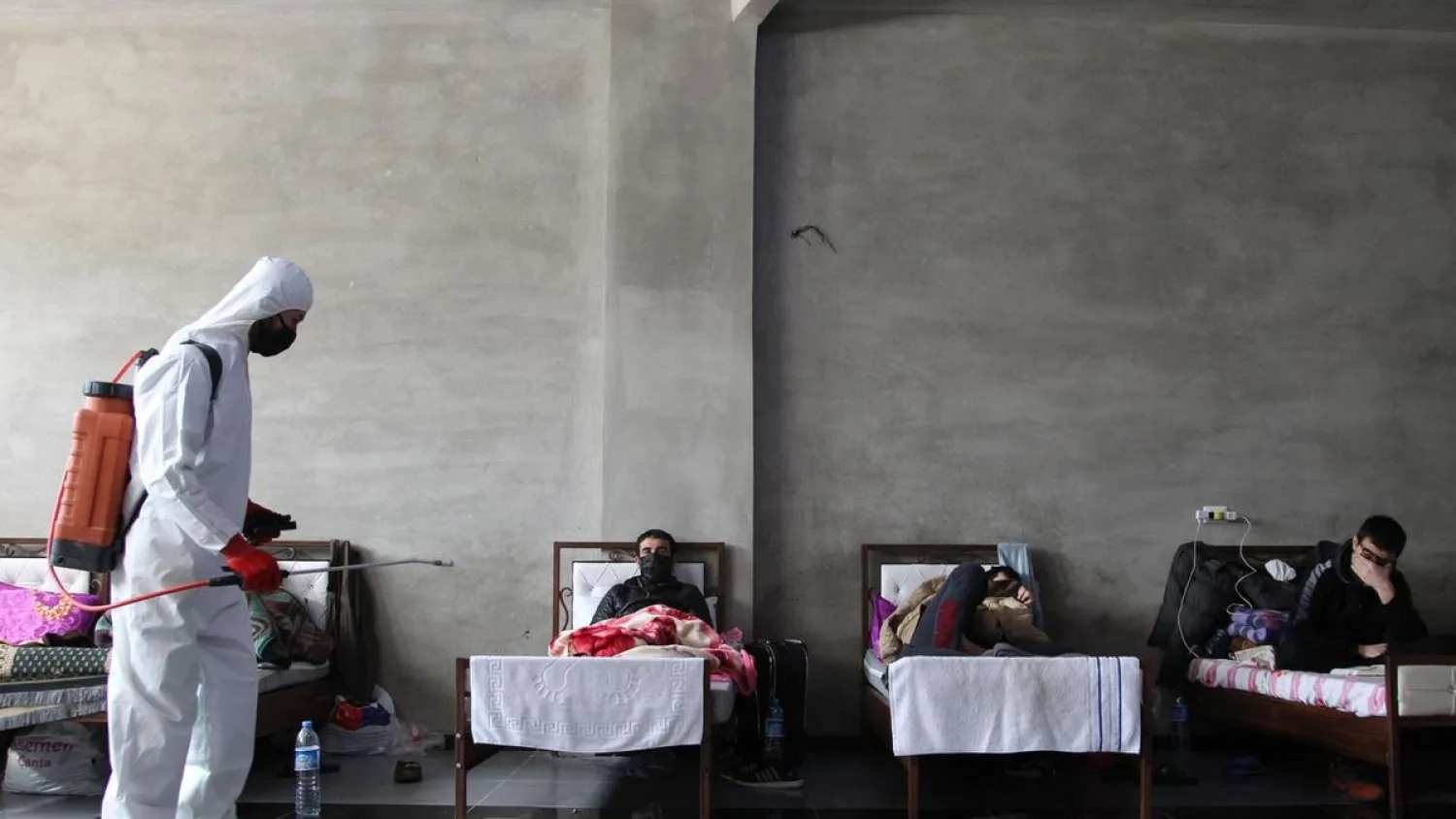
A health worker disinfects a makeshift quarantine facility near the town of Jisr al-Shughur, west of Idlib. (AFP)
TT

Virus Outbreak Spreads in Damascus, Infects Senior Officials

A health worker disinfects a makeshift quarantine facility near the town of Jisr al-Shughur, west of Idlib. (AFP)

Lebanese people in contact with relatives in Damascus confirmed the “rapid” spread of the coronavirus in the Syrian capital.

Security officials and former officers are among senior officials infected by the virus. Authorities have meanwhile, issued strict orders to withhold the actual figures of the outbreak “in order to avoid sparking panic among the people, who are already suffering from an economic crisis and nine years of war.”

A Syrian official was quoted as revealing that 130 deaths are being confirmed on a daily basis, according to statistics from the Damascus province. He said that is safe to assume that some died from the virus.

People who have died from the disease are being buried in the Najha cemetery in southern Damascus, he added. The cemetery was previously dedicated to burying army casualties.

A Syrian medical official said that 25 deaths from the coronavirus are being reported daily in Damascus.

The burials are being carried out by a trained government team that has taken necessary precautions, reported local media.

Alikhbaria Syria channel announced on Monday the death of its editor-in-chief Khalil Mahmoud from the coronavirus. The official media ministry did not disclose the cause of death, while his Facebook page stated that he passed away from the virus.

Lebanese artist Marwan Mahfouz died from the disease while residing in Damascus. Sheikh Mohammed Mazen al-Dimashki, the preacher at a mosque in Rokneddine, also died from the virus.

As of Monday, Syria reported 650 infections, 200 of which have recovered and 38 have died.

The health minister warned that the numbers may climb and the outbreak may spread, urging the people to adhere to preventive measures. He acknowledged that authorities do not have an accurate number of fatalities, “possibly because some people prefer to be treated at home or are late in seeking medical help.”

The Syrian government announced that it was banning mass prayers on the occasion of Eid al-Adha, which falls at the end of the week. It also announced the closure of all reception halls.

In regions outside regime control, authorities reported the first coronavirus case in Sarmin city in the Idlib countryside. The person contracted the disease after coming in contact with an infected case in Damascus. Sarmin has since been put in lockdown.

Twenty-six infections have been reported in Idlib in recent days.


Lebanon-Israel Ceasefire Extended by 3 Weeks after White House Meeting

US President Donald Trump speaks to the media in the Oval Office of the White House in Washington, DC, USA, 23 April 2026. President Trump met with Lebanese and Israeli envoys at the White House for a new round of peace talks.  EPA/WILL OLIVER / POOL
US President Donald Trump speaks to the media in the Oval Office of the White House in Washington, DC, USA, 23 April 2026. President Trump met with Lebanese and Israeli envoys at the White House for a new round of peace talks. EPA/WILL OLIVER / POOL
TT

Lebanon-Israel Ceasefire Extended by 3 Weeks after White House Meeting

US President Donald Trump speaks to the media in the Oval Office of the White House in Washington, DC, USA, 23 April 2026. President Trump met with Lebanese and Israeli envoys at the White House for a new round of peace talks.  EPA/WILL OLIVER / POOL
US President Donald Trump speaks to the media in the Oval Office of the White House in Washington, DC, USA, 23 April 2026. President Trump met with Lebanese and Israeli envoys at the White House for a new round of peace talks. EPA/WILL OLIVER / POOL

Lebanon and Israel extended their ceasefire for three weeks after a high-level meeting at the White House, US President Donald Trump said on Thursday.

Trump hosted Israel's ambassador to Washington Yechiel Leiter and Lebanese ambassador to the US Nada Moawad in the Oval Office for a second round of US-facilitated talks.

"The Meeting went very well! The United States is going to work with Lebanon in order to help it protect itself from Hezbollah," Trump wrote on Truth Social.

Trump added that he looked forward to hosting Israeli Prime Minister Benjamin Netanyahu and Lebanese President Joseph Aoun in the near future.

Trump also spoke to reporters in the Oval Office alongside the participants in the meeting, saying he hoped the leaders would meet during the three-week cessation of hostilities. He said there was "a great chance" the two countries would reach a peace agreement this year.

Vice President JD Vance, Secretary of State Marco Rubio, US Ambassador to Israel Mike Huckabee and U.S. Ambassador to Lebanon Michel Issa also attended the meeting.

The ceasefire, reached after talks between the two nations' ambassadors ⁠to Washington ⁠last week, was set to expire on Sunday. It has yielded a significant reduction in violence, but attacks have continued in southern Lebanon, where Israeli troops have seized a self-declared buffer zone.

The Lebanese president said a day earlier that during the talks Moawad would ask for an end to Israeli home demolitions in villages and towns occupied by Israel after the latest war broke out on March 2.

Moawad thanked Trump for hosting the talks. "I think with your help, with your support, we can make Lebanon great again," she said.

Asked how the US would help Lebanon to fight Hezbollah, Trump did not provide details but said Washington had "a great relationship with Lebanon."

Trump said Israel had to be able to defend itself against attacks from Hezbollah.

He also called for Lebanon to abolish laws against engagement with Israel.

"Well, I'm pretty sure that that will be ended very quickly. I'll make sure of that," Trump said.


Iraq Ruling Alliance Nears Critical Constitutional Deadline

 From a Coordination Framework alliance meeting in Baghdad (INA)
From a Coordination Framework alliance meeting in Baghdad (INA)
TT

Iraq Ruling Alliance Nears Critical Constitutional Deadline

 From a Coordination Framework alliance meeting in Baghdad (INA)
From a Coordination Framework alliance meeting in Baghdad (INA)

Iraq’s Coordination Framework is set to meet on Friday, the final day of the constitutional deadline to name a prime minister-designate, as disputes persist among Shiite factions over both the selection mechanism and the final nominee, threatening to push the country into a new constitutional crisis.

In that context, the Reconstruction and Development Coalition, led by Mohammed Shia al-Sudani, denied any US objection to his serving a second term and rejected reports that Ihsan al-Awadi had been proposed as an alternative candidate to form a government, reaffirming its backing for al-Sudani as the “sole candidate.”

The Coordination Framework has postponed its decisive meeting more than once before announcing in an official statement that the session would be moved to Friday “to allow more time for dialogue and to reach a conclusion within the constitutional period.”

Hardening positions

Mushriq al-Furaiji, a member of the Reconstruction and Development Coalition, said divisions inside the Framework were marked by “hardening positions.”

He said a proposal to adopt a two-thirds vote of Framework lawmakers to choose the nominee had been rejected by Nouri al-Maliki. He added that about 114 lawmakers backed Sudani’s nomination, compared with around 50 supporting Maliki.

Firas al-Musallamawi, spokesman for the coalition, said Framework leaders had discussed adopting the principle of a two-thirds majority, but disagreement remained over whether that should be calculated from the total number of Framework leaders or from the number of their lawmakers in parliament.

By contrast, Hassan Fadam, a member of the Hikma Movement, said the final contest was likely to narrow to Sudani and Bassem al-Badri, while Zuhair al-Jalabi of the State of Law Coalition said Maliki had “not officially withdrawn,” adding that his continued candidacy was limiting the possibility of putting forward other nominees.

Saqr al-Mohammadawi, a lawmaker from the Sadiqoun bloc, said in a press statement that Framework leaders were moving to settle the nominee’s name at the upcoming meeting, adding that the option of a compromise candidate would remain on the table if differences persisted.

Fallout from the delay

The developments come after Nizar Amidi was elected president, triggering a 15-day constitutional deadline for the designation of a candidate from the largest parliamentary bloc to form a government, under Article 76 of the constitution.

During a meeting with Maliki, Amidi urged Framework forces to quickly settle on their nominee “within the constitutional timelines,” warning of the consequences of delay for political stability.

The dispute within the Framework centers on the definition of the “largest bloc” and the mechanism for choosing the nominee: either relying on a decision by Framework leaders or resorting to a vote by its roughly 185 lawmakers.

A legal debate has also emerged over what would happen if the deadline expired without a nominee being presented, given the absence of any explicit constitutional text addressing such a case.

Observers say failure to reach agreement at Friday’s meeting could return the country to political deadlock and leave the president facing complex constitutional choices, at a time when Shiite factions are confronting, for the first time since 2003, a sharp split that threatens their political cohesion.

The political crisis comes amid US pressure on Baghdad. Sources said Washington had halted a cash shipment worth about $500 million that had been headed to Iraq and had suspended parts of its security cooperation with Baghdad, in a move aimed at pressuring the Iraqi government over the actions of Iran-backed militias, according to Reuters.

Western sources also told Asharq Al-Awsat that coordination between Washington and Baghdad was currently “at its lowest level.”


Will Syria’s Parliament Meet on Sharaa’s Timeline?

President Ahmed al-Sharaa meets members of the Supreme Committee for People’s Assembly elections, July 2025 (Presidency page)
TT

Will Syria’s Parliament Meet on Sharaa’s Timeline?

President Ahmed al-Sharaa meets members of the Supreme Committee for People’s Assembly elections, July 2025 (Presidency page)

Holding the first session of Syria’s parliament, the People’s Assembly, on the timeline set by Ahmed al-Sharaa in Antalya will require faster efforts to select representatives from Hasaka, as the Supreme Elections Committee moves to resolve key issues delaying the launch.

Al-Sharaa said at the Antalya Diplomacy Forum last Friday that parliament would convene by the end of April. The new Assembly, he said, will set the course for the post-five-year transitional phase, led by drafting a constitution to define laws, state institutions, presidential powers, and the system of governance, all subject to a vote.

The president’s office is expected to name his appointees, who will fill one-third of the seats, after ratifying Hasaka’s election results, completing the quorum ahead of the first session.

Hasaka tests timeline

Al-Sharaa’s remarks point to progress on stalled issues, especially in Hasaka, but they have also raised doubts over whether elections there can be completed in time.

Analysts say the province’s ethnic, sectarian, and social diversity demands a cautious approach to a process carrying political weight. That includes how representatives are chosen, and how subcommittees and electoral bodies are formed.

Researcher Samer al-Ahmad, affiliated with the Middle East Institute, said Hasaka’s mix of Kurdish and Assyrian parties, tribal structures, revolutionary groups, and the Autonomous Administration adds complexity.

This diversity, he said, makes the elections highly sensitive, requiring Damascus to balance competing interests and limit external interference.

The vote falls under the January 29 understandings with the Syrian Democratic Forces, which may seek a dedicated share similar to the president’s quota or obstruct the process, as seen in the recent refusal to hand over the offices and the Justice Palace in Qamishli.

Hasaka Governor Nour al-Din Ahmad met a delegation from the elections committee on Saturday as preparations gathered pace.

Committee member Mohammed Wali said the process could take 15 to 21 days.

“The committee has begun preparations to resume the process based on Hasaka’s allocated seats, forming the electoral body and engaging official and social actors to ensure representation of all Syrian components in the first parliament after liberation,” he said.

Wali said the earlier delay was aimed at securing a suitable environment under state sovereignty and ensuring representation for Hasaka as part of Syria.

He added that the process effectively began with the committee’s recent visit, meetings with the governor and a presidential envoy, and steps to implement the December 29 agreement, including logistical preparations and initial lists for subcommittees.

May more likely

Syrian government sources told Asharq Al-Awsat that holding the first session within the announced timeframe will be difficult, warning of disputes similar to those seen in Raqqa’s elections.

They said authorities are unlikely to stick rigidly to the date and may allow more time, pointing to the end of the first week of May as a more likely date.

The sources said recent presidential remarks reflect a push to activate the legislative authority, given pending files requiring approval, including internal laws, the constitution, transitional justice and foreign agreements.

They stressed the need for representation from the eastern region through elections mirroring other provinces to ensure the Assembly’s legitimacy.

Raqqa, previously under SDF control, has already held elections, producing four members, with two more from Tal Abyad completing the province’s representation.

Sweida and the presidential quota

Hasaka’s file also brings attention to Sweida and the president’s one-third share, seen as key to maintaining political and social balance.

Ahmed Qarbi, director of the Syrian Dialogue Center for Studies, said a solution in Sweida remains distant as the Hijri group continues to press separatist demands, complicating efforts to hold elections there.

He said the government may compensate for Sweida’s three seats through the president’s quota of 70, under Article 24 of the constitutional declaration, to ensure fair representation, including ethnic, sectarian and gender balance, likely securing Druze representation.

Qarbi said this would not be a quota system, but a way to fill gaps, ensure broad representation and account for expertise.

“It is not possible to suspend a state parliament with 207 out of 210 members present,” he said, adding that Druze representation could be covered through figures from areas such as Jaramana and Ashrafiyat Sahnaya, as well as influential figures from Sweida who oppose separation.

Pressure to convene

Beyond its legislative role, the Assembly’s launch carries political weight.

Newly elected member Abdulaziz Maghribi said its convening is critical at home and abroad.

“For the first time in decades, after the Assembly’s role was sidelined under Assad family rule, Syrians are waiting for it to convene and exercise oversight, improve institutional performance through proposing, passing and amending laws, and approve the state budget,” he said.

The president’s office is expected to finalize its appointees after Hasaka’s results are ratified, completing the quorum ahead of the first session.

Parliamentary elections began in October under an exceptional electoral system based on electoral colleges, which selected two-thirds of the 210-member Assembly.